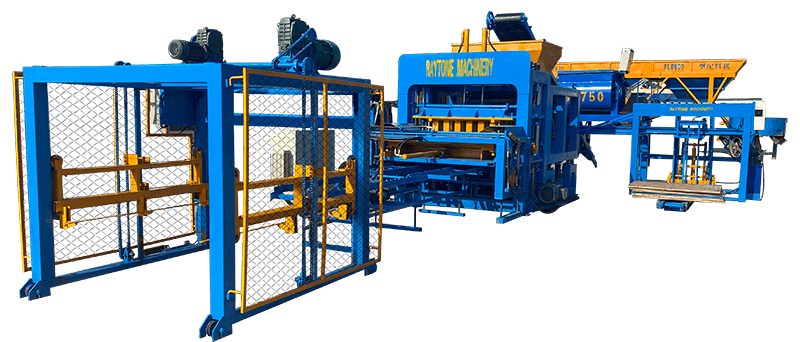
Block manufacturing facilities prevent 80-90% of workplace injuries through proper safety protocols and equipment implementation. After investigating dozens of block plant accidents across multiple countries, the pattern is clear: facilities with comprehensive safety programs, proper PPE enforcement, and routine equipment maintenance eliminate the most serious hazards. Those without structured safety systems face preventable accidents, OSHA citations, production shutdowns, and worker compensation costs that can exceed $500,000 per incident.
This guide covers the essential safety protocols, equipment requirements, hazard identification, and compliance standards that protect workers while maintaining productivity. Whether operating manual, semi-automatic, or fully automatic production lines, these safety fundamentals apply universally across all block manufacturing operations.
Critical Safety Hazards in Block Manufacturing
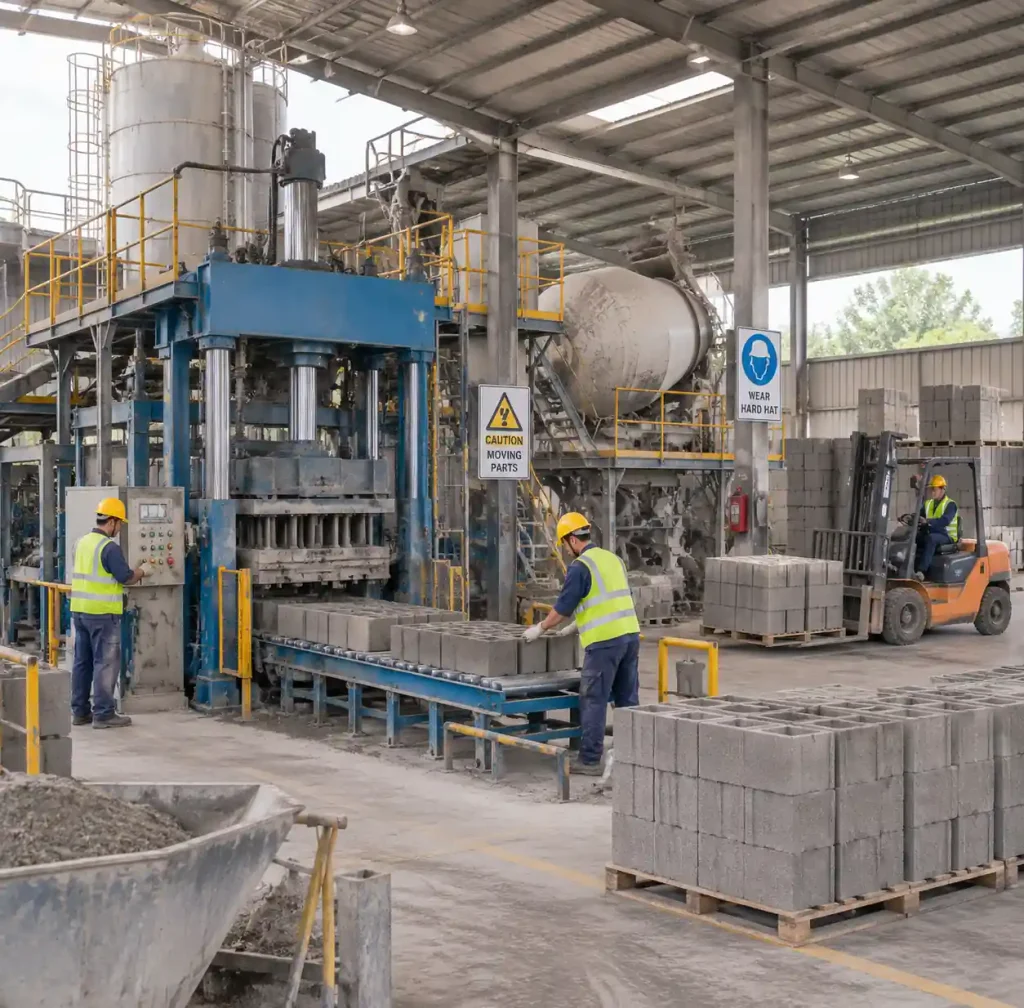
Block manufacturing presents multiple hazard categories that require systematic controls. Understanding these risks forms the foundation for effective safety protocol development.
Mechanical Hazards
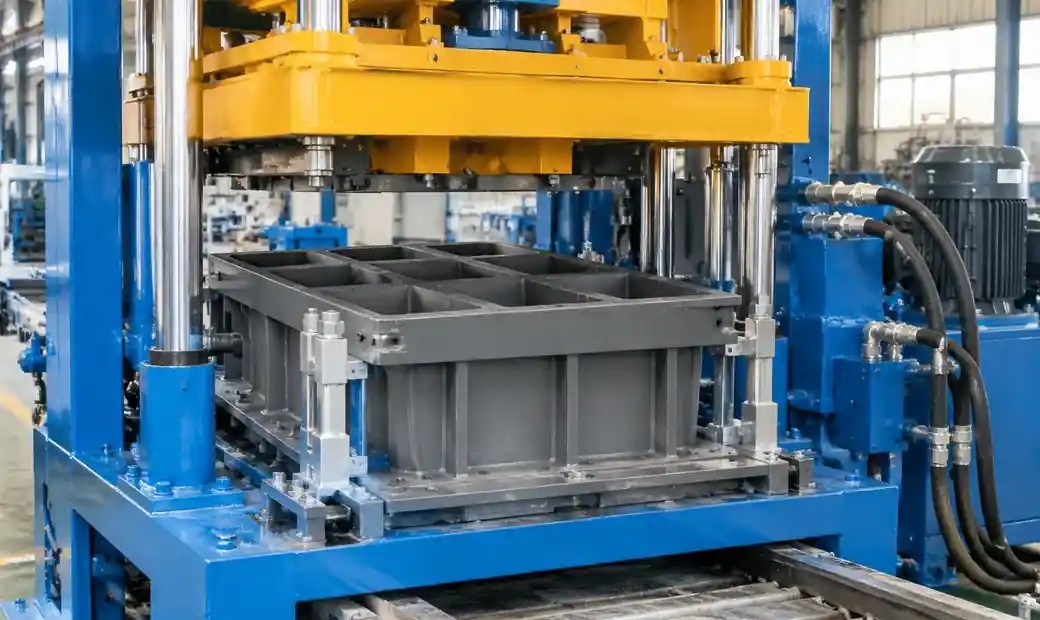
Crushing and Pinch Points: Hydraulic presses generate 200-600 tons of force during block compression cycles. Workers face crushing hazards near mold areas, pallet transfer zones, and material feeding points. A 2026 OSHA investigation cited a Miami concrete manufacturer after a worker suffered fatal injuries entering an unprotected machine area—the incident occurred because proper guarding was not installed and lockout/tagout procedures were not followed.
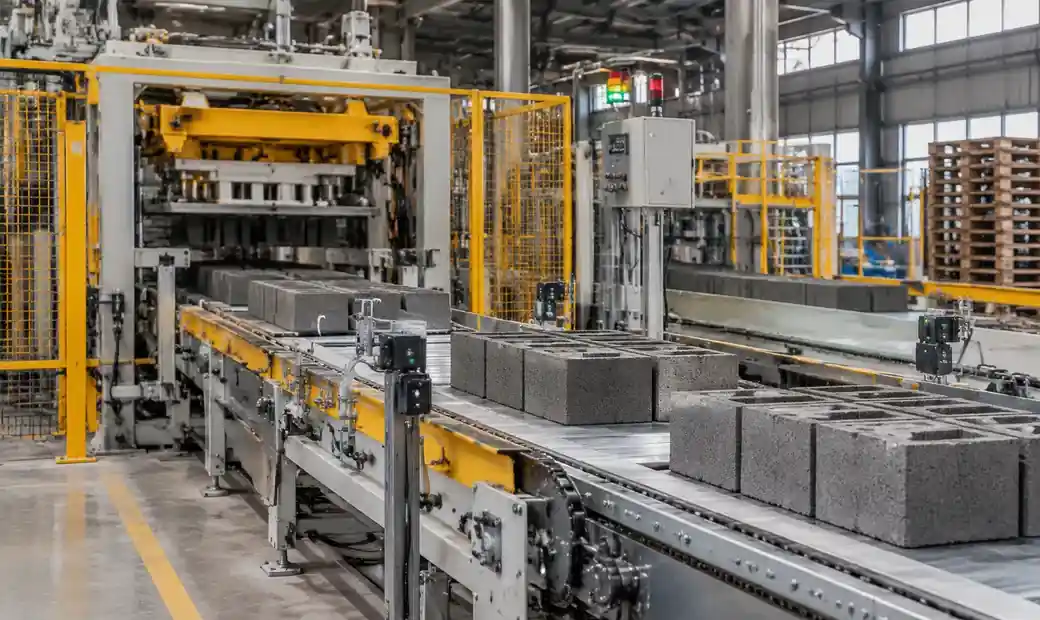
Moving Parts: Conveyor systems, pallet stackers, vibration tables, and automated transfer mechanisms create caught-between hazards. According to OSHA concrete manufacturing guidelines, rotating shafts, belts, and pulleys must have guards installed and maintained. Loose clothing, gloves, or jewelry near moving equipment can pull workers into machinery.
Ejection Hazards: Defective blocks occasionally eject during demolding or transfer. High-pressure hydraulic system failures can cause hose whip injuries. Compressed air lines require proper securing and pressure regulation to prevent uncontrolled releases.
Chemical and Dust Exposure
Cement Dust: Portland cement contains crystalline silica, which causes silicosis through prolonged inhalation. OSHA’s permissible exposure limit (PEL) for respirable crystalline silica is 50 µg/m³ as an 8-hour time-weighted average. Block plants generate significant dust during cement handling, mixing, and dry material transfer.
Alkaline Chemical Burns: Wet concrete has pH levels of 12-13, causing chemical burns through skin contact. Workers handling fresh mix, cleaning molds, or maintaining equipment face exposure to cement’s caustic properties. Burns develop gradually—workers often don’t notice until significant skin damage occurs.
Respiratory Hazards: Beyond cement dust, block plants contain aggregate dust, diesel exhaust from forklifts, and potential mold growth in damp storage areas. Proper ventilation systems and respiratory protection prevent chronic respiratory diseases.
Physical Hazards
| Hazard Type | Source | Typical Exposure Level | Health Impact | Control Measures |
|---|---|---|---|---|
| Noise | Block machines, vibrators, compressors | 85-95 dB | Permanent hearing loss, tinnitus | Hearing protection, noise barriers, equipment maintenance |
| Vibration | Vibration tables, compaction equipment | Hand-arm vibration 2.5-8 m/s² | Vibration white finger, nerve damage | Anti-vibration gloves, exposure time limits, equipment design |
| Heat Stress | Curing chambers, summer production | 32-45°C in curing areas | Heat exhaustion, heat stroke, dehydration | Ventilation, cooling periods, hydration protocols |
| Ergonomic Strain | Manual material handling, repetitive motions | Lifting 15-50 kg repeatedly | Back injuries, joint damage, muscle strain | Mechanical assists, job rotation, proper lifting techniques |
| Falls | Elevated platforms, pallet stacks, equipment | Heights 1-4 meters typical | Fractures, head injuries, fatalities | Fall protection, stable work surfaces, proper access |
Electrical Hazards
Block manufacturing equipment operates on 220-480V three-phase power. Electrical hazards include contact with energized conductors during maintenance, improper grounding, damaged insulation, and water exposure near electrical panels. Facilities must implement lockout/tagout (LOTO) procedures and ensure only qualified electricians perform electrical work.
Essential Personal Protective Equipment
PPE serves as the last line of defense after engineering and administrative controls. According to OSHA PPE requirements, employers must assess workplace hazards, provide appropriate PPE at no cost to workers, train employees on proper use, and ensure PPE is maintained.
Required PPE by Hazard Zone
Production Floor (General Operations):
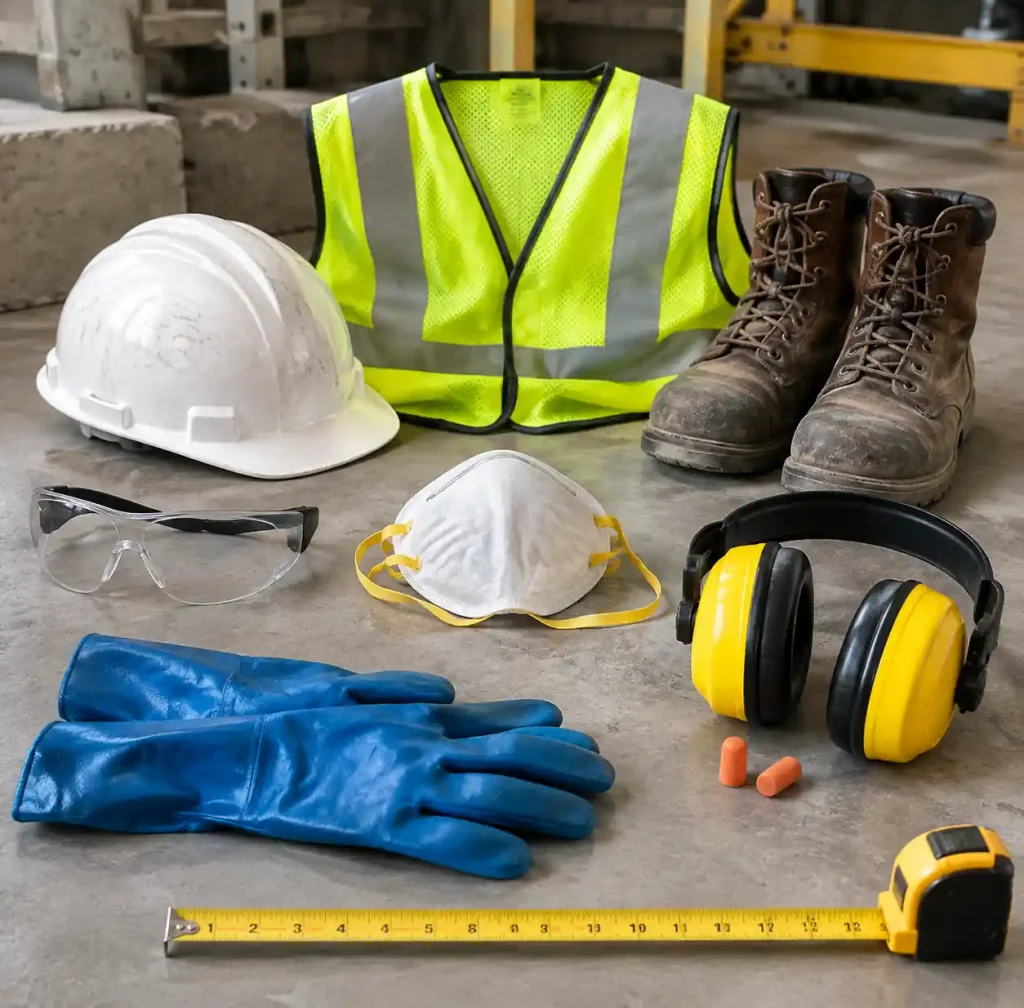
- Safety glasses with side shields (ANSI Z87.1+ rated) for impact protection
- N95 or P100 respirators for cement dust exposure
- Steel-toed boots meeting ASTM F2413 standards (compression resistance 2,500 lbs, impact resistance 75 ft-lbs)
- High-visibility vests in facilities with forklift traffic
- Hearing protection (earplugs or earmuffs) providing at least 25 dB noise reduction
Wet Concrete Handling:
- Alkali-resistant chemical gloves (nitrile or neoprene construction)
- Waterproof boots with chemical-resistant properties
- Long-sleeved shirts and full-length pants (no exposed skin contact with wet concrete)
- Face shields when mixing or pouring concrete above shoulder height
- Chemical-resistant aprons for extended concrete exposure
Machine Maintenance Operations:
- Cut-resistant gloves when handling sharp components (molds, cutting wires, metal parts)
- Arc-rated PPE for electrical work
- Respirators with organic vapor cartridges when working with hydraulic fluids or solvents
- Knee pads for ground-level maintenance
- Leather gloves for handling hot components or welding operations
Material Handling and Forklift Areas:
- Hard hats (ANSI Z89.1 Type I or II) required in designated zones
- High-visibility Class 2 or Class 3 safety vests
- Metatarsal guards for heavy block handling
- Back support belts for manual lifting (though not a substitute for proper lifting technique)
PPE Maintenance and Replacement
Damaged PPE provides no protection. Safety managers must establish inspection schedules: daily for frequently used items (gloves, safety glasses), weekly for respirators, monthly for fall protection equipment. Replace safety glasses with scratched lenses, boots with worn toe caps, hard hats after any impact, and respirator cartridges according to manufacturer schedules or when breathing resistance increases.
Critical Safety Protocols and Procedures
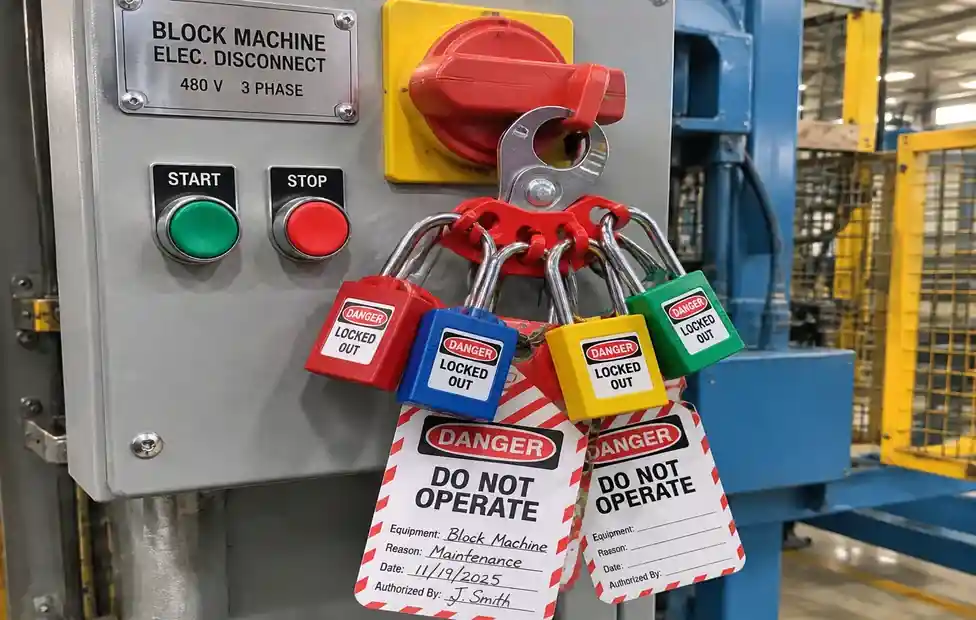
Effective safety protocols transform hazard awareness into consistent protective practices. These procedures must be written, trained, enforced, and regularly audited.
Lockout/Tagout (LOTO) Procedures
OSHA standard 1910.147 requires LOTO procedures for servicing and maintaining equipment where unexpected startup or energy release could cause injury. A 2001 New Jersey fatality investigation documented a block plant worker killed when his head was crushed in a palletizing machine—the accident occurred during cleaning without proper lockout procedures.
LOTO Implementation Steps:
- Identify all energy sources: Electrical power, hydraulic pressure, compressed air, stored mechanical energy, gravitational potential
- Notify affected employees: Announce equipment shutdown and lockout procedure initiation
- Shut down equipment: Use normal stopping procedures, verify all moving parts stop completely
- Isolate energy sources: Disconnect electrical disconnects, close hydraulic valves, bleed pressure lines, block mechanical motion
- Apply locks and tags: Personal locks with employee identification, danger tags explaining the lockout
- Release stored energy: Discharge capacitors, release hydraulic pressure, lower elevated components
- Verify isolation: Test start controls, check pressure gauges, confirm zero energy state
- Perform authorized work: Complete maintenance or service activities
- Remove lockout devices: Verify equipment is operational and safe, remove personal locks, restore energy, test equipment function
Group Lockout: When multiple employees work on the same equipment, each applies their personal lock using a group lockout box. No one removes locks until their personal work is complete and they physically remove their own lock.
Machine Guarding Requirements
EN 12629-2 safety standards specify guarding requirements for block manufacturing machines. Fixed guards protect workers from routine hazards, while interlocked guards stop machine operation when opened.
Guard Types and Applications:
- Fixed guards: Permanently installed barriers around drive belts, chains, gears, and rotating shafts
- Interlocked guards: Guillotine-style doors that prevent machine operation when open (mold access areas, maintenance panels)
- Adjustable guards: Movable barriers adjusted for different block sizes while maintaining protection
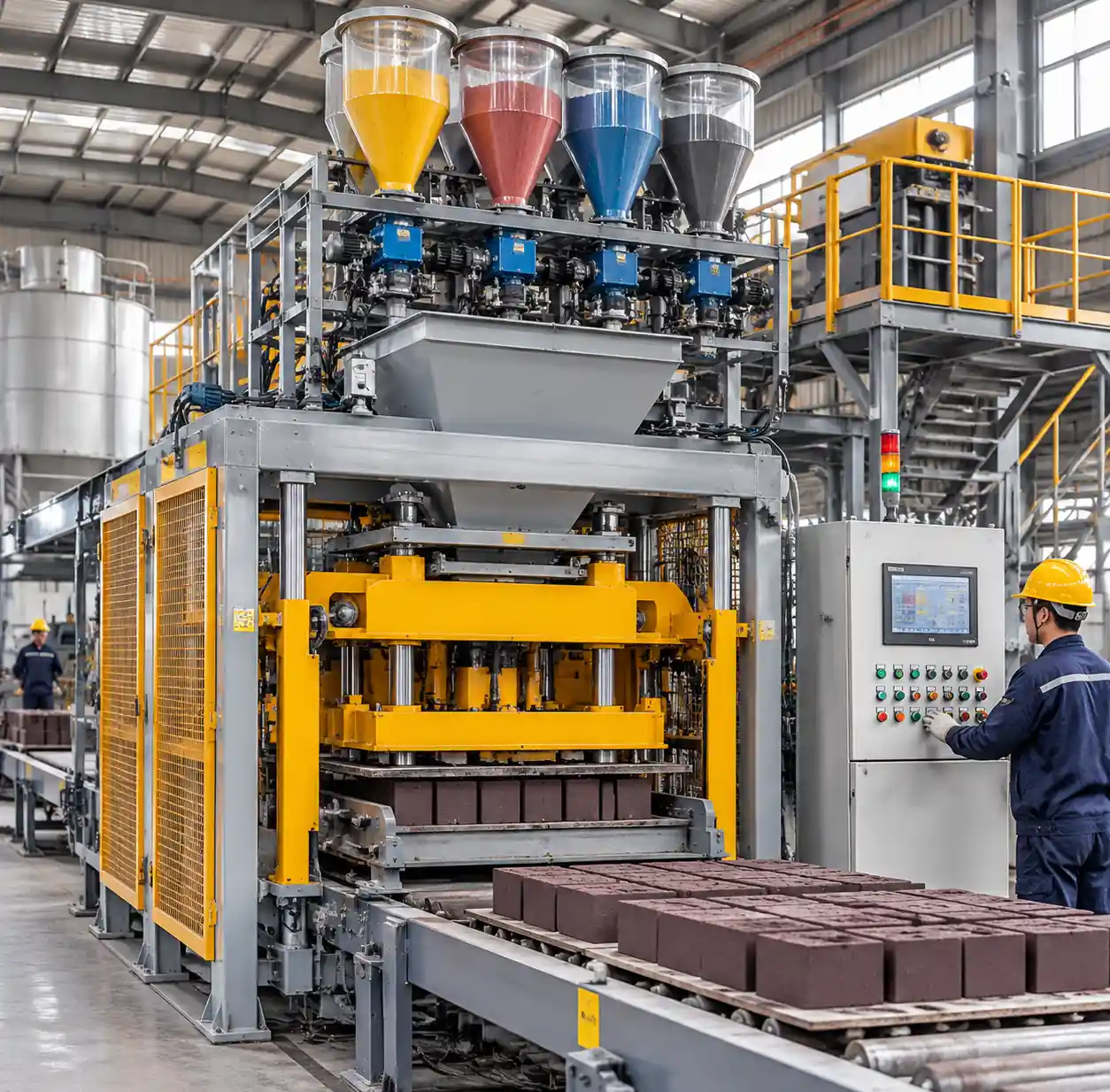
- Presence-sensing devices: Light curtains or laser scanners that stop machine operation when workers enter dangerous zones
Guards must be tamper-resistant, provide no new hazards (sharp edges, pinch points), not interfere with operation, and allow safe maintenance access. Never operate equipment with guards removed, bypassed, or damaged.
Pre-Operational Safety Checks
Operators perform daily safety inspections before production begins. Raytone Block Machinery installation guidelines recommend a standardized checklist approach:
Daily Inspection Checklist:
- Emergency stop buttons: Test all e-stop buttons respond within 2 seconds
- Guards and safety devices: Verify all guards in place, interlocks functioning
- Hydraulic system: Check oil level, inspect hoses for leaks or damage, verify pressure gauges operational
- Electrical components: Inspect cables for damage, check control panel condition, verify grounding connections
- Lubrication: Apply grease to specified points, check for adequate lubrication at moving parts
- Molds and tooling: Inspect for cracks, wear, or damage that could affect block quality or safety
- Work area: Remove debris, check lighting adequacy, verify emergency exits accessible
- PPE availability: Confirm required PPE available and in good condition
Weekly Inspection Requirements:
- Vibration system balance and mounting bolts
- Pallet stacking mechanisms and safety interlocks
- Conveyor alignment and emergency stops
- Fire extinguisher pressure and accessibility
- First aid kit supplies and AED functionality
Safe Material Handling Procedures
| Material Handling Task | Hazard | Safe Procedure | Mechanical Assist Options |
|---|---|---|---|
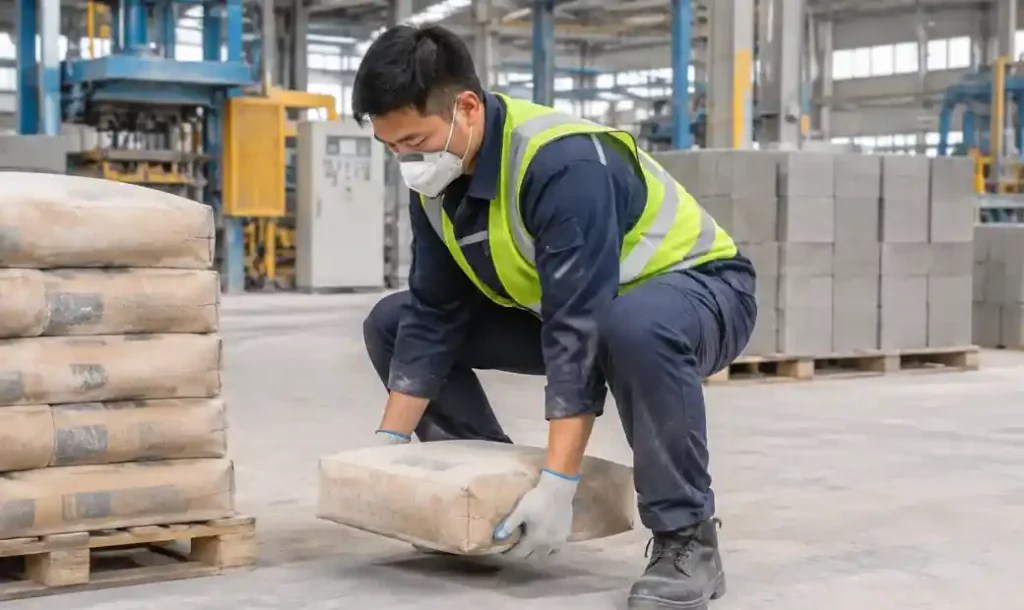
| Cement Bag Handling (25-50 kg) | Back strain, cement dust exposure | Two-person lift for bags >25 kg, cut bags over mixing equipment to minimize dust, wash hands immediately after contact | Automated bag breakers with dust collection, pneumatic conveyors, bulk cement silos |
| Pallet Movement (150-500 kg loaded) | Forklift accidents, manual handling injuries | Never walk under elevated loads, use certified forklift operators only, maintain 3-point contact when mounting/dismounting equipment | Electric pallet jacks, automated pallet transfer systems, roller conveyors |
| Mold Changeover (30-80 kg per mold set) | Pinch points, back strain, falling objects | Use lifting equipment for molds >30 kg, secure molds during transport, verify hydraulic pressure released before removal | Overhead hoists with below-the-hook devices, mold carts with positioning mechanisms |
| Block Stacking (18-35 kg per block) | Repetitive motion injuries, crush hazards | Use proper lifting posture, rotate tasks every 2 hours, wear metatarsal protection, never place fingers under blocks | Automatic stacking systems, robotic palletizers, vacuum lifting devices |
| Aggregate Handling | Struck-by hazards, dust exposure | Stay clear of conveyor discharge points, use water spray for dust suppression, inspect conveyors before starting | Enclosed conveyor systems, automated batching with dust collection, remote monitoring |
Lifting Technique Standards: Keep loads close to body, lift with legs not back, avoid twisting motions, test weight before committing to lift, ask for help with loads exceeding 25 kg, use mechanical assists whenever possible.
Equipment Safety Features and Requirements
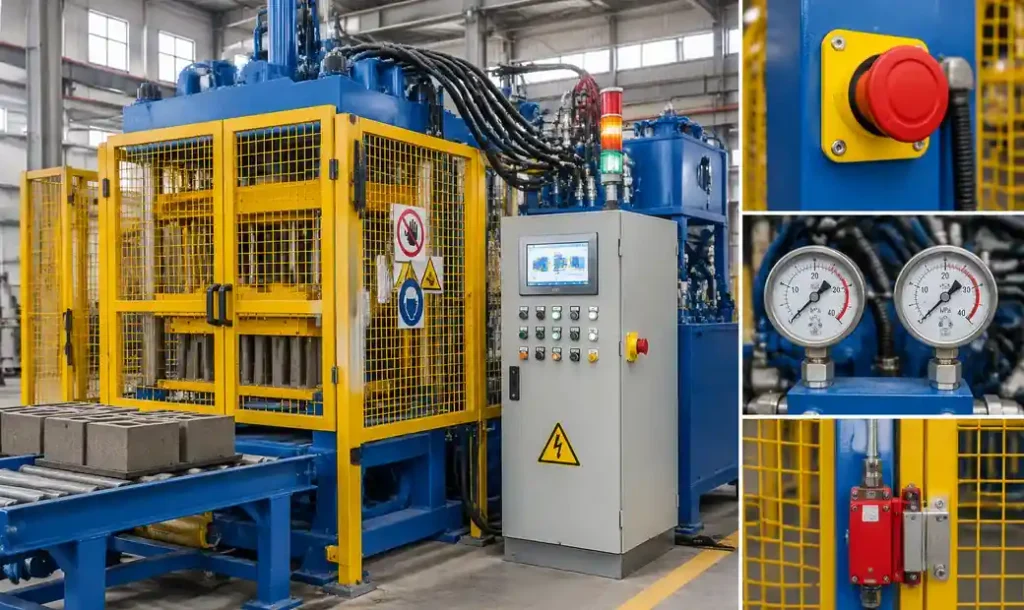
Modern block manufacturing equipment incorporates safety features mandated by international standards. When specifying or purchasing equipment, these features are non-negotiable safety requirements.
Hydraulic System Safety
Pressure Relief Valves: Prevent over-pressurization that could cause hose bursts or structural failures. Systems should include primary and secondary relief valves set at maximum safe working pressure plus 10% margin.
Hose Protection: Hydraulic hoses operating above 1,000 PSI require burst protection—either spiral wire reinforcement or external hose guards that contain fluid spray if failures occur. Route hoses away from hot surfaces and moving parts.
Pressure Gauges: Install gauges at critical points to monitor system pressure. Operators must know normal operating ranges and stop equipment if pressures exceed specifications.
Leak Detection: Hydraulic fluid leaks create slip hazards and fire risks. Weekly inspections should identify and repair leaks promptly. Never use hands to check for leaks—pressurized hydraulic fluid can inject through skin causing serious injuries.
Electrical Safety Systems
Emergency Stop Controls: EN 12629-2 requires emergency stops within easy reach of all operator positions. E-stops must have red mushroom-head buttons on yellow backgrounds, remain accessible (never obstructed), and stop all hazardous motion within 2 seconds.
Control Circuits: Dual-channel safety relay systems prevent single-point failures from allowing dangerous equipment operation. Control voltage should be 24V DC or lower for operator safety.
Electrical Enclosures: Control panels must meet IP54 or higher ingress protection ratings in dusty block plant environments. Proper grounding prevents electrical shock hazards.
Mechanical Safety Interlocks
Mold Access Interlocks: Machine operation must stop when mold access doors open. Interlocks should be hardwired into safety relay circuits—not software-controlled which can be overridden.
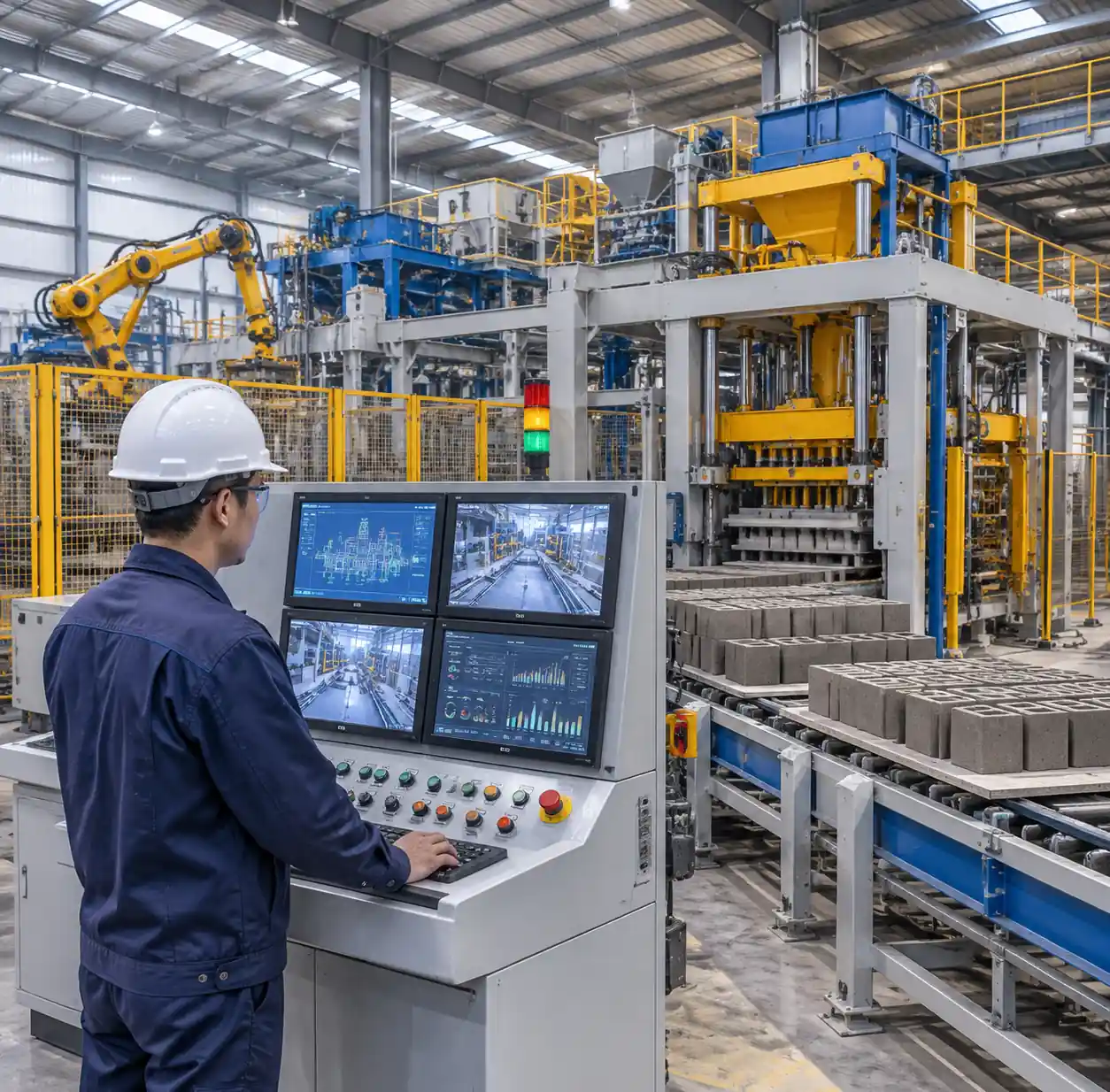
Light Curtains and Safety Mats: For automatic production lines, presence-sensing devices detect workers in dangerous zones and immediately stop hazardous motion. Light curtains must be positioned so workers cannot reach hazardous areas without interrupting the beam.
Two-Hand Controls: Requires both hands on control buttons to initiate machine cycles, preventing hands from being in dangerous positions during operation. Buttons must be separated enough that one person cannot operate both with one hand.
Facility Design for Safety
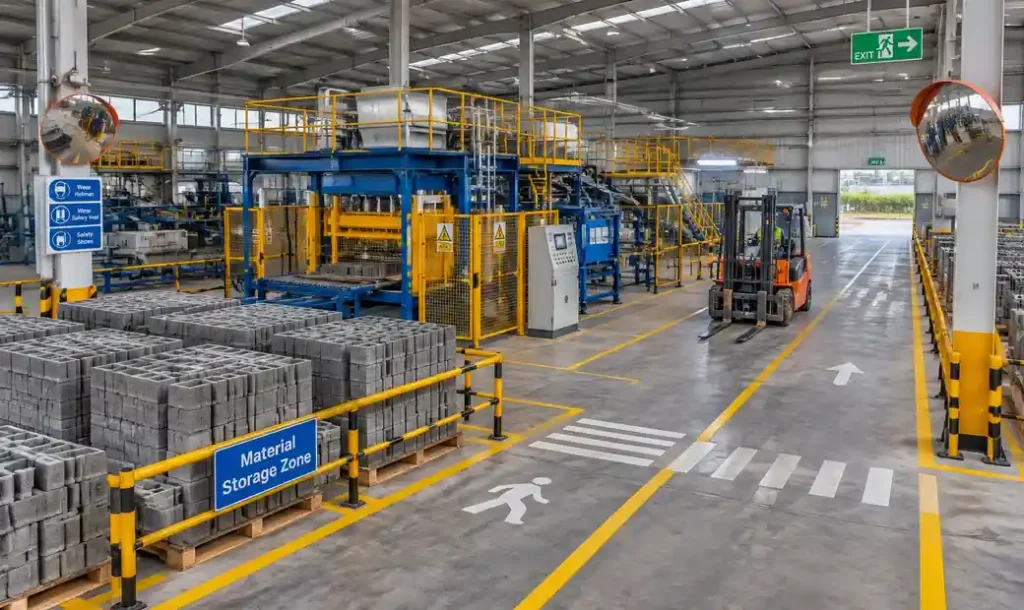
Plant layout significantly influences safety outcomes. Proper facility design eliminates hazards before they manifest as accidents.
Traffic Flow Management:
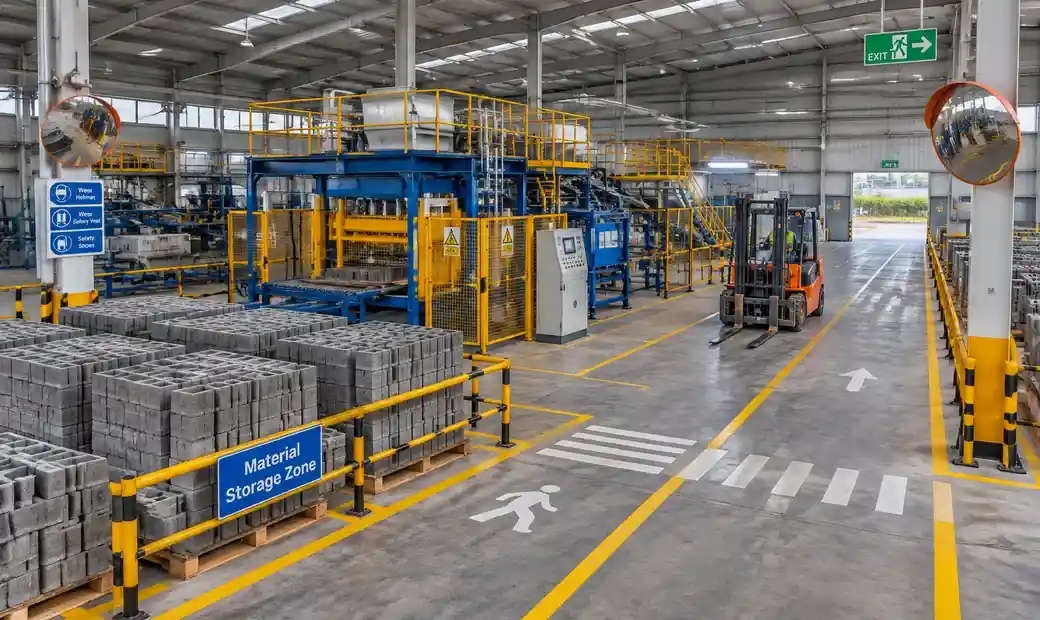
- Separate pedestrian walkways from forklift traffic with painted lines, barriers, or elevation changes
- Install convex mirrors at blind corners where forklifts turn
- Designate one-way traffic patterns to prevent head-on collisions
- Mark floor loading limits where block storage occurs (typical floor load capacity 1,000-1,500 kg/m²)
Ventilation Systems:
- Local exhaust ventilation (LEV) at dust generation points: bag breakers, mixer discharge, dry material transfer
- General dilution ventilation providing 6-10 air changes per hour in production areas
- Air velocity of 0.5-1.0 m/s at dust source capture points
- Regular filter maintenance to maintain effectiveness
Emergency Access:
- Emergency exits clearly marked with illuminated signs, unobstructed at all times
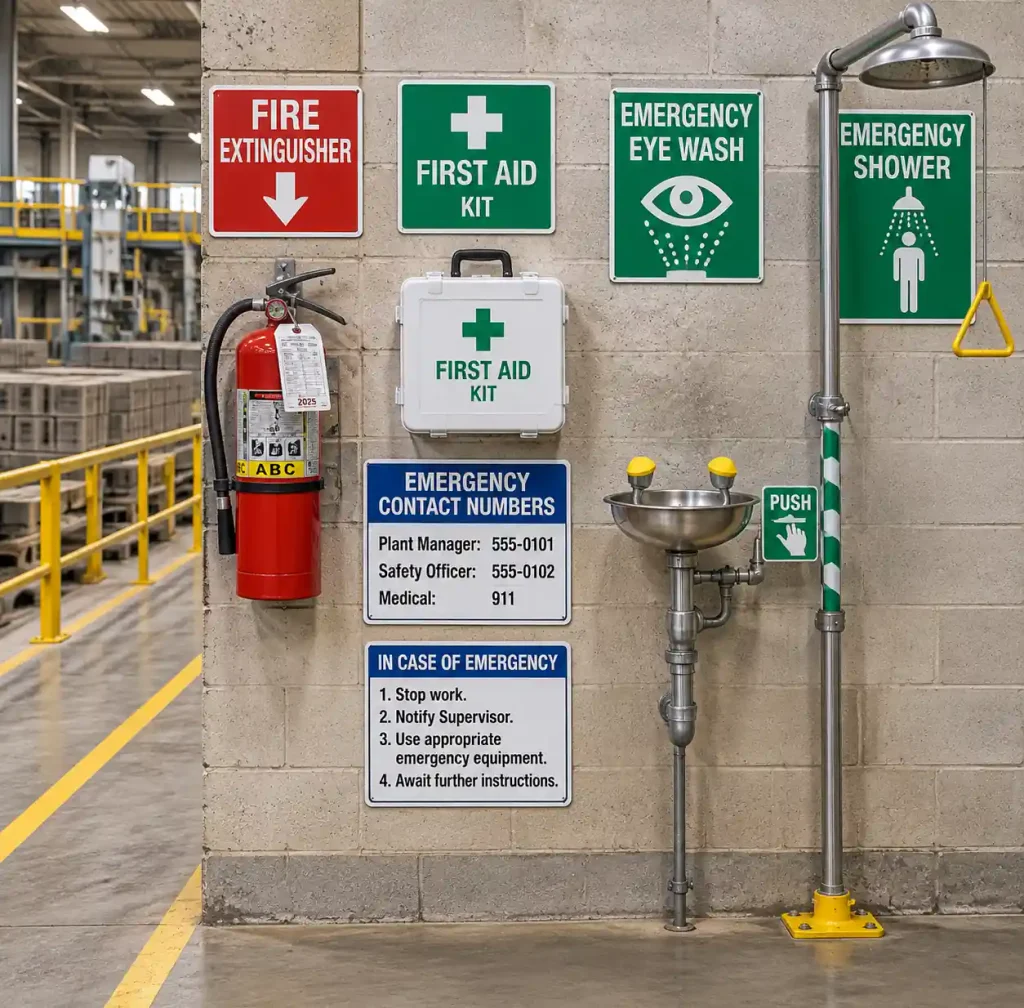
- Fire extinguishers positioned within 23 meters of any point in facility (NFSHA Standard 10)
- First aid stations with eye wash stations near cement handling areas
- AED (automated external defibrillator) accessible within 3-minute response time
Lighting Standards:
- Production areas: 300-500 lux general lighting
- Quality inspection zones: 750-1,000 lux for detailed visual work
- Maintenance areas: 500-750 lux
- Emergency lighting providing minimum 10 lux along escape routes
Training and Competency Requirements
Properly trained workers recognize hazards, follow safety procedures, and respond effectively to emergencies. Block machine operator training should include comprehensive safety instruction alongside technical skills.
New Worker Orientation (8-16 hours)
Safety Culture and Policies (2 hours):
- Company safety policies and consequences for violations
- Reporting procedures for hazards, near-misses, and injuries
- Workers’ rights under OSHA regulations
- Location of safety equipment and emergency procedures
Hazard Recognition (3 hours):
- Tour of facility identifying specific hazards at each workstation
- Review of recent accidents and lessons learned
- Hazard communication training for chemical exposures
- Personal protective equipment selection and use
Emergency Response (2 hours):
- Evacuation routes and assembly points
- Fire extinguisher use and when to fight fires vs. evacuate
- First aid basics and when to call for medical help
- Spill response procedures for hydraulic fluid or chemical leaks
Equipment-Specific Safety (3-9 hours depending on role):
- Machine-specific hazards and controls
- Lockout/tagout procedures for assigned equipment
- Safe material handling techniques
- Pre-operational inspection procedures
Ongoing Safety Training
Monthly Safety Meetings (30-60 minutes):
- Review of previous month’s incidents and near-misses
- Specific safety topic deep-dives (fall protection, respiratory protection, hearing conservation)
- Seasonal safety concerns (heat stress in summer, winter slip hazards)
- Equipment-specific safety refreshers
Annual Refresher Training (4-8 hours):
- Updated OSHA regulations and company policy changes
- Competency verification for critical safety skills (LOTO procedures, emergency response)
- New equipment safety features and procedures
- Review of facility safety performance and improvement goals
Specialized Training Certifications:
- Forklift operator certification (OSHA 1910.178): 8-12 hours initial, 3-year recertification
- First aid/CPR certification: 4-8 hours, annual renewal
- Confined space entry (if applicable): 8 hours initial, annual refresher
- Fall protection (if working above 1.2 meters): 4 hours initial, annual refresher
Regulatory Compliance and Standards
Block manufacturing facilities must comply with multiple overlapping regulatory frameworks. Non-compliance results in citations, fines, and potential facility shutdowns.
OSHA General Industry Standards (United States):
- 1910.147: Lockout/Tagout procedures for machinery maintenance
- 1910.212: Machine guarding requirements for moving parts
- 1910.134: Respiratory protection program for dust exposure
- 1910.178: Powered industrial truck (forklift) operation
- 1910.1053: Respirable crystalline silica standard (effective 2018, enforced 2023)
European Safety Standards:
- EN 12629-1 and EN 12629-2: Machines for manufacture of constructional products from concrete
- EN ISO 12100: Safety of machinery—General principles for design
- Machinery Directive 2006/42/EC: Essential health and safety requirements
International Standards:
- ISO 45001: Occupational health and safety management systems
- IS 13291 (India): Concrete block making machine—General requirements
Inspection and Recordkeeping:
- OSHA Form 300: Log of work-related injuries and illnesses (maintained for 5 years)
- Annual summary of injuries (OSHA Form 300A) posted February-April each year
- Hazard assessments documenting PPE requirements by job task
- Safety training records including dates, topics, trainers, and attendee signatures
- Equipment inspection logs and maintenance records
- Incident investigation reports and corrective actions implemented
Frequently Asked Questions
What is the most common cause of accidents in block manufacturing plants?
Crushing and pinch point injuries from hydraulic presses and material handling equipment account for approximately 35-40% of serious block plant accidents. The second most common cause is forklift-related incidents (struck-by, falling loads, tip-overs) at 20-25%. Implementing proper machine guarding, lockout/tagout procedures, and forklift safety protocols prevents the majority of these accidents.
What PPE is required for block machine operators?
Mandatory PPE includes ANSI Z87.1-rated safety glasses, N95 or P100 respirators for cement dust, steel-toed boots meeting ASTM F2413 standards, and hearing protection (earplugs or earmuffs providing 25+ dB noise reduction). When handling wet concrete, add alkali-resistant gloves, waterproof boots, and long sleeves. High-visibility vests are required in areas with forklift traffic. Face shields are needed when working above shoulder height with concrete.
How often should safety training be conducted?
New workers require 8-16 hours of comprehensive safety orientation before beginning work. All workers should attend monthly 30-60 minute safety meetings addressing specific topics. Annual refresher training (4-8 hours) ensures competency in critical safety procedures. Specialized certifications like forklift operation require initial training plus evaluation every 3 years. Training must occur whenever new equipment is introduced or after serious accidents.
What are the OSHA requirements for dust control in block manufacturing?
OSHA’s respirable crystalline silica standard (1910.1053) sets a permissible exposure limit of 50 µg/m³ as an 8-hour time-weighted average. Facilities must implement engineering controls (local exhaust ventilation, wet cutting methods, enclosed material transfer) as the primary control method. Where engineering controls cannot achieve the PEL, respiratory protection is required. Annual employee exposure assessments and medical surveillance programs are mandatory for workers exposed above the action level (25 µg/m³).
What is lockout/tagout and when is it required?
Lockout/tagout (LOTO) is a set of procedures that ensure equipment is properly shut down and isolated from all energy sources before maintenance or service work. OSHA standard 1910.147 requires LOTO whenever servicing or maintenance activities could expose workers to unexpected equipment startup or energy release. This includes electrical work, hydraulic system repairs, mold changes, cleaning inside equipment, and any maintenance requiring guard removal. Each worker applies their personal lock and tag, and only that worker removes them when their work is complete.
How can we prevent back injuries from manual material handling?
Implement a hierarchy of controls: first, use mechanical assists (pallet jacks, hoists, conveyors) to eliminate manual lifting whenever possible. Second, reduce load weights—switch from 50 kg cement bags to 25 kg bags or bulk delivery systems. Third, train workers in proper lifting techniques (lift with legs, keep loads close, avoid twisting). Fourth, implement job rotation to limit repetitive lifting exposure. Fifth, provide back support belts as a supplement (not replacement) for proper technique. Engineering solutions are always more effective than relying on worker behavior alone.
What emergency equipment is required in a block manufacturing facility?
Required emergency equipment includes fire extinguishers (10 ABC-rated minimum) positioned within 23 meters of any point, eye wash stations near cement handling areas capable of delivering 15 minutes of flushing water, first aid kits with supplies for chemical burns and cuts, AED (automated external defibrillator) accessible within 3 minutes of any location, emergency lighting along evacuation routes, and spill containment supplies for hydraulic fluid and chemical leaks. All emergency equipment must be inspected monthly and maintained per manufacturer specifications.
What are the noise level limits and hearing protection requirements?
OSHA requires hearing protection when noise levels exceed 85 dB for 8-hour exposure (action level). Block manufacturing equipment typically generates 85-95 dB, necessitating mandatory hearing protection programs. At 90 dB, exposure time limits to 8 hours; at 95 dB, exposure limits to 4 hours. Facilities must provide annual audiometric testing for workers in hearing protection programs. Engineering controls (equipment maintenance, noise barriers, vibration isolation) should be implemented before relying solely on PPE.
Conclusão
Comprehensive safety protocols and proper equipment prevent the majority of block manufacturing accidents. The evidence is clear: facilities implementing systematic hazard controls, enforcing PPE requirements, maintaining equipment properly, and training workers thoroughly achieve 80-90% reduction in injury rates compared to those with minimal safety programs.
Effective block plant safety requires commitment at all levels—management must provide resources and enforce policies, supervisors must model safe behaviors and address violations immediately, and workers must follow procedures and report hazards. The financial case is compelling: every dollar invested in safety returns $4-6 through reduced insurance premiums, lower worker compensation costs, decreased equipment downtime, and improved productivity.
Whether operating manual block machines, semi-automatic systems, or fully automatic production lines, these safety fundamentals protect your most valuable asset—your workforce. Raytone Block Machinery designs equipment with comprehensive safety features including emergency stops, hydraulic safety valves, proper guarding, and operator-friendly controls. Contact our safety specialists for equipment safety assessments and facility safety program development tailored to your specific block manufacturing operations.