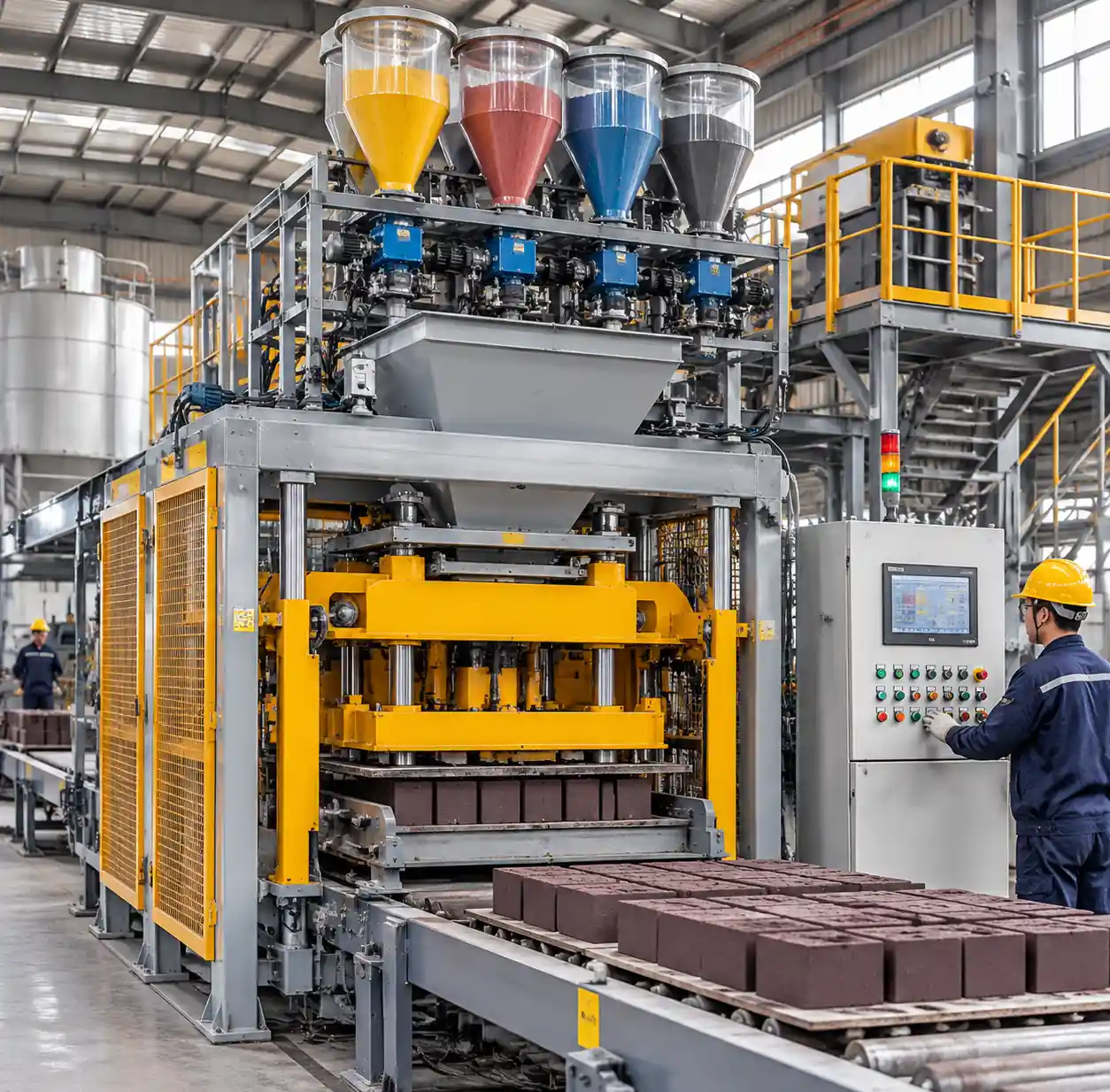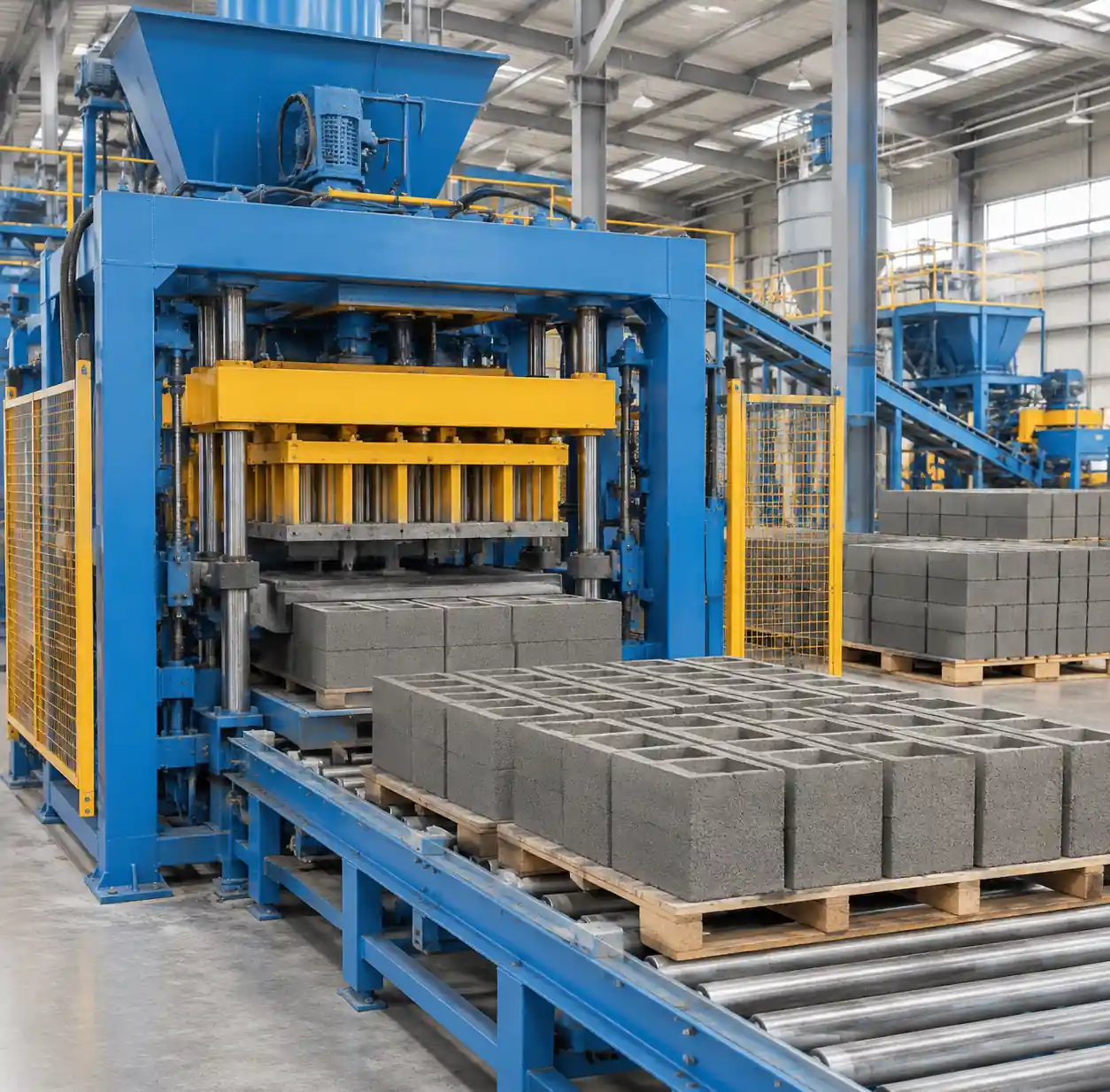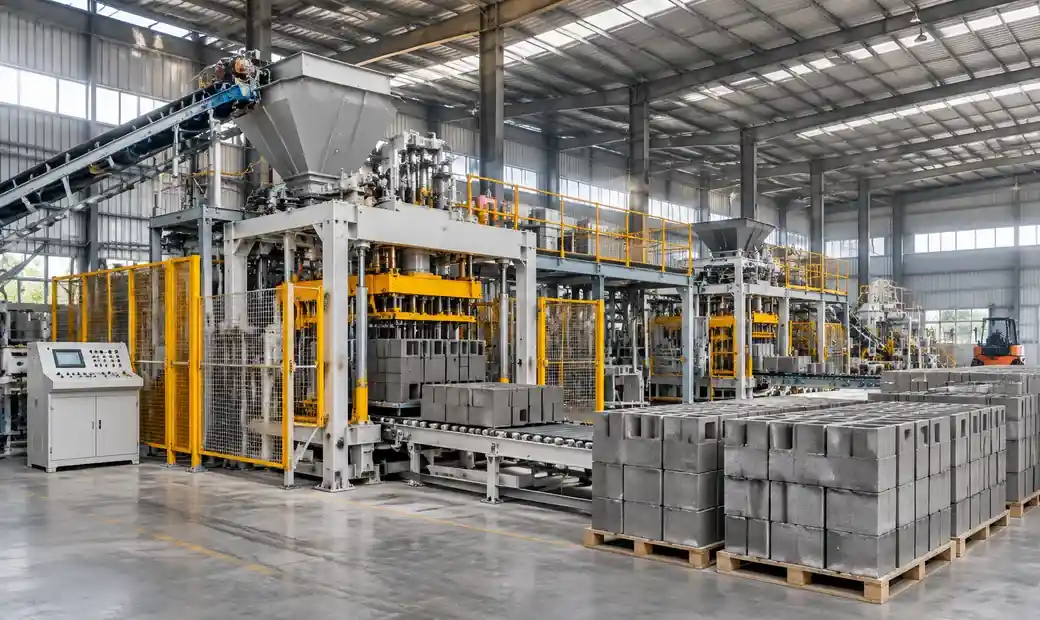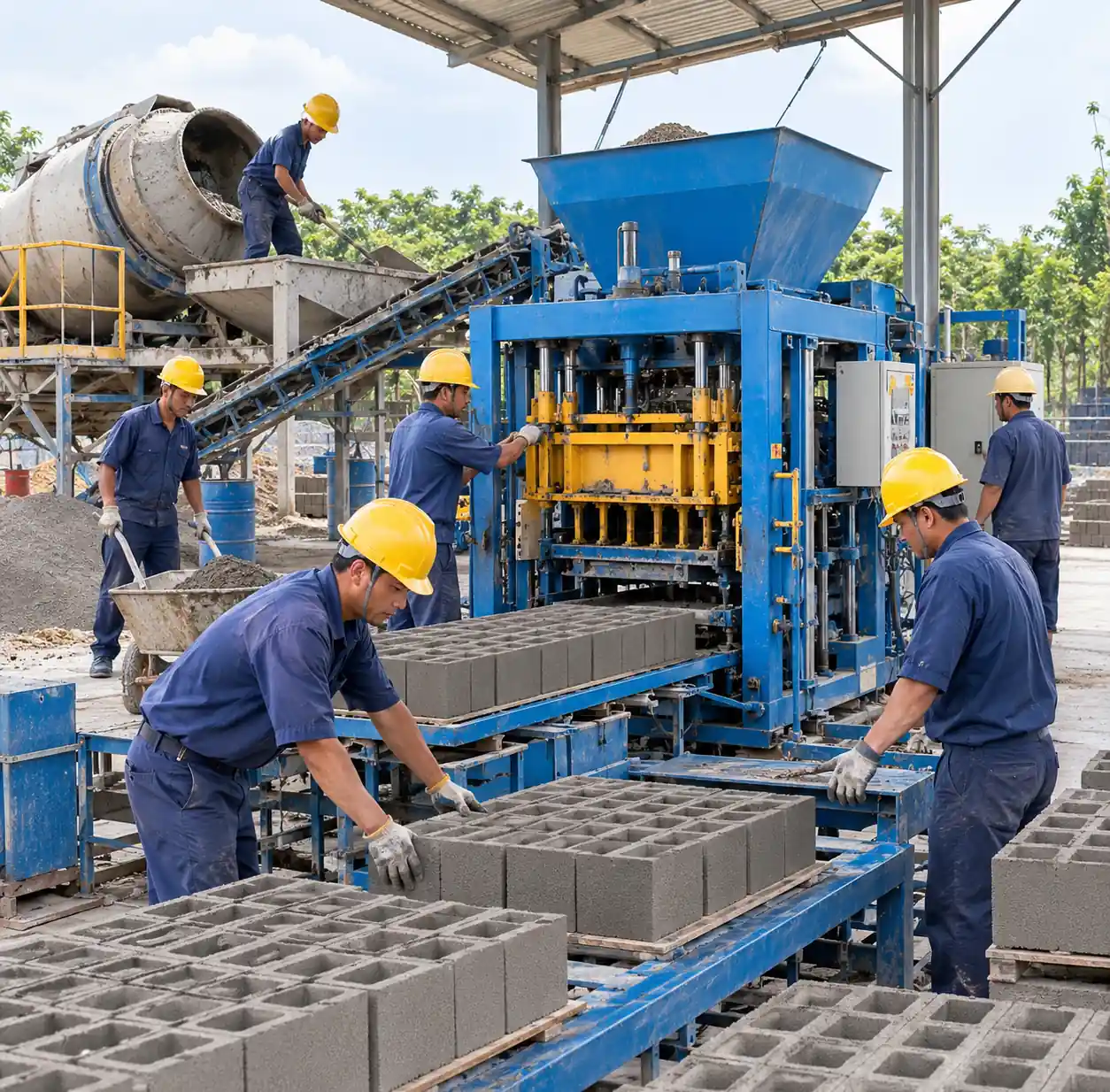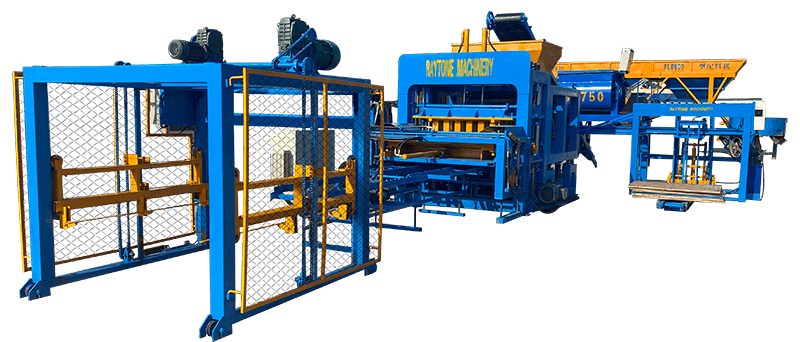
Automated block stacking and handling systems eliminate manual labor from the most physically demanding stage of concrete block production, reducing workplace injuries by 80% while increasing throughput by 40-60%. Modern palletizing robots and automated handling equipment stack 1,200-1,800 blocks per hour with precision patterns, consistent quality, and ROI payback periods of 18-36 months for medium to high-volume operations.
This comprehensive guide covers automatic palletizing technology, system types, ROI calculations, and implementation strategies that leading block manufacturers use to scale production while improving safety and reducing costs.
Why Automated Stacking Systems Transform Block Production
Manual block stacking represents one of the heaviest, most repetitive tasks in concrete manufacturing. A standard 8x8x16 hollow CMU weighs approximately 28 pounds, and workers handling 1,200-1,800 blocks per shift lift over 33,000-50,000 pounds daily. This repetitive strain causes shoulder injuries, back problems, and chronic fatigue that drive worker compensation claims and high turnover rates.
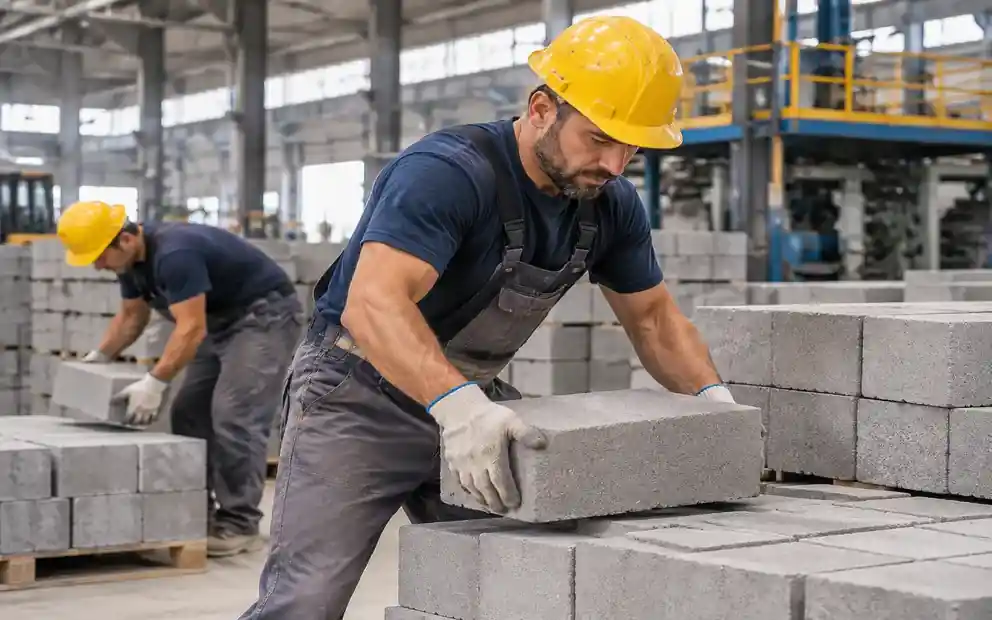
Automated stacking systems address these challenges while delivering measurable production benefits. Automatic palletizers eliminate human exposure to repetitive lifting, reduce stacking errors that cause transportation damage, and maintain consistent pallet patterns that optimize truck loading. Manufacturers implementing automated handling report 65-75% reductions in product damage during transportation and storage.
The technology advantage extends beyond safety. Automated systems operate continuously without breaks, maintain precise stacking patterns regardless of block weight or dimensions, and integrate seamlessly with automatic block machines producing 1,200-3,000 units per hour. As production speeds increase, manual labor simply cannot match automated throughput and consistency.
Types of Automated Block Handling Systems
Robotic Palletizing Arms
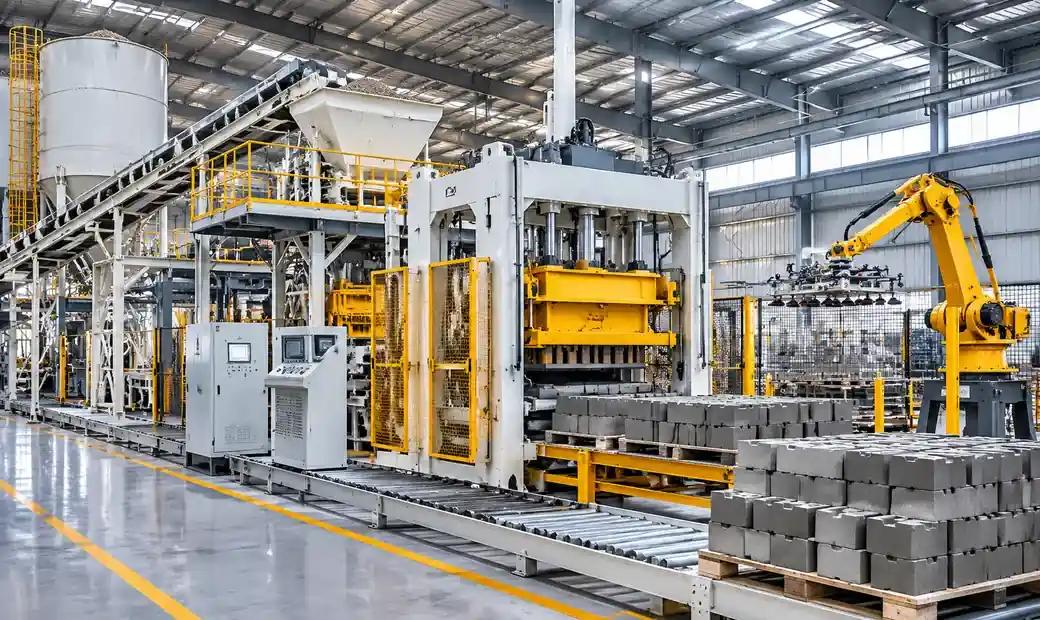
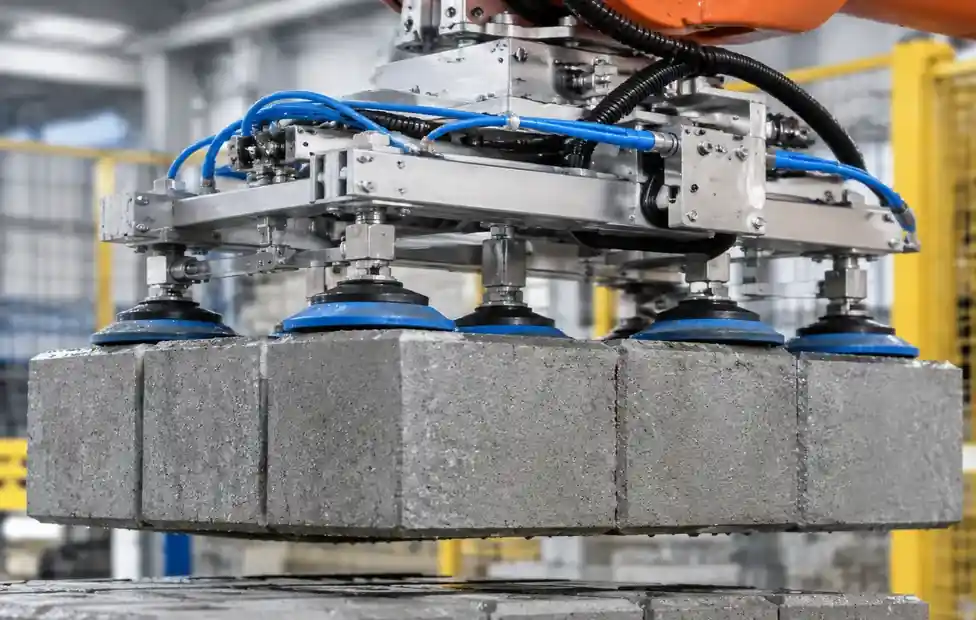
Industrial robotic arms equipped with specialized end-of-arm tooling (EOAT) represent the most flexible automated palletizing solution. These systems use vacuum grippers, mechanical clamps, or custom fixtures to grip blocks from conveyors and stack them onto pallets in programmed patterns.
Key Characteristics:
- Payload capacity: 50-300 kg per cycle depending on arm size
- Reach radius: 2-4 meters for most concrete block applications
- Cycle time: 6-12 seconds per block placement
- Pattern flexibility: Easily reprogrammed for different block sizes and pallet configurations
- Integration: Works with multiple production lines simultaneously
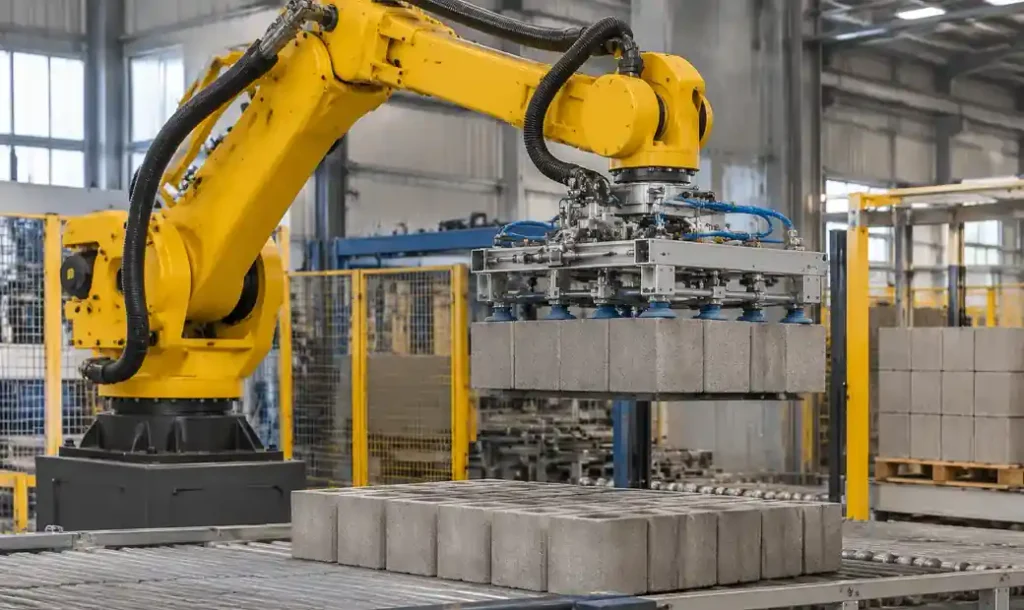
Collaborative robots (cobots) operate safely alongside human workers without safety caging, making them ideal for facilities with space constraints or semi-automated workflows. Traditional industrial robots require safety fencing but deliver higher speeds and payload capacity for fully automatic production lines. According to industry data on robotic palletizing, the global palletizing robot market reached $1.6 billion in 2026, driven by manufacturers seeking higher throughput and safer working conditions.
Gantry-Style Automatic Palletizers
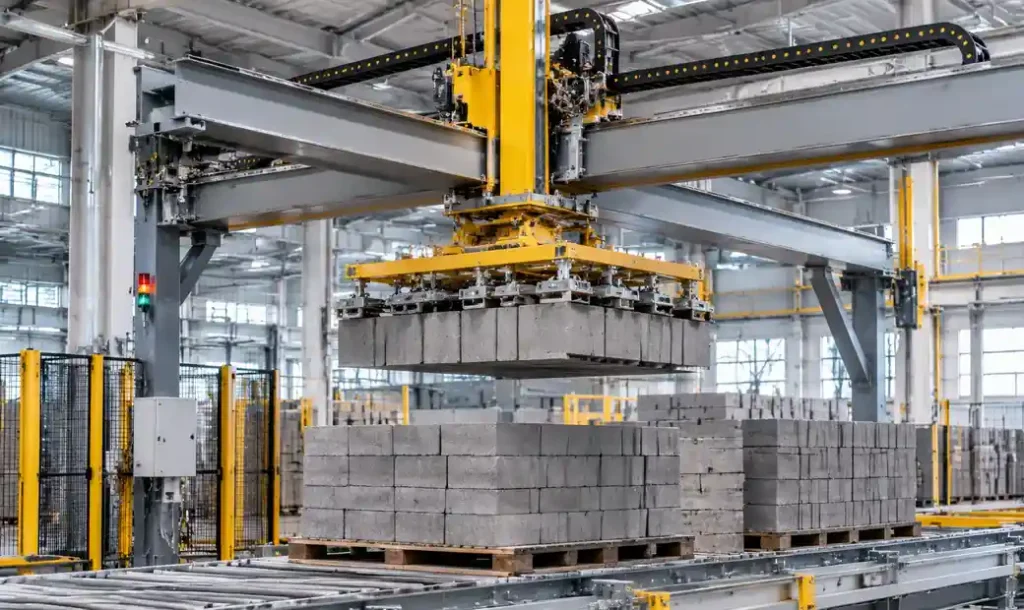
Gantry palletizers use overhead beam systems with gripping devices that travel along X-Y-Z axes to pick and place blocks. These systems excel in high-speed production environments where consistent patterns and maximum throughput matter most.
Performance Specifications:
- Stacking speed: 1,200-2,500 blocks per hour
- Accuracy: ±2-3mm positioning precision
- Pallet capacity: Handle multiple pallet stations simultaneously
- Footprint: Require 15-25 square meters floor space
- Control: PLC-based systems with touchscreen interfaces
Gantry systems typically cost $80,000-$200,000 depending on capacity and automation level, positioning them as solutions for manufacturers producing 500,000+ blocks monthly. These systems integrate directly with fully automatic block machines to create continuous production workflows.
Layer-Formation Palletizing Systems
Layer palletizers accumulate blocks into complete layers on forming tables, then transfer entire layers onto pallets in single movements. This approach maximizes stacking speed for standard block patterns and reduces mechanical complexity compared to individual block placement.
System Advantages:
- Highest throughput: 2,000-3,000 blocks per hour
- Simple mechanics: Fewer moving parts than robotic systems
- Pattern limitation: Best suited for standard rectangular patterns
- Quick changeover: Modify forming tables for different block configurations
- Cost efficiency: $60,000-$150,000 for complete systems
Layer palletizers work exceptionally well with consistent production runs of standard blocks. Facilities producing multiple specialty shapes or frequent pattern changes benefit more from robotic flexibility.
Automated vs. Manual Stacking: Performance Comparison
| Parameter | Automated Systems | Manual Stacking | Impact |
|---|---|---|---|
| Stacking Speed | 1,200-2,500 blocks/hour | 400-600 blocks/hour | 100-300% throughput increase |
| Labor Requirements | 0.5-1 operator (supervision) | 3-5 workers per line | 70-85% labor reduction |
| Injury Risk | Minimal operator exposure | High repetitive strain risk | 80%+ workplace injury reduction |
| Pallet Quality | Consistent patterns, <2% damage | Variable quality, 5-8% damage | 60-75% damage reduction |
| Operating Hours | 22-23 hours/day capability | 8-10 hours/day realistic | 120-180% capacity utilization |
| Initial Investment | $60,000-$250,000 | $5,000-$15,000 (conveyors) | Higher capital requirement |
| Annual Operating Cost | $15,000-$30,000 | $120,000-$200,000 (3-5 workers) | 75-85% cost reduction after payback |
This comparison demonstrates why manufacturers producing over 300,000 blocks annually achieve ROI within 18-36 months. The labor savings alone typically justify automation investment, with injury reduction and quality improvements providing additional value.
ROI Calculation for Automated Palletizing
Direct Labor Savings
Manual stacking operations require 3-5 workers earning $15-$22/hour including benefits. Annual labor costs for two-shift operations:
- Manual system: 3 workers × $18/hour × 4,000 hours = $216,000/year
- Automated system: 1 supervisor × $22/hour × 4,000 hours = $88,000/year
- Annual savings: $128,000
Productivity Gains
Automated systems handle production increases without proportional labor scaling. A facility growing from 500,000 to 1,000,000 blocks annually:
- Manual: Requires doubling stacking crew (6-10 workers)
- Automated: Same system handles increased volume, possibly adding second shift supervisor
- Avoided costs: $120,000-$180,000 annually in additional labor
Quality and Damage Reduction
Consistent pallet patterns reduce transportation damage from 5-8% to under 2%, saving:
- 1,000,000 blocks × $0.60/block × 5% damage reduction = $30,000/year
- Reduced customer complaints and warranty claims
- Improved delivery reliability and customer satisfaction
Worker Compensation Savings
According to industry injury data, stacking-related injuries cost manufacturers $15,000-$45,000 per incident in claims, lost time, and replacement labor. Automated systems virtually eliminate these costs.
Typical ROI Timeline:
- System cost: $120,000 (mid-range robotic palletizer)
- Annual savings: $160,000 (labor + productivity + quality)
- Payback period: 9-11 months
Even accounting for maintenance, energy costs, and financing, most manufacturers achieve positive ROI within 24 months while building foundation for future capacity expansion.
Integration with Block Production Lines
Conveyor System Requirements
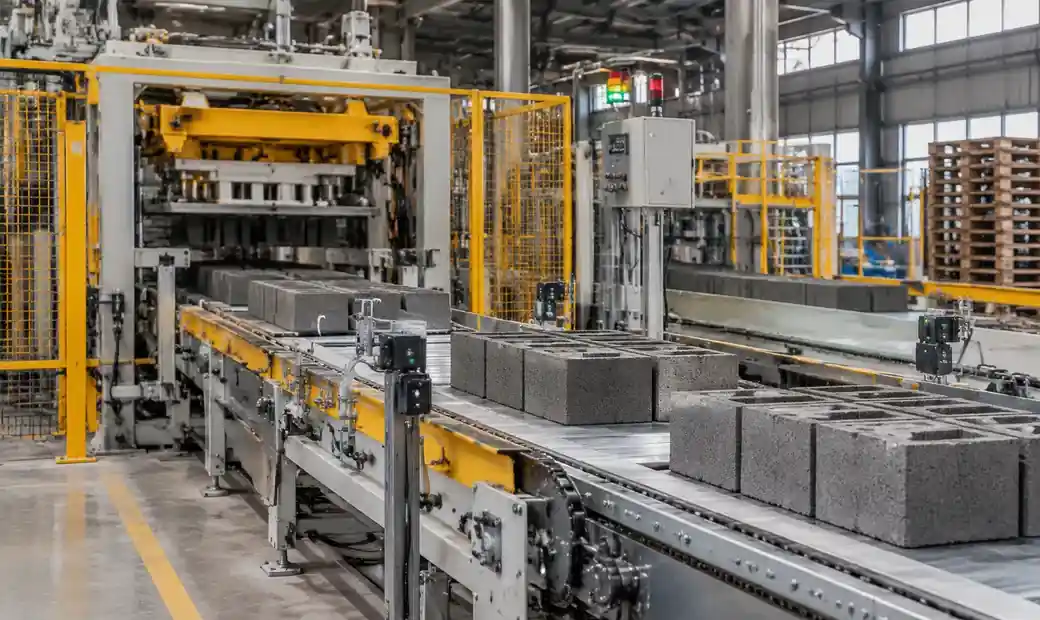
Effective automation requires properly designed material handling from block machines to palletizing stations. Conveyor specifications must match block weights, production speeds, and facility layouts.
Design Considerations:
- Belt speed: 15-30 meters/minute for smooth block transfer
- Accumulation zones: Buffer capacity for 20-40 blocks prevents production interruptions
- Orientation control: Blocks must arrive in correct position for gripper pickup
- Sensor integration: Photo-eyes and proximity sensors coordinate block flow
- Emergency stops: Safety systems halt conveyor and palletizer simultaneously
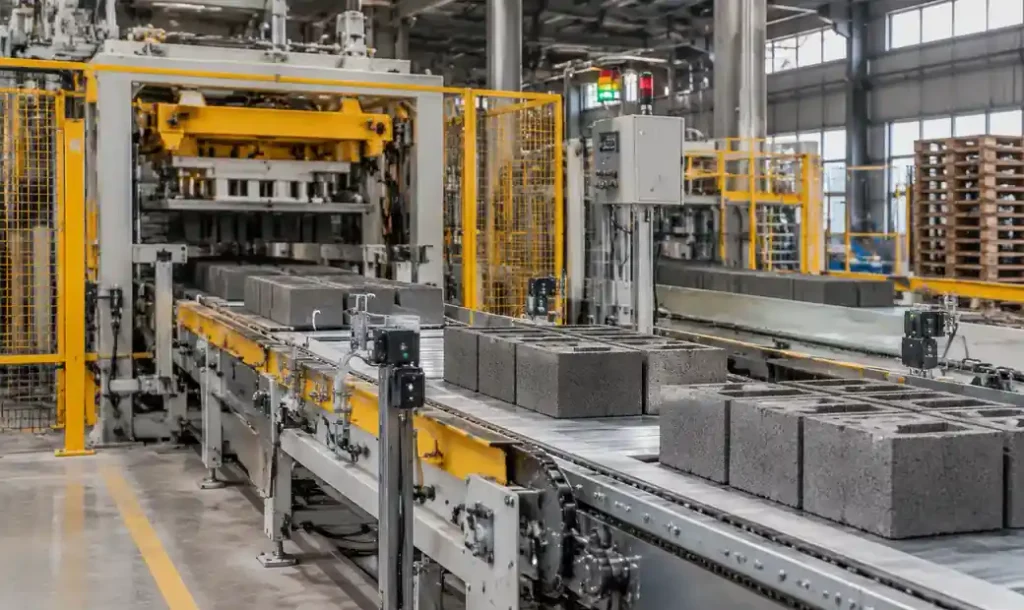
Raytone Block Machinery offers integrated conveyor systems specifically engineered for concrete block handling, with heavy-duty construction that withstands abrasive conditions and wet concrete exposure common in block plants.
Pallet Handling Automation
Complete automation extends beyond block stacking to include pallet management. Advanced systems incorporate:
- Automatic pallet dispensers: Feed empty pallets to stacking stations
- Full pallet removal: Transfer completed pallets to curing areas or storage
- Pallet inverters: Flip entire loads for secondary operations
- Wrapping stations: Apply stretch film or banding for transportation
Facilities implementing full pallet automation eliminate manual pallet handling that accounts for 25-35% of material handling labor. This comprehensive approach maximizes automation benefits and removes bottlenecks that limit production capacity.
Block Type Considerations and EOAT Selection
Standard Hollow Blocks
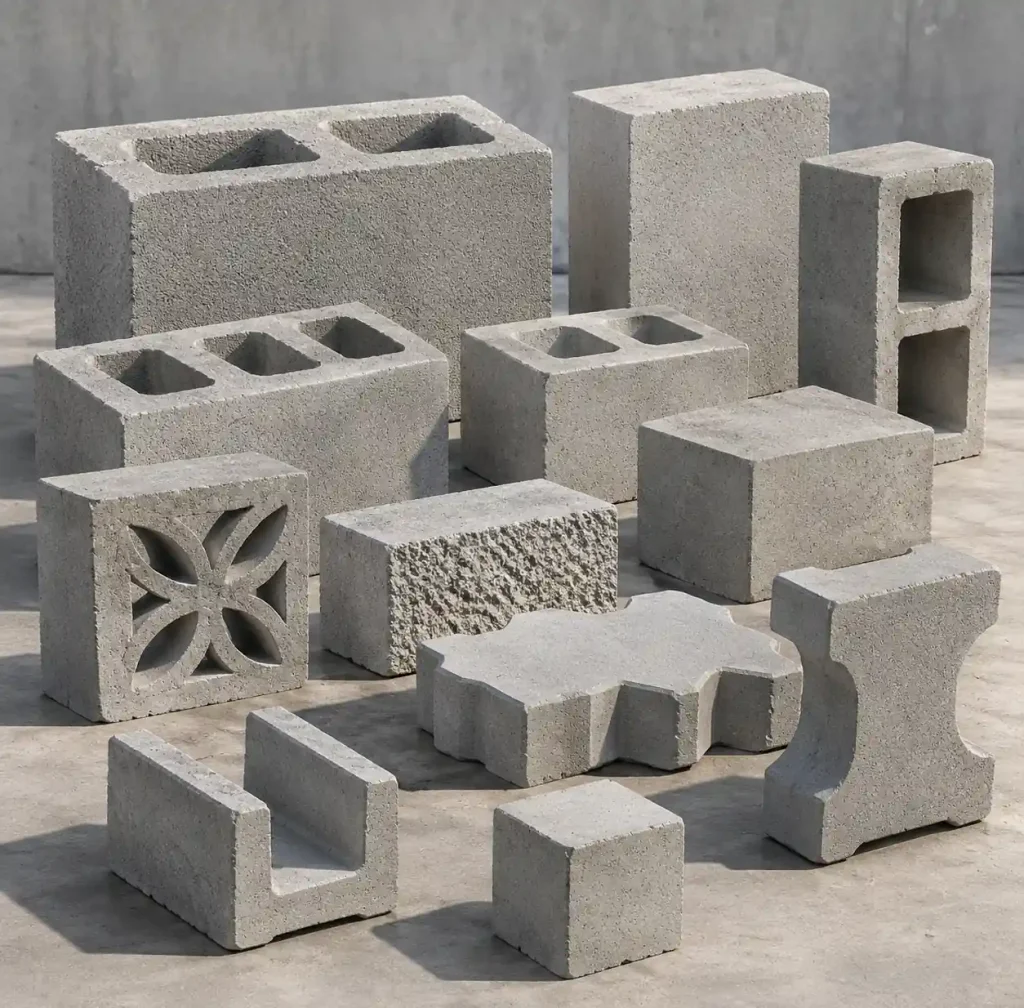
8x8x16 and similar hollow CMUs represent the most common blocks in production. These units weigh 28-36 pounds and feature rectangular profiles that simplify automated handling.
Recommended EOAT:
- Vacuum grippers with 4-8 suction cups
- Mechanical clamps for wet blocks with insufficient surface area
- Adaptive grippers that accommodate minor dimensional variations
Solid and Dense Blocks
Solid concrete blocks weighing 45-65 pounds require higher payload capacity and more robust gripping force. Dense blocks for foundation and structural applications demand precision placement to prevent cracking.
Specialty Shapes and Interlocking Blocks
Decorative blocks, interlocking units, and custom shapes present unique handling challenges. Robotic systems excel here due to programmable grip points and pattern flexibility that accommodates non-standard geometries.
System Selection Guide
| Production Volume | Recommended System | Investment Range | Key Factors |
|---|---|---|---|
| <300,000 blocks/year | Semi-automatic or manual | $15,000-$40,000 | Labor costs may not justify full automation |
| 300,000-800,000 blocks/year | Entry-level robotic or gantry | $60,000-$120,000 | ROI achievable in 24-36 months |
| 800,000-2,000,000 blocks/year | Mid-range robotic or layer palletizer | $100,000-$180,000 | Optimal ROI zone: 12-24 month payback |
| >2,000,000 blocks/year | High-speed gantry or multiple robots | $150,000-$300,000 | Maximum efficiency, <18 month ROI |
System selection depends on current production volume, growth projections, block type mix, and labor market conditions. Manufacturers in regions with high labor costs or worker shortages achieve faster ROI and stronger business cases for automation.
Implementation Best Practices
Site Preparation Requirements
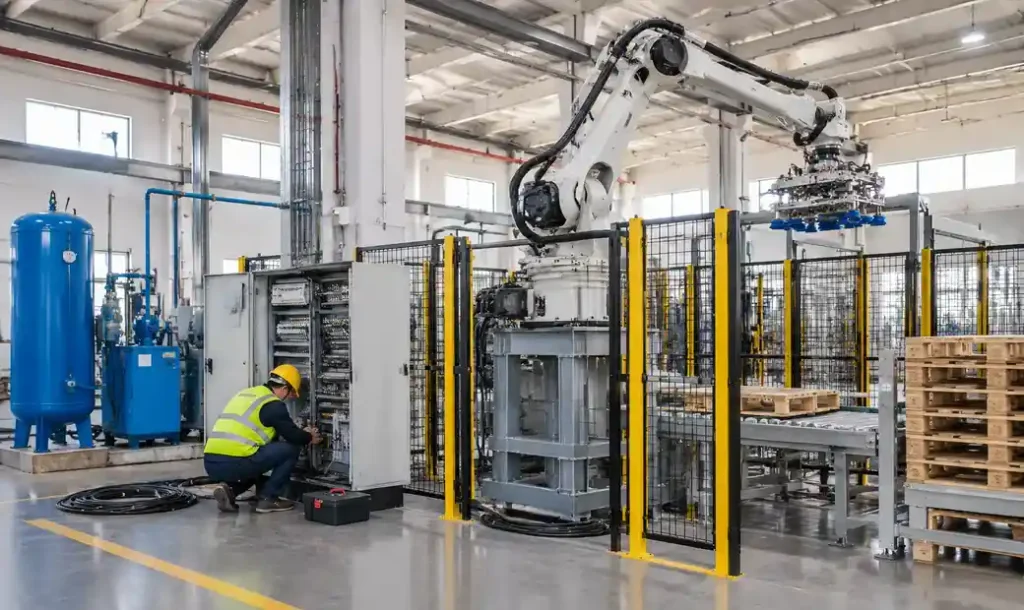
Successful installation requires proper facility preparation before equipment arrival:
- Floor capacity: Reinforced concrete capable of supporting equipment weight plus maximum pallet loads
- Electrical service: 480V three-phase power with appropriate amperage for motor loads
- Compressed air: 90-120 PSI clean, dry air for pneumatic controls and grippers
- Space allocation: Clear 20-30 square meters including access for maintenance and pallet flow
- Environmental control: Protection from extreme temperatures that affect sensor reliability
Operator Training Programs
Automation requires different skill sets than manual labor. Effective training programs cover:
- PLC control panel operation and basic programming
- EOAT adjustment and gripper maintenance
- Pattern programming for different block sizes
- Troubleshooting common issues (sensor misalignment, gripper problems)
- Safety protocols and emergency procedures
Raytone provides comprehensive training during installation and ongoing technical support to ensure operators maximize system capabilities.
Maintenance Protocols
Automated systems deliver reliability when properly maintained. Critical maintenance includes:
Daily Checks:
- Inspect gripper pads for wear or concrete buildup
- Verify sensor alignment and cleanliness
- Check compressed air pressure and filter condition
- Confirm proper lubrication of moving components
Weekly Maintenance:
- Clean sensors and photo-eyes thoroughly
- Inspect electrical connections for looseness
- Test emergency stop functions
- Review error logs for recurring issues
Monthly Service:
- Lubricate bearings, guides, and actuators per manufacturer specifications
- Inspect belts, chains, and drive components for wear
- Calibrate sensors and positioning systems
- Update PLC software if needed
Preventive maintenance typically requires 2-4 hours weekly and prevents costly downtime that disrupts production schedules.
Advanced Features in Modern Systems
Vision Systems and Quality Control
High-end automated palletizers incorporate vision systems that inspect blocks before stacking. Cameras identify:
- Dimensional defects (chips, cracks, malformed units)
- Surface finish problems
- Incorrect block orientation
- Foreign material contamination
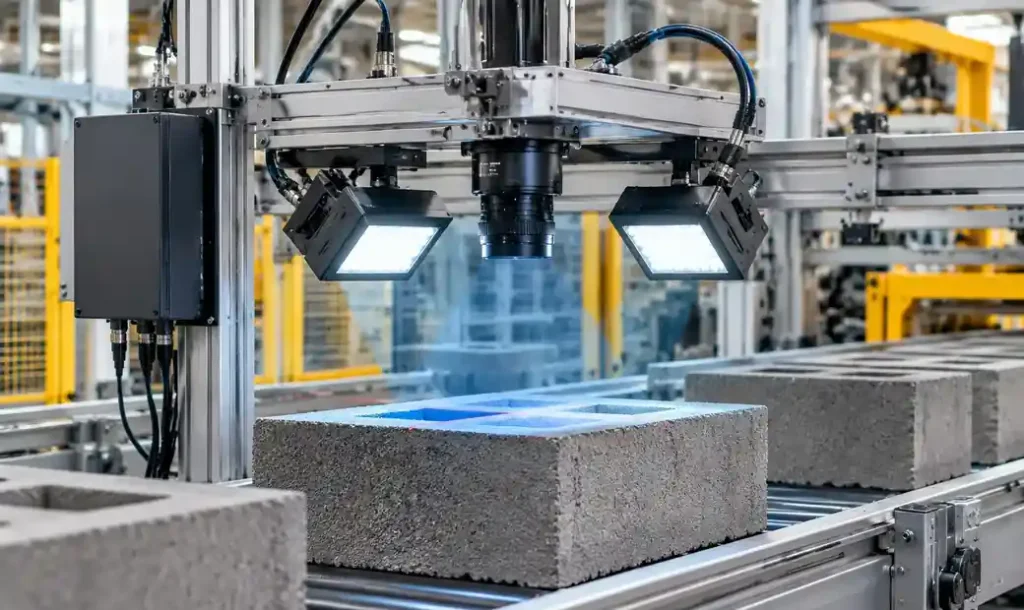
Rejected blocks divert to separate pallets for inspection or recycling, ensuring only specification-compliant units reach customers. This automated quality control reduces field complaints by 40-60% according to concrete block quality control research.
Adaptive Palletizing Algorithms
Modern control systems use adaptive algorithms that optimize pallet patterns based on:
- Block dimensions and weight distribution
- Pallet size and load capacity limits
- Transportation requirements and stacking stability
- Storage space utilization
These intelligent systems calculate optimal layer patterns that maximize pallet density while maintaining structural integrity during transportation. Facilities shipping long distances benefit significantly from optimized patterns that reduce movement and damage.
Remote Monitoring and Diagnostics
Industry 4.0 connectivity enables remote system monitoring and predictive maintenance. Web-based dashboards display:
- Real-time production counts and cycle times
- Equipment health metrics and wear indicators
- Error frequency and maintenance requirements
- Performance trends and efficiency analysis
Remote diagnostics allow Raytone technical support to troubleshoot issues without on-site visits, minimizing downtime and reducing service costs. Predictive maintenance alerts identify component wear before failures occur, enabling scheduled replacements during planned maintenance windows.
Common Implementation Challenges
Block Surface Moisture
Freshly molded blocks retain surface moisture that reduces vacuum gripper adhesion. Solutions include:
- Mechanical clamps or fork-style grippers for wet blocks
- Short curing delays (5-10 minutes) before palletizing
- High-flow vacuum pumps that overcome moisture effects
- EOAT designs that contact dry areas of block surfaces
Variable Block Dimensions
Manufacturing tolerances cause minor dimensional variations that affect automated handling. Modern systems accommodate these variations through:
- Compliant gripper designs that adapt to size differences
- Vision-guided positioning that compensates for placement errors
- Wider gripper adjustment ranges (±10-15mm typical)
- Adaptive control algorithms that learn from previous cycles
Facility Space Constraints
Existing facilities often lack space for ideal automated system layouts. Creative solutions include:
- Compact robotic systems with smaller footprints than gantry palletizers
- Vertical pallet storage that maximizes cubic space utilization
- Mobile palletizing robots that service multiple production lines
- Mezzanine installations that utilize overhead space
Raytone engineering teams specialize in custom layouts that maximize automation benefits within existing facility constraints.
Future Trends in Block Handling Automation
Artificial Intelligence Integration
AI-powered systems learn optimal stacking patterns through machine learning, continuously improving efficiency and adapting to new block types without manual reprogramming. These systems analyze thousands of stacking cycles to identify patterns that maximize pallet stability, minimize damage, and optimize transportation efficiency.
Autonomous Mobile Robots (AMRs)
Next-generation facilities deploy autonomous mobile robots that transport pallets from production areas to curing yards and storage without fixed conveyor infrastructure. AMRs navigate dynamically using sensors and mapping software, providing ultimate flexibility for changing production layouts.
Collaborative Automation
Hybrid systems combine robot efficiency with human judgment for specialty blocks and custom orders. Cobots handle repetitive stacking while operators manage exceptions, quality checks, and pattern adjustments. This approach delivers automation benefits while maintaining workforce flexibility.
Frequently Asked Questions
What is the minimum production volume to justify automated block stacking?
Automated systems become cost-effective at approximately 300,000 blocks annually or 1,200-1,500 blocks per day. Facilities producing below this threshold often achieve better ROI by optimizing manual processes or implementing semi-automatic pallet handling. However, manufacturers facing worker shortages, high injury rates, or aggressive growth plans may justify automation at lower volumes based on strategic factors beyond pure ROI calculations.
How long does it take to install and commission an automated palletizing system?
Installation typically requires 1-2 weeks including equipment placement, electrical connections, compressed air plumbing, and conveyor integration. Commissioning and operator training add another 3-5 days. Total timeline from equipment delivery to full production: 2-3 weeks. Complex integrations with multiple production lines or custom configurations may extend this to 4-6 weeks.
What ongoing maintenance costs should I budget for automated systems?
Annual maintenance costs typically run 3-5% of equipment purchase price. For a $120,000 robotic palletizer, budget $3,600-$6,000 annually for replacement grippers, filters, lubricants, and wear components. Major overhauls at 5-7 year intervals may cost $8,000-$15,000. These costs remain far below manual labor expenses while ensuring reliable operation.
Can automated systems handle multiple block sizes and types?
Yes, modern robotic and gantry systems change between block sizes in under 5 minutes through quick-change EOAT and pattern reprogramming. Layer palletizers require physical modifications to forming tables, taking 15-30 minutes for changeover. Systems with programmable patterns store dozens of configurations that operators select via touchscreen interfaces, enabling efficient production of varied product mixes.
What happens if the automated system breaks down during production?
Well-designed installations include manual bypass capabilities that route blocks around automated equipment for hand stacking during repairs. Most breakdowns involve minor issues (sensor misalignment, gripper adjustment) that operators resolve in 10-30 minutes using basic training. Major component failures occur infrequently with proper maintenance but may require 4-24 hours for parts delivery and replacement. Facilities with extended technical support contracts receive priority response and remote diagnostic assistance.
Do automated systems work with existing block machines and conveyors?
Yes, automated palletizers integrate with virtually all block machine brands and existing conveyor systems. Integration requires coordination of control signals, proper conveyor speeds, and adequate accumulation space but rarely necessitates replacing existing production equipment. Raytone provides integration engineering services that ensure seamless compatibility with your current production line regardless of age or manufacturer.
Conclusão
Automated block stacking and handling systems represent one of the highest-ROI investments available to concrete block manufacturers, delivering labor cost reductions of 70-85%, throughput increases of 40-60%, and workplace injury elimination within payback periods of 18-36 months. Modern robotic, gantry, and layer palletizing technologies accommodate production volumes from 300,000 to several million blocks annually with flexibility to grow as your business expands.
Successful implementation requires proper system selection based on production volume, block types, and facility constraints. Integration with production lines, comprehensive operator training, and preventive maintenance protocols ensure reliable operation and maximum ROI. As concrete block demand grows and labor markets tighten, automation transforms from competitive advantage to operational necessity for manufacturers committed to sustainable growth.
Raytone Block Machinery specializes in complete automation solutions including block making machines, conveyor systems, and palletizing equipment engineered specifically for concrete block production environments. Our integrated approach ensures all components work together seamlessly, delivering reliable performance and exceptional return on investment. Contact our automation specialists today to evaluate how automated stacking and handling systems can transform your block production operations.