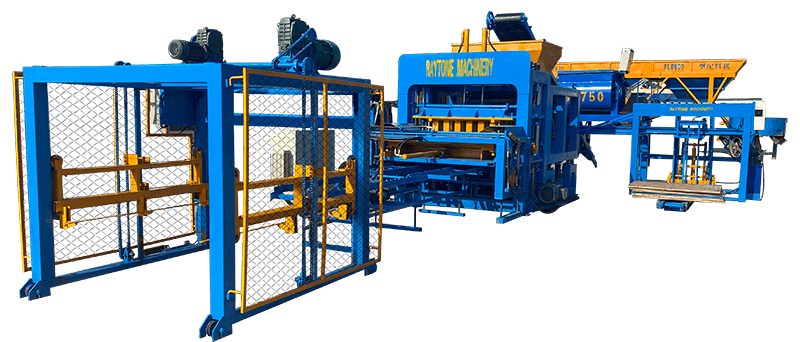
If you’re considering lightweight construction materials that combine strength, insulation, and sustainability, aerated concrete blocks (AAC blocks) represent one of the most innovative building solutions available today. The global AAC market continues to expand as construction projects demand materials that reduce structural load, improve energy efficiency, and accelerate building timelines.
This guide covers the complete AAC block production process, essential equipment requirements, technical specifications, and investment considerations. You’ll understand how AAC blocks are manufactured, what machinery you need, and whether this production line fits your business goals.
What Are Aerated Concrete Blocks?
Aerated concrete blocks, also known as autoclaved aerated concrete (AAC) or autoclaved cellular concrete, are lightweight precast building materials with a cellular structure. These blocks are manufactured through a precise chemical process that introduces millions of tiny air pockets into the concrete matrix.
The material consists of cement, lime, fly ash or sand, gypsum, aluminum powder, and water mixed in specific proportions. When aluminum powder reacts with the alkaline slurry, it releases hydrogen gas that creates air cells throughout the mixture. After curing in high-pressure autoclaves, the result is a lightweight block with 60-85% air content by volume.
AAC blocks typically weigh 400-700 kg/m³, which is approximately one-third the weight of conventional concrete blocks. This significant weight reduction translates to lower foundation loads, easier handling, and faster construction. The material provides excellent thermal insulation, fire resistance up to 4 hours, and sound dampening properties that make it suitable for residential, commercial, and industrial applications.
AAC Block Production Process
Raw Material Preparation
The production process begins with precise measurement and storage of raw materials. Modern AAC plants use computerized batching systems to ensure consistent proportions:
- Fly ash or sand: 60-70% of the mix (ground to fine particles if using sand)
- Cement: 7-15% for binding strength
- Lime: 7-15% for chemical reaction
- Gypsum: 0.5-1% as a setting regulator
- Aluminum powder: 0.05-0.08% as the foaming agent
Sand-based AAC requires a ball mill to grind silica sand into fine powder, while fly ash-based production uses the material directly from thermal power plants. The choice between sand and fly ash depends on local availability and cost considerations.
Mixing and Slurry Formation
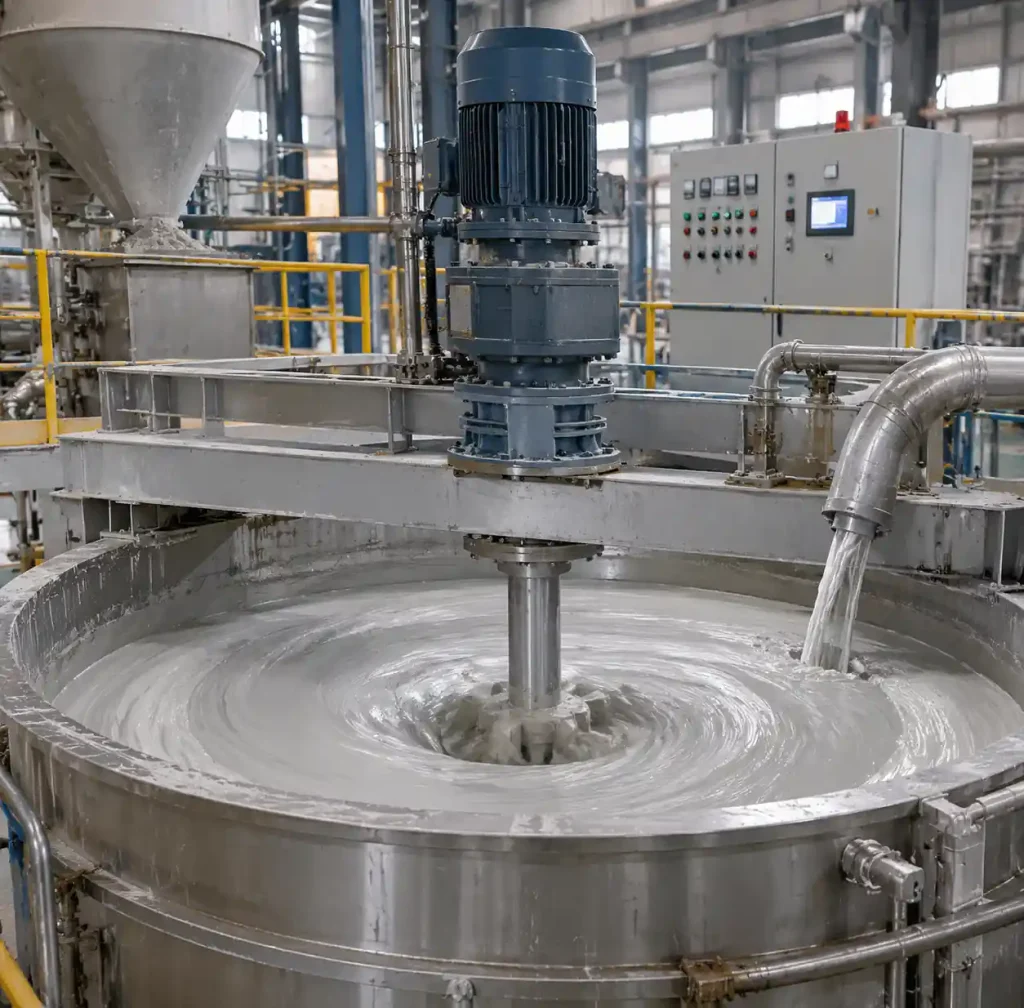
Raw materials are dosed automatically into high-speed mixing units where they combine with water to form a homogeneous slurry. The mixing process typically takes 3-5 minutes and must achieve uniform consistency throughout the batch.
Water content is carefully controlled at 60-65% of the total mix weight. Too much water weakens the final product, while insufficient water prevents proper chemical reactions. Temperature control during mixing is critical because the aluminum reaction begins immediately upon contact with the alkaline mixture.
Casting and Rising
The prepared slurry is poured into large steel molds measuring approximately 6m × 1.5m × 0.75m. As soon as the aluminum powder contacts the alkaline slurry, hydrogen gas generation begins. This chemical reaction causes the mixture to expand or “rise” like bread dough, increasing volume by 50-100% over 4-8 hours.
The rising process creates millions of microscopic air cells that give AAC its characteristic lightweight and insulating properties. Precise control of rising time and temperature ensures uniform cell distribution and optimal density. The mixture reaches initial set during this phase, gaining enough strength for subsequent cutting operations.
Wire Cutting
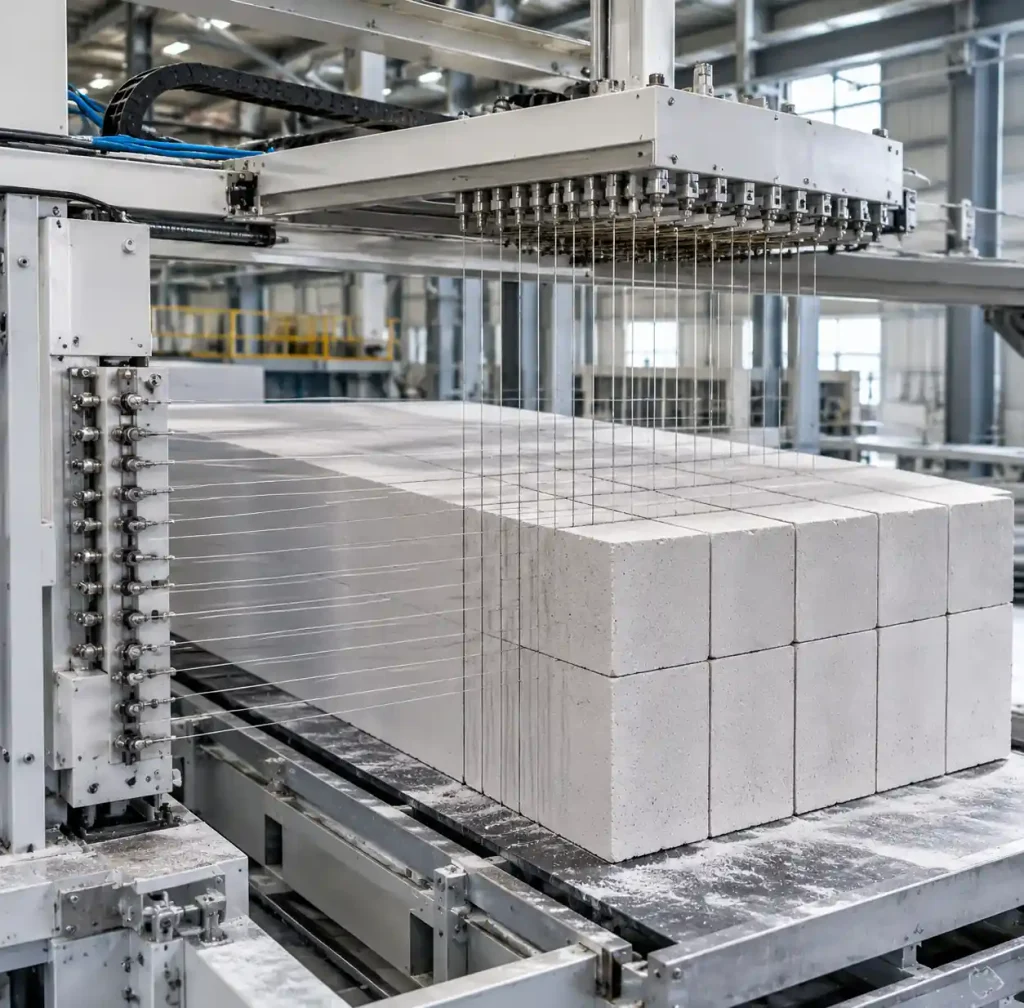
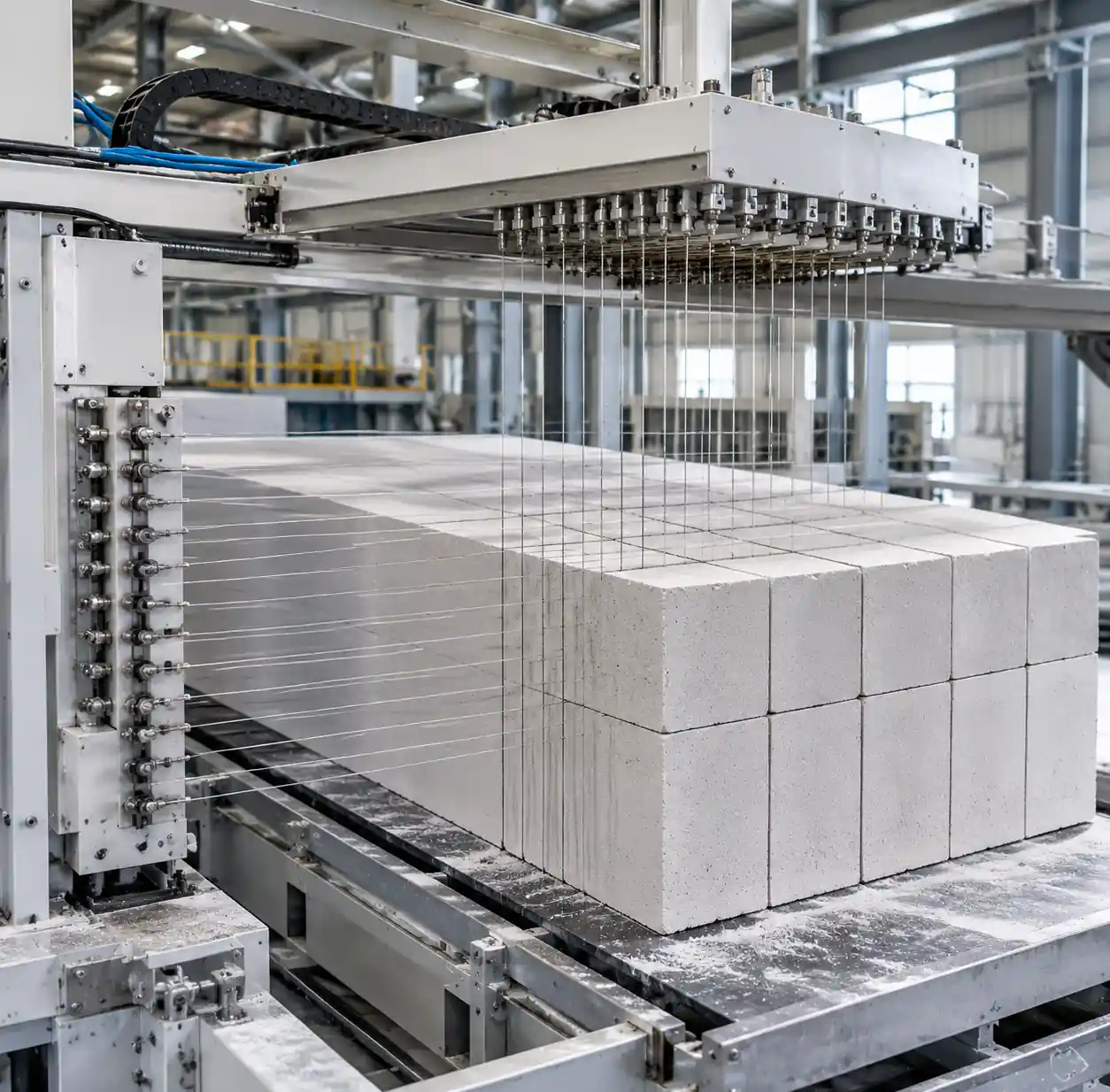
After rising and initial hardening, the semi-hardened cake must be cut into individual blocks before full curing. Automated wire cutting machines use thin steel wires to slice the large cake into precise block dimensions in three axes simultaneously.
Modern cutting equipment can produce blocks in multiple standard sizes within a single cutting cycle:
| Block Size | Common Applications |
|---|---|
| 600×200×100mm | Partition walls |
| 600×200×150mm | Load-bearing walls (low-rise) |
| 600×200×200mm | Load-bearing walls (multi-story) |
| 600×200×250mm | External walls (high insulation) |
The cutting process removes excess material from the top and sides of the cake, which is recycled back into the slurry mixing stage. This zero-waste approach makes AAC production environmentally efficient.
Autoclaving
The cut blocks are loaded onto curing trolleys and moved into autoclaves—large steel pressure vessels that look like horizontal cylindrical tanks. Autoclaving is the most critical and equipment-intensive stage of AAC production.
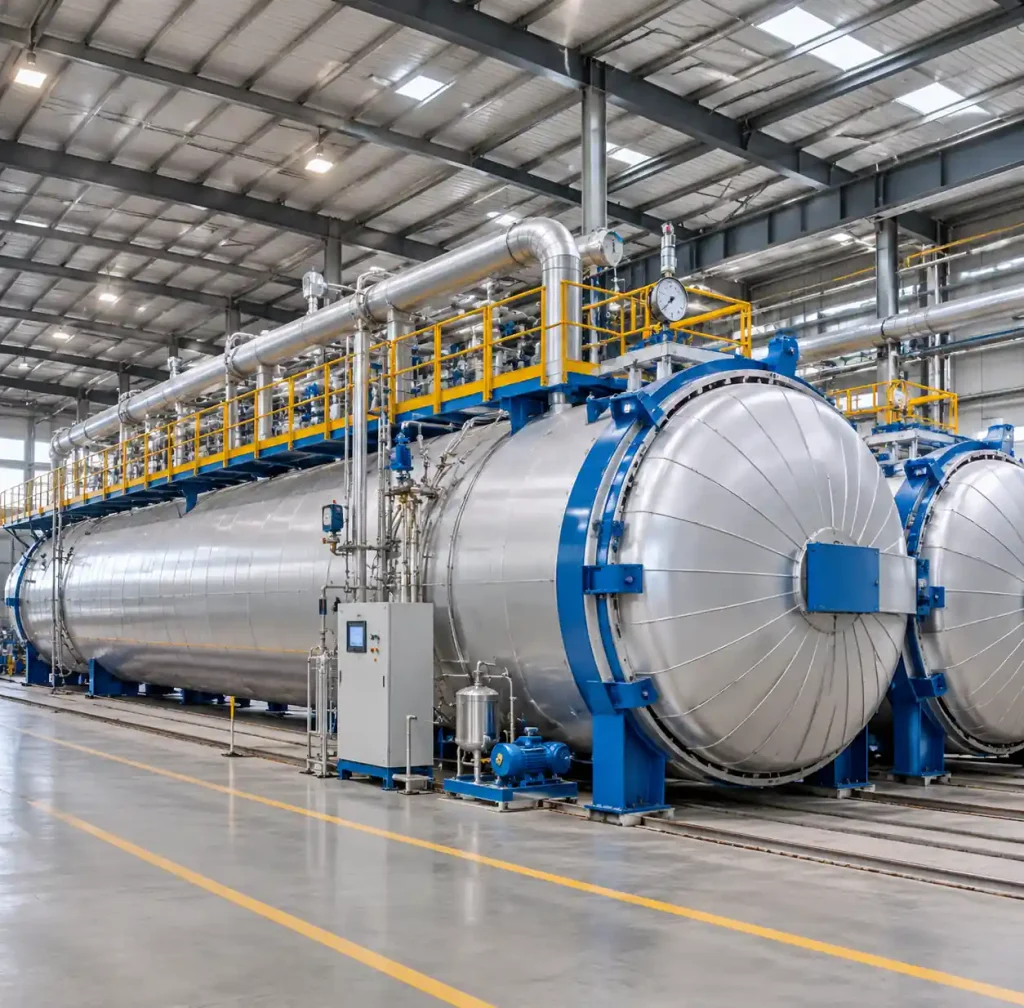
Inside the autoclave, blocks cure under specific conditions:
- Temperature: 180-190°C
- Pressure: 10-12 bar (atmospheric pressure)
- Duration: 8-12 hours depending on capacity
High-pressure steam treatment triggers chemical reactions between lime and silica that create calcium silicate hydrates. These compounds give AAC blocks their final strength, dimensional stability, and durability. The autoclaving process cannot be rushed—blocks that don’t receive sufficient curing time will have reduced strength and higher shrinkage.
Unloading and Packaging
After autoclaving, blocks cool gradually before being unloaded from curing trolleys. Automatic or manual systems transfer blocks to packaging lines where they are:
- Inspected for dimensional accuracy and surface quality
- Sorted by size and grade
- Wrapped in plastic film for moisture protection
- Stacked on wooden pallets
- Shrink-wrapped for transportation
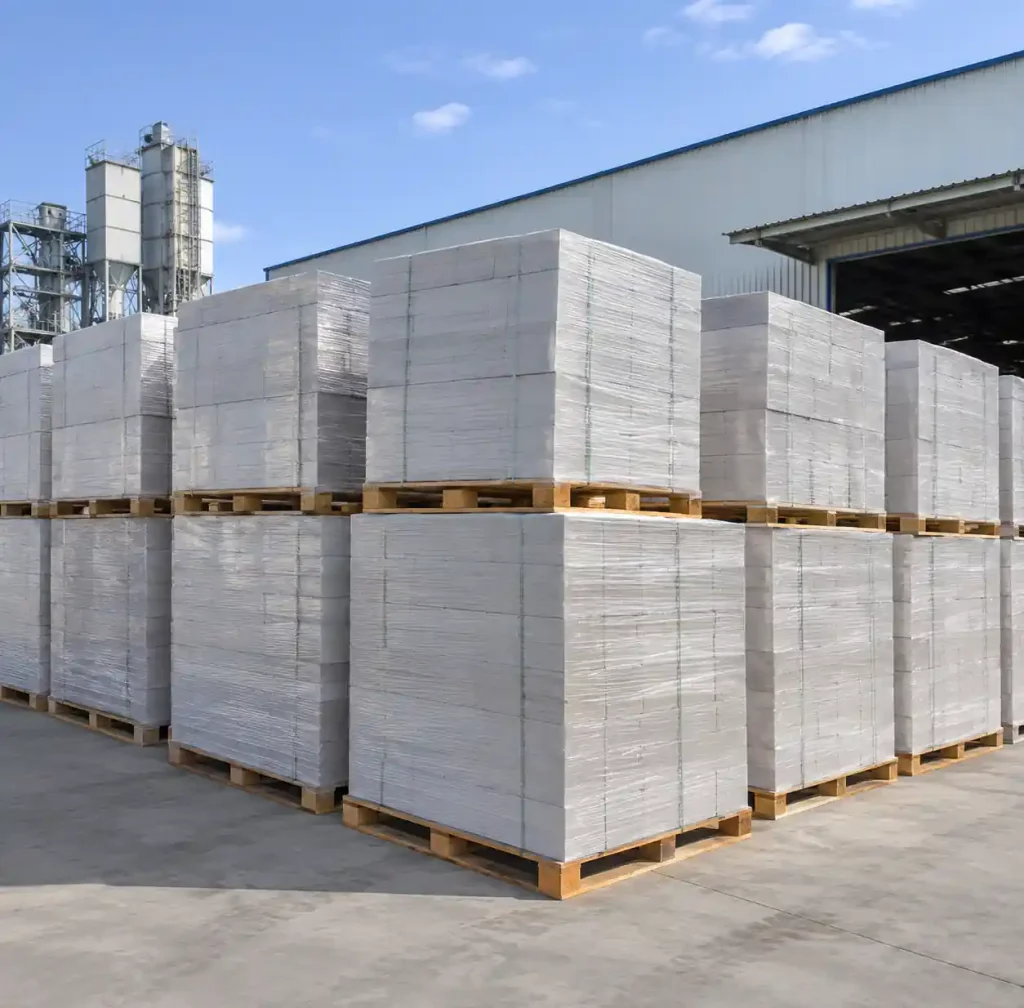
Finished AAC blocks can be stored outdoors but should be covered to prevent water absorption before installation. Proper packaging protects blocks during transportation and ensures they arrive at construction sites in optimal condition.
Essential Equipment for AAC Production
A complete AAC block manufacturing plant requires major process equipment and supporting auxiliary systems. The investment scale depends on target production capacity, level of automation, and whether you choose sand-based or fly ash-based production.
Major Equipment Components
| Equipment | Function | Technical Specifications |
|---|---|---|
| Ball Mill (sand-based only) | Grinds silica sand to fine powder | 1.5-2.5m diameter, 4.5-7.5m length |
| Mixing Machine | Creates homogeneous slurry from raw materials | 2-3m³ capacity, high-speed mixer |
| Casting System | Pours slurry into steel molds | Automated dosing, 6m × 1.5m molds |
| Autoclave | High-pressure steam curing | 2-3m diameter, 20-31m length, 10-12 bar |
| Wire Cutting Machine | Cuts blocks to precise dimensions | Automated 3-axis cutting, multiple wire configurations |
| Tilting Crane | Moves molds and blocks | 10-20 ton capacity, 15-20m span |
| Curing Trolleys | Transport blocks through autoclave | Steel construction, multiple layers |
Equipamento auxiliar
Beyond the main production line, AAC plants require:
- Jaw crushers: Break large limestone or gypsum into manageable pieces
- Bucket elevators: Transport materials vertically between processing stages
- Screw conveyors: Move raw materials horizontally to storage or mixing
- Slurry storage tanks: Hold prepared mix before casting
- Computer control systems: Monitor and automate the entire production process
- Boilers: Generate steam for autoclave operation
- Compressors: Provide compressed air for pneumatic systems
The autoclave represents the single largest capital investment in an AAC plant, accounting for 30-40% of total equipment costs. Autoclave size directly determines plant capacity—larger diameter and length units can cure more blocks per cycle but require significantly higher initial investment.
Production Capacity and Output
AAC plants are classified by annual production capacity, typically measured in cubic meters:
| Plant Scale | Annual Capacity | Daily Output | Investment Range |
|—|—|—|
| Small Scale | 50,000-100,000 m³/year | 150-300 m³/day | $800,000-1,500,000 |
| Medium Scale | 100,000-200,000 m³/year | 300-600 m³/day | $1,500,000-3,500,000 |
| Large Scale | 200,000-400,000 m³/year | 600-1,200 m³/day | $3,500,000-8,000,000 |
One cubic meter of AAC material produces approximately 50-55 standard blocks (600×200×200mm). A medium-scale plant producing 150,000 m³ annually manufactures about 7.5-8 million blocks per year.
Production efficiency depends on several factors:
- Autoclave cycle time: 8-12 hours per batch limits how many batches you can process daily
- Number of autoclaves: Multiple units allow continuous production while others are curing
- Raw material quality: Consistent inputs reduce defects and rework
- Labor skill level: Trained operators optimize mixing, cutting, and quality control
Most AAC plants operate with 2-3 production shifts daily to maximize autoclave utilization. The curing process cannot be accelerated without compromising block quality, making autoclave capacity the primary bottleneck in production expansion.
AAC Blocks vs Conventional Concrete Blocks
Understanding the performance differences between AAC and conventional concrete blocks helps you evaluate market demand and positioning:
| Property | AAC Blocks | Conventional Concrete Blocks |
|—|—|
| Density | 400-700 kg/m³ | 1,800-2,200 kg/m³ |
| Compressive Strength | 3-5 MPa | 4-10 MPa |
| Thermal Conductivity | 0.16-0.24 W/mK | 0.7-1.28 W/mK |
| Fire Resistance | 4-6 hours | 2-4 hours |
| Water Absorption | 40-50% by weight | 10-15% by weight |
| Construction Speed | 3x faster | Baseline |
| Cost per m³ | $45-75 | $35-50 |
AAC blocks excel in thermal insulation, reducing heating and cooling energy costs by 25-30% compared to conventional masonry. The lightweight nature cuts foundation costs by 15-20% due to reduced structural loads. However, AAC blocks absorb more water and require proper plastering with water-resistant materials.
From a production perspective, AAC manufacturing requires significantly higher capital investment due to autoclave costs. Conventional block machines cost $8,000-120,000 depending on automation level, while AAC plants start at $800,000 for minimal capacity. This 10x difference in entry costs means AAC production makes economic sense only at medium to large scale where you can achieve economies of scale.
Raw Material Costs and Sourcing
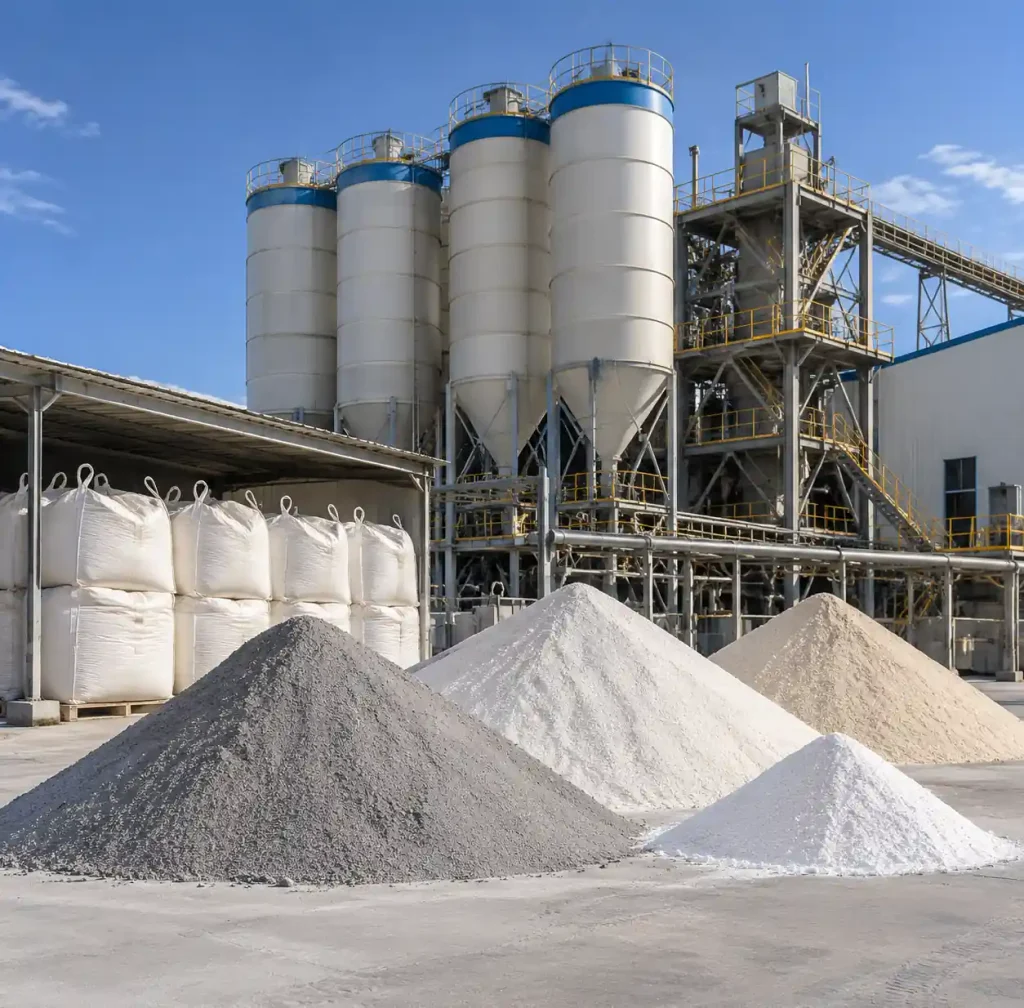
Raw material costs constitute 40-50% of AAC block production expenses. Strategic sourcing directly impacts profitability:
Fly Ash: If available from nearby thermal power plants, fly ash costs $8-15 per ton and eliminates the need for expensive ball mill equipment. Fly ash-based AAC plants have 15-20% lower capital costs and 20-25% lower operating costs compared to sand-based plants.
Cement: Premium-grade cement costs $80-120 per ton depending on location. AAC production uses less cement per cubic meter than conventional blocks (approximately 50-70 kg/m³), providing a material efficiency advantage.
Lime: Quicklime costs $60-90 per ton. Quality lime with high calcium content ensures better chemical reactions during autoclaving. Low-grade lime can cause strength variations and increased rejection rates.
Aluminum Powder: As the foaming agent, aluminum powder costs $2,000-2,500 per ton but represents only 0.05-0.08% of the mix. A medium-scale plant uses approximately 150-200 kg of aluminum powder daily, or $300-500 in daily aluminum costs.
Proximity to raw material sources significantly affects logistics costs and inventory management. Plants located within 100 km of fly ash sources and limestone quarries enjoy 10-15% lower production costs compared to facilities that must transport materials longer distances.
Investment Breakdown and ROI
Starting an AAC block manufacturing plant requires careful financial planning. Here’s a realistic breakdown for a medium-scale plant (150,000 m³/year capacity):
Capital Investment:
- Land and site preparation: $150,000-250,000 (3-5 acres)
- Main equipment: $1,500,000-2,000,000
- Civil construction: $300,000-400,000
- Utilities and infrastructure: $200,000-300,000
- Working capital: $150,000-200,000
- Total initial investment: $2,300,000-3,150,000
Monthly Operating Costs:
- Raw materials: $120,000-150,000
- Energy (electricity and fuel): $35,000-45,000
- Labor (25-35 workers): $18,000-25,000
- Maintenance and spare parts: $8,000-12,000
- Total monthly costs: $181,000-232,000
Revenue Projections:
With an average selling price of $55-70 per cubic meter and 150,000 m³ annual production:
- Annual revenue: $8,250,000-10,500,000
- Annual operating costs: $2,172,000-2,784,000
- Gross profit: $6,078,000-7,716,000
- Payback period: 3-4 years
These figures assume 85-90% capacity utilization in years 1-2, ramping up to 95-100% by year 3. Market conditions, raw material availability, competition, and local construction activity significantly impact actual financial performance.
Quality Control and Standards
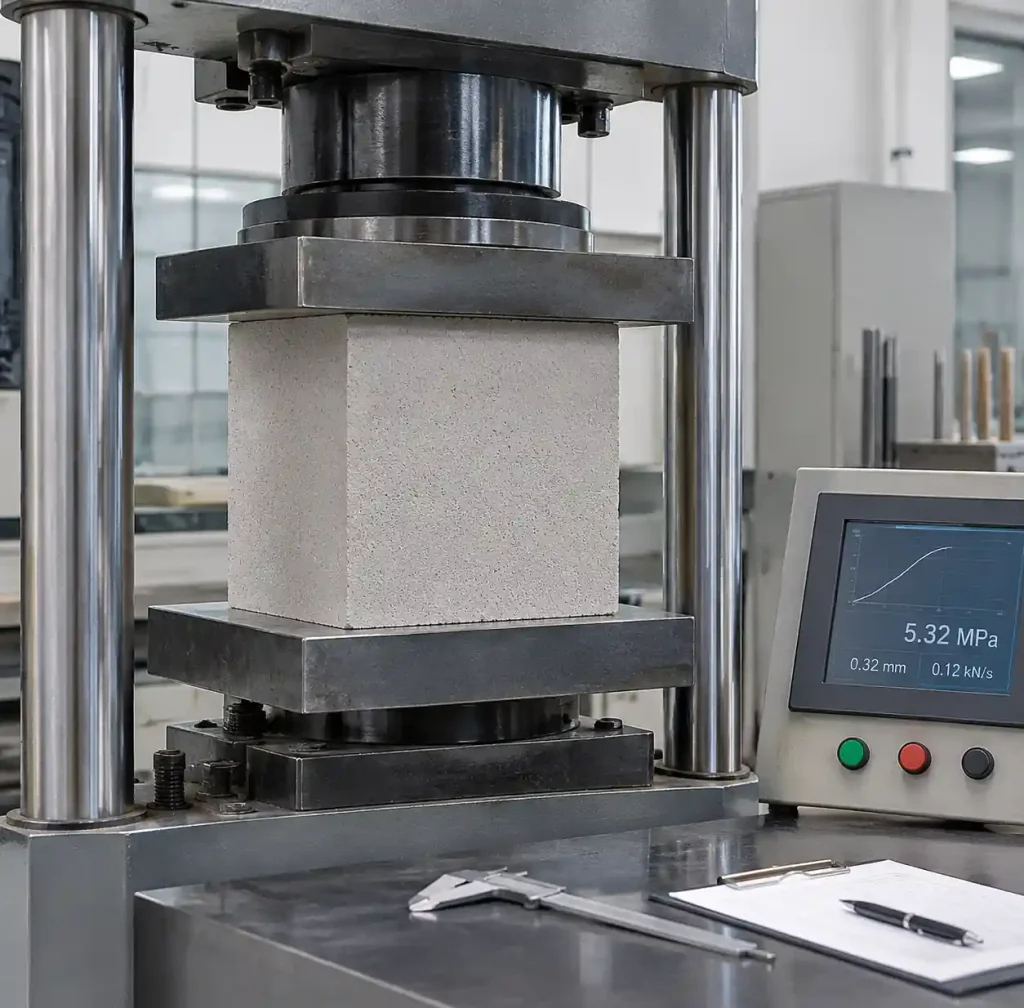
AAC blocks must meet specific technical standards to ensure structural safety and performance. Testing protocols include:
Compressive Strength Testing: Blocks should achieve minimum 3.0-4.0 MPa compressive strength according to ASTM C1386 or relevant national standards. Strength testing occurs on samples from each autoclave batch.
Dimensional Accuracy: Length, width, and height must remain within ±2mm tolerance. Automated cutting systems typically achieve ±1mm precision, but manual cutting increases variation.
Density Control: Target density ranges from 400-700 kg/m³ depending on block grade. Density affects both strength and insulation properties. Regular density testing ensures consistent aluminum dosing and mixing.
Water Absorption: AAC blocks typically absorb 40-50% of their dry weight in water. While higher than conventional blocks, this absorption doesn’t compromise performance when proper plastering and waterproofing systems are used during construction.
Quality issues typically arise from:
- Inadequate curing time or temperature in the autoclave
- Inconsistent raw material proportions
- Poor aluminum powder quality or incorrect dosing
- Cutting performed too early when the cake hasn’t sufficiently hardened
Implementing a quality management system based on ISO 9001 standards helps identify and correct production variables before they affect final product quality.
Market Opportunities and Applications
The AAC block market continues expanding globally due to several driving factors:
Green Building Standards: AAC blocks contribute to LEED certification and energy-efficient building codes. The material’s thermal properties reduce HVAC energy consumption, appealing to environmentally conscious developers.
Earthquake-Prone Regions: Lightweight construction reduces seismic loads on building frames. Countries like Japan, Indonesia, and parts of South America prefer AAC for earthquake resilience.
Rapid Urbanization: Fast-paced construction in developing economies favors AAC because large-format blocks accelerate building timelines by 30-40% compared to conventional masonry.
Labor Shortages: As skilled masonry labor becomes scarce and expensive, AAC blocks’ lighter weight and larger size reduce labor hours per square meter of wall construction.
Common AAC block applications include:
- Residential construction: Load-bearing and non-load-bearing walls up to 3-4 stories
- Commercial buildings: Partition walls, external walls with insulation requirements
- Industrial facilities: Fire-resistant walls, insulated cold storage
- High-rise buildings: Infill walls in frame structures (not primary load-bearing)
Market research before plant setup is essential. Analyze local construction activity, competitor presence, transportation costs to key markets, and customer preferences between AAC and conventional blocks.
Comparison with Other Block Manufacturing
For entrepreneurs considering block production, understanding the differences between AAC and conventional concrete block manufacturing helps determine which path aligns with your capital, market, and business objectives:
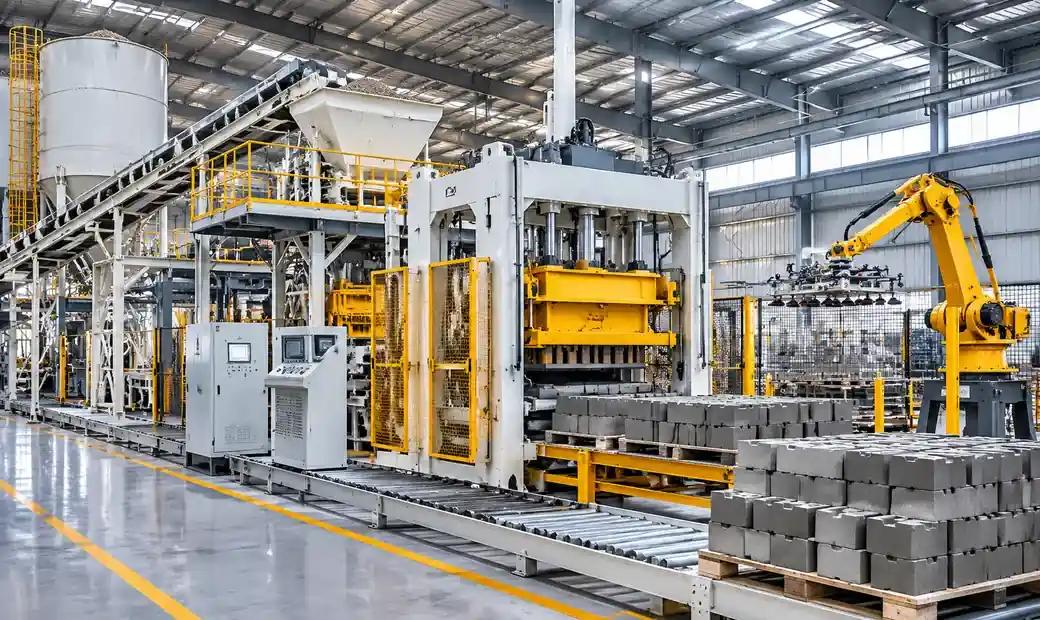
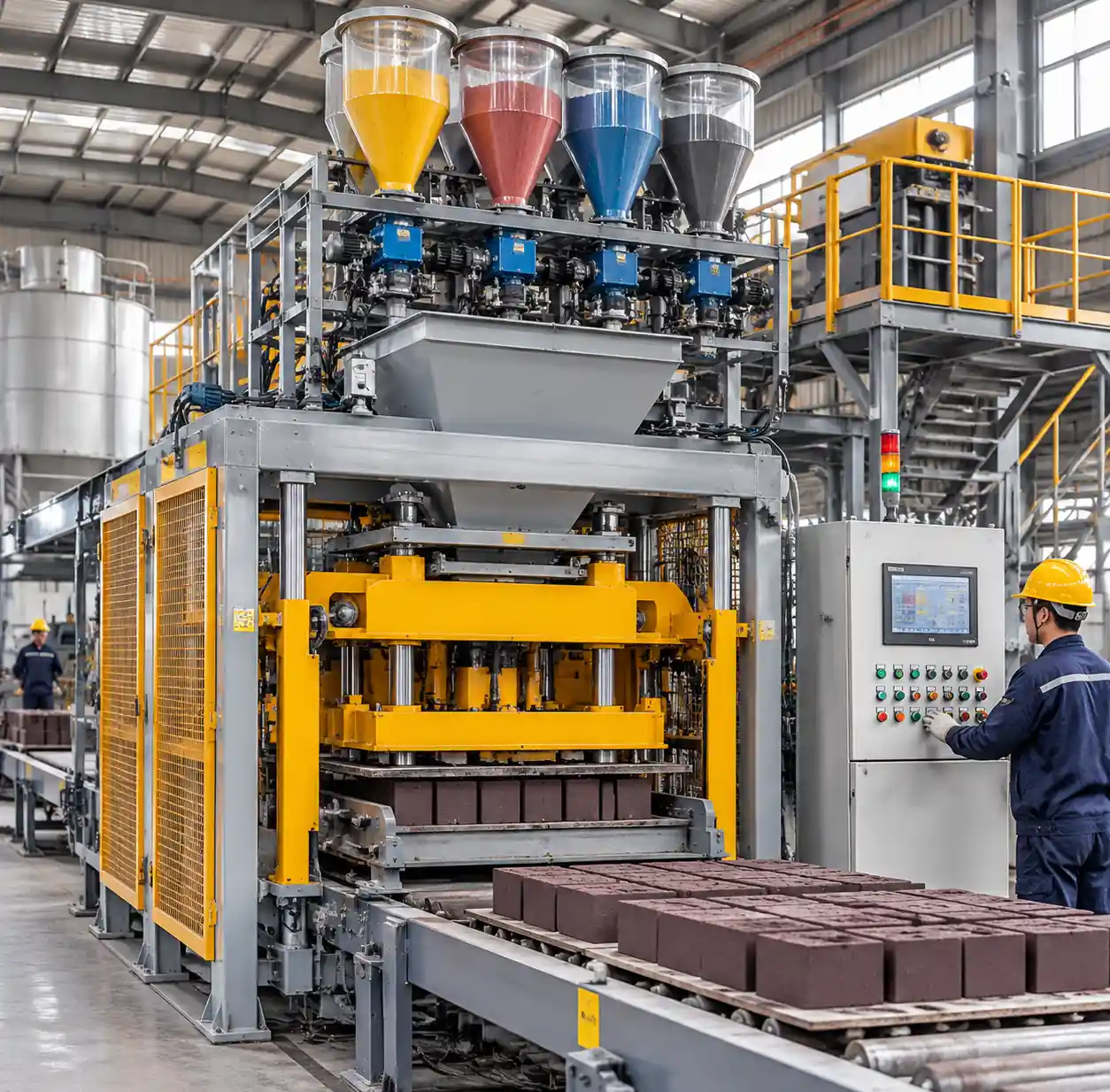
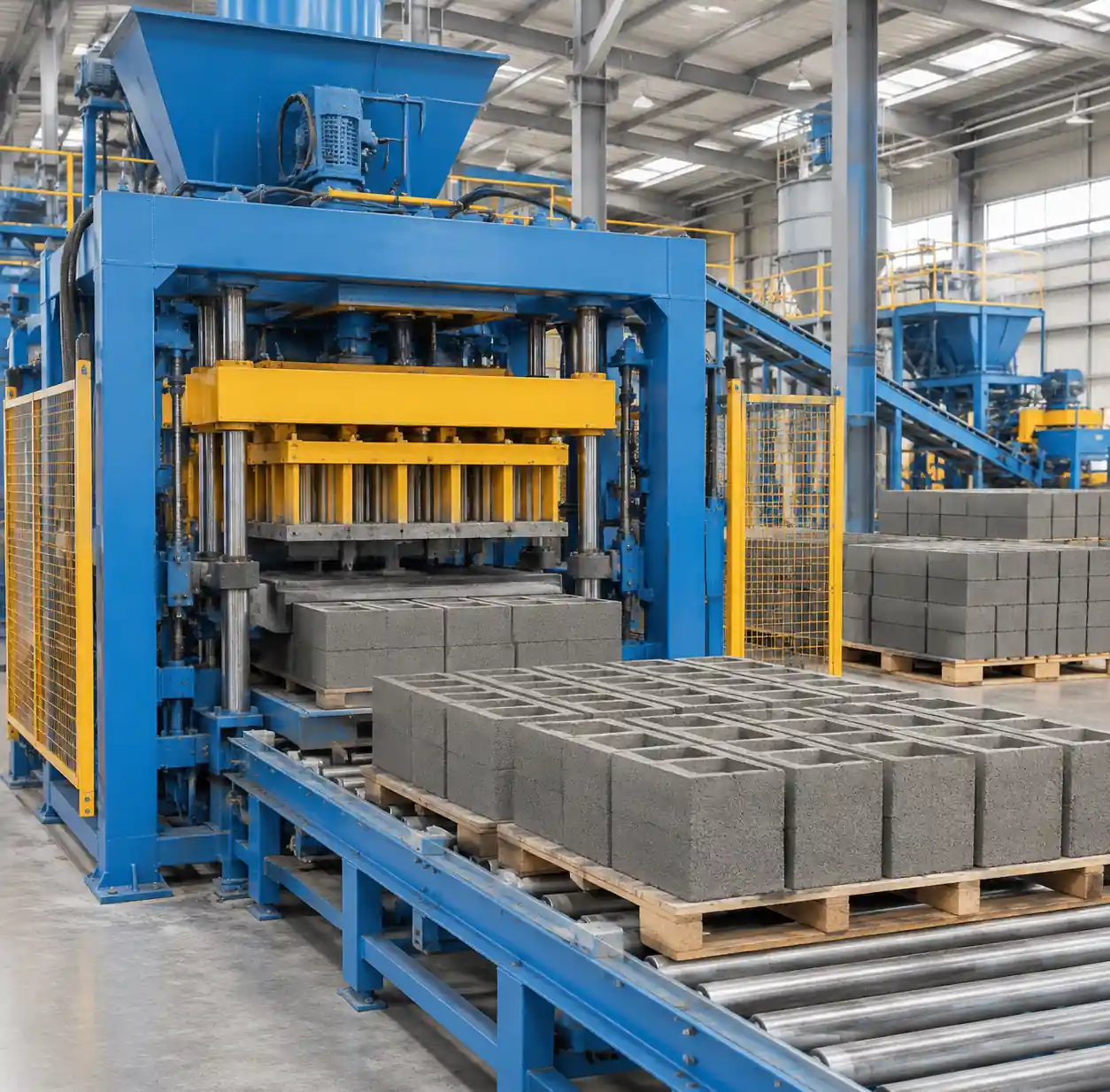
Entry Barriers: Conventional block machines require $8,000-120,000 investment and can start production within weeks. AAC plants need $800,000+ and 8-12 months for plant construction and commissioning. This 10-100x difference in capital makes conventional blocks more accessible for small businesses.
Production Scale: Manual and semi-automatic block machines produce 800-10,000 blocks per day, suitable for local markets. AAC plants must operate at 150-1,200 m³ daily (7,500-60,000 blocks) to justify autoclave investment. This minimum viable scale requires larger market territories.
Technical Complexity: Conventional block production involves mixing, molding, and curing—relatively straightforward processes. AAC manufacturing requires precise chemical control, high-pressure steam systems, and automated cutting equipment. Technical expertise and trained operators are more critical in AAC plants.
Product Performance: AAC blocks command 20-40% price premiums over conventional blocks due to superior insulation, fire resistance, and construction speed benefits. However, the conventional block market is larger and more established in most regions.
For manufacturers already operating conventional block machines, expanding into AAC represents a significant strategic shift rather than a simple capacity addition. The two production methods share few common elements beyond basic concrete knowledge.
FAQ
What is the main difference between AAC blocks and regular concrete blocks?
AAC blocks are lightweight (400-700 kg/m³) with 60-85% air content, manufactured through autoclaving, while regular concrete blocks are dense (1,800-2,200 kg/m³) and cured at ambient conditions. AAC provides better thermal insulation but requires higher manufacturing investment.
How long does it take to set up an AAC block plant?
A complete AAC production plant typically requires 8-12 months from land acquisition to commercial production. This includes 2-3 months for design and approvals, 4-6 months for civil construction, 2-3 months for equipment installation and commissioning, and 1 month for trial production.
What is the minimum capacity to make AAC production profitable?
Economically viable AAC plants start at 50,000-100,000 m³ annual capacity due to high autoclave costs. Smaller capacities cannot achieve sufficient economies of scale to compete with conventional block prices. Medium to large scale (150,000-400,000 m³/year) offers better returns.
Can I produce AAC blocks without an autoclave?
No. The autoclave is essential for AAC production. High-pressure steam curing creates the calcium silicate hydrates that give AAC its strength and dimensional stability. Non-autoclaved aerated concrete exists but has significantly lower strength and durability, limiting construction applications.
What are the main challenges in AAC block production?
Key challenges include high initial capital investment, consistent raw material quality (especially fly ash and lime), skilled operator training for chemical process control, energy costs for steam generation, and market education since AAC is less familiar than conventional blocks in some regions.
Is fly ash or sand better for AAC production?
Fly ash-based AAC has lower capital costs (no ball mill needed) and 20-25% lower operating costs. However, fly ash availability depends on proximity to coal-fired power plants. Sand-based production offers supply independence but requires additional grinding equipment and energy.
How does AAC block production compare to conventional block machines?
AAC production requires 10-100x higher capital investment ($800,000+ vs $8,000-120,000) and operates at larger minimum scale. However, AAC blocks command 20-40% price premiums and offer better profit margins at medium to large scale. The technologies serve different market segments.
Conclusão
Aerated concrete block production represents a capital-intensive but potentially lucrative manufacturing opportunity in regions with strong construction growth and demand for lightweight, insulated building materials. The complete production process—from raw material mixing through wire cutting to autoclaving—requires specialized equipment, technical expertise, and significant financial commitment.
Success in AAC manufacturing depends on achieving sufficient production scale to justify autoclave investment, securing reliable raw material sources, implementing rigorous quality control, and effectively marketing the performance advantages of AAC blocks to construction professionals. The 3-4 year payback period and strong gross margins make AAC attractive for manufacturers who can commit the necessary capital and operational focus.
If you’re evaluating AAC block production equipment for your construction materials business, Raytone Block Machinery provides complete automated production solutions including technical consultation, equipment supply, installation, and operator training. While our core expertise lies in conventional concrete block machines that offer lower entry costs and faster market entry, we can guide you toward the right production technology for your market and investment capacity.
Contact us today for detailed feasibility analysis, equipment specifications, and customized production line designs that match your business objectives and local market conditions.