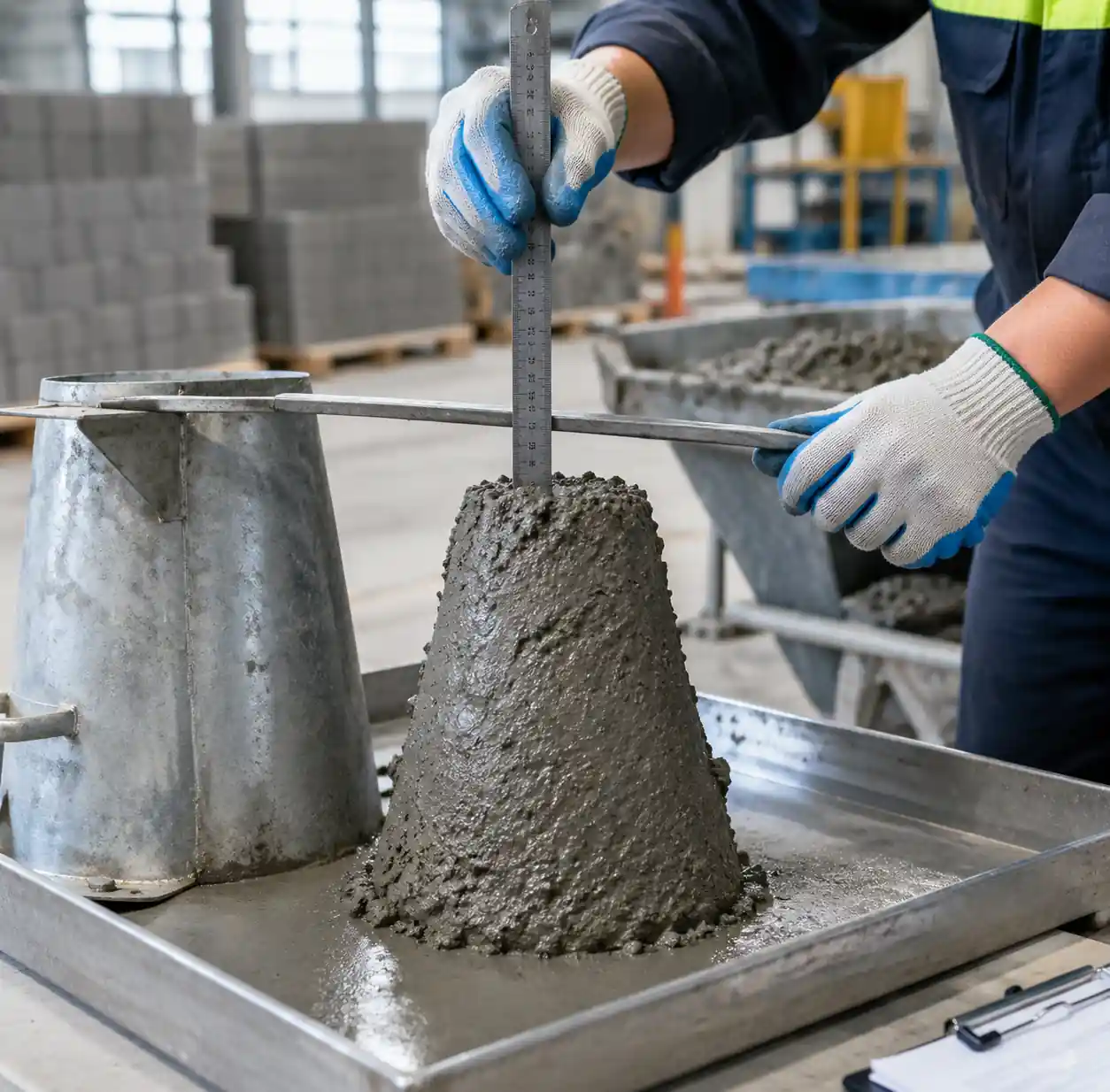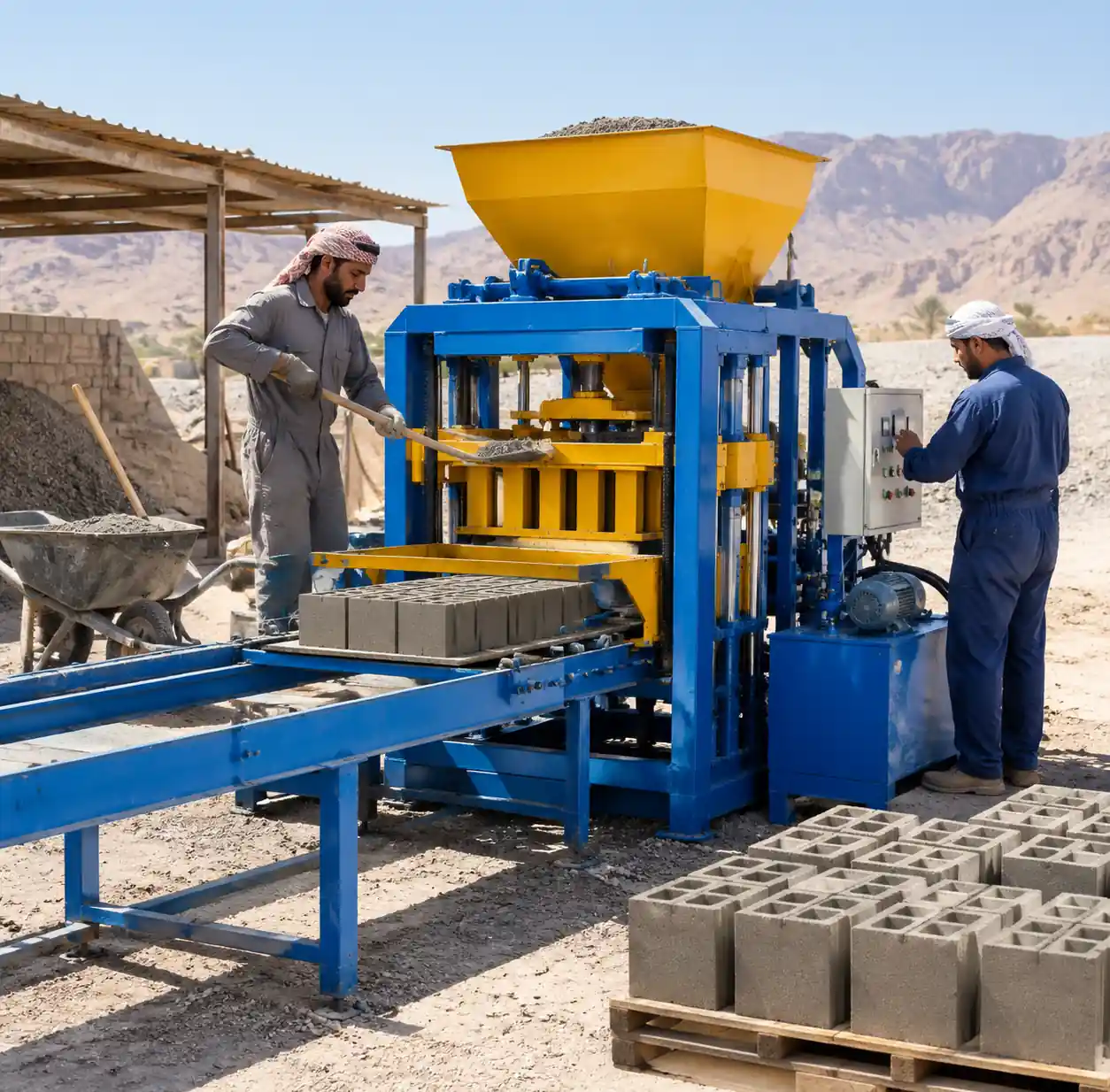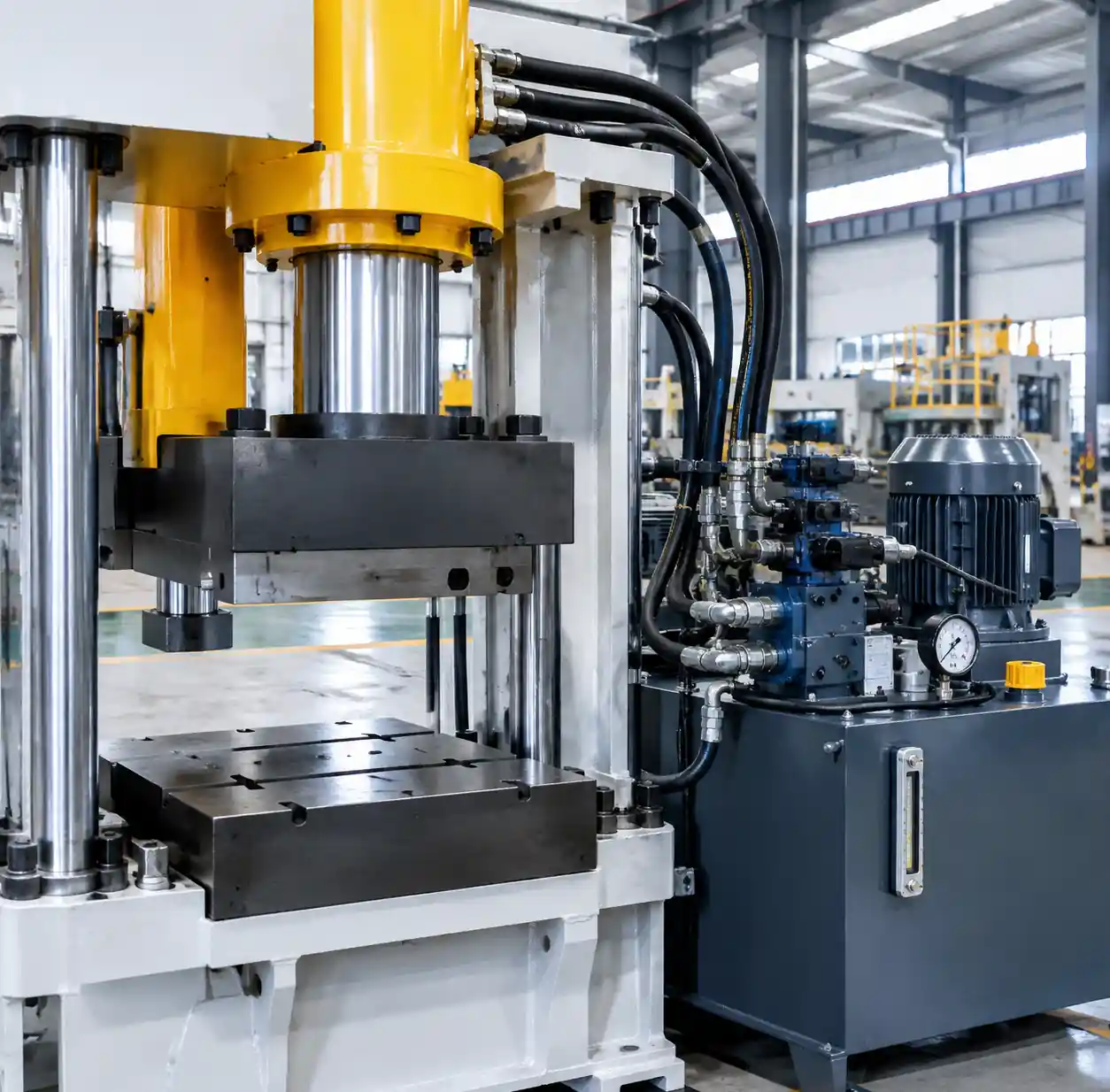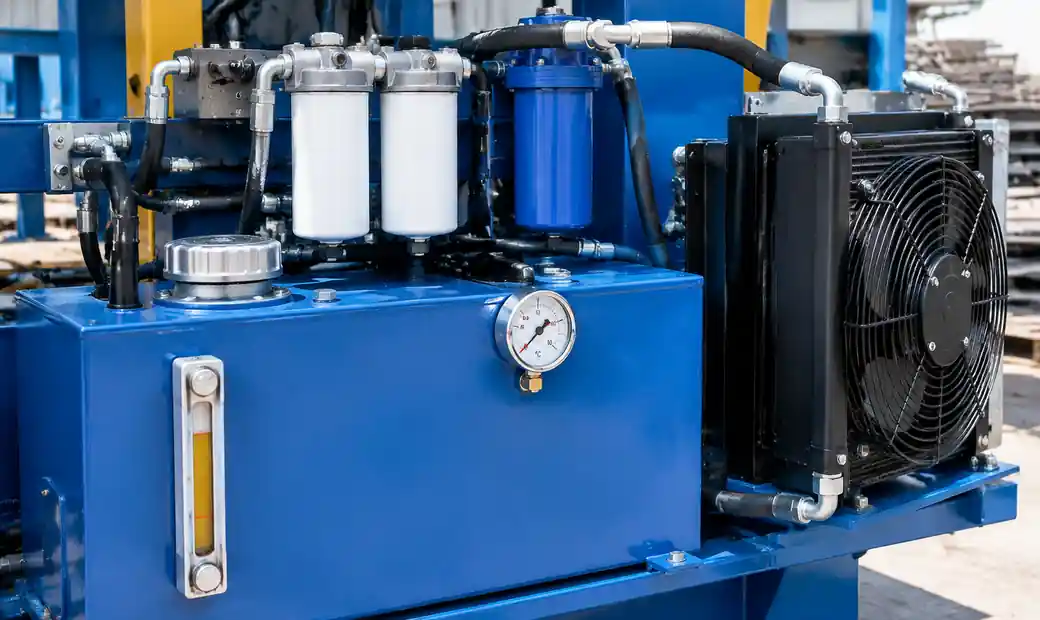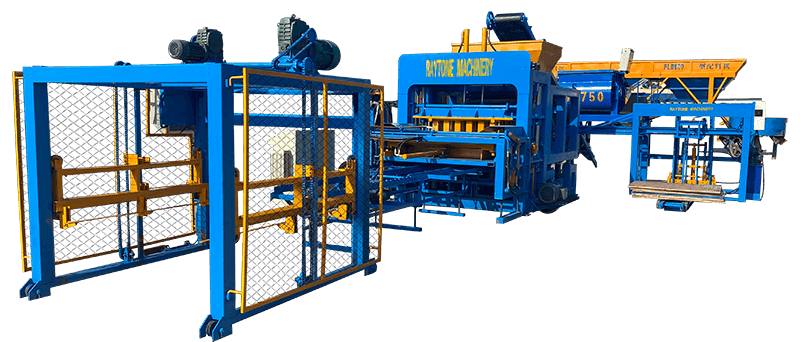






Hydraulic block machines have transformed concrete block manufacturing from labor-intensive processes into precision-controlled production. Understanding hydraulic technology separates profitable operations from those struggling with quality issues and downtime. This guide covers the hydraulic systems driving modern block production and essential maintenance protocols.
Why Hydraulic Systems Dominate Block Production
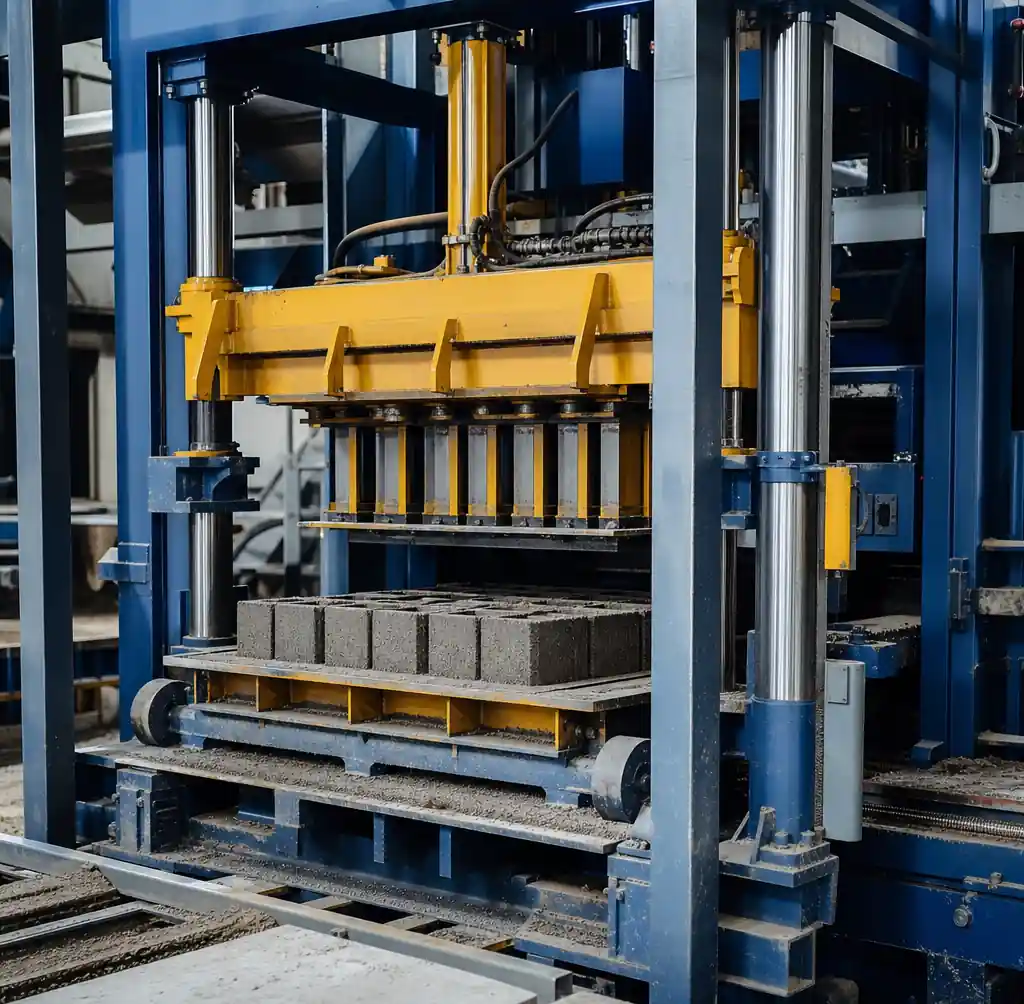
Hydraulic block machines fundamentally changed manufacturing possibilities. Traditional vibration machines create blocks with variable density. Hydraulic systems apply controlled compression forces exceeding 20 MPa, with advanced models reaching 600 tons, ensuring uniform compaction.
Hydraulic systems maintain force precision within ±2%, producing blocks where strength variation stays under 3%—critical for structural applications. A semi-automatic hydraulic block machine produces 3,000-5,000 blocks per shift with 2-3 operators, while fully automatic systems reach 15,000-30,000 blocks, reducing labor costs by 60-75%.
Core Hydraulic System Components
Hydraulic Power Unit
The power unit generates and regulates oil pressure powering block formation. Units operate at 160-210 bar, reaching 250 bar for high-density production. Components include an electric motor (15-75 kW), pump, reservoir, and control valves.
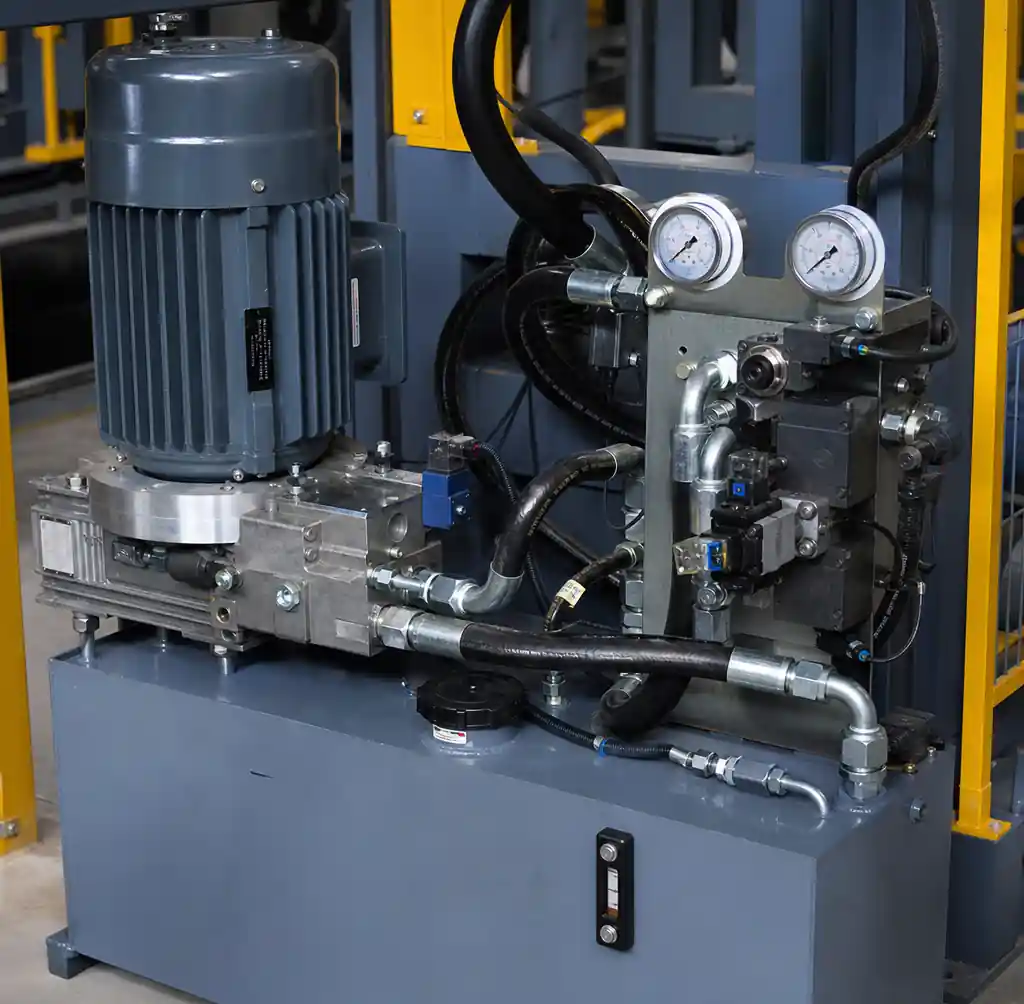
Piston pumps cost more initially but consume 12-18% less electricity than gear pumps. For 12+ hour operations, efficiency gains recover premium costs within 18-24 months. Proper reservoir capacity (3-5 times pump flow rate) prevents overheating—every 10°C above 55°C cuts oil life by 50%.
Main Pressing Cylinder
The pressing cylinder converts hydraulic pressure into compaction force. Semi-automatic machines use 250-320mm bore cylinders, while automatic systems employ 400-500mm bores generating 200-600 tons. Premium seals last 8,000-12,000 hours versus 3,000-5,000 hours for standard seals.
Control Valves
Directional control valves coordinate cylinder movements in timed sequences. Fast-response valves (under 50ms switching) enable 15-20 second cycles for semi-automatic and 8-12 seconds for automatic machines. Slower valves cost 800-1,600 blocks per shift.
Hydraulic vs Mechanical Block Machines: Technology Comparison
| Feature | Hydraulic Block Machines | Mechanical Block Machines |
|---|---|---|
| Compression Force Control | Precise pressure regulation, adjustable 160-250 bar | Fixed force based on flywheel momentum |
| Block Density Consistency | ±2% variation, 18-22 MPa strength uniformity | ±8-12% variation, 14-20 MPa range |
| Production Cycle Speed | 8-25 seconds depending on automation level | 15-35 seconds, operator-dependent |
| Energy Efficiency | 0.8-1.2 kWh per standard block | 1.5-2.3 kWh per standard block |
| Maintenance Complexity | Hydraulic oil changes, seal replacement, filter service | Flywheel bearing service, clutch adjustment, linkage wear |
| Initial Investment | $15,000-$180,000 (manual to fully automatic) | $8,000-$45,000 (comparable capacity) |
| Block Quality Range | Structural blocks 18-25 MPa achievable | Typically limited to 12-18 MPa blocks |
| Mold Changeover Time | 15-30 minutes with quick-change systems | 45-90 minutes, manual adjustment intensive |
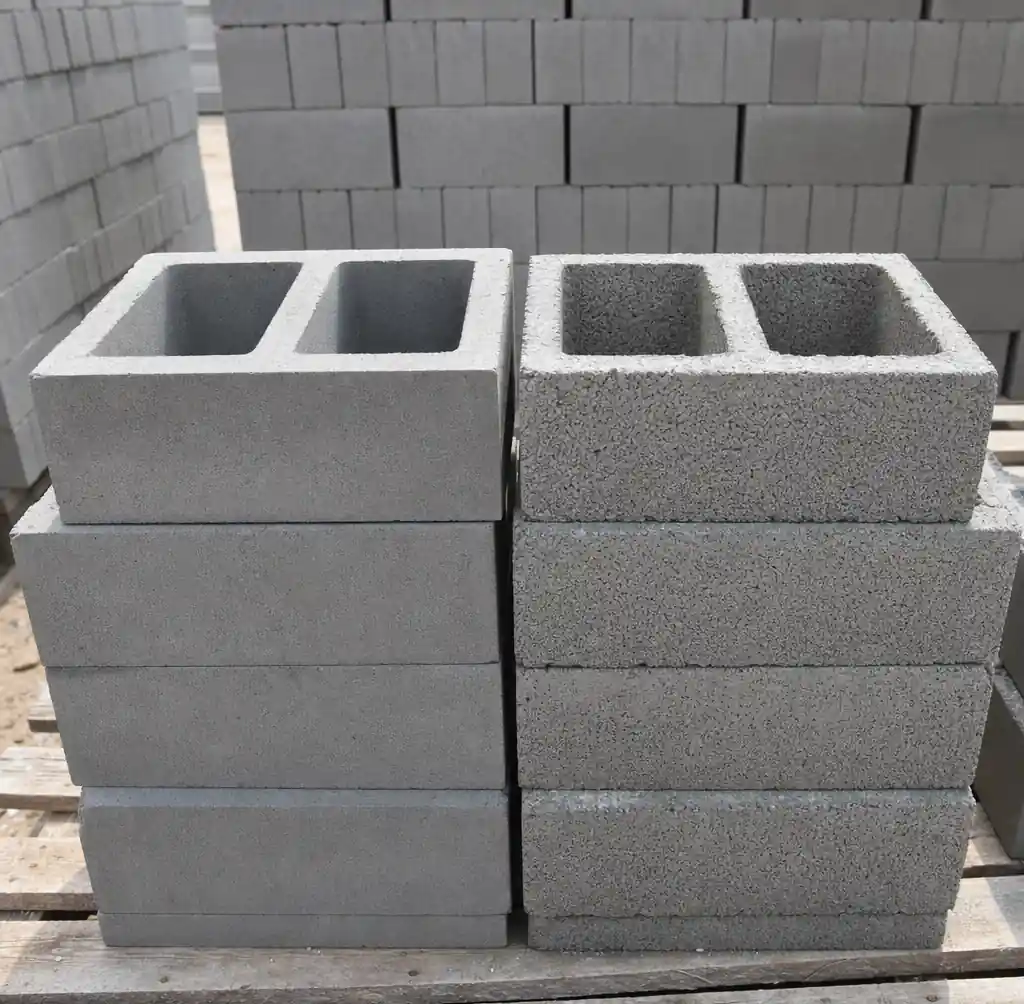
The force control difference fundamentally changes what products you can manufacture profitably. Hydraulic machines produce interlocking blocks, decorative pavers with fine surface detail, and high-density structural blocks—products where mechanical machines either fail quality requirements or require excessive manual finishing.
Critical Hydraulic Maintenance
Hydraulic Oil Management
Oil quality determines 70-80% of hydraulic system reliability. Check oil level before every shift—low oil causes pump cavitation and accelerated wear. Oil should appear translucent amber; cloudy indicates oxidation, milky means water contamination requiring immediate replacement.
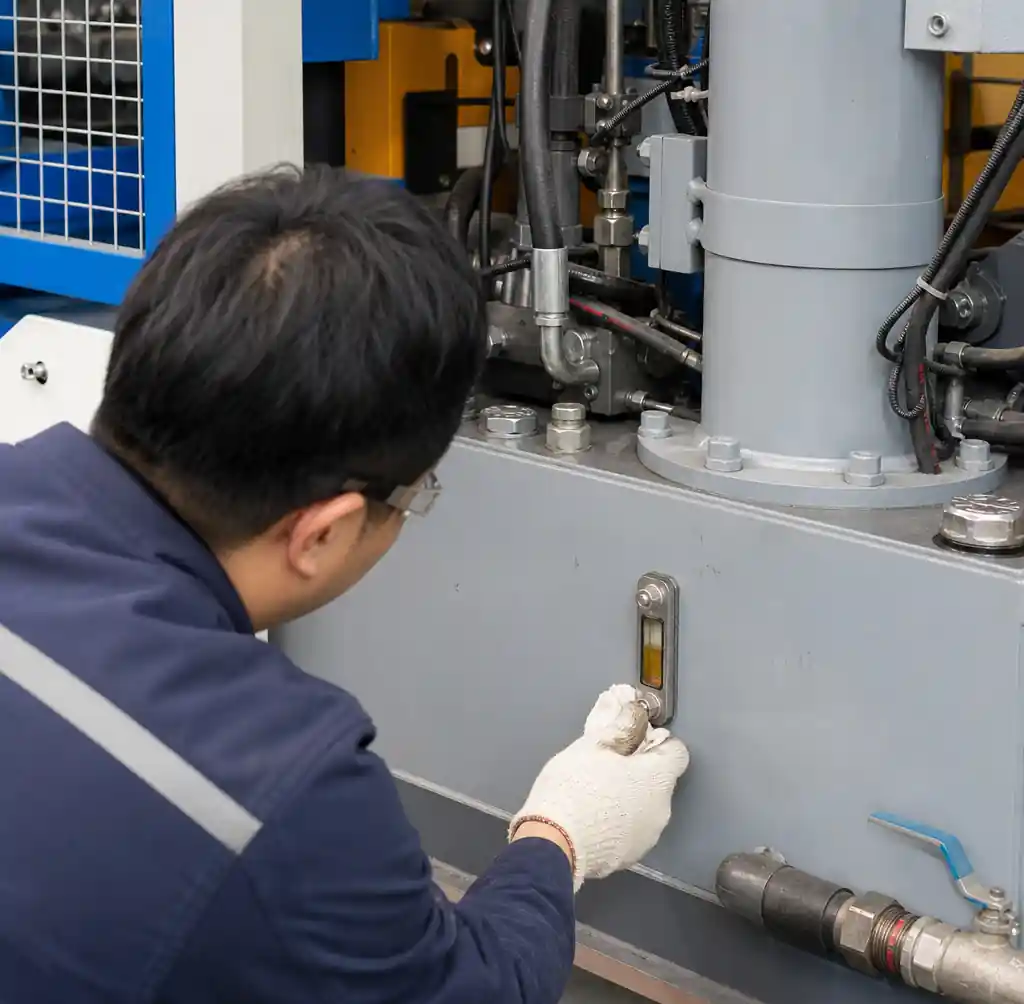
Premium ISO VG 46 or VG 68 anti-wear hydraulic oils last 2,000-2,500 hours in well-maintained systems. Economy oils require changes every 1,200-1,500 hours. Monitor temperature—oil consistently above 60°C indicates system problems. Operation above 70°C cuts oil life by 50-60%.
Filter Maintenance
Hydraulic filters (10-micron rating) remove abrasive particles causing 90% of component wear. Replace filters every 500 hours minimum, more frequently in dusty environments. A $45 filter protects $8,000-$15,000 in hydraulic components. Replace when differential pressure exceeds 15 PSI.
Daily Operational Checks
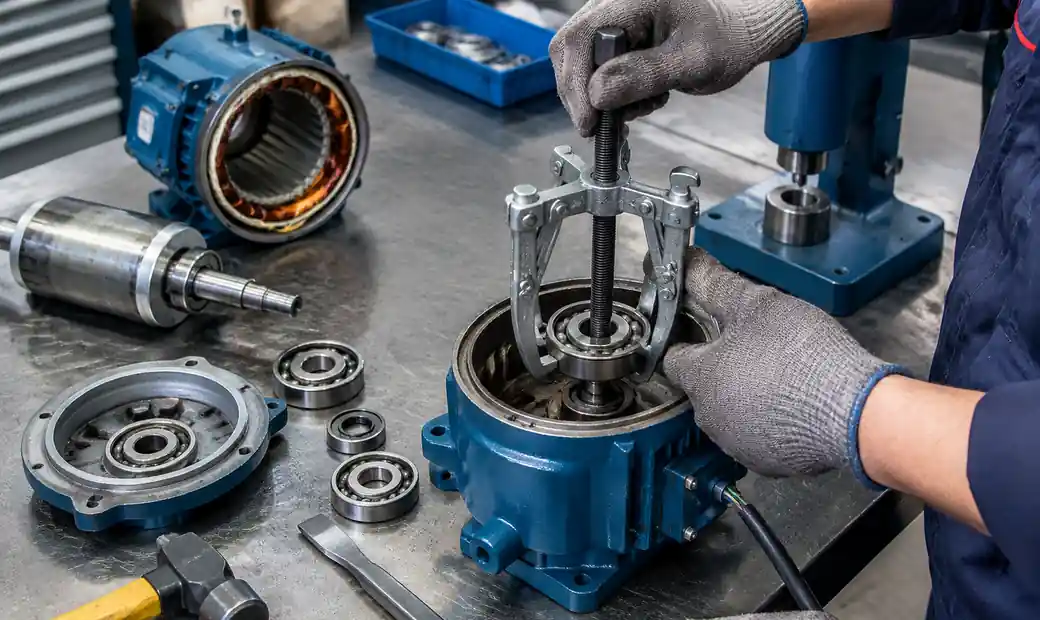
Visual inspection: Check for oil leaks around cylinders, valves, and hose connections. Small seepage progresses rapidly.
Pressure monitoring: System pressure should reach 160-200 bar within 2-3 seconds and hold steady. Fluctuations exceeding ±5% signal developing problems.
Sound baseline: Whining indicates pump cavitation. Knocking suggests pressure spikes. Catch these audibly before failure.
Temperature check: Pump housing exceeding 65-70°C signals inadequate cooling or internal leakage.
Performance Optimization
Pressure Settings by Block Type
Standard hollow blocks: 160-180 bar. Solid blocks and pavers: 180-200 bar. High-density structural blocks: 200-220 bar. Test at ±10 bar increments to find optimal pressure—higher than needed accelerates wear, insufficient pressure produces weak blocks.
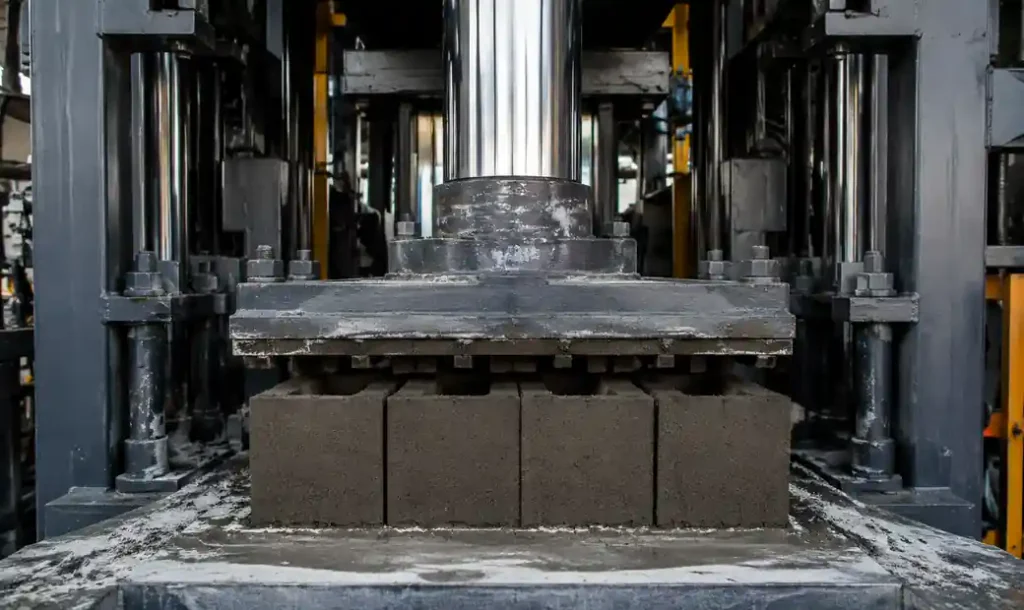
Oil Specification
ISO VG 46 suits 15-35°C climates. Hot environments (>35°C) need VG 68. Cold climates (<10°C) require VG 32. Anti-wear additives reduce wear by 80-90% and extend component life 200-300% despite costing 30-50% more.
Proactive Seal Replacement
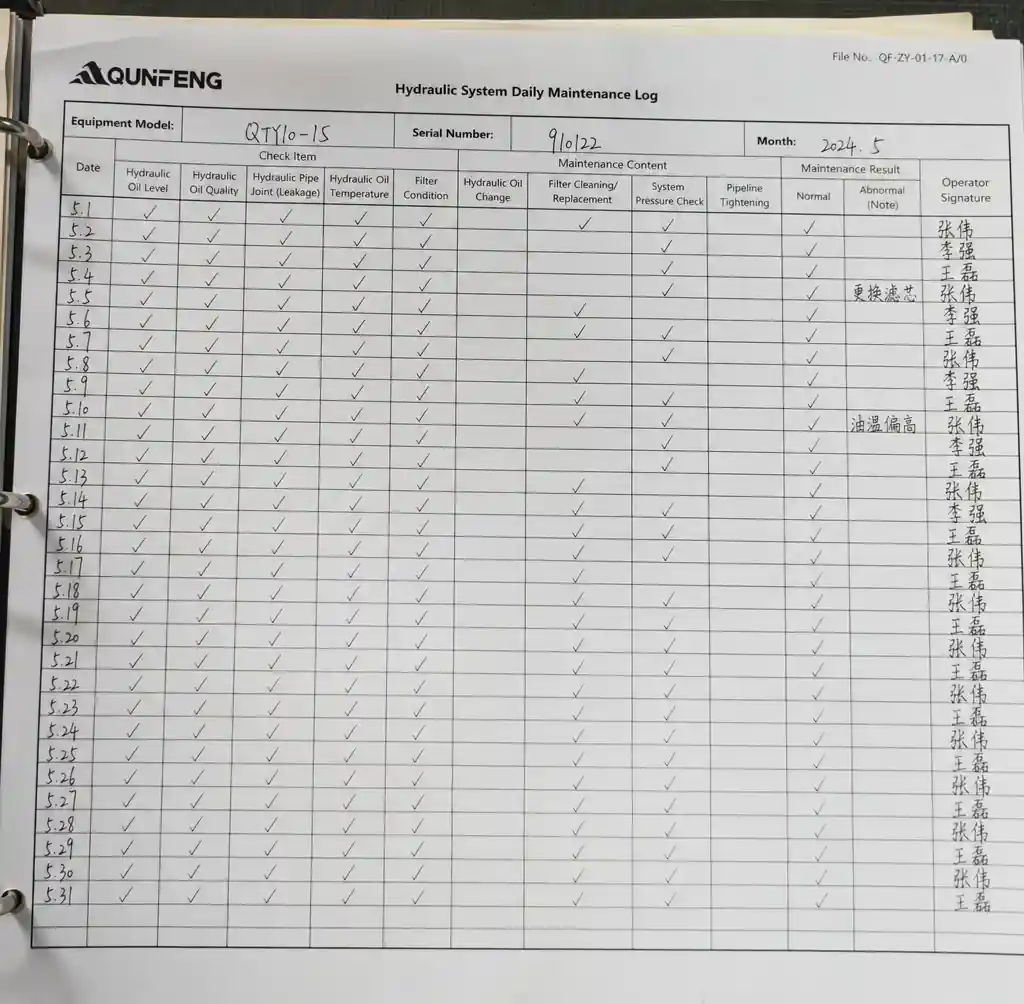
Replace main cylinder seals at 8,000-10,000 hours (automatic) or 6,000-8,000 hours (semi-automatic). Use OEM quality seals—aftermarket alternatives fail at 40-60% of OEM lifespan, and labor costs far exceed material savings.
Maintenance Schedule by Machine Type
| Maintenance Task | Fully Automatic | Semi-Automatic | Manual Hydraulic | Critical Warning Signs |
|---|---|---|---|---|
| Hydraulic Oil Level Check | Daily, pre-shift | Daily, pre-shift | Daily, pre-shift | Low level, foaming, milky appearance |
| Oil Temperature Monitoring | Every shift | Daily check | Weekly | Consistently >60°C, sudden increases |
| Complete Oil Change | Every 2,000 hrs | Every 1,500 hrs | Every 1,200 hrs | Dark color, burnt smell, cloudiness |
| Hydraulic Filter Replacement | Every 500 hrs | Every 400 hrs | Every 300 hrs | Differential pressure >15 PSI |
| Main Cylinder Seals | 8,000-10,000 hrs | 6,000-8,000 hrs | 5,000-7,000 hrs | Visible leaking, pressure loss >5% |
| Valve Manifold Inspection | Every 1,000 hrs | Every 800 hrs | Every 600 hrs | Slow response, erratic movements |
| Pressure Relief Valve Test | Every 2,000 hrs | Every 1,500 hrs | Every 1,200 hrs | System overpressure, inability to reach pressure |
| Accumulator Pre-charge Check | Every 3,000 hrs | Every 2,500 hrs | Every 2,000 hrs | Pressure fluctuations, slow response |
Troubleshooting Common Hydraulic Problems
Insufficient Pressing Force
Check system pressure during compression—it should reach and hold specification. Causes include: pump wear, relief valve failure, cylinder seal leakage, or control valve wear. Test pressure at pump outlet versus cylinder to locate loss point.
Slow Cycle Times
Cycles extending 20-30% beyond specification indicate: worn pump, clogged filters, undersized hoses, valve contamination, or cylinder friction. Monitor cycle time daily and investigate 10% increases. Check filter differential pressure and oil cleanliness.
Excessive Heat
Systems operating above 65°C waste energy as heat. Causes: internal leakage, unnecessarily high pressure, inadequate cooling, or contaminated oil. High-capacity machines running 12+ hours need oil coolers with fans or heat exchangers.
Comparing Operational Costs: Hydraulic vs Other Technologies
| Cost Factor | Hydraulic Block Machines | Mechanical Block Machines | Vibration-Only Machines |
|---|---|---|---|
| Energy per Block | $0.04-$0.06 (at $0.12/kWh) | $0.07-$0.11 | $0.03-$0.05 |
| Maintenance Costs (Annual) | $3,500-$8,000 | $2,800-$6,500 | $1,200-$3,000 |
| Operator Labor per 1,000 Blocks | $15-$35 | $45-$85 | $85-$150 |
| Consumables (Seals, Filters, Oil) | $2,200-$4,500/year | $1,500-$3,000/year | $600-$1,200/year |
| Average Downtime | 2-4 days/year | 4-7 days/year | 3-5 days/year |
| Block Quality Consistency | 95-98% within spec | 88-93% within spec | 75-85% within spec |
| Equipment Lifespan | 15-20 years with maintenance | 12-18 years | 8-12 years |
While hydraulic systems carry higher maintenance costs, total production cost per block runs 18-25% lower than mechanical systems and 40-55% lower than manual vibration methods when factoring labor efficiency, quality consistency, and production speed. For operations producing 5,000+ blocks daily, hydraulic technology delivers ROI within 8-18 months despite higher initial investment.
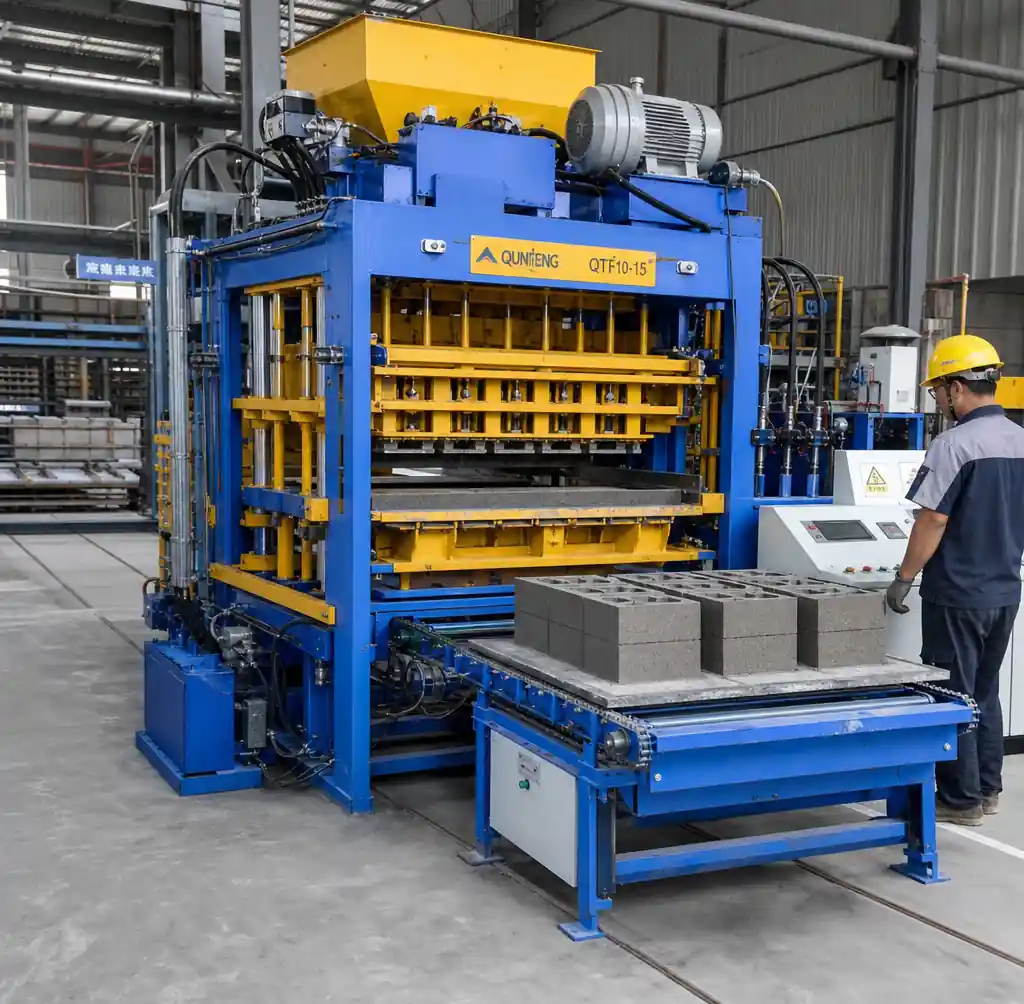
Integration with Supporting Equipment
Hydraulic block machines perform optimally with properly matched supporting equipment. Concrete mixer capacity should supply 20-30% more material than maximum machine consumption. For semi-automatic machines consuming 1.2-1.5 m³/hour, a JS500 or JS750 mixer provides adequate capacity.
Computer-controlled batching systems measure cement, aggregates, and water with ±2% accuracy—critical for structural blocks. Manual batching introduces 8-15% variation, negating hydraulic precision advantages.
Frequently Asked Questions
How much does hydraulic oil replacement cost?
Semi-automatic machines hold 150-250 liters requiring $180-$400 per change for quality oil. Fully automatic systems hold 400-600 liters costing $500-$900. Including filters and labor, expect $250-$1,200 per service. Annual maintenance runs $500-$2,400 for typical operations.
Can I use cheaper hydraulic oil?
Economy oils cause component wear 3-5x higher than quality oils. The $150-$300 saved per change leads to premature pump, cylinder, and valve replacement costing $5,000-$15,000. Quality hydraulic oil is essential performance insurance.
What causes hydraulic oil to turn black quickly?
Rapid darkening within 200-400 hours indicates contamination or excessive heat. Check for: inadequate air filtration, worn cylinder seals allowing concrete dust in, oil operating above 70°C, or incompatible oils mixed. Correct the contamination source rather than just changing oil.
How do I know if hydraulic pump needs replacement?
Pump wear shows as: inability to reach specified pressure, excessive noise, higher operating temperature, oil contamination with metal particles, and increased power consumption. Before replacing pumps ($2,500-$8,000), verify relief valve settings and check for cylinder seal leakage.
What’s the difference between hydraulic block machine types?
Manual hydraulic machines require operators to feed material and remove blocks but use hydraulic compression. Semi-automatic machines automate compression and mold cycles while requiring manual loading and removal. Fully automatic machines automate the entire process—operators supervise.
How long do hydraulic cylinders last?
Main cylinders operate 8,000-12,000 hours before seal replacement. Complete rebuilds including rod replating extend life another 8,000-12,000 hours. Total service life of 20,000-30,000 hours is achievable. Contaminated oil or improper pressure reduces life by 40-60%.
Is special training required for maintenance?
Basic maintenance—oil checks, filter changes, inspections—requires minimal training provided during installation. Advanced troubleshooting benefits from hydraulic system training. Most manufacturers offer 2-3 day installation and commissioning training covering essential procedures.
Can I convert my mechanical machine to hydraulic?
Conversion requires replacing pressing mechanism, power system, and controls—essentially building a new machine. Conversion costs 60-80% of new hydraulic machine prices. Most operators find purpose-built hydraulic machines more cost-effective.
Conclusão
Hydraulic technology delivers the force control and consistency modern construction demands. The maintenance protocols outlined here prevent 70-80% of hydraulic failures. Daily oil checks, scheduled filter changes, temperature monitoring, and proactive seal replacement keep systems operating at design capacity for 15-20 years.
Operations implementing these practices cut unplanned downtime by 75% while extending equipment life 40-60%. Whether operating semi-automatic systems or fully automatic plants, hydraulic reliability determines profitability. Invest in proper maintenance, use quality consumables, and your hydraulic block machine delivers consistent production for decades.
Contact our technical team for maintenance protocol customization and genuine parts that protect your investment.