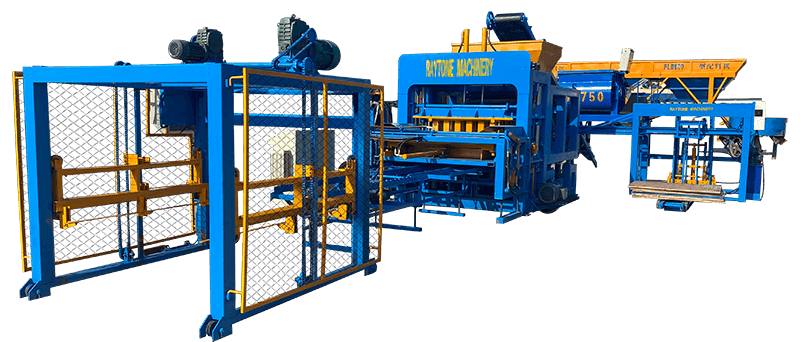






The Middle East construction sector is experiencing explosive growth, with over $2.5 trillion in ongoing projects across the GCC alone. Yet choosing the wrong block production equipment in this region costs more than anywhere else on earth. Temperature extremes reaching 50°C, salt-contaminated materials, and dust storms that shut down operations for days create challenges that eliminate machines working perfectly in temperate climates. This guide reveals which equipment survives Middle East conditions and delivers consistent quality despite environmental extremes that would destroy standard machines within months.
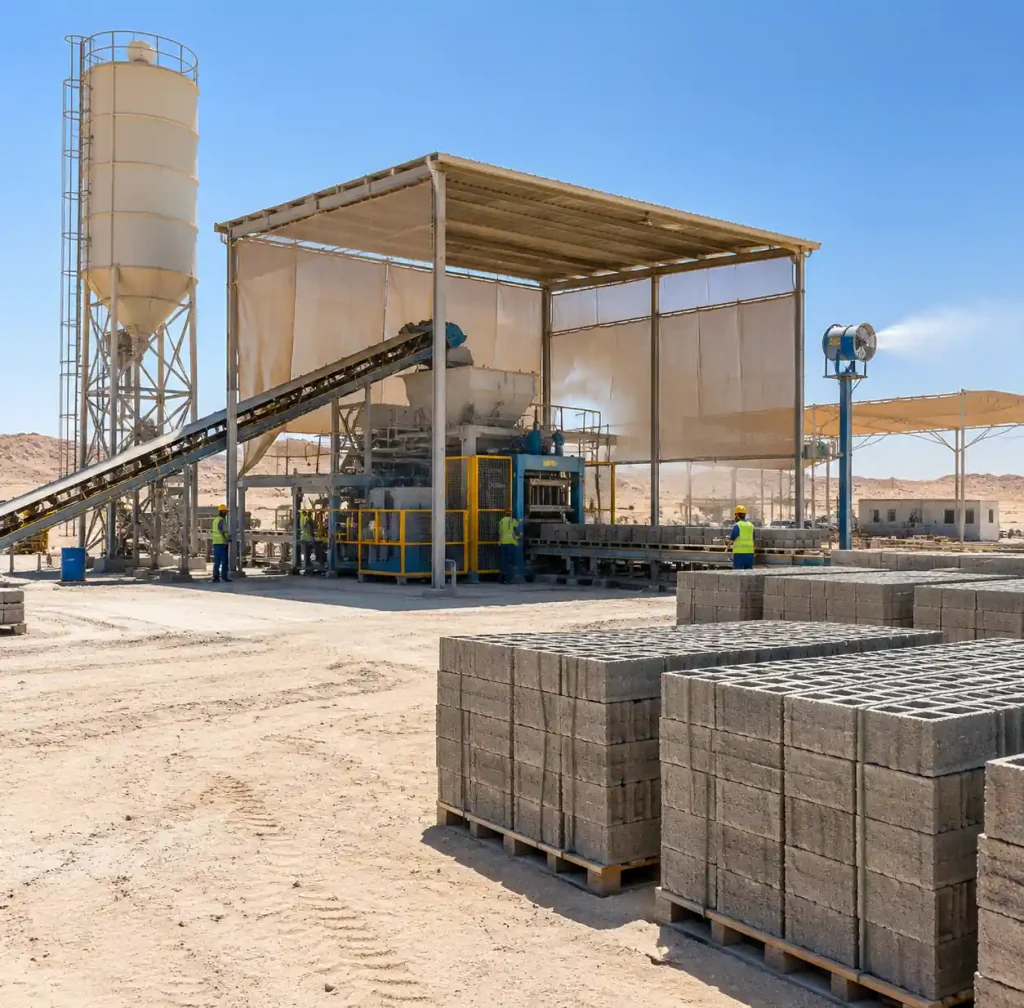
Why Middle East Conditions Demand Specialized Equipment
Construction projects across Saudi Arabia, UAE, Qatar, and Kuwait face material challenges unknown in Europe or North America. Salt contamination affects both coastal regions and inland areas where evaporation concentrates minerals in groundwater. Local aggregates frequently contain high chloride and sulfate levels that accelerate equipment corrosion. Sand quality varies dramatically—dune sands with excessive fines create mixing problems while poorly graded aggregates affect block strength.
The extreme climate compounds these material issues. Temperatures exceeding 45°C for months reduce hydraulic fluid viscosity, affecting compression force consistency. Dust storms carrying fine particles infiltrate electrical systems, causing shorts and controller failures. Solar radiation intensity requires covered production areas, adding infrastructure costs that surprise buyers budgeting only for equipment.
Water scarcity creates operational constraints absent in other markets. Block curing requires significant water, yet availability restrictions in many Middle East locations force producers to implement recycling systems costing $5,000-$12,000 beyond basic equipment. These regional factors explain why machines dominating European or Asian markets often fail within 6-12 months when deployed to Riyadh or Abu Dhabi without climate-specific modifications.
Equipment Types for Desert Climate Production
Hydraulic Block Machines: Desert-Proven Technology
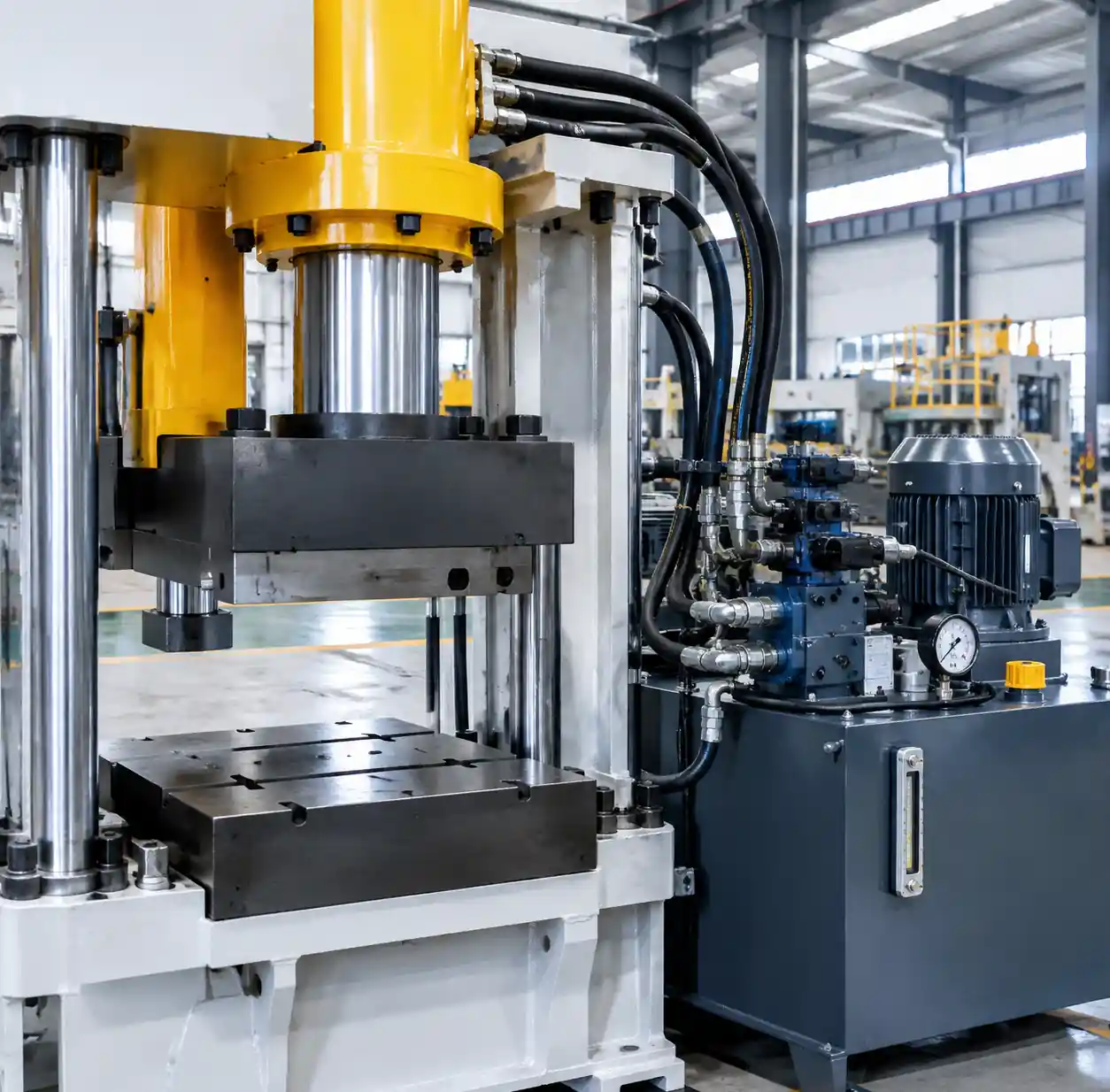
Hydraulic systems dominate Middle East block production because consistent pressure compensates for temperature-induced material variations. When ambient temperatures swing 20°C between morning and afternoon shifts, hydraulic machines maintain uniform compression force while mechanical systems produce blocks with density variations exceeding acceptable tolerances.
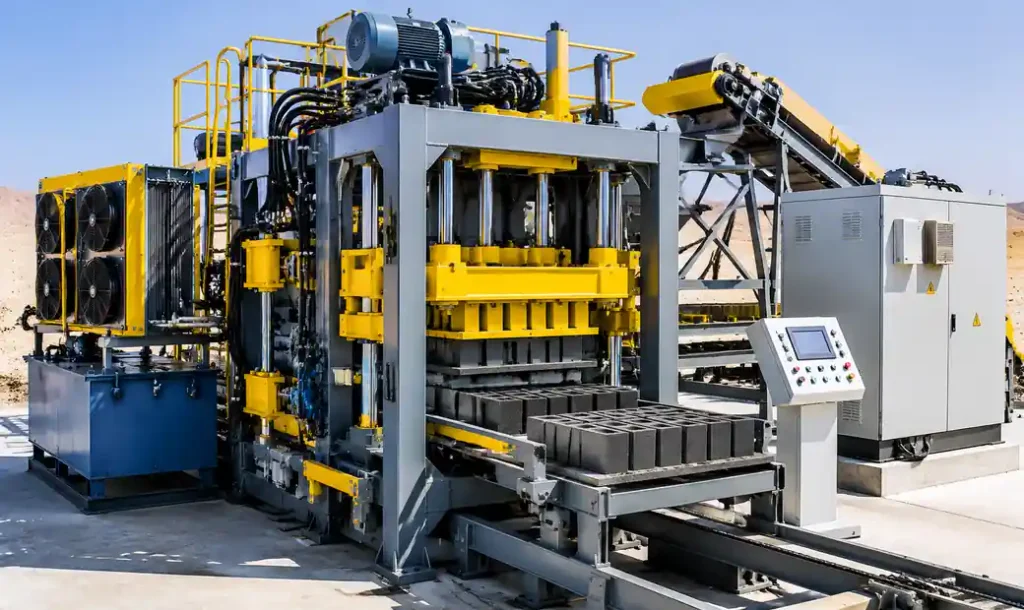
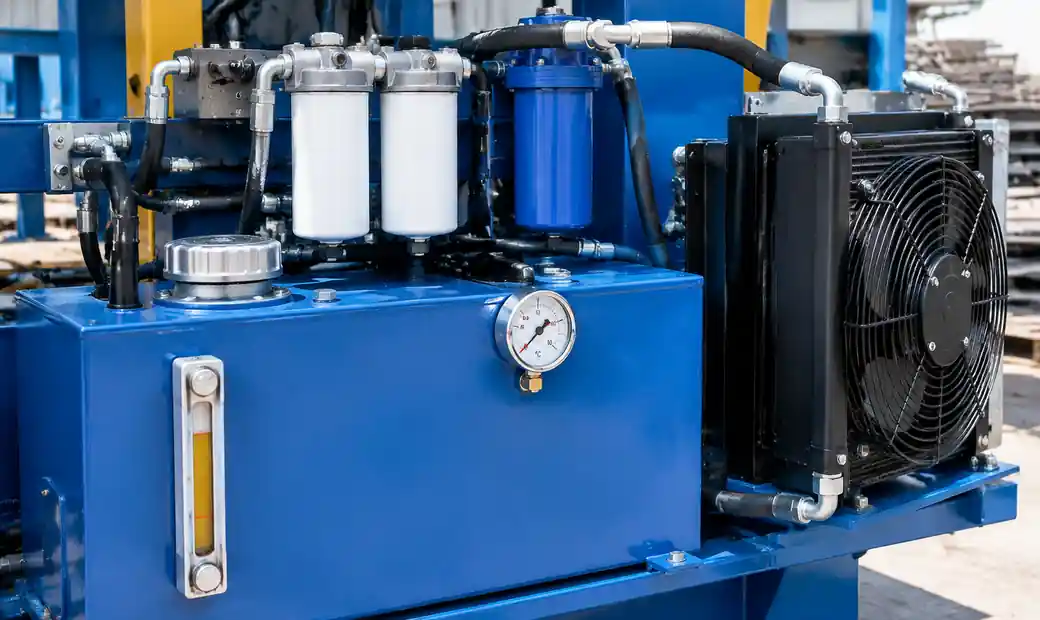
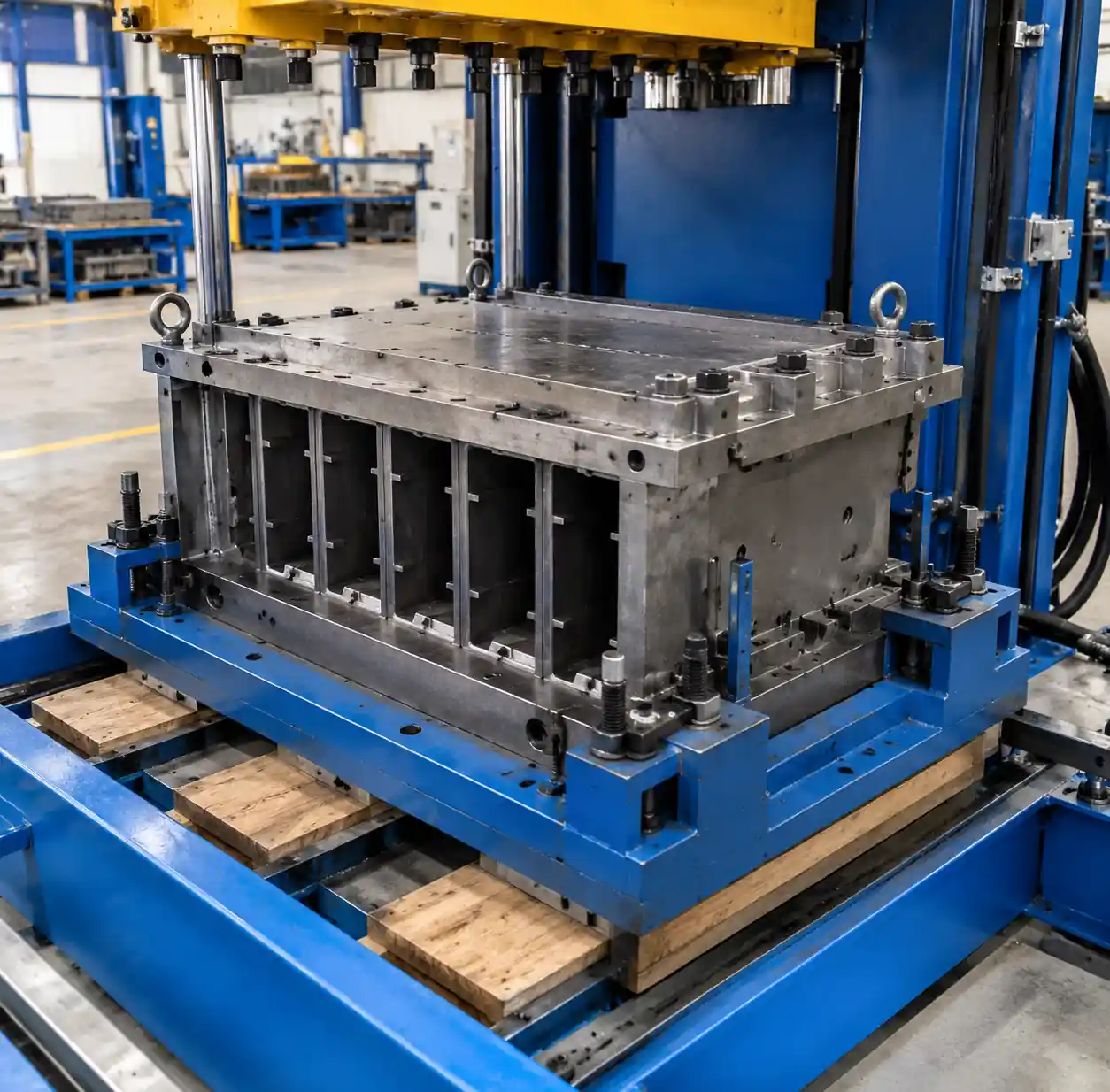
Modern hydraulic machines operating in Gulf states feature upgraded components specifically engineered for extreme heat. Oil coolers maintain hydraulic fluid within optimal viscosity ranges despite external temperatures. Dust-sealed cylinders prevent contamination that causes seal failures—the leading breakdown in desert environments. These modifications cost 15-20% more than standard specifications but reduce downtime by 60-75% over the machine’s operational life.
Production capacity ranges from 800 blocks per 8-hour shift for semi-automatic models to 46,000 blocks for fully automatic plants. The critical advantage appears in quality consistency: hydraulic machines produce blocks testing within ±3% of target compressive strength regardless of ambient conditions, while mechanical alternatives show ±12% variation when temperatures fluctuate.
| Equipment Feature | Standard Machines | Middle East Adapted Machines |
|---|---|---|
| Hydraulic Oil System | Standard viscosity oil | High-temperature synthetic oil with active cooling |
| Dust Protection | Basic IP54 sealing | IP65+ with positive pressure enclosures |
| Electrical Components | Standard industrial grade | Conformal-coated boards, sealed connectors |
| Vibration System | Air-cooled motors | Liquid-cooled with backup redundancy |
| Manuseamento de materiais | Open hoppers | Enclosed feeding with dust suppression |
| Water Management | Fresh water continuous | Recycling system with mineral removal |
| PLC Controllers | Standard operating range | Extended temperature range (-10°C to 55°C) |
| Maintenance Intervals | Every 2,000 hours | Every 1,200-1,500 hours with climate factors |
Automatic vs Semi-Automatic: Capacity Trade-offs
Fully automatic machines require three-phase 380V power with voltage stability within ±5%. This eliminates them from many Middle East locations experiencing frequent voltage fluctuations. Semi-automatic machines operating on single-phase 220V offer more practical deployment, though production capacity drops to 1,500-2,500 blocks per shift versus 15,000-46,000 for automatic systems.
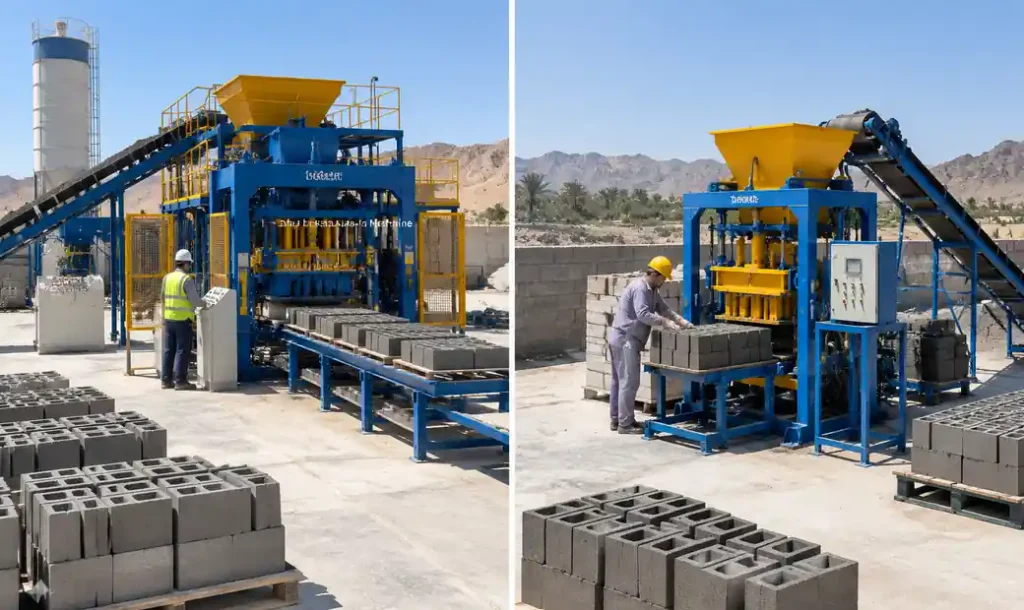
The decision point lies in infrastructure reality rather than production goals. Qatar, UAE, and Kuwait’s major industrial zones provide stable three-phase power making automatic machines viable. Saudi Arabia’s secondary cities and rural project sites experience voltage swings requiring backup generators costing $12,000-$22,000 for 75-100 kVA capacity. This infrastructure investment frequently exceeds the price difference between semi-automatic and automatic machines, changing the ROI calculation fundamentally.
Contractors supplying mega-projects like NEOM’s THE LINE construction, where daily concrete demand exceeds 20,000 cubic meters, require fully automatic systems despite power infrastructure costs. Smaller operations serving regional housing developments achieve better returns with semi-automatic equipment avoiding three-phase power complications.
Critical Climate Adaptations for Middle East Operations
Heat Management Systems
Standard block machines operate reliably up to 35°C ambient temperature. Middle East summer conditions regularly exceed this by 15-20°C, creating failure modes manufacturers never encounter in European testing facilities. Hydraulic oil temperatures rise beyond optimal ranges, reducing pressure consistency. Electric motors overheat despite meeting nameplate specifications. PLC controllers shut down when internal temperatures trigger thermal protection circuits.
Climate-adapted machines incorporate several critical modifications. Hydraulic systems include dedicated oil coolers maintaining fluid temperature within 45-65°C regardless of ambient conditions. Motor housings feature enhanced ventilation or liquid cooling for continuous operation at 50°C ambient. PLC enclosures install cooling units maintaining 35-40°C internally even when external temperatures reach 55°C.
These adaptations prevent the production stoppages that cost Middle East manufacturers $1,200-$2,800 daily in lost output plus worker wages for idle crews. The equipment modifications add $8,000-$15,000 to initial purchase costs but recover this investment within 8-12 months through eliminated downtime.
Dust Control and Filtration
Dust generation during block production combines with environmental dust from surrounding desert areas, creating contamination levels that destroy standard equipment within months. Fine particles infiltrate through standard electrical enclosures, causing controller failures. Dust accumulation on vibration motors creates imbalance leading to bearing failures. Hydraulic cylinder dust contamination scores seals, causing fluid leaks that shut down production until replacement parts arrive—often 4-6 weeks for remote locations.
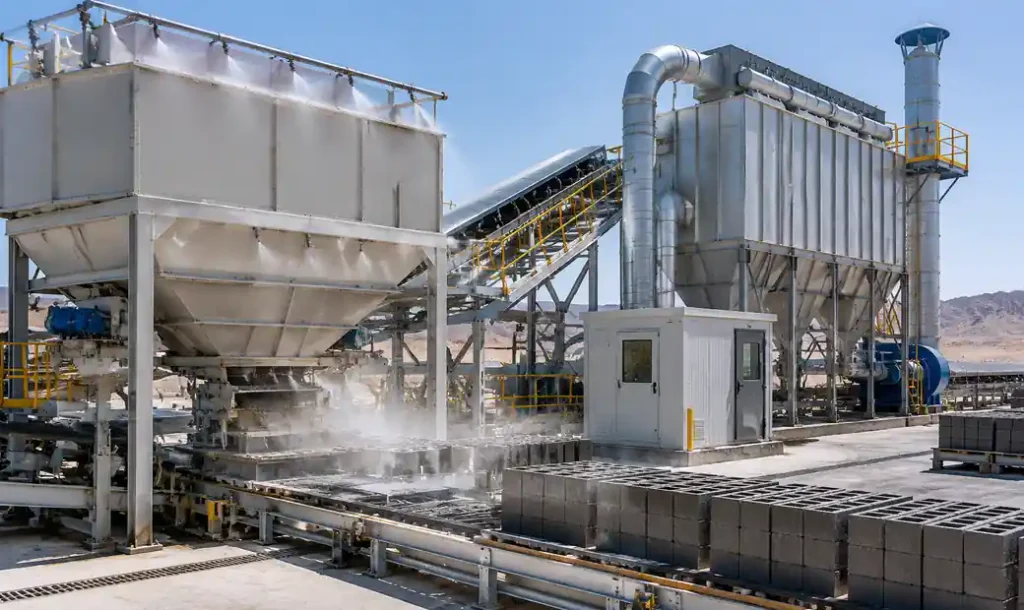
Effective dust control requires integrated systems across material handling, production, and curing stages. Enclosed material feeding with spray nozzles at transfer points reduces airborne particles by 70-85% versus open hoppers. Positive pressure enclosures for electrical cabinets prevent dust infiltration through filtered air supply. Vibration motors in sealed housings with nitrogen purging eliminate the leading failure mode in desert environments.
Modern facilities serving Gulf construction markets implement complete dust management systems including:
- Enclosed raw material silos with level sensors preventing overflow dust
- Spray bars at conveyor transfer points activated by production cycle sensors
- Sealed motor enclosures with pressure relief valves
- Daily compressed air cleaning procedures for accessible surfaces
- HEPA filtration on air supplies to control enclosures
This comprehensive approach costs $12,000-$25,000 for mid-capacity installations but reduces maintenance costs by 40-60% while improving block surface quality by eliminating dust contamination during curing.
Equipment Selection by Production Scale
Small-Scale Operations (500-2,000 blocks/day)
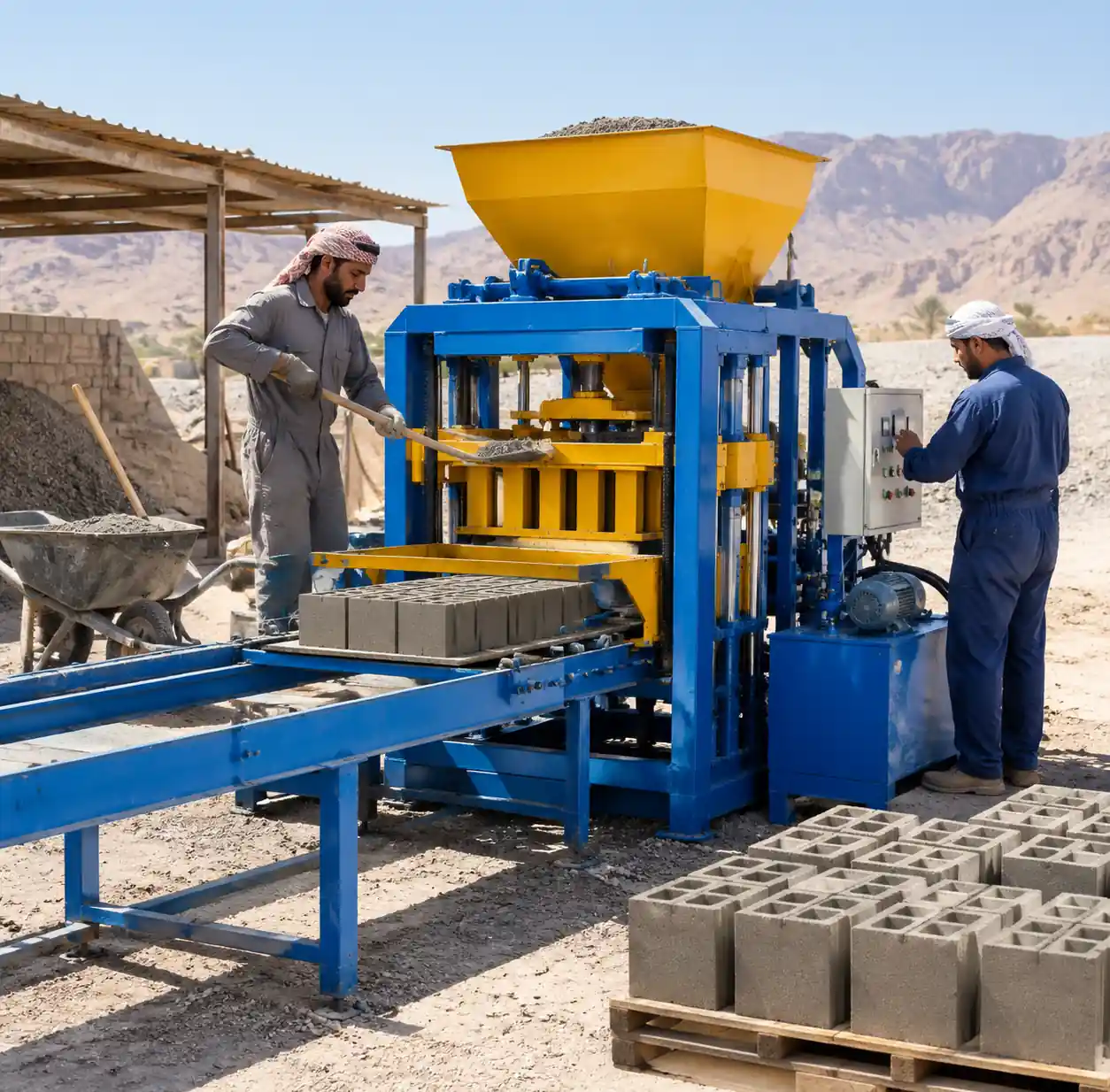
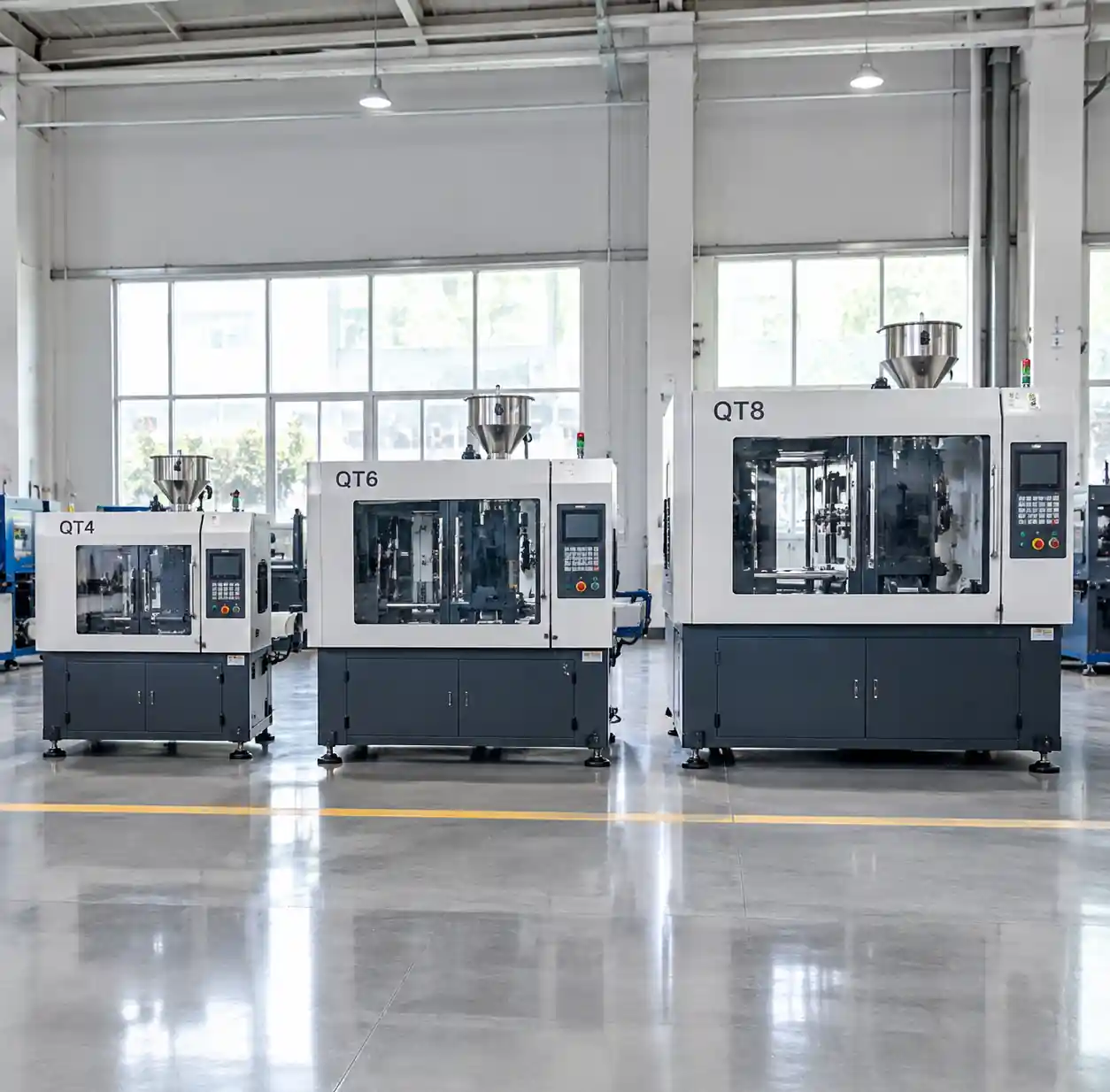
Regional contractors serving residential projects and small commercial buildings typically operate at this capacity level. Semi-automatic machines producing 800-1,500 blocks per 8-hour shift meet demand without requiring three-phase power infrastructure. Models like the QT4-40 operate on 220V single-phase power, making deployment practical across Middle East locations with basic electrical service.
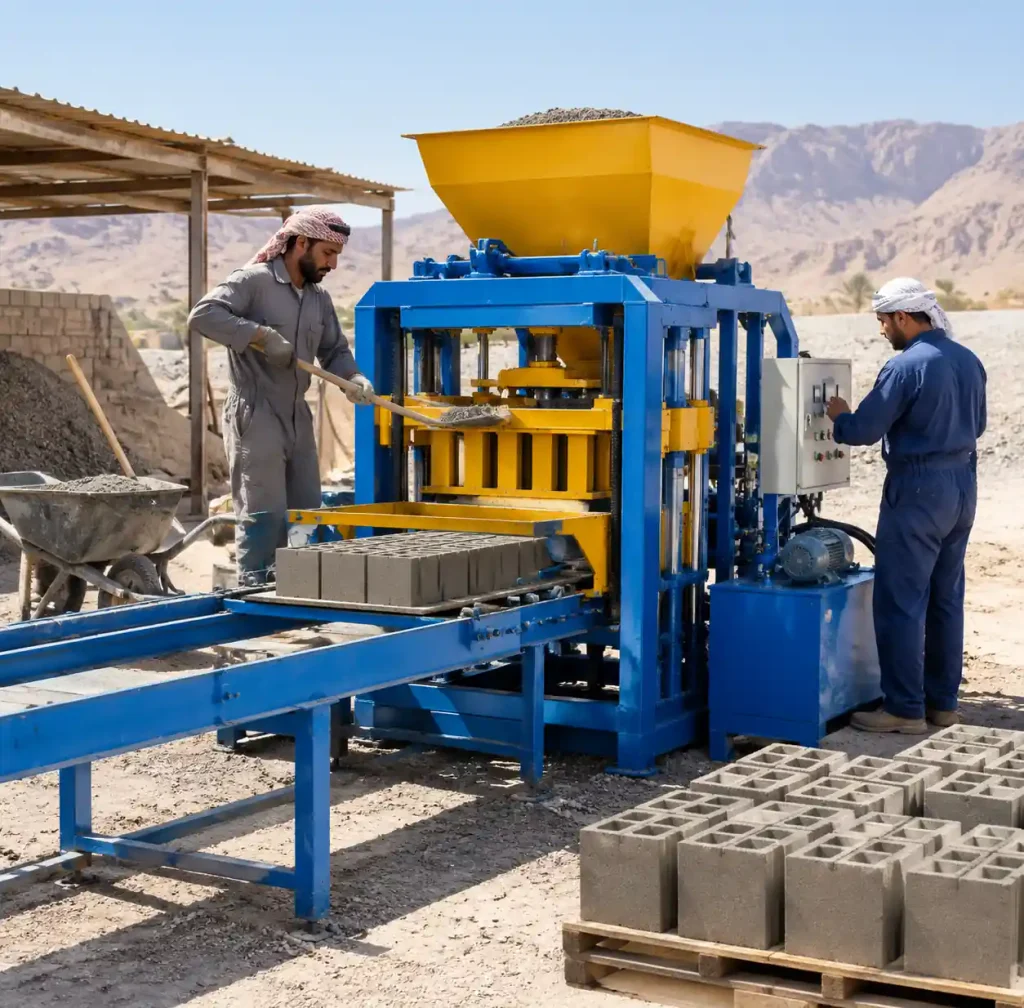
These machines cost $9,500-$16,000 FOB, with total setup including shipping, installation, and initial mold sets reaching $18,000-$28,000. Production costs per block range from $0.18-$0.24 depending on local cement prices and aggregate availability. With hollow blocks selling at $0.45-$0.65 across Middle East markets, operators achieve 12-18 month ROI periods even with small-scale production.
The limitation appears when contracts require 3,000+ blocks daily. Semi-automatic machines running two shifts produce 1,600-3,000 blocks, barely meeting this threshold with no buffer for equipment maintenance or operator scheduling challenges. Contractors consistently operating at these volumes need mid-capacity equipment to maintain reliable delivery schedules.
Mid-Scale Production (3,000-15,000 blocks/day)
This capacity range serves contractors supplying multi-unit housing developments, commercial buildings, and infrastructure projects. Fully automatic machines like the QT8-15 produce 3,600-5,000 blocks per 8-hour shift, meeting demand with single-shift operation and providing capacity buffer for maintenance cycles or rush orders.
| Machine Model | Capacidade de produção | Power Requirements | Compression Force | Footprint | Price Range FOB |
|---|---|---|---|---|---|
| QT4-40 | 960-1,200 blocks/shift | 220V single-phase, 13.5kW | 100-120 tons | 3.2m × 1.8m | $9,500-$14,000 |
| QT8-15 | 3,600-5,000 blocks/shift | 380V three-phase, 36.75kW | 200 tons | 9.8m × 2.1m | $32,000-$42,000 |
| QT10-15 | 12,000-15,000 blocks/shift | 380V three-phase, 51.25kW | 250-300 tons | 11.5m × 2.8m | $95,000-$135,000 |
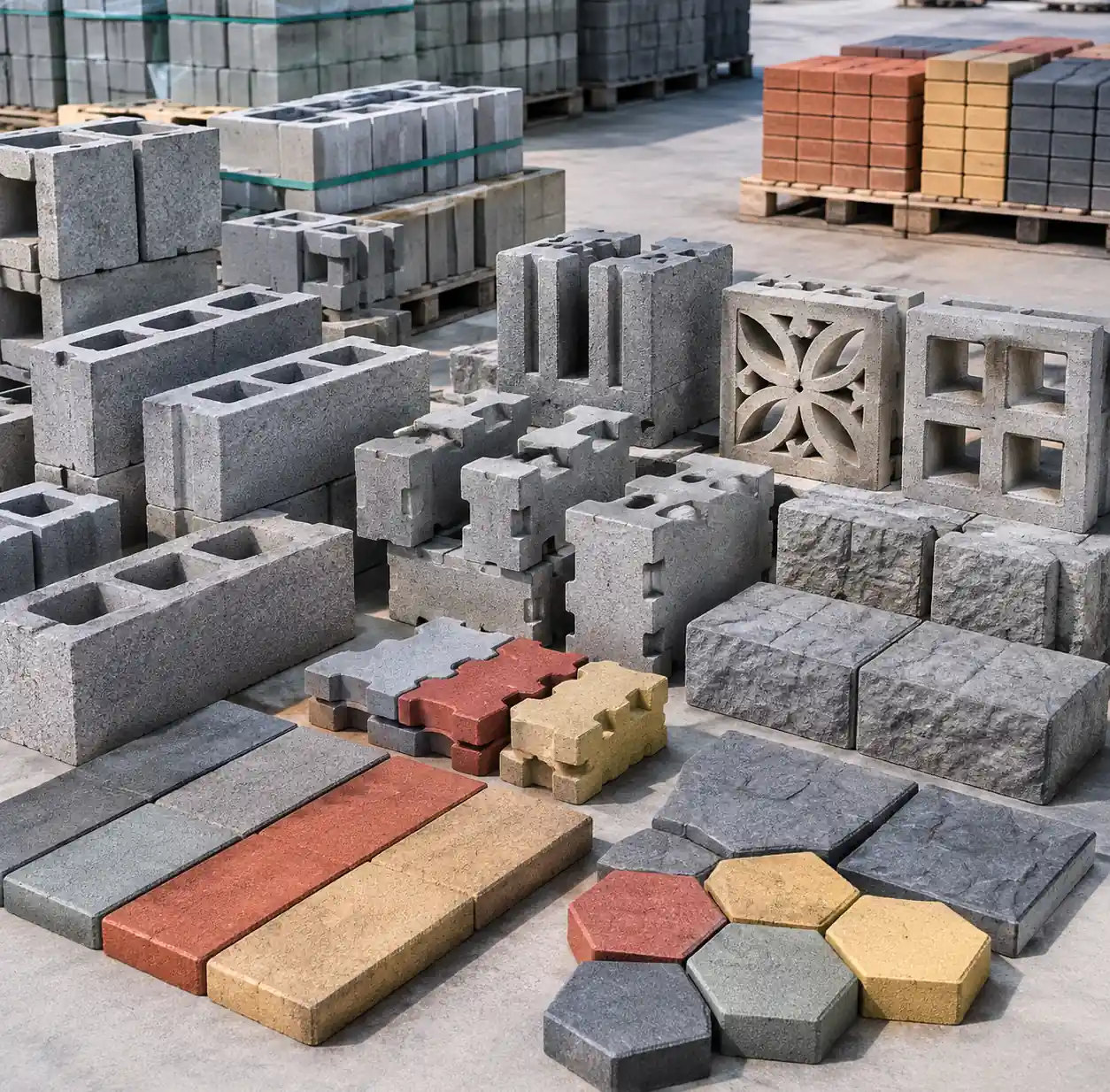
Middle East operators favor the QT8-15 for its balance between production capacity and power requirements. The 36.75kW demand allows operation on 50-75 kVA generators in locations without stable grid power, while production capacity satisfies contracts requiring 500-800 blocks daily per housing unit. Mold change systems allowing switches between hollow blocks, pavers, and decorative surfaces in 25-35 minutes provide product flexibility crucial for competitive bidding.
These machines require three-phase power with voltage regulation, pushing total installation costs to $50,000-$75,000 including generator backup for unstable power areas. Per-block production costs drop to $0.14-$0.19 through improved material utilization and reduced labor requirements. At market prices of $0.50-$0.70 per block, ROI periods extend to 18-24 months due to higher capital investment despite better per-unit economics.
High-Capacity Plants (15,000+ blocks/day)
Large-scale producers supplying mega-projects across the Gulf region operate fully automatic plants producing 15,000-46,000 blocks per 8-hour shift. The QT10-15 produces 10 blocks per molding cycle with 12-15 second cycle times, achieving maximum capacity of 46,080 blocks per shift under optimal conditions. Real-world production typically reaches 12,000-15,000 blocks per shift accounting for material loading cycles, mold changes, and routine maintenance.
These installations require substantial infrastructure beyond the core machine: automatic batching systems costing $25,000-$45,000, material handling conveyors adding $15,000-$30,000, and automated stacking systems ranging $40,000-$80,000. Total facility investment reaches $180,000-$320,000 depending on automation level and climate control requirements.
The scale economics become compelling at high utilization rates. Production costs drop to $0.11-$0.15 per block through automated material handling reducing waste, optimized curing cycles, and minimal labor requirements. Plants operating two shifts producing 24,000-28,000 blocks daily generate $9,600-$16,800 gross revenue at current Middle East market prices, supporting 14-20 month ROI periods despite high capital requirements.
Material Challenges Specific to Middle East Production
Salt Contamination and Aggregate Quality
Coastal regions throughout the Gulf experience salt contamination in both groundwater and aggregates. Chloride levels in local materials frequently exceed 0.06% by weight of cement—double the threshold for reinforced concrete applications. While concrete blocks don’t contain rebar, high chloride accelerates efflorescence and surface deterioration, creating quality complaints and contract disputes.
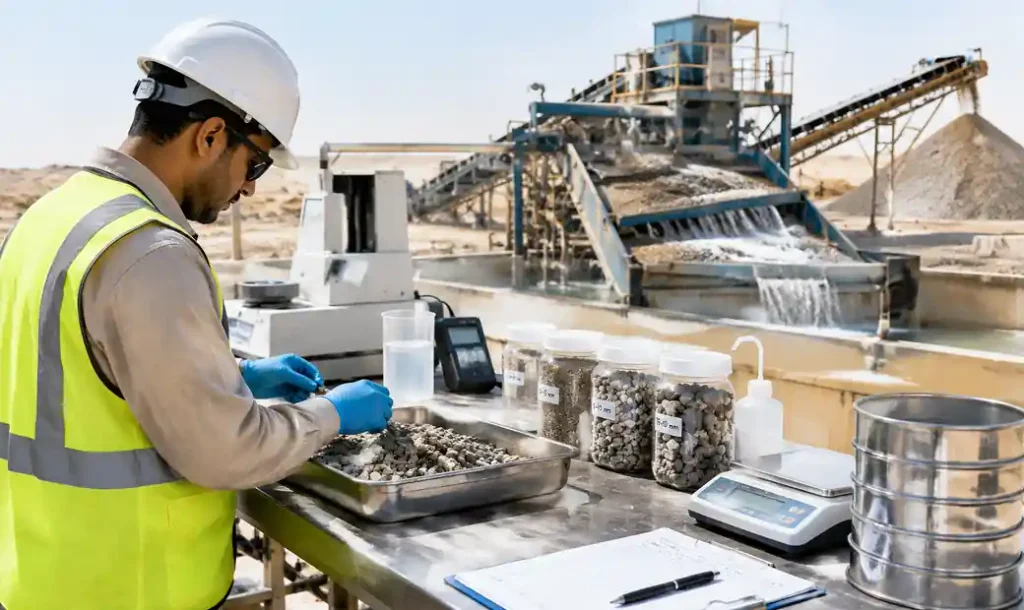
Producers address this through several material management strategies. Sourcing aggregates from inland quarries 50-150 km from coastal production sites adds transportation costs of $3-$8 per cubic meter but delivers cleaner materials. Washing systems remove surface chlorides from local aggregates, though installation costs of $18,000-$35,000 and water consumption of 200-400 liters per ton make this economical only for high-capacity operations.
Testing protocols become essential in Middle East operations whereas European or North American producers rely on consistent local material suppliers. Weekly chloride testing of aggregates costs $150-$300 per test but prevents batch rejections that occur when chloride-contaminated blocks show premature deterioration within 12-18 months of installation.
Cement Quality Variations
Cement sourcing presents challenges across Middle East markets despite regional production capacity. Major clinker property variations affect block strength, setting times, and curing requirements. Cement from Saudi Arabian mills differs significantly from UAE or Egyptian suppliers, requiring formula adjustments when switching sources.
Successful Middle East producers maintain relationships with 2-3 cement suppliers, testing each supplier’s product quarterly to document strength development curves and optimal water ratios. This redundancy prevents production stoppages when supply chain disruptions affect primary cement sources—a recurring issue in the region’s logistics infrastructure.
Formula documentation becomes critical when cement sources change. Maintaining detailed batch records showing cement source, aggregate ratios, water content, and resulting block strengths allows rapid adjustment when switching suppliers. This operational discipline separates successful Middle East block producers from operations experiencing frequent quality complaints and contractor disputes.
After-Sales Support and Spare Parts Logistics
Equipment failure in Middle East locations 600-1,200 km from the nearest service center costs substantially more than the repair itself. Production stops, workers collect wages without producing revenue, and construction contracts face delays triggering penalty clauses. A 4-day shutdown for hydraulic seal replacement costs $4,800-$11,200 in lost gross profit plus potential contract penalties.
Manufacturers with established Middle East service networks respond within 24-48 hours for major markets. Raytone Block Machinery operates service centers covering Saudi Arabia, UAE, and Qatar with spare parts inventories for high-wear components including hydraulic seals, vibration motors, mold components, and PLC modules. This regional presence reduces average downtime to 1-2 days versus 2-4 weeks when ordering parts from China directly.
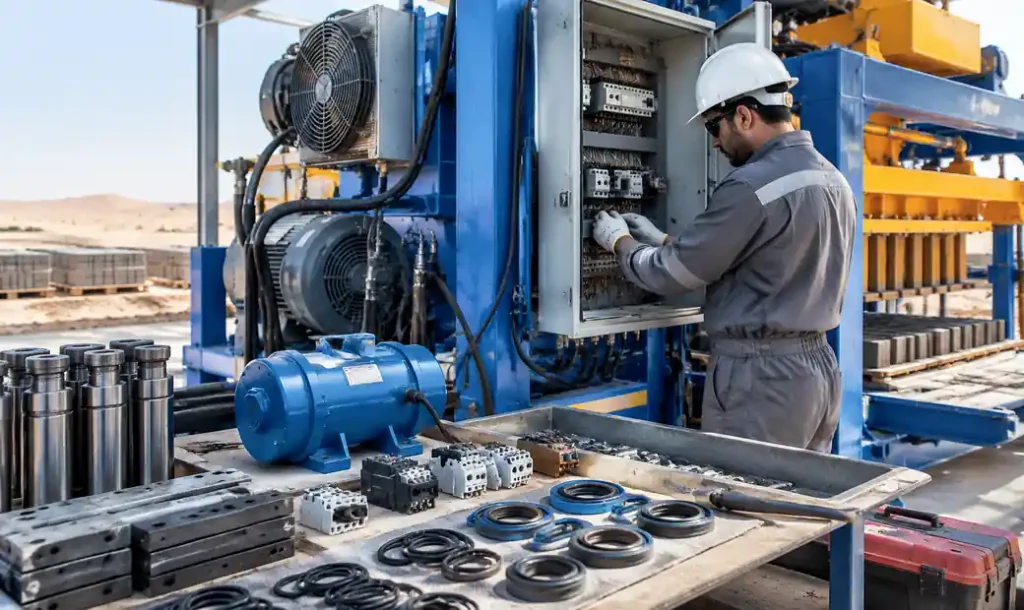
Smart operators maintain critical spare parts inventory despite the $3,000-$6,000 investment. Hydraulic seal kits, vibration motor bearings, and electrical contactors prevent extended shutdowns from predictable wear items. The inventory investment recovers during the first prevented shutdown, making it essential insurance rather than optional expense.
Service contracts covering annual maintenance, 24-hour technical support, and priority parts shipping cost $2,200-$4,500 annually depending on equipment capacity. These contracts reduce annual downtime by 40-65% according to data from Gulf region installations, justifying costs through improved production reliability.
For more insights on maintenance practices, see our block machine maintenance guide.
Total Cost of Ownership in Middle East Markets
Initial equipment purchase represents 45-60% of total 5-year ownership costs in Middle East operations, compared to 60-70% in temperate climates. The harsh environment accelerates component wear, increases maintenance frequency, and requires climate-specific consumables adding operational expenses.
5-Year Ownership Cost Breakdown for QT8-15 System:
| Cost Category | Amount (USD) | Percentage of Total |
|---|---|---|
| Equipment Purchase | $35,000 | 31% |
| Installation & Setup | $8,500 | 7% |
| Climate Modifications | $12,000 | 11% |
| Backup Generator | $15,000 | 13% |
| Maintenance (5 years) | $22,000 | 19% |
| Spare Parts | $11,500 | 10% |
| Energy Costs | $10,000 | 9% |
| Total 5-Year Cost | $114,000 | 100% |
Understanding true ownership costs prevents the common mistake of selecting lowest-price equipment that becomes expensive through frequent breakdowns and high maintenance requirements. Chinese manufacturers offering machines at 30-40% below established brands rarely include climate modifications, provide no regional service support, and use components failing rapidly in extreme conditions.
Middle East operators report 35-50% lower total ownership costs over 5-10 year periods when purchasing climate-adapted equipment from manufacturers with regional service networks, despite 18-25% higher initial purchase prices. The cost difference appears in maintenance expenses, downtime frequency, and component replacement intervals rather than purchase price alone.
FAQ
What production capacity do I need for Middle East construction contracts?
Typical residential contracts requiring blocks for 50-100 houses demand 2,500-4,000 blocks daily over 6-9 month periods. Commercial projects consume 5,000-15,000 blocks daily during peak construction phases. Select equipment producing 20-30% above average daily requirements to buffer for maintenance cycles and rush orders without forcing two-shift operation.
How does extreme heat affect block production quality?
Temperatures above 40°C accelerate water evaporation during mixing and curing, reducing block strength by 15-25% without proper controls. Rapid curing requires water spraying systems maintaining surface moisture for 7-14 days depending on cement type. Temperature-controlled curing facilities using shade structures or misting systems cost $8,000-$18,000 but ensure consistent block strength meeting specification requirements.
What power infrastructure do I need for automatic block machines?
Fully automatic machines require three-phase 380V power with voltage stability within ±5%. Locations experiencing voltage fluctuations need 60-100 kVA generators with automatic voltage regulators costing $12,000-$25,000. Semi-automatic machines operate on single-phase 220V power available at most Middle East industrial locations, eliminating generator requirements for small to mid-scale operations. Learn more about power requirements for block machines.
How do I prevent dust-related equipment failures?
Implement enclosed material feeding systems, positive pressure electrical enclosures, and daily compressed air cleaning. Dust causes 60-75% of electrical failures and 40-55% of hydraulic issues in desert environments. Complete dust management systems cost $10,000-$20,000 installed but reduce maintenance costs by 40-60% over equipment lifespan.
What spare parts inventory should I maintain?
Stock hydraulic seal kits ($200-$400), vibration motor bearings ($150-$300), electrical contactors ($80-$180), and mold wear components ($400-$800). This $3,000-$6,000 inventory prevents 1-2 week shutdowns waiting for parts shipping from manufacturers. Replace based on operating hour schedules rather than failure occurrence. For complete spare parts guidance, read our block machine spare parts guide.
How long does equipment last in Middle East conditions?
Climate-adapted machines with proper maintenance operate 8-12 years before requiring major rebuilds. Standard equipment without heat management and dust protection typically fails within 3-5 years. Annual maintenance costs for adapted equipment run $3,500-$5,500 versus $6,000-$10,000 for standard machines experiencing accelerated wear from environmental stress.
Conclusão
Concrete block production in the Middle East demands equipment specifically engineered for extreme temperatures, dust exposure, and material challenges absent in other global markets. Standard machines failing within months cost far more through downtime and lost contracts than climate-adapted equipment commanding 18-25% price premiums. Successful operators prioritize hydraulic systems with active cooling, dust-sealed electrical components, and manufacturers maintaining regional service networks over lowest initial purchase price.
Production scale determines optimal equipment selection: semi-automatic hydraulic machines for 500-2,000 blocks daily, fully automatic systems for 3,000-15,000 blocks, and complete automated plants for operations exceeding 15,000 blocks daily. Total ownership costs over 5-10 year periods favor quality equipment from established manufacturers despite higher initial investment.
Raytone Block Machinery engineers equipment specifically for Gulf region conditions, incorporating heat management systems, dust protection, and salt-resistant components as standard features rather than optional upgrades. Our Middle East service network provides 24-48 hour response times across Saudi Arabia, UAE, and Qatar, minimizing production disruptions that cost thousands daily. Contact us for equipment recommendations tailored to your specific production requirements and location challenges.
Sources: