Block manufacturers lose 15-25% of potential compressive strength through improper curing. I’ve seen operations shipping blocks at 60% rated capacity because they rushed curing schedules. The difference between a block that meets spec and one that gets rejected? The curing method you choose and how precisely you execute it.
Steam curing delivers 70-80% of 28-day strength in 18-24 hours. Water curing reaches the same milestone in 7 days. Natural curing takes 14-21 days depending on climate. Each method has distinct cost structures, equipment requirements, and strength development patterns.
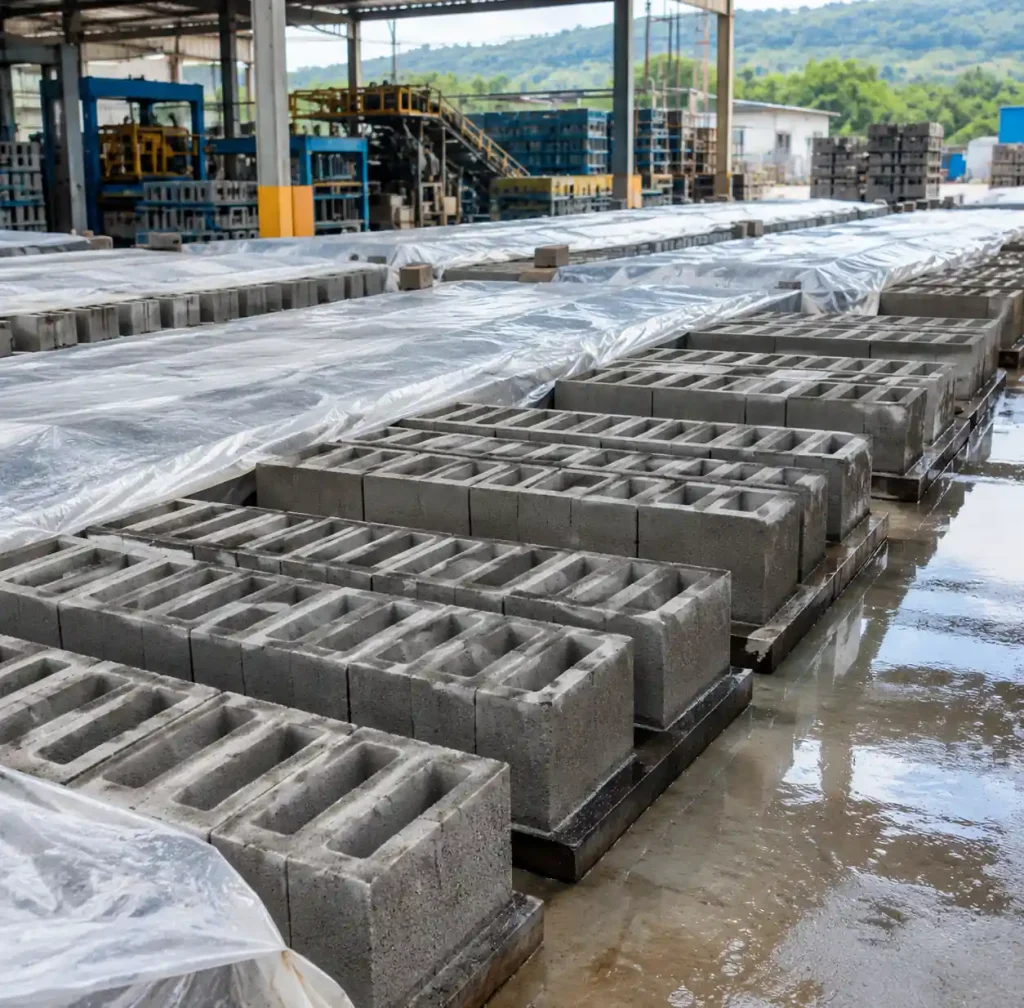
Understanding Block Curing Fundamentals
Curing controls the cement hydration reaction that converts concrete mix into load-bearing masonry. Portland cement needs moisture and controlled temperature to form calcium silicate hydrate crystals—the microscopic structures that give concrete its strength.
A normal concrete mix gains approximately 40% of its 28-day strength in 3 days, 65% in 7 days, and 90% in 14 days under standard curing at 20-25°C. Temperature and moisture dramatically accelerate or retard this timeline.
Insufficient curing creates surface dusting (outer 2-5mm doesn’t hydrate properly), reduced compressive strength (cement particles don’t fully react), and shrinkage cracking (blocks lose moisture faster than they can hydrate).
Steam Curing: Accelerated Strength Development
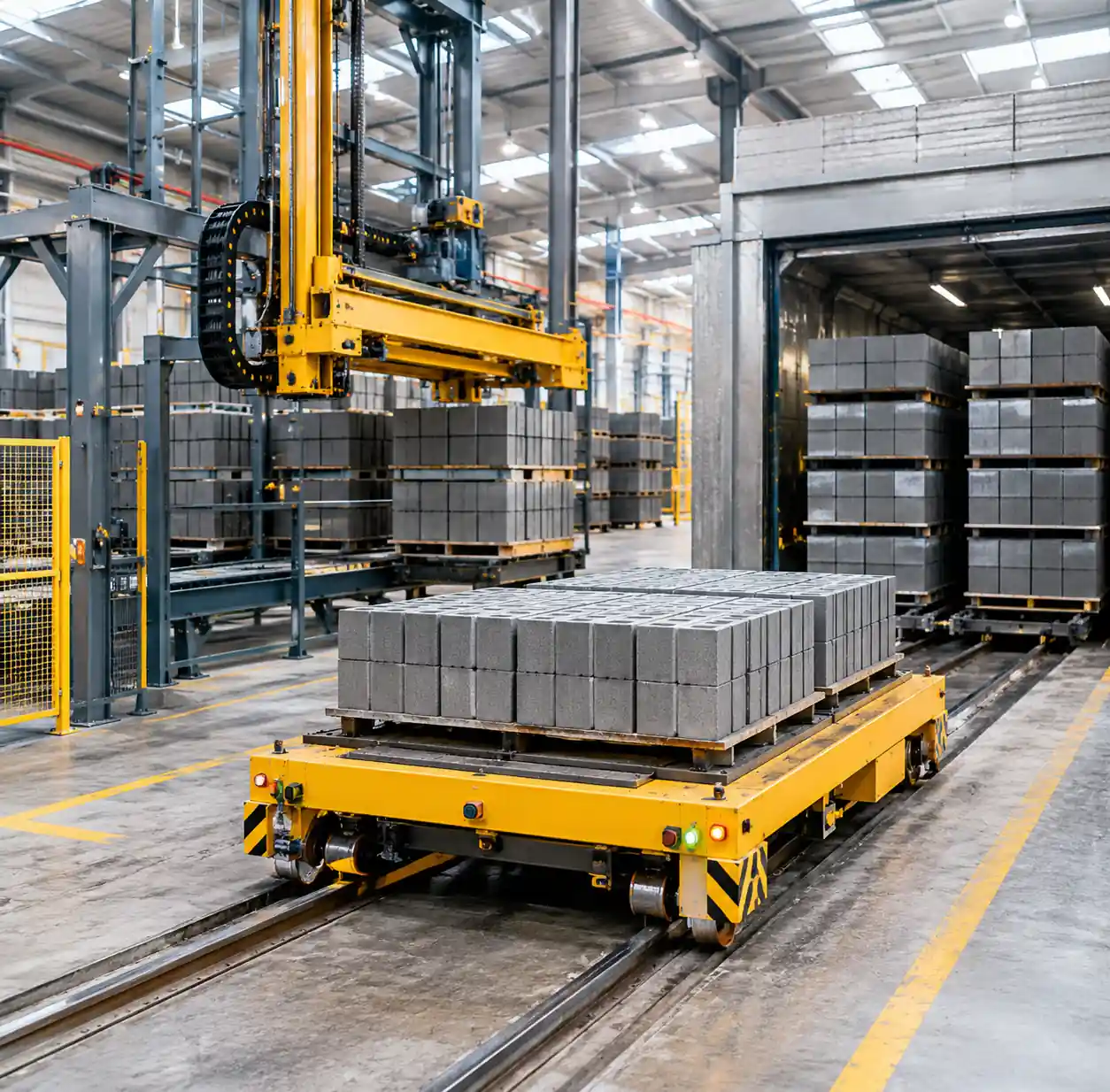
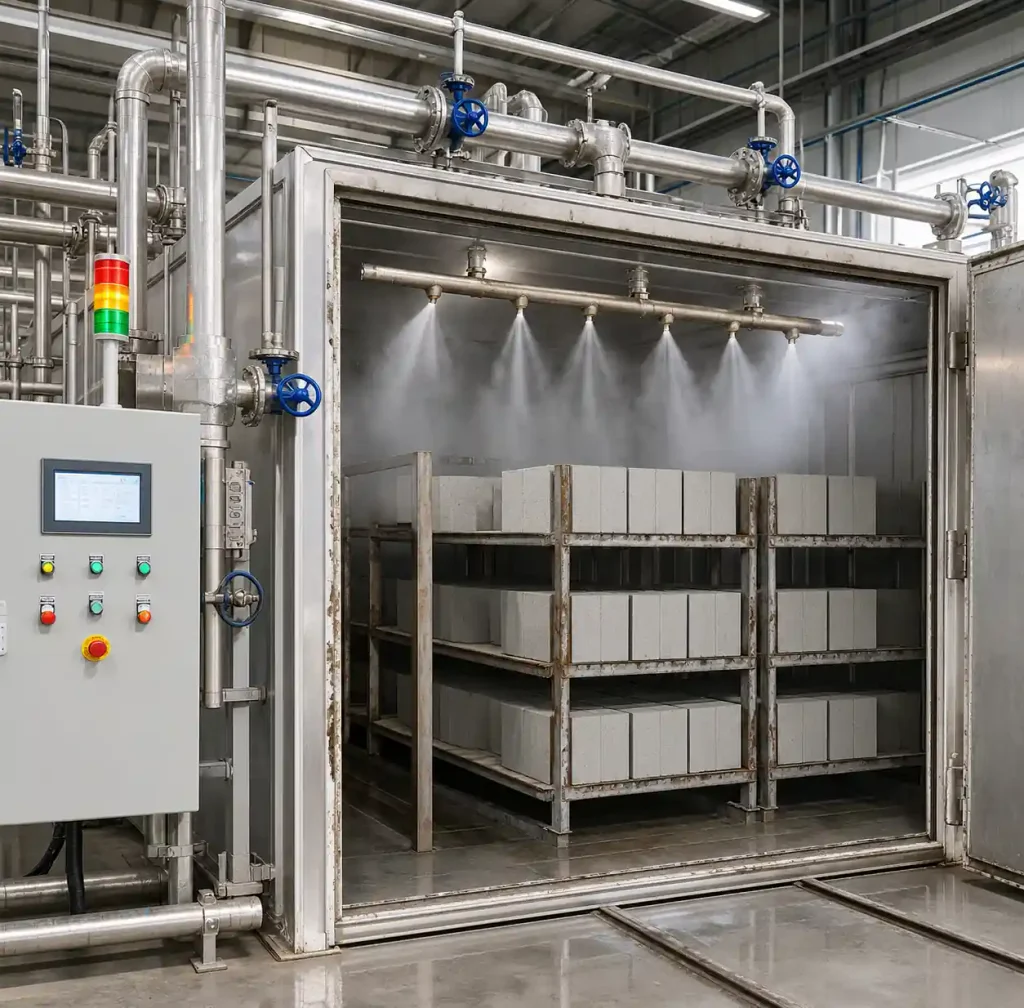
Steam curing applies 60-80°C temperature and 95-100% humidity to accelerate cement hydration. Blocks enter chambers immediately after molding. Temperature ramps up 5-10°C per hour to prevent thermal shock, holds for 4-8 hours, then cools gradually.
Typical cycle: 18-24 hours total (3-4 hours preheating, 6-8 hours peak, 3-4 hours cooldown). Blocks exit with 70-80% of 28-day strength already developed.
Strength Development
Steam-cured blocks gain strength faster initially but achieve slightly lower ultimate strength. At 1 day: 25-35 MPa (steam) vs 8-12 MPa (water). By 28 days: 35-45 MPa (steam) vs 40-50 MPa (water) for identical mixes.
The trade-off comes from microstructure. High-temperature curing creates coarser crystals that form quickly but leave larger pores. Water curing produces finer, denser structures.
Equipment Requirements
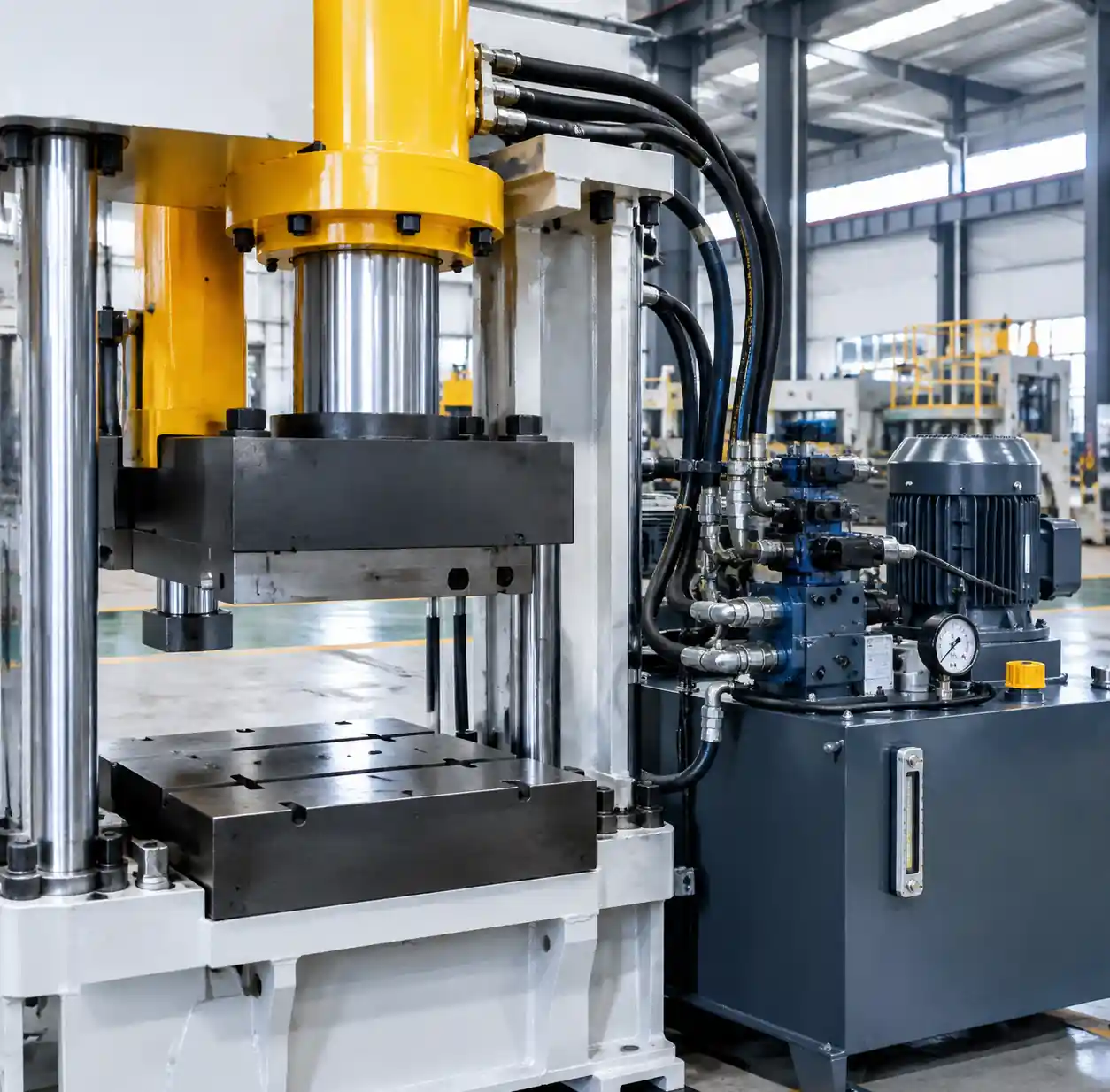
For 50,000 blocks monthly: boiler (500-1000 kg/hr), steam chambers (500-2000 block capacity), piping, controls. Capital: $80,000-$200,000.
Operating costs: $0.15-$0.35 per block (fuel, labor, maintenance). Energy: 0.8-1.2 kg steam per kg cement. Automated systems with heat recovery cut fuel costs 25-30%.
Water Curing: Traditional Strength Development
Water curing maintains continuous moisture contact at ambient temperature. This traditional method produces blocks with optimal long-term strength when properly executed.
Water Curing Methods
Ponding/immersion submerges blocks in tanks for 7-14 days. Requires 15-20 m² tank area per 1000 blocks for continuous production. Water needs regular changing to prevent algae.
Wet covering drapes blocks with saturated burlap or canvas. Less space than ponding but requires daily watering to keep covers wet.
Continuous spraying uses automatic misting every 15-30 minutes. Works in dry climates but wastes water—15-25 liters per m² daily.
Strength Development
Water-cured blocks follow standard hydration curves. 3 days: 40-45% of 28-day strength (16-20 MPa for 40 MPa mix). 7 days: 65-70% (26-32 MPa). 28 days: typically exceed nominal strength by 5-10%.
Extended timeline means holding 14,000-28,000 blocks for a 2000-block daily line—tying up 400-800 m² yard space.
Cost Analysis
Low capital: $5,000-$15,000 for tanks, covers, or spray systems. Operating: $0.05-$0.10 per block.
Real cost sits in working capital. 14 days of 2000-block daily production = 28,000 units inventory at $1.50-$2.50 material cost = $42,000-$70,000 tied up earning no return.
Natural Curing: Climate-Dependent Method
Natural curing relies on ambient moisture and temperature without added heat or water supply. This works only in specific climates and typically produces lower, inconsistent quality.
Performance by Climate
In humid coastal regions (70-90% RH), natural curing can work if blocks are covered immediately after molding. Strength reaches 85-95% of water-cured blocks.
In dry climates below 50% RH, natural curing fails. Surface moisture evaporates faster than cement hydrates, creating weak, dusty surfaces. Temperature swings compound problems.
Applications and Limitations
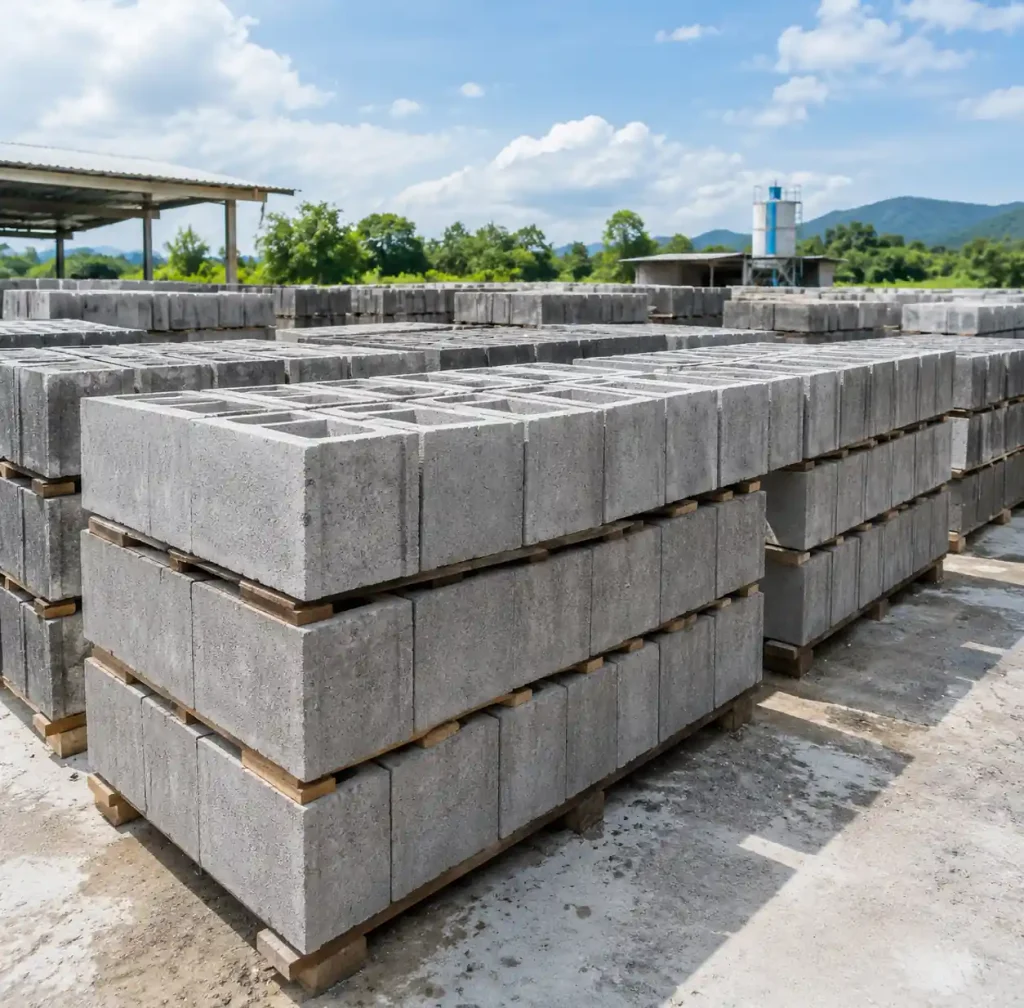
Natural curing suits only low-volume operations (200-500 blocks daily) in favorable climates where quality demands aren’t strict.
Quality inconsistency makes it unsuitable for commercial plants. Strength variations of 20-30% between batches are common. Reject rates run 10-15% vs 2-5% for controlled methods. Most building codes prohibit natural curing for structural applications.
Curing Method Comparison
| Factor | Steam Curing | Water Curing | Natural Curing |
|---|---|---|---|
| Cycle Time | 18-24 hours | 7-14 days | 14-21 days |
| 1-Day Strength | 70-80% of 28-day | 20-25% of 28-day | 15-20% of 28-day |
| 28-Day Strength | 35-45 MPa (typical) | 40-50 MPa (typical) | 30-40 MPa (typical) |
| Capital Cost | $80,000-$200,000 | $5,000-$15,000 | Under $2,000 |
| Operating Cost/Block | $0.15-$0.35 | $0.05-$0.10 | $0.01-$0.03 |
| Space Requirements | 500-1500 m² | 400-800 m² | 600-1200 m² |
| Climate Sensitivity | Low | Moderate | Very High |
| Quality Consistency | Excellent (±5%) | Very Good (±8%) | Poor (±20-30%) |
Equipment Requirements by Curing Method
| Equipment Type | Steam Curing | Water Curing | Natural Curing |
|---|---|---|---|
| Primary Equipment | Boiler (500-1000 kg/hr) Steam chambers Control systems | Curing tanks or Spray systems Covers/tarps | Plastic sheets Stacking pallets |
| Secondary Systems | Piping & distribution Heat recovery Condensate return | Water pumps Filtration Drainage | Shade structures |
| Automation Level | High (PLC control) | Low-Medium | None |
| Maintenance Requirements | Boiler service (monthly) Valve inspection Insulation repair | Tank cleaning Pump maintenance Cover replacement | Minimal |
| Energy Source | Natural gas, diesel, biomass, electricity | Electricity (pumps) | None |
| Monitoring Needs | Temperature/pressure sensors, data logging | Manual checks | Visual inspection |
Climate Considerations
Hot, arid climates (Middle East, North Africa, Southwest US) favor steam curing. Ambient temperatures above 35°C and humidity below 30% cause water-cured blocks to lose surface moisture in hours. Steam chambers protect blocks regardless of external conditions.
Humid tropical climates (Southeast Asia, coastal regions) work well for water curing. High humidity (70-90% RH) naturally slows evaporation. Main challenge: algae and mold on covers and tanks—regular cleaning prevents contamination.
Temperate climates need flexible systems. Many operations use water curing in summer (May-September above 15°C), then switch to steam in winter.
Freezing conditions require heated curing. Water curing fails below 5°C—surface moisture freezes, halting hydration and potentially damaging blocks. Steam curing becomes essential, or production shuts down.
Quality Control and Testing
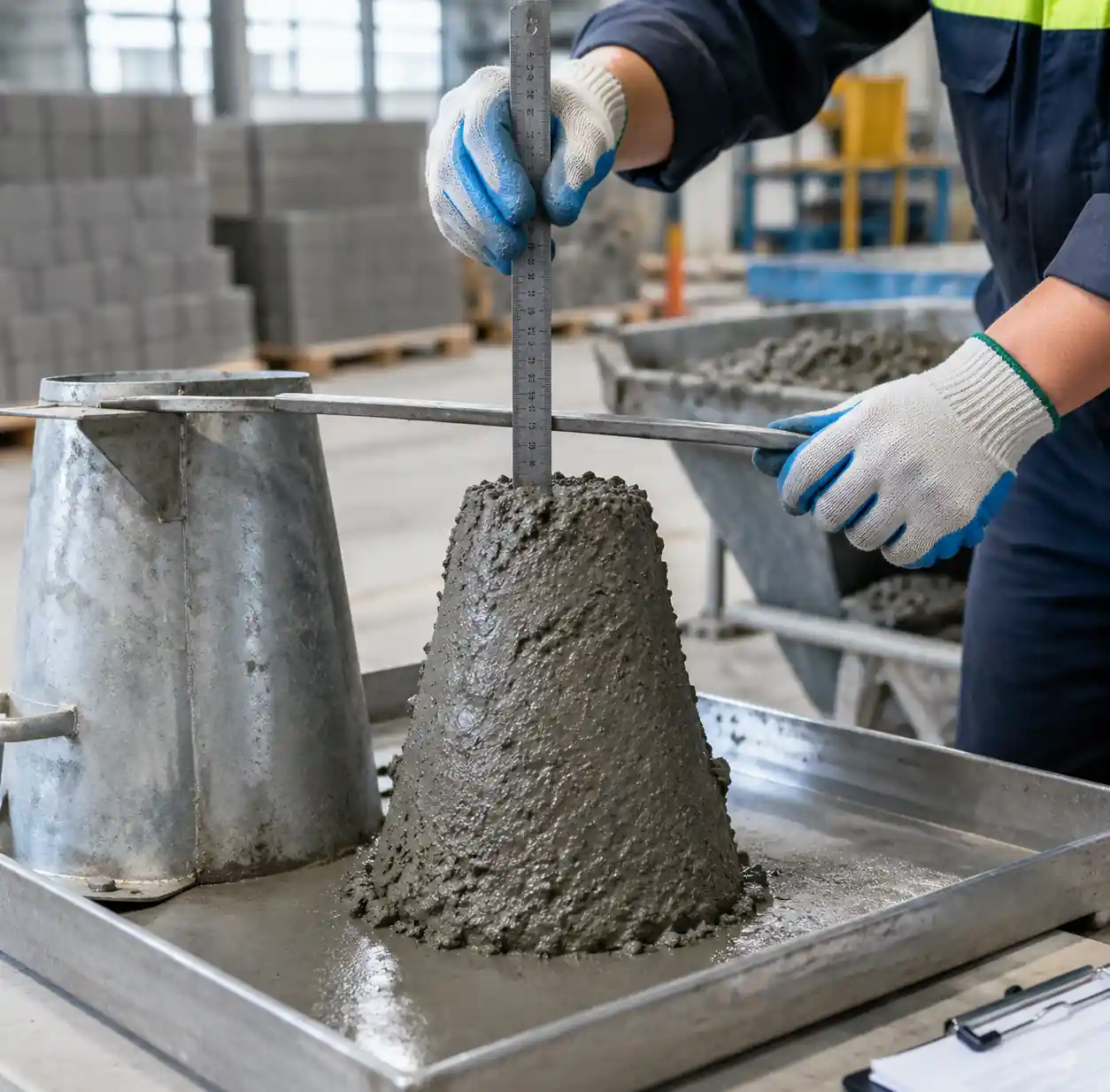
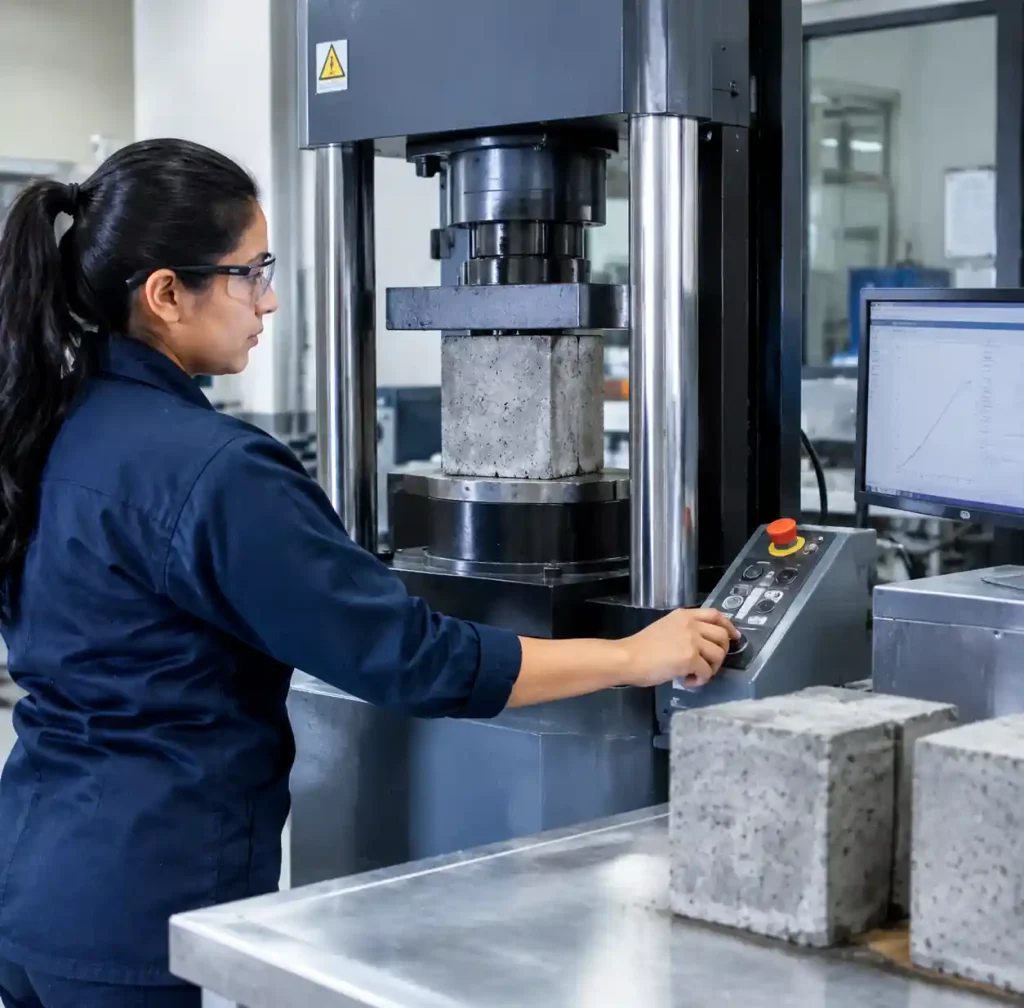
Compressive strength testing at 1, 7, and 28 days establishes your strength curve. Test 10-15 blocks per shift initially to map variability.
Steam blocks need temperature profiling with wireless loggers. Rapid heating (over 15°C/hour) causes microcracking—I’ve seen blocks lose 15-20% strength from 10°C temperature spikes.
Water blocks require moisture monitoring. Surface dryness over 2 hours during first 7 days permanently reduces strength 8-12%. Check every 4-6 hours in hot/windy weather.
Absorption testing reveals hidden problems. Properly cured blocks absorb 6-10% of dry weight in 24 hours. Over 12% indicates insufficient curing.
Cost Analysis and Economics
Steam curing makes sense above 30,000-50,000 blocks monthly. Capital ($80,000-$200,000) amortizes over 5-7 years while 18-24 hour cycles enable 12-15x annual inventory turnover vs 3-5x for water curing.
Water curing suits 5,000-50,000 blocks monthly with limited capital but available space. Equipment costs $5,000-$15,000, operating runs $0.05-$0.10/block, but 7-14 day cycles limit throughput.
Working capital drives decisions. Steam turns inventory 12x annually, water turns 4x. Example: $2.00 material cost, $4.50 selling price, 2,000-block average inventory. Steam generates $108,000 annually (12 × 2,000 × $4.50) vs $36,000 for water (4 × 2,000 × $4.50).
Selecting the Right Method
Operations prioritizing fast turnaround choose steam curing for pre-cast work, strict timelines, and commercial construction with mandatory testing. Steam eliminates weather delays and quality variability.
Budget-conscious operations with space and favorable climate select water curing. Lower capital preserves cash, and superior 28-day strength satisfies requirements with longer lead times.
Climate and volume make the decision: hot/arid regions need steam, humid tropics work with water year-round, temperate zones need dual systems. Operations above 50,000 blocks monthly usually justify steam curing economically.
Equipment Integration
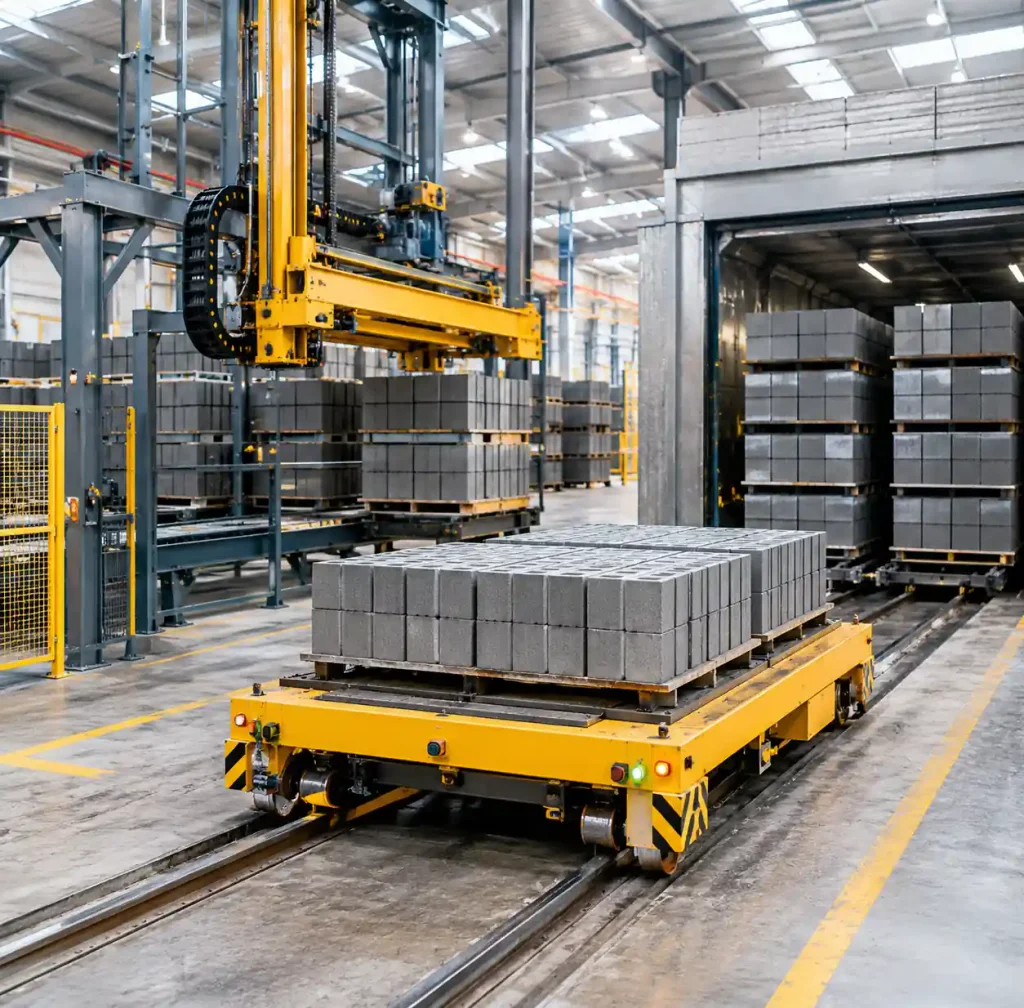
Supporting equipment must match your curing cycle. Steam curing needs robust handling for hot blocks (40-50°C). Your complete block plant solution should integrate curing with molding capacity.
Water curing requires 3-5% slope for drainage, catch basins, and covered space protecting blocks from oversaturating rain.
Common Problems and Solutions
Thermal shock cracking in steam curing happens from rapid temperature changes. Solution: enforce maximum 10°C/hour heating/cooling rates. Use multiple temperature zones—blocks near inlet points often cure 5-8°C hotter than corners.
Surface drying in water curing occurs during hot, windy weather. Fix: increase misting to 15-minute cycles, use double-layer wet covers, or add windbreaks.
Color variation indicates uneven moisture exposure. Consistent covering and uniform water distribution solve 90% of color issues.
Mix Design and Sustainability
High-early-strength mixes with accelerators work better under steam curing (12-16 hours to design strength). Mixes with fly ash (15-30%) benefit from extended water curing—pozzolanic reactions continue 60-90 days.
Recent studies show electric curing reduces energy demand 40% versus steam curing. Emerging carbonation curing technology can lower CO₂ emissions 30-50% through carbon sequestration.
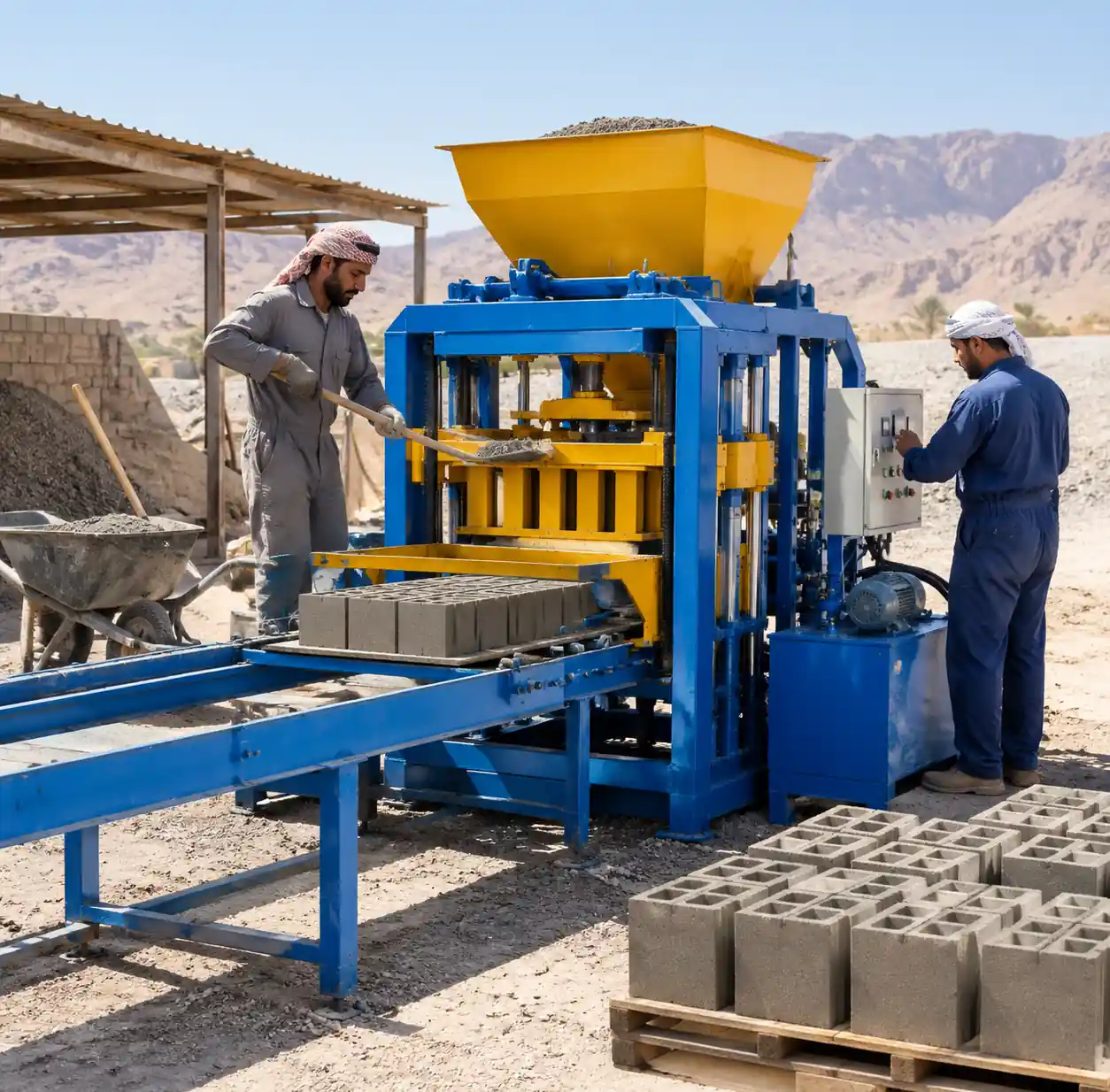
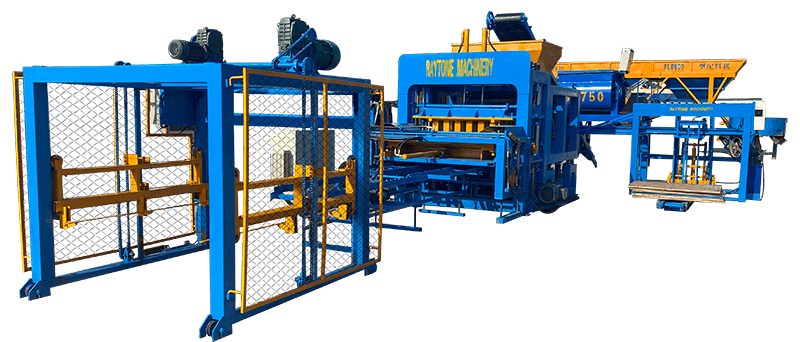
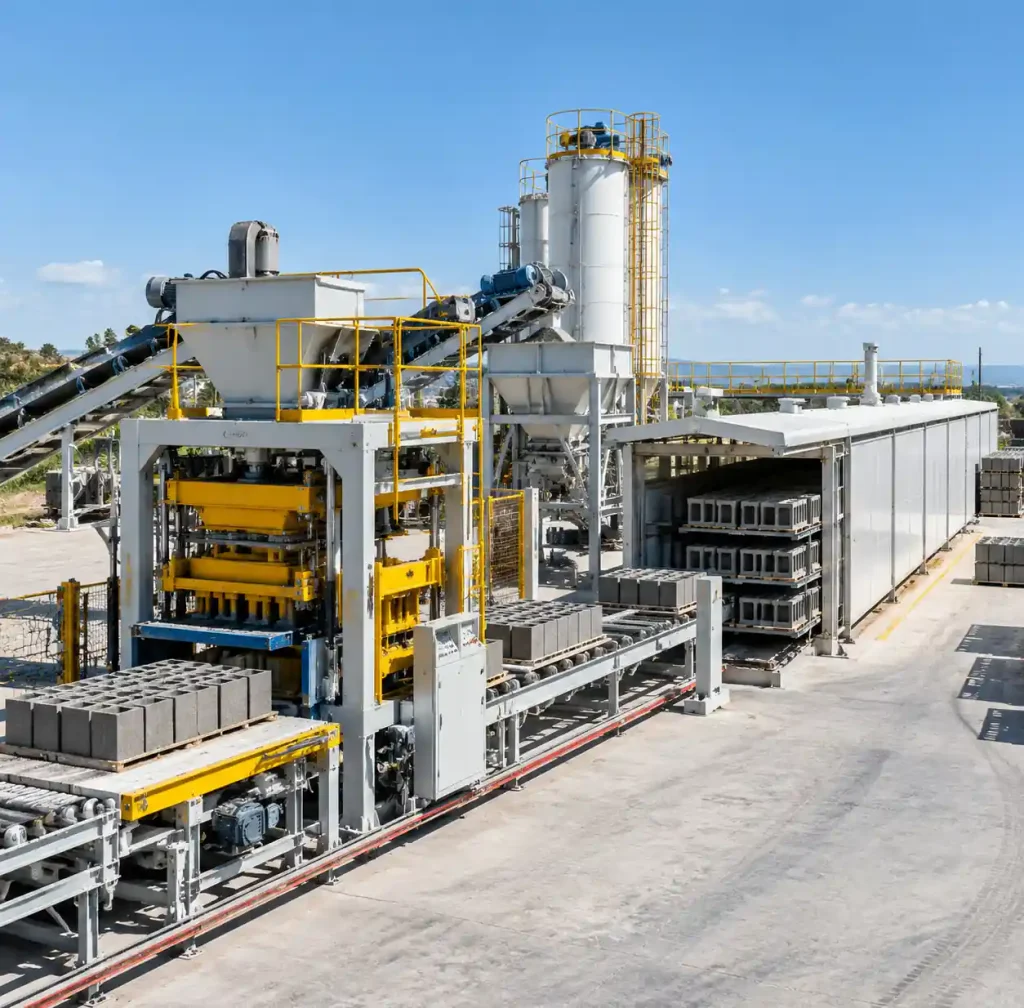
Raytone Block Machinery designs complete automatic block plants with integrated curing systems optimized for your climate and production targets.
FAQ
How long must blocks cure before shipping?
Steam-cured blocks ship after 24-48 hours at 70-80% design strength. Water-cured blocks need 7-14 days to reach 65-75% strength for safe handling. Building codes typically require 28-day testing but allow early installation if compressive strength meets minimum thresholds (usually 75% of nominal strength).
Can you combine curing methods?
Yes. Many operations use short-cycle steam curing (8-12 hours) followed by water curing. Blocks gain 50-60% strength from steam, then complete hydration under water. This hybrid reduces steam costs while maintaining faster turnaround.
What temperature is optimal for water curing?
20-25°C produces ideal hydration rates. Below 10°C, blocks may need 21-28 days to reach design strength. Above 30°C, evaporation becomes limiting rather than hydration rate, requiring more frequent water application.
Does steam curing affect block durability?
Properly controlled steam curing doesn’t reduce durability. However, excessive peak temperatures (above 85°C) or rapid temperature changes create microstructure defects that reduce freeze-thaw resistance. Following ASTM C1693 or EN 13369 temperature profiles prevents these issues.
How much does curing impact final block cost?
Curing represents 8-15% of total production cost. Steam curing adds $0.15-$0.35 per block but reduces inventory carrying costs 60-75%. Water curing adds $0.05-$0.10 per block but increases working capital requirements 200-300%.
What happens if blocks don’t cure properly?
Insufficient curing reduces strength 20-40%, increases absorption 50-100%, and creates surface dusting. Blocks may pass visual inspection but fail strength testing. There’s no remediation—inadequately cured blocks must be rejected or downgraded.
Conclusão
Block curing method selection directly impacts production economics, quality consistency, and market competitiveness. Steam curing delivers fastest strength development at highest capital and operating costs—ideal for high-volume operations in challenging climates. Water curing provides superior ultimate strength at lower costs but requires more space and longer cycles—suitable for mid-volume operations in favorable climates.
The best choice aligns with your production volume, climate, capital, and quality requirements. Operations above 50,000 blocks monthly in hot or variable climates almost always justify steam curing. Smaller operations in humid regions with available space find water curing more economical. Natural curing rarely makes sense commercially—quality inconsistency creates too many risks. The right curing infrastructure supports consistent quality and profitable operations regardless of external conditions.