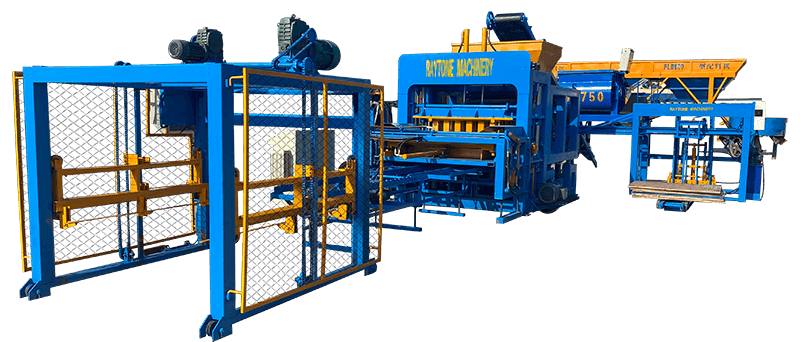






Choosing between stationary and mobile block making machines isn’t about which technology is “better”—it’s about matching equipment capabilities to your production requirements, site constraints, and business model. A mobile machine delivering flexibility for contractors across multiple rural sites becomes a bottleneck for centralized plants targeting 8,000 blocks daily. Conversely, stationary systems dominating high-volume production sit idle on projects needing only 1,200 blocks over three weeks.
This comparison draws from real installation data across Africa, Southeast Asia, and Latin America, where both machine types serve distinct, profitable niches.
Understanding the Core Difference
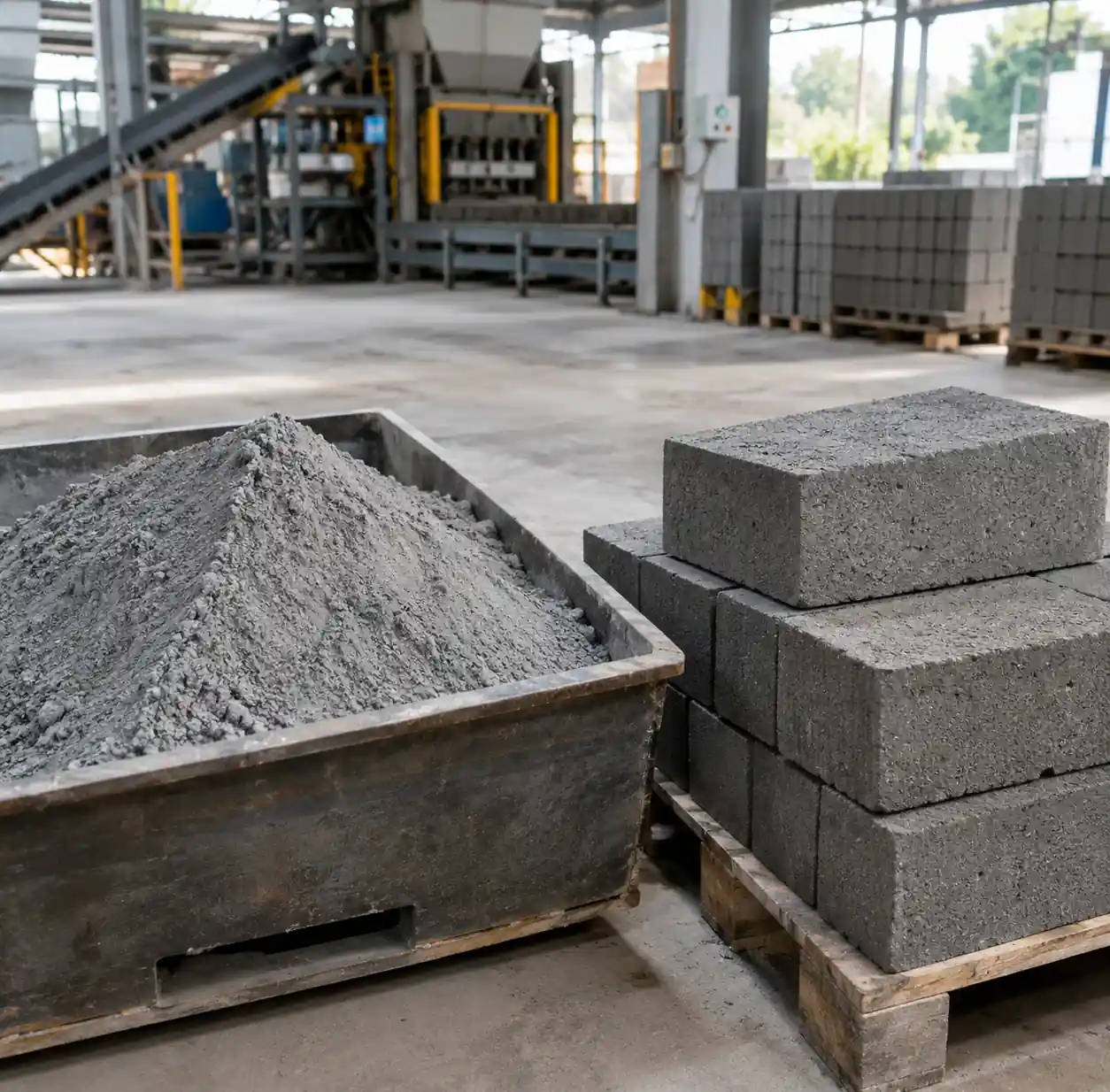
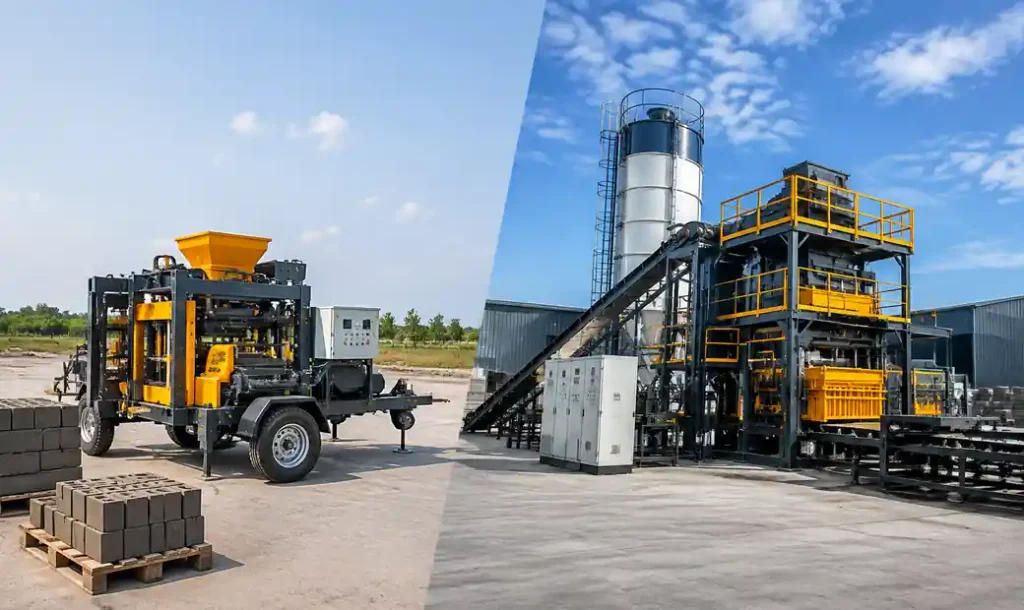
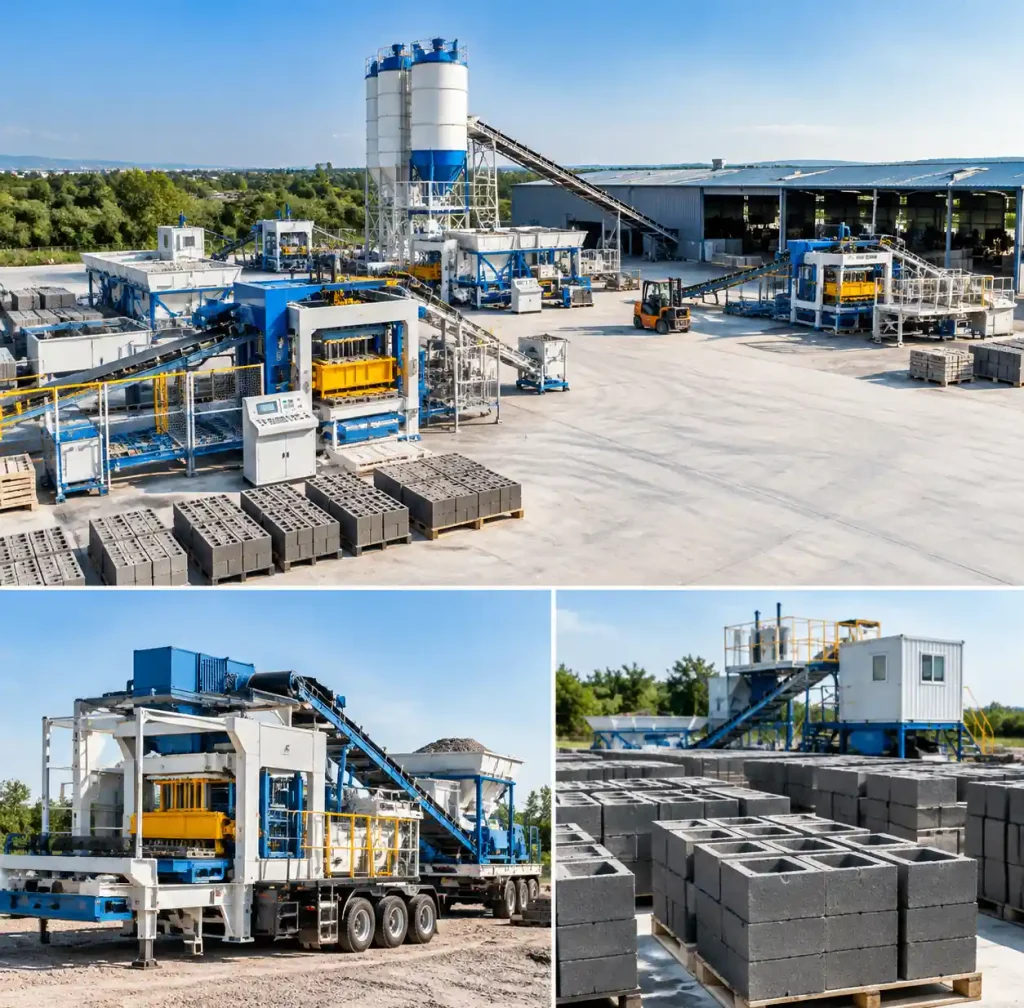
Stationary machines are permanent installations designed for centralized, high-volume manufacturing. They require foundation work, utility connections, and material handling infrastructure. Investment ranges from $15,000 for basic semi-automatic units to $50,000+ for fully automated lines, with setup costs adding $5,000-$30,000.
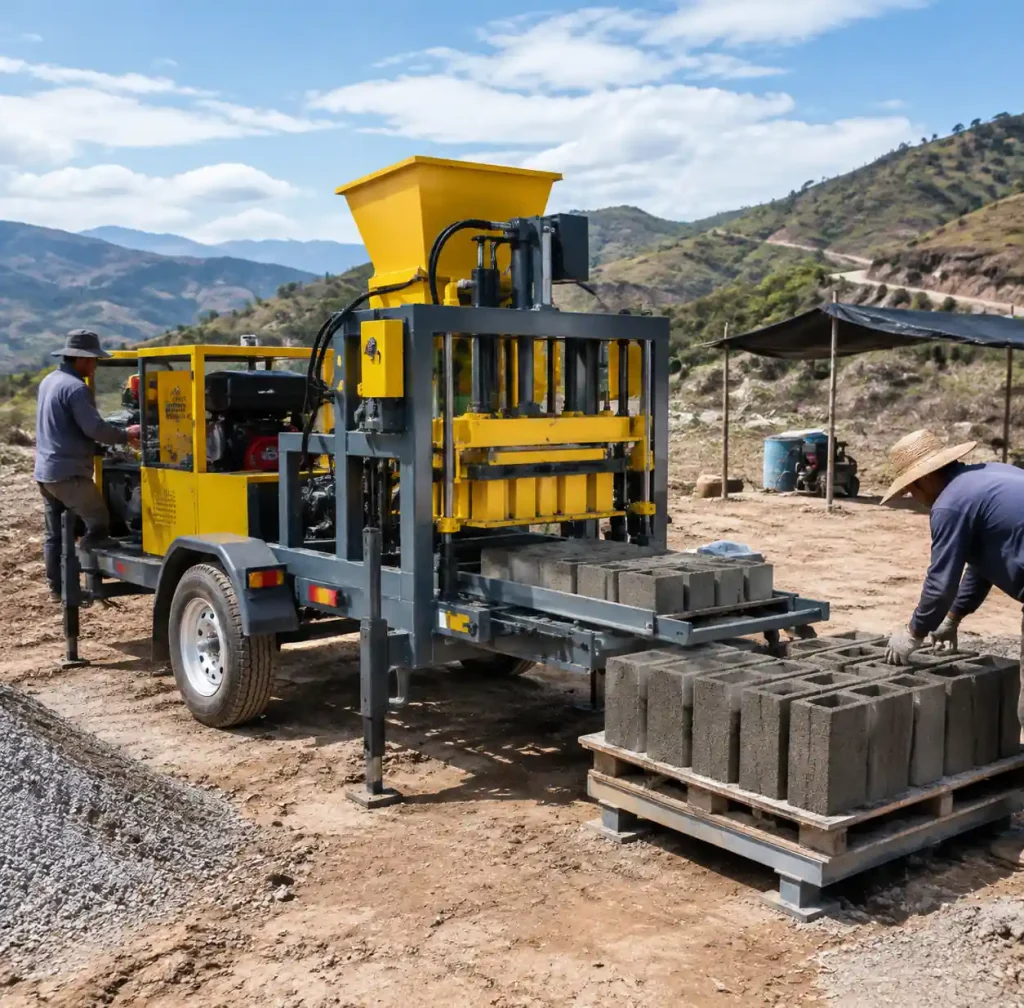
Mobile machines are self-contained units that move to where blocks are needed. They operate on prepared ground without permanent foundations, running on diesel generators or temporary power. Investment spans $2,500-$10,000 with minimal site preparation beyond a level working surface.
Production Capacity Comparison
| Machine Type | Blocks per 8-Hour Shift | Blocks per Hour | Typical Crew Size |
|---|---|---|---|
| Mobile (Egg Layer) | 100-800 | 12-100 | 2-3 operators |
| Mobile (Hydraulic) | 800-4,000 | 100-500 | 3-4 operators |
| Stationary Manual | 1,000-3,000 | 125-375 | 4-6 operators |
| Stationary Semi-Auto | 3,000-8,000 | 375-1,000 | 3-4 operators |
| Stationary Fully Auto | 8,000-46,080 | 1,000-5,760 | 2-3 operators |
A mobile block machine producing 2,400 blocks per shift serves contractors building three houses simultaneously. Scaling to ten houses monthly requires 7,200-9,000 blocks weekly—semi-automatic stationary territory.
Setup and Installation Requirements
Mobile machines deliver immediate deployment—drive to site, level the ground, connect power, and start production within 2-4 hours. No permits, no foundation curing, no utility installation delays. When projects finish, load and relocate.
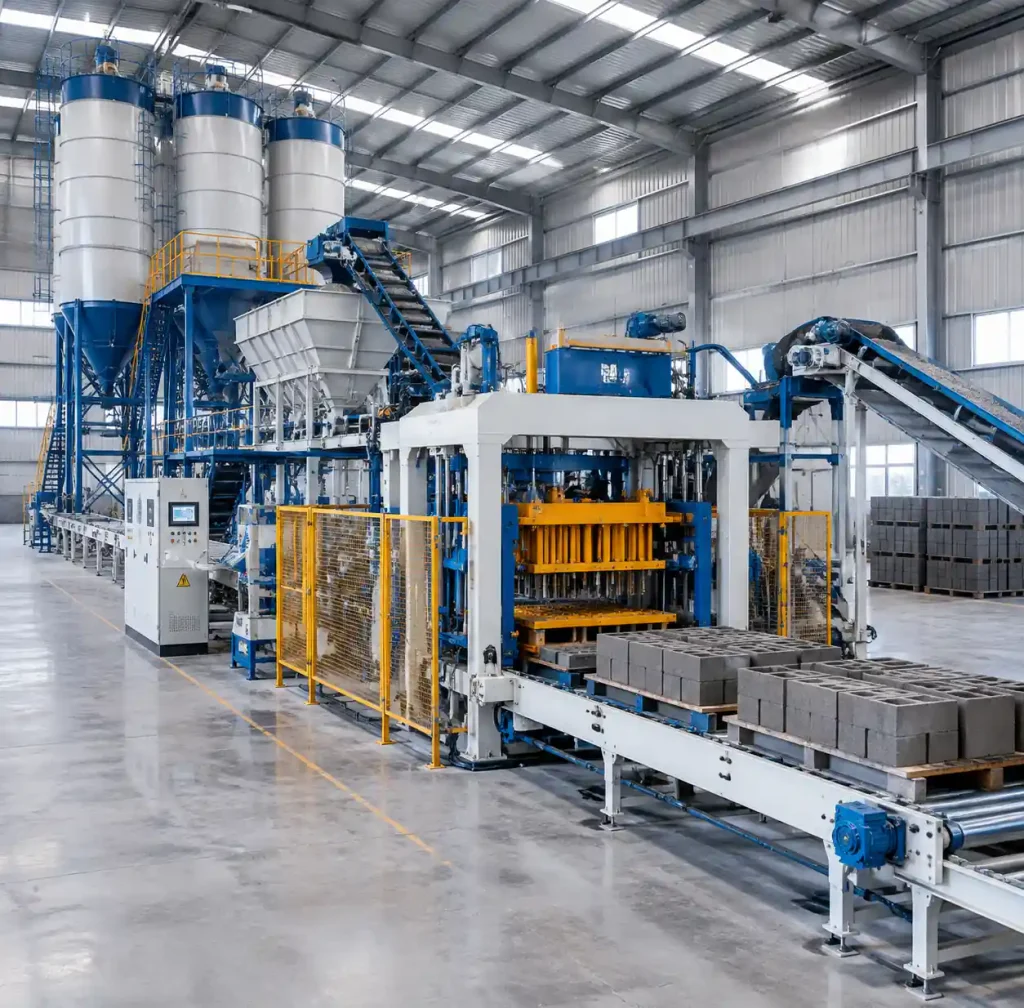
Stationary machines require 3-16 weeks of preparation. Foundation work, three-phase electrical installation, water connections, curing yard layout, and equipment commissioning all precede production. Basic semi-automatic installations take 3-4 weeks. Fully automatic block plants with integrated systems require 8-16 weeks.
The infrastructure investment returns through higher output, consistent quality, and automated material handling—programmable mixers, conveyor systems, and controlled curing schedules.
Investment and Operating Costs
Capital Investment Comparison
| Cost Category | Mobile Machine | Stationary Semi-Auto | Stationary Fully Auto |
|---|---|---|---|
| Equipment | $2,500-$10,000 | $15,000-$35,000 | $80,000-$230,000 |
| Site Preparation | $500-$2,000 | $5,000-$15,000 | $20,000-$80,000 |
| Installation | $0-$500 | $2,000-$5,000 | $15,000-$40,000 |
| Equipamento auxiliar | $1,000-$3,000 | $8,000-$20,000 | Included in line |
| Total Setup | $4,000-$15,500 | $30,000-$75,000 | $115,000-$350,000 |
Operating Economics
Labor dominates mobile operations. Producing 2,000 blocks daily with 3-4 operators at $15-25 each costs $22.50-$50.00 per 1,000 blocks in labor alone. Semi-automatic stationary systems producing 7,000 blocks daily yield $6.43-$14.29 per 1,000 blocks—a 60-70% reduction. Fully automatic systems drop to $1.67-$5.00 per 1,000 blocks.
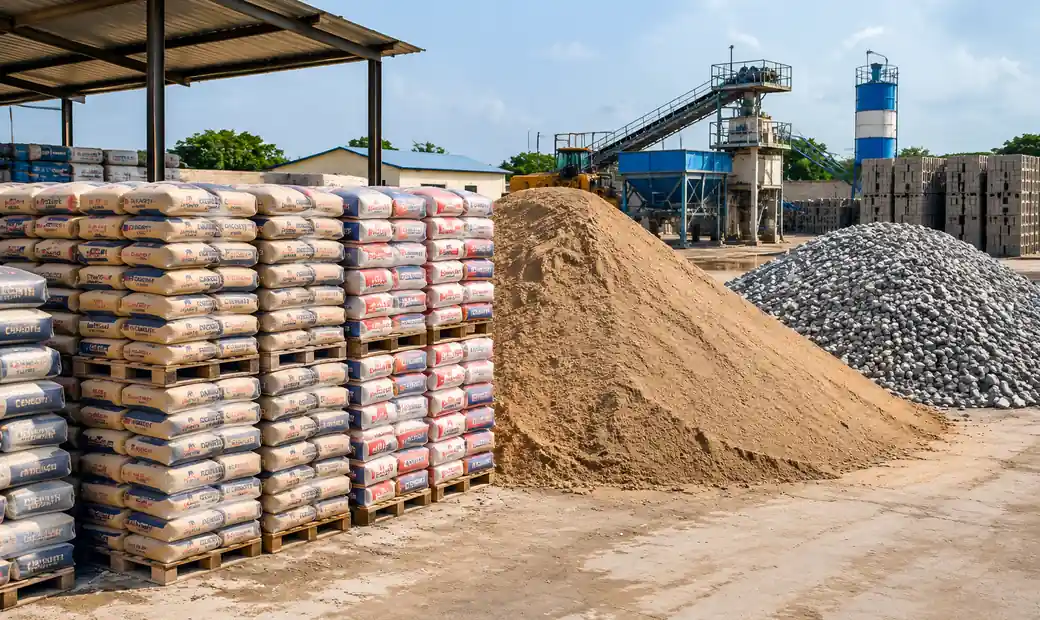
Material and power costs remain consistent at $40-65 per 1,000 blocks. Labor differential drives per-unit economics.
Transportation Economics
Mobile machines eliminate finished block transportation costs of $0.10-$0.25 per block. For projects 20-50 kilometers from suppliers, transportation adds $100-250 per 1,000 blocks—often exceeding manufacturing costs. A contractor building 40 kilometers from the nearest supplier saves $180-220 per 1,000 blocks. Over 30,000 blocks, that’s $5,400-$6,600 saved—covering the mobile machine purchase.
Stationary plants benefit from delivery scale—trucks carrying 3,000-4,000 blocks serve multiple customers per route, spreading costs. Operators often charge delivery fees, converting transportation from cost to revenue.
Power Supply Considerations
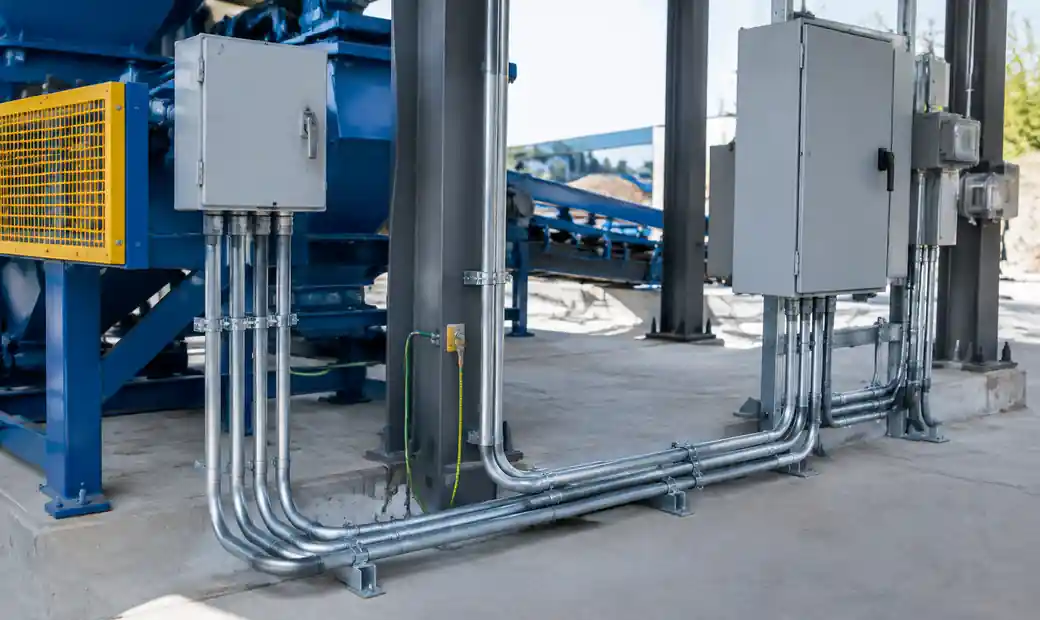
Stationary machines require stable electrical infrastructure—7-15 kW for semi-automatic systems, 25-60 kW for fully automatic lines. Unreliable grid power requires backup generators ($8,000-25,000) plus fuel costs during outages.
Mobile machines frequently run on diesel engines, providing power independence. Fuel consumption: 8-15 liters per shift for 1,500-3,000 blocks. At $1.20-1.80 per liter, that’s $3.20-9.00 per 1,000 blocks. Grid-connected stationary operations pay $0.08-0.18 per kWh, costing $6.40-21.60 per shift—significantly less but requiring reliable infrastructure.
Quality and Consistency
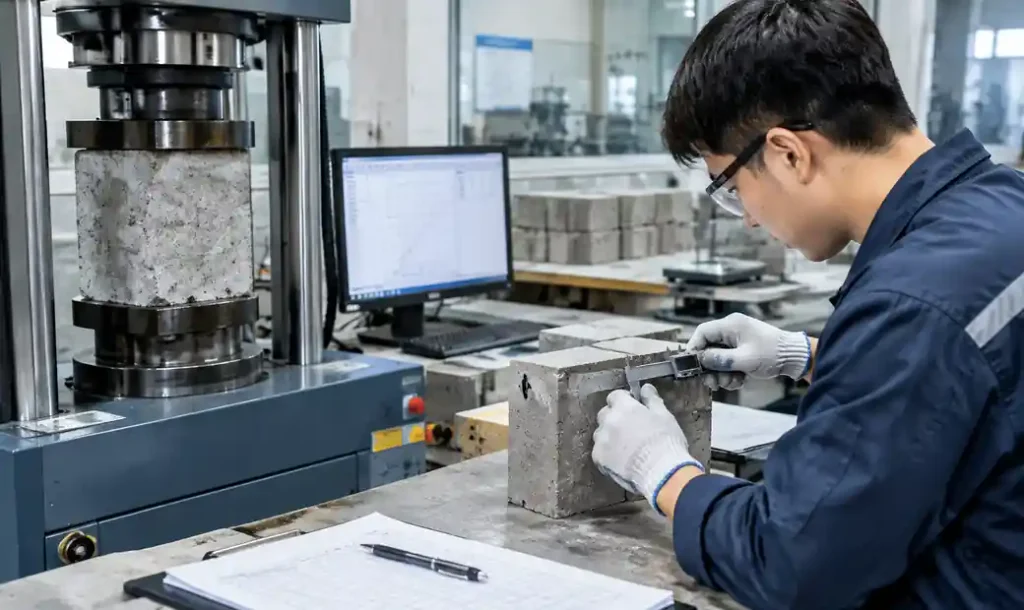
Stationary machines operating in controlled environments achieve block strength variation of 3-5%—critical for structural applications. Mobile production introduces variables: outdoor temperature fluctuations, manual batching inconsistencies, and ground vibration variations. Strength variation typically runs 8-15%, acceptable for non-structural applications.
Quality control measures—pre-batched materials, consistent water-cement ratios, and controlled curing—can bring mobile production to 6-10% variation, workable for most residential construction.
Maintenance and Durability
Mobile machines feature simpler systems with 6-10 grease points and straightforward hydraulics. Operators with basic mechanical skills handle routine maintenance. Critical spares (hoses, seals, bearings) cost $200-400 for a complete set. Service life: 8-12 years.
Stationary automatic systems incorporate PLC controls, multiple hydraulic circuits, and automated systems requiring 45-90 minutes daily maintenance. Operators stock $2,000-5,000 in critical spares and need higher technical skills. Properly maintained systems deliver 15-30 years of service depending on automation level.
Project Suitability
When Mobile Machines Excel
Remote construction projects: Sites 30+ kilometers from suppliers where transportation exceeds $150 per 1,000 blocks.
Multiple small projects: Contractors managing 3-6 concurrent sites each requiring 8,000-15,000 blocks.
Infrastructure-limited areas: Locations without reliable electrical service or facing permitting delays.
Owner-builder projects: Developers constructing their own buildings needing 20,000-50,000 blocks over 6-12 months.
When Stationary Systems Dominate
Centralized commercial production: Manufacturers serving customers within 30-50 kilometer radius, producing 5,000+ blocks daily with multiple product lines.
Large-scale housing developments: Projects requiring 200,000-500,000+ blocks where consistent quality and volume justify dedicated facilities.
Industrial and infrastructure projects: Applications demanding tight strength tolerances and documented quality control.
Urban locations: Areas with stable grids, available industrial land, and customer concentration supporting centralized distribution.
Scaling and Growth Strategies
Mobile operators scale horizontally—adding more units across different sites. Three mobile machines produce 6,000-9,000 blocks daily with flexibility to redeploy. Each machine requires its own crew, so labor costs per 1,000 blocks remain constant regardless of fleet size.
Stationary operators scale vertically through capacity upgrades. Starting with semi-automatic (7,000 blocks/shift), operators upgrade to fully automatic (30,000-45,000 blocks/shift). Labor requirements increase minimally—from 3-4 to 4-6 operators—while output quintuples. Labor cost per 1,000 blocks drops 70-80%.
Decision Framework
Key Questions:
- Target daily production? Under 3,000 blocks: mobile or manual stationary. 3,000-10,000: semi-automatic stationary. Above 10,000: fully automatic.
- Reliable electrical infrastructure? No grid or frequent outages favor diesel mobile machines. Stable power enables efficient automatic production.
- Customer concentration? Customers within 20-30 kilometers support centralized stationary production. Scattered remote projects favor mobile deployment.
- Available capital? Under $20,000: mobile or basic manual. $30,000-80,000: semi-automatic. Above $150,000: fully automatic.
- Quality requirements? Non-structural residential accepts mobile production. Engineered construction requires stationary production with documented QC.
Hybrid Approaches
Sophisticated operators deploy both strategically. Centralized stationary plants handle volume production for urban customers while mobile units serve remote projects where on-site production provides unique value. This captures advantages of both approaches—efficient high-quality production at scale plus premium-priced revenue from specialized applications.
Combined operations smooth demand fluctuations and build defensible competitive advantages across multiple market segments.
Frequently Asked Questions
Can mobile machines produce the same quality blocks as stationary systems?
Mobile machines produce structurally sound blocks meeting residential standards, but with higher variation (8-15%) versus stationary production (3-5%). For non-structural applications and residential use, mobile quality suffices. Engineered construction requiring tight tolerances needs stationary production with controlled curing.
What’s the realistic payback period for each machine type?
Mobile machines targeting remote areas pay back in 4-8 months when transportation savings exceed $150 per 1,000 blocks. Stationary semi-automatic systems recover investment in 12-18 months. Fully automatic plants require 18-30 months depending on capacity utilization.
Can I start with mobile and upgrade to stationary later?
Yes. Many operators follow this path—start with mobile production to prove market demand with minimal capital risk. After 12-18 months of sustained demand, install stationary capacity while keeping mobile equipment for remote projects or backup.
Which machine works better in areas with unstable electricity?
Mobile machines with diesel engines operate independently of grid power, making them reliable for frequent outage areas. Stationary machines require generator backup ($8,000-25,000) plus fuel costs. If grid power runs under 6-8 hours daily, diesel mobile machines prove more economical.
How do maintenance costs compare?
Mobile machines cost $800-1,500 annually ($0.40-0.75 per 1,000 blocks) due to simpler systems. Stationary semi-automatic systems run $2,000-4,000 annually ($0.15-0.35 per 1,000 blocks). Fully automatic systems cost $5,000-12,000 annually ($0.10-0.25 per 1,000 blocks) through higher volume.
What’s the minimum land requirement for stationary plants?
Semi-automatic plants producing 7,000 blocks daily need 600-1,000 square meters including production area, curing yard, and material storage. Fully automatic facilities producing 30,000+ blocks daily require 1,500-3,000 square meters. Mobile machines need only 100-200 square meters of level ground plus storage area.
Which type handles different block designs better?
Stationary machines with interchangeable molds handle multiple products efficiently. Mold changes take 15-30 minutes, enabling varied production within shifts. Mobile machines typically run single configurations—changing designs requires downtime and different mold sets, best suited for single-product runs.
Conclusão
The stationary versus mobile decision reflects your business model more than equipment capabilities. Mobile machines deliver location flexibility and low capital entry for contractors, remote projects, and market testing. Stationary systems provide efficient, high-volume production for commercial manufacturers serving concentrated markets.
Neither is universally superior. Mobile machines generate profitable returns where on-site production eliminates transportation costs. Stationary plants dominate markets where volume, variety, and consistent quality justify infrastructure investment. Successful operators recognize these serve different strategic purposes—starting mobile to prove demand before stationary investment reduces risk, while hybrid strategies deploying both types capture advantages across market segments.
Your choice depends on target market, available capital, production requirements, and infrastructure access—not which technology is “better.”
Sources: