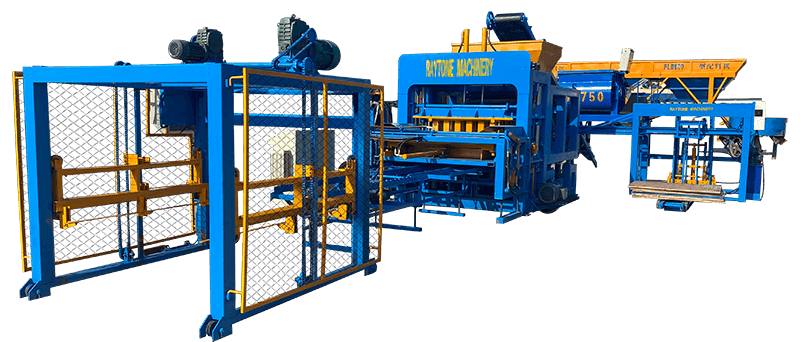






Precast concrete flooring accounts for over 35% of modern commercial building construction, with hollow core slabs representing the most efficient solution for mid-rise structures. These prestressed concrete elements reduce floor weight by 40% compared to solid slabs while maintaining superior load capacity and spanning capabilities up to 12 meters without intermediate supports.
This guide covers hollow core slab machine technology, production processes, extruder versus slipformer systems, technical specifications, investment costs, and production economics. You’ll understand which machine type fits your manufacturing scale and how automated extrusion technology delivers consistent quality for residential towers, parking structures, and commercial developments.
What is a Hollow Core Slab Machine?
A hollow core slab machine is specialized equipment that produces precast, prestressed concrete floor and roof elements containing continuous longitudinal voids. The machine extrudes or slipforms concrete over prestressed steel strands while simultaneously forming hollow cores that reduce material weight without compromising structural performance.
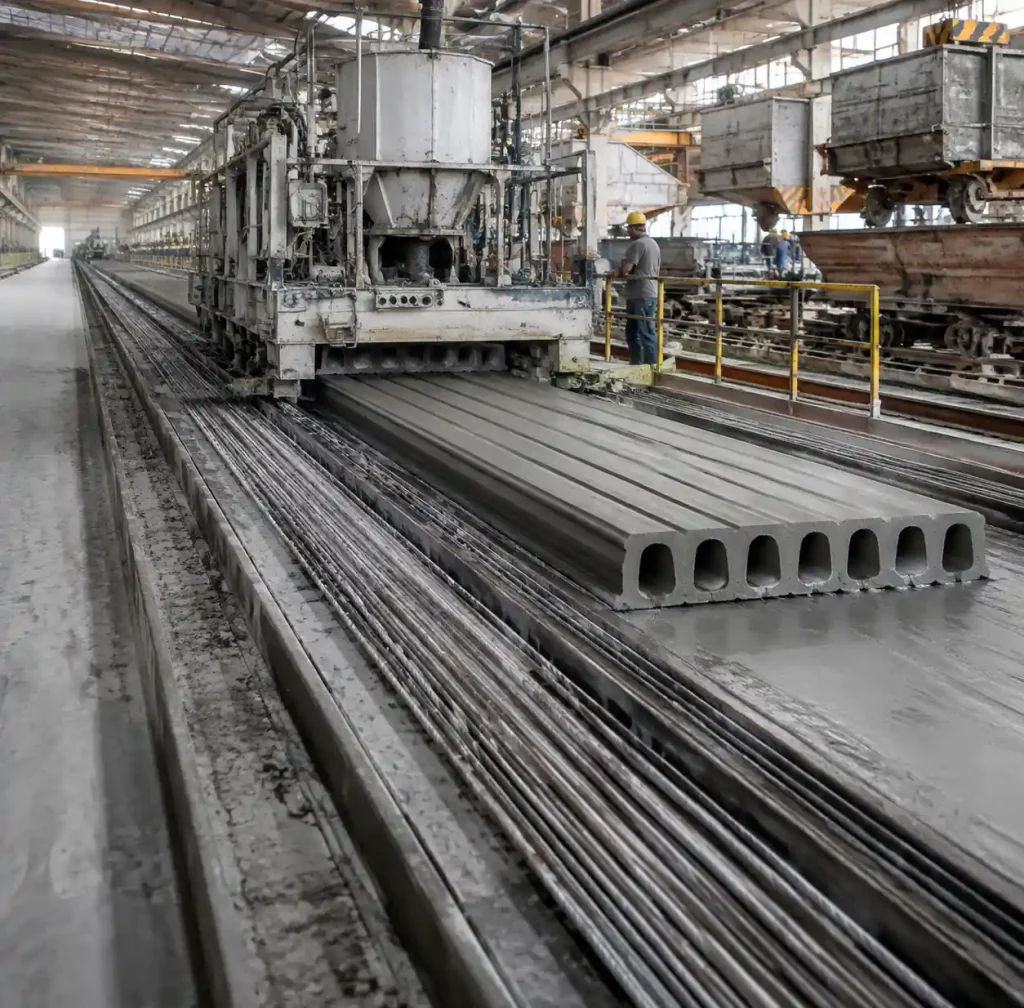
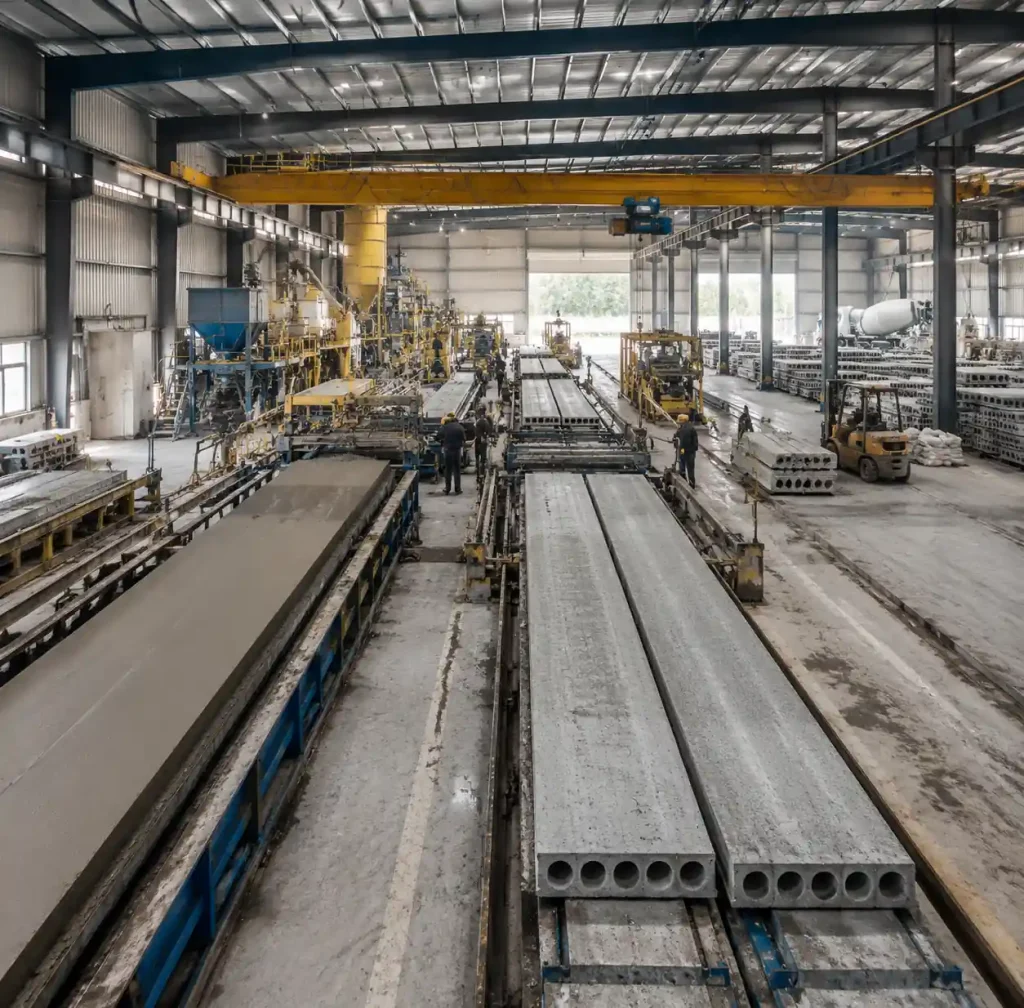
Modern hollow core slab machines operate on prepared casting beds ranging from 100 to 150 meters in length. The equipment travels along these beds, depositing concrete through precision molds while internal mandrels or tubes create the characteristic voids. Production capacity ranges from 200 to 800 square meters per 8-hour shift depending on machine sophistication and slab dimensions.
Core Components of Hollow Core Slab Production Lines
Complete production systems integrate five essential subsystems that work together for efficient manufacturing.
Prestressing equipment tensions steel strands before concrete placement. Hydraulic jacks apply forces between 150 kN and 250 kN per strand, creating the prestress that enables long spans and high load capacity. You can install tensioning equipment at one or both ends of the casting bed.
Concrete batching and mixing plants supply the specialized zero-slump concrete required for extrusion. Twin-shaft mixers produce the stiff consistency necessary for shape retention as the machine advances. Material delivery systems use overhead conveyors or concrete distribution carts that travel along the casting bed.
Extrusion or slipforming machines form the slabs through continuous motion along the bed. These machines contain the mold cavity, compaction systems, and core-forming mechanisms. Modern extruders achieve production speeds of 0.8 to 1.2 meters per minute.
Cutting and finishing equipment includes longitudinal saws for trimming slab edges, transverse saws for length cuts, and core drilling equipment for creating openings. Automated systems improve accuracy and reduce labor requirements.
Bed preparation and handling systems clean and oil casting surfaces, position prestressing strands, and later lift finished slabs for transport to curing areas or direct loading.
Extruder vs Slipformer Technology
The choice between extruder and slipformer technology fundamentally shapes your production capabilities and operating economics.
Extruder Machines
Extruders dominate hollow core slab manufacturing, with approximately 90% of producers worldwide using this technology. The machine advances along the casting bed while auger screws feed concrete into a steel mold. Vibration and controlled three-dimensional motion at approximately 10 Hz compact the concrete as internal mandrels form the voids.
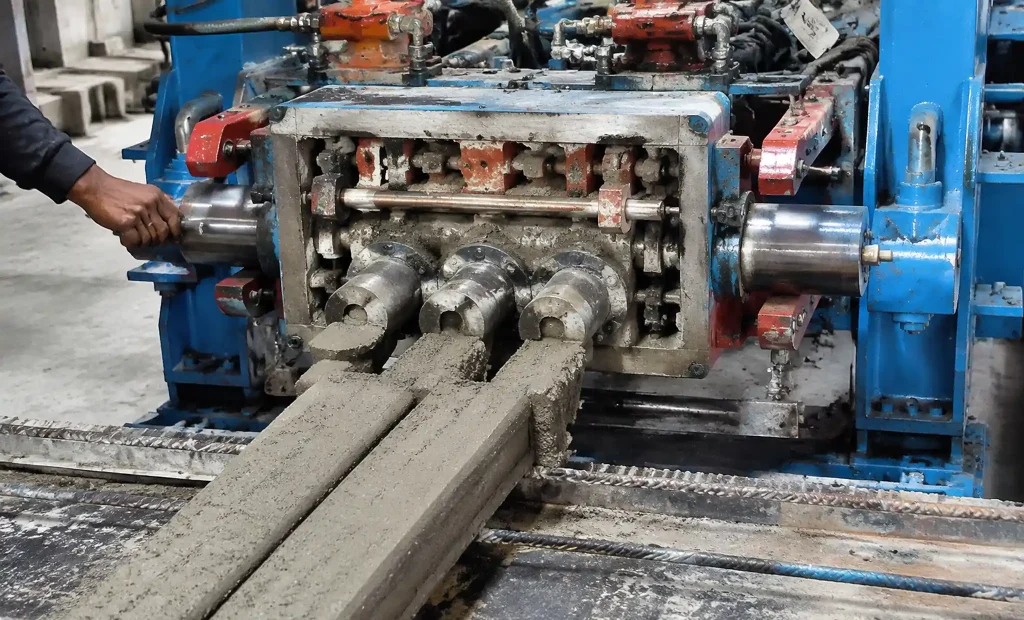
Material efficiency advantage: Modern extruders require 30% less concrete than slipformers and save up to 100 kg/m³ of cement. This efficiency comes from superior compaction and precise material placement. Over a production year of 50,000 square meters, cement savings alone can reach $75,000 to $100,000.
Production range: Extruders produce hollow core slabs from 120mm to 500mm in height and 400mm to 2,400mm in width. This range covers standard floor applications in residential and commercial construction. The Elematic Extruder P7 serves as the industry benchmark for dedicated hollow core production.
Product focus: Extruders optimize for hollow core slabs specifically. While some advanced models produce narrow variations, the technology excels at high-volume production of standard floor elements rather than diverse precast shapes.
Slipformer Machines
Slipformers use a different compaction method with higher vibration frequencies and less controlled material feeding. The concrete mix must have slightly higher workability to flow through the slipform mold as the machine advances.
Product versatility: Slipformers can produce hollow core slabs plus piles, poles, solid slabs, wing-slabs, walls, and stadium elements. This flexibility matters when your facility serves diverse precast markets rather than focusing exclusively on flooring systems.
Material consumption: Slipformers use more concrete per square meter due to less efficient compaction. The higher cement requirement increases operating costs but may be acceptable when product versatility justifies the premium.
Market position: Slipformers remain the choice for precast plants producing multiple product lines from shared equipment. The Elematic E9 slipformer demonstrates multi-product capabilities beyond standard hollow core.
| Feature | Extruder | Slipformer |
|---|---|---|
| Market share | 90% of hollow core producers | 10% of hollow core producers |
| Cement consumption | Baseline | +100 kg/m³ |
| Concrete requirement | Baseline | +30% |
| Slab height range | 120-500mm | 100-500mm |
| Product variety | Hollow core focused | Multiple precast types |
| Compaction frequency | ~10 Hz controlled | Higher frequency vibration |
| Material efficiency | Superior | Standard |
| Investment cost | $90,000-$450,000 | $120,000-$500,000 |
Choose an extruder when your business focuses on hollow core slab production and material efficiency drives profitability. Choose a slipformer when your facility must produce diverse precast elements beyond flooring systems.
Hollow Core Slab Production Process
Understanding the production sequence helps you optimize facility layout, staffing, and quality control procedures.
Step 1: Bed Preparation
Production begins with cleaning the casting bed surface and applying release agents. Operators remove concrete residue from previous production runs and inspect the bed for damage or irregularities. Proper surface preparation prevents bond issues and ensures finished slabs release cleanly.
Workers position prestressing strands through the bed length using strand placement systems. Strand spacing follows engineering drawings specific to each slab design. Typical layouts use 7-wire strands at 50mm to 100mm centers depending on load requirements.
Step 2: Prestressing
Hydraulic tensioning equipment stretches steel strands simultaneously. Operators monitor tension force using load cells and adjust jacks to achieve specified prestress levels. Standard practice applies 150 kN to 200 kN per strand for Grade 1860 MPa steel.
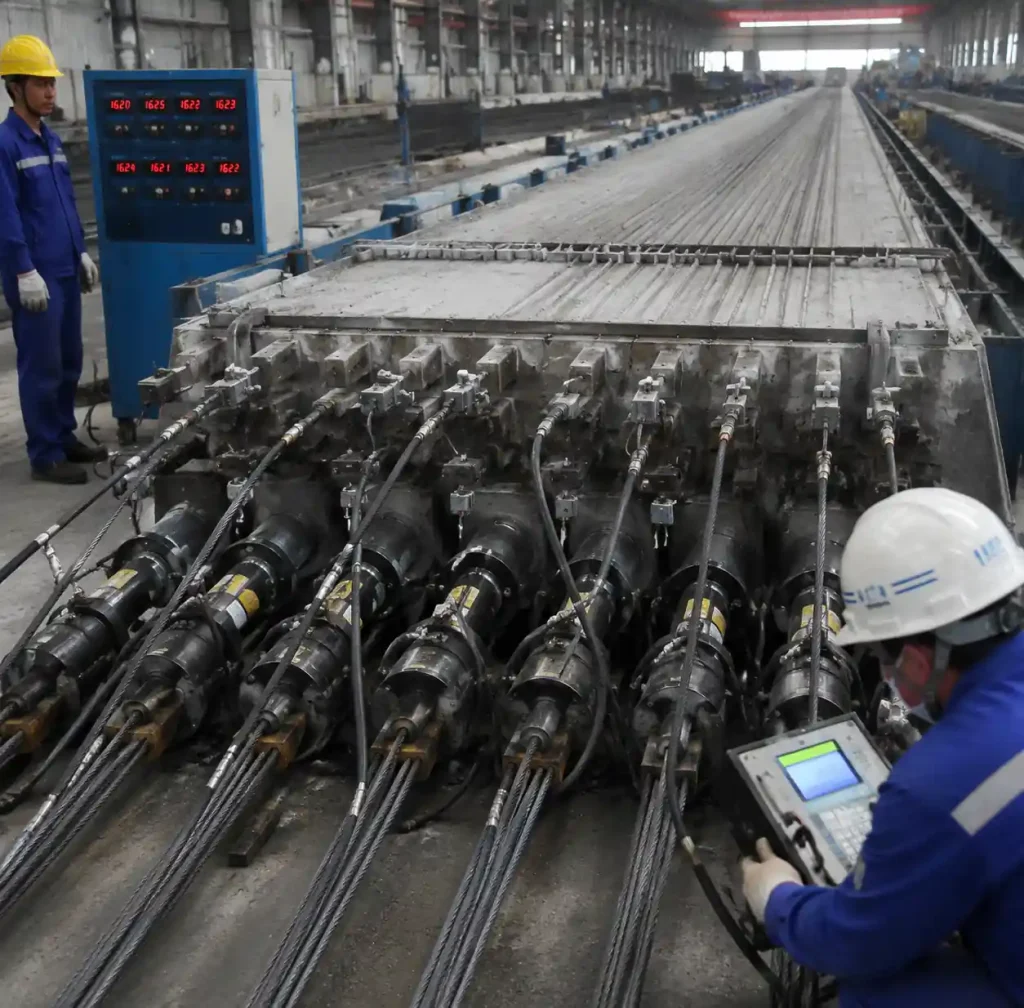
The prestress creates compressive forces in the finished concrete that counteract service loads. This principle allows hollow core slabs to span longer distances than reinforced concrete of equal depth while using less material.
Step 3: Concrete Extrusion
The mixing plant delivers zero-slump concrete with compressive strengths typically ranging from 40 MPa to 60 MPa. High early strength mixes enable next-day strand release and faster production cycles.
As the extruder advances along the bed, auger feeders distribute concrete into the mold cavity. Vibration and controlled motion compact the material around prestressing strands and core-forming mandrels. Production speed ranges from 0.8 to 1.2 meters per minute depending on slab height and concrete properties.
The machine deposits a continuous ribbon of concrete with integrated hollow cores. Modern extruders maintain dimensional tolerances within ±2mm across the slab width and ±1mm in height.
Step 4: Post-Extrusion Operations
Immediately after extrusion, operators mark slab lengths, create transverse cuts for openings, and install lifting anchors if specified. This work occurs while concrete remains workable but has sufficient green strength to maintain shape.
Temperature and humidity monitoring begins during initial curing. Many plants use insulated covers or steam curing to accelerate strength development. Target release strength typically reaches 30 MPa to 35 MPa within 16 to 24 hours.
Step 5: Strand Release and Cutting
Once concrete achieves release strength, hydraulic strand cutters sever prestressing steel at bed ends. The prestress transfers into the concrete, creating the compressive forces that enable long spans. Operators hear characteristic pinging sounds as strands release and seat into the concrete.
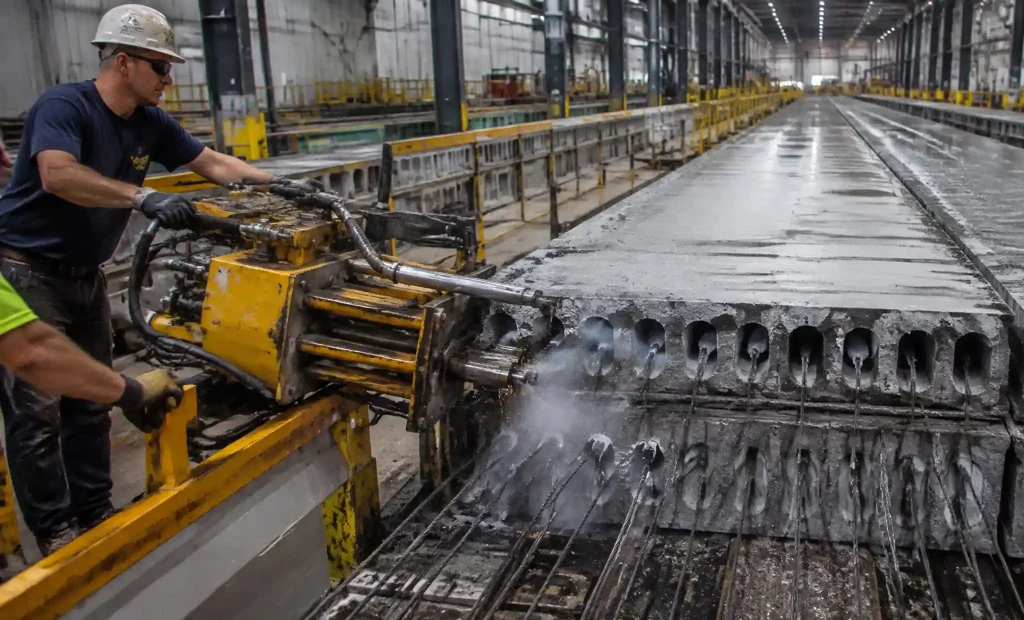
Transverse saws cut the continuous slab ribbon into specified lengths. Longitudinal saws trim edges to final width dimensions. Automated sawing systems improve accuracy and reduce cutting time to 2-3 minutes per slab.
Step 6: Handling and Storage
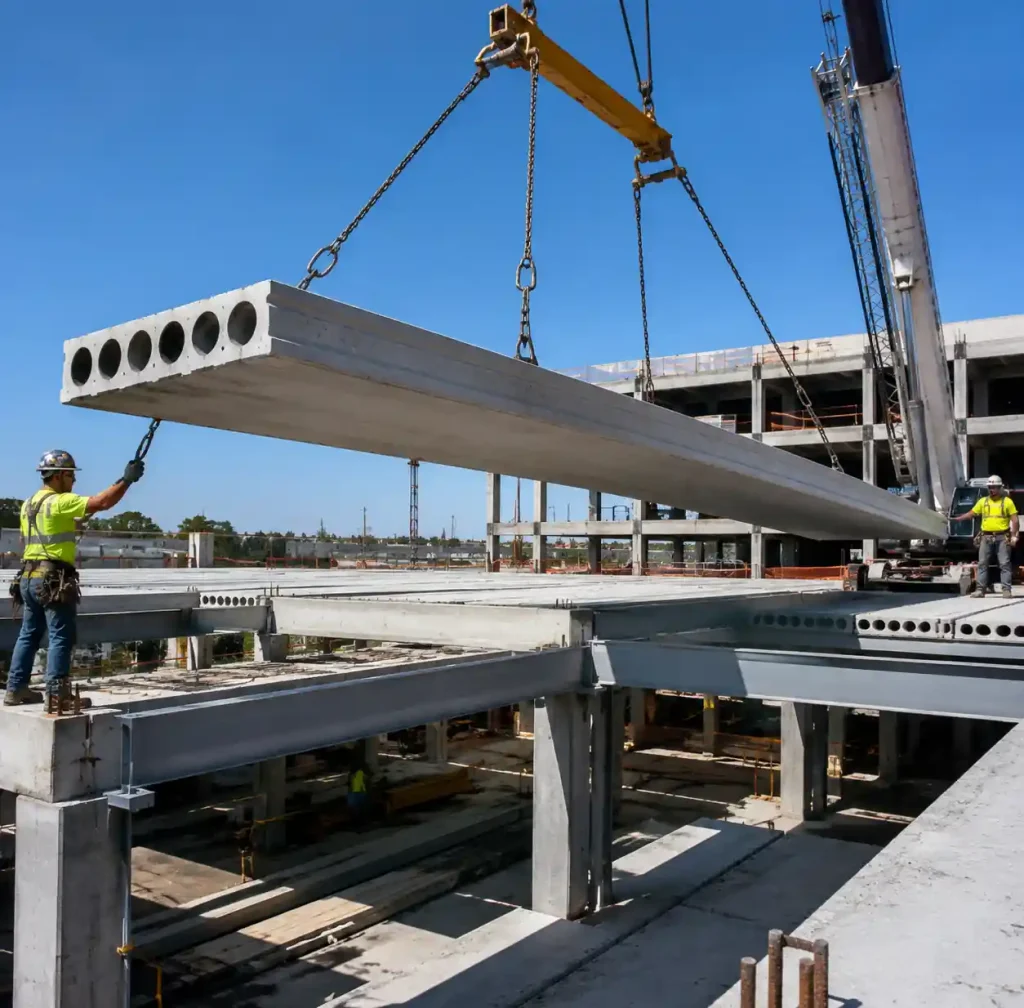
Overhead cranes or specialized lifting equipment move finished slabs from casting beds to storage yards or directly to delivery trucks. Proper lifting point location prevents cracking during handling. Most slabs cure vertically in storage racks to minimize yard space requirements.
Full design strength develops over 28 days, though slabs can ship for installation as soon as 3 to 7 days after production once minimum strength and dimensional stability requirements are met.
Technical Specifications and Production Capabilities
Modern hollow core slab machines accommodate wide ranges of dimensions and configurations to serve diverse construction applications.
Dimensional Ranges
| Specification | Standard Range | Maximum Capability |
|---|---|---|
| Slab thickness | 150mm – 400mm | 120mm – 500mm |
| Slab width | 600mm – 1,200mm | 400mm – 2,400mm |
| Slab length | 4m – 10m | Up to 12m |
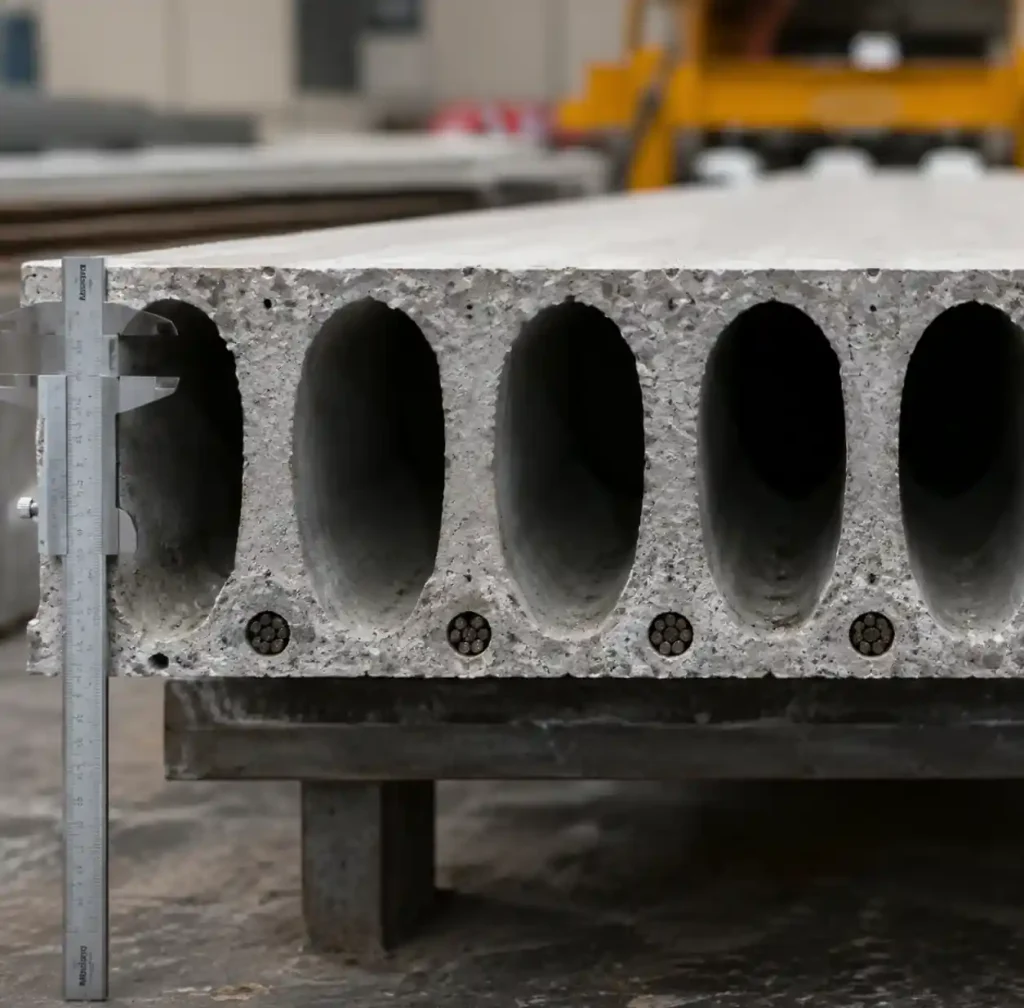
| Core diameter | 100mm – 200mm | Varies by thickness |
| Number of cores | 4 – 8 | 3 – 10 |
| Prestressing strand | 9.3mm – 15.2mm | 7-wire Grade 1860 |
Production capacity: A single extruder line produces 200 to 800 square meters per 8-hour shift. Actual output depends on slab thickness, production run length, and changeover frequency. Facilities running standard 200mm slabs in long production runs achieve higher daily output than operations with frequent dimension changes.
Casting bed length: Most plants install beds ranging from 100 to 150 meters. Longer beds reduce setup time per unit area but require more facility space and higher material handling capacity. Bed width accommodates 8 to 16 slabs side by side depending on individual slab widths.
Load Capacity and Performance
Hollow core slabs carry superimposed loads from 2.5 kN/m² to 10 kN/m² depending on thickness, span, and prestress level. Residential floor applications typically require 2.5 to 5 kN/m² capacity, while commercial floors need 5 to 7.5 kN/m² or higher.
The hollow cores reduce slab self-weight by 40% compared to solid concrete floors of equal depth. A 200mm hollow core slab weighs approximately 280 kg/m² versus 480 kg/m² for solid construction. This weight reduction lowers structural frame requirements and foundation loads throughout the building.
Span capabilities:
- 150mm slabs: 4m to 6m spans
- 200mm slabs: 6m to 8m spans
- 265mm slabs: 8m to 10m spans
- 320mm slabs: 10m to 12m spans
- 400mm slabs: 12m to 15m spans
Concrete Mix Requirements
Hollow core production requires specialized zero-slump mixes with high cement content and carefully controlled aggregate gradation. Typical mix designs use 400 to 500 kg/m³ cement, fine aggregate (sand) at 40-45% of total aggregate volume, and coarse aggregate sized 8mm to 16mm.
The stiff consistency enables the extruded concrete to maintain shape immediately after the machine passes. Standard slump cone tests yield zero measurable slump, with consistency evaluated instead by compacting factor or Vebe time tests.
Investment Costs and Production Economics
Total investment for hollow core slab manufacturing varies significantly based on production scale, automation level, and facility infrastructure.
Equipment Investment
Entry-level systems ($50,000 – $100,000): Basic extruders with manual controls and limited automation suit small plants producing 5,000 to 15,000 square meters annually. These systems require more labor and achieve lower material efficiency but provide accessible entry into hollow core manufacturing.
Mid-range production lines ($200,000 – $350,000): Semi-automated extruders with PLC controls, automatic concrete feeding, and integrated sawing equipment serve regional manufacturers producing 25,000 to 50,000 square meters per year. This category represents the most common investment level for established precast plants adding hollow core capacity.
High-end automated systems ($450,000 – $800,000): Fully automated lines with advanced controls, multiple product configurations, minimal labor requirements, and maximum material efficiency. Large-scale producers exceeding 75,000 square meters annually justify this investment through labor savings and production consistency.
| System Component | Entry-Level | Mid-Range | High-End |
|---|---|---|---|
| Extruder machine | $30,000-$50,000 | $120,000-$200,000 | $300,000-$450,000 |
| Prestressing equipment | $8,000-$12,000 | $25,000-$35,000 | $50,000-$75,000 |
| Concrete batching plant | Existing facility | $35,000-$60,000 | $80,000-$150,000 |
| Cutting equipment | $5,000-$8,000 | $15,000-$25,000 | $40,000-$60,000 |
| Material handling | $7,000-$10,000 | $20,000-$30,000 | $45,000-$65,000 |
Facility Infrastructure
Casting bed construction: Steel or concrete beds with precise leveling and anchor systems cost $150 to $250 per linear meter. A 120-meter bed requires $18,000 to $30,000 investment. Facilities often install two or three parallel beds for continuous production.
Building requirements: Enclosed or semi-enclosed structures protect production from weather while allowing crane access. Budget $80 to $150 per square meter for basic steel-frame buildings with overhead doors. A 2,000 m² production facility costs $160,000 to $300,000.
Material handling equipment: Overhead bridge cranes (15-30 ton capacity) range from $45,000 to $120,000 installed. Slab tilting and stacking equipment adds $25,000 to $60,000. Transportation forklifts and specialized trailers contribute another $40,000 to $80,000.
Curing and storage yards: Outdoor storage with vertical slab racks requires minimal investment beyond site preparation and rack fabrication. Budget $15 to $30 per square meter of storage capacity. Most plants allocate 3,000 to 5,000 m² for finished product staging.
Operating Economics
Production costs per square meter depend on material prices, labor rates, energy costs, and production volume. Representative cost structure for a mid-scale operation:
Materials (200mm hollow core slab):
- Concrete (0.12 m³/m²): $12-$16 per m²
- Prestressing strand (3.5 kg/m²): $4-$6 per m²
- Release agents and consumables: $0.80-$1.20 per m²
- Material subtotal: $16.80-$23.20 per m²
Direct labor (7-10 operators per line): $2.50-$4.50 per m² depending on regional wage rates and production volume.
Energy and utilities: $1.20-$2.00 per m² for concrete mixing, machine operation, and curing systems.
Total production cost: $20.50-$29.70 per m²
Hollow core slabs typically sell for $45 to $75 per square meter depending on regional market conditions, specifications, and delivery distance. Using mid-range pricing ($60/m²) and costs ($25/m²), gross margins reach $35 per m² or 58%.
A facility producing 40,000 m² annually generates $1,400,000 in gross profit before overhead and financing costs. With proper market development and operational efficiency, payback periods range from 18 to 36 months on total facility investment.
Applications and Market Demand
Hollow core slabs serve multiple construction segments with growing demand driven by construction speed advantages and sustainability benefits.
Residential Construction
Multi-story apartment buildings from 4 to 12 stories rely on hollow core floors for rapid construction schedules. Developers can complete one floor level per week when using precast slabs versus 2 to 3 weeks with cast-in-place construction. This acceleration reduces financing costs and accelerates project completion.
The smooth soffit finish eliminates ceiling work in many residential applications. Paint can apply directly to the concrete surface, reducing finishing costs by $8 to $15 per square meter compared to suspended ceiling systems.
Commercial Buildings
Office buildings, retail centers, and hotels use hollow core slabs for their combination of long spans and modest self-weight. The ability to span 8 to 10 meters between columns provides flexible interior layouts without intermediate support walls.
Sound insulation properties make hollow core slabs particularly suitable for hotels and multi-tenant buildings where acoustic separation between floors is critical. The combination of concrete mass and air voids achieves sound transmission class (STC) ratings of 50 to 55 without additional soundproofing.
Parking Structures
Parking facilities benefit from both the long spans and the reduced dead load of hollow core systems. Fewer columns improve traffic flow and parking efficiency. The lighter floor weight reduces foundation requirements in weak soil conditions.
Surface durability handles vehicle traffic and snow removal operations with minimal maintenance over 30 to 50 year service lives.
Industrial and Warehouse Facilities
Manufacturing plants and distribution centers use hollow core slabs for mezzanine floors and roof structures. The prestressed design accommodates concentrated equipment loads while maintaining economical construction costs.
Fire resistance ratings of 1 to 4 hours depending on thickness meet building code requirements without additional fire protection materials.
Quality Control and Standards
Hollow core slab manufacturing must comply with multiple standards governing materials, production processes, and finished product performance.
Key Standards and Certifications
ASTM C1030: Standard Specification for Fiber-Reinforced Concrete and Shotcrete (United States)
EN 1168: Precast Concrete Products – Hollow Core Slabs (European Union)
ACI 318: Building Code Requirements for Structural Concrete (United States)
ISO 9001: Quality Management Systems (International)
Production facilities implement quality control programs addressing concrete mix consistency, prestress levels, dimensional accuracy, strength development, and handling procedures.
Critical Quality Checkpoints
Fresh concrete testing: Slump or consistency measurements every 2 hours, compressive strength cylinders from each production run, and mix temperature monitoring ensure concrete properties remain within specification.
Prestress verification: Operators record strand tension force, elongation measurements, and transfer length after release. These parameters directly affect slab structural capacity and must stay within ±5% of design values.
Dimensional inspection: Width, depth, straightness, and core location measurements occur during production and after cutting. Automated measurement systems improve consistency over manual methods.
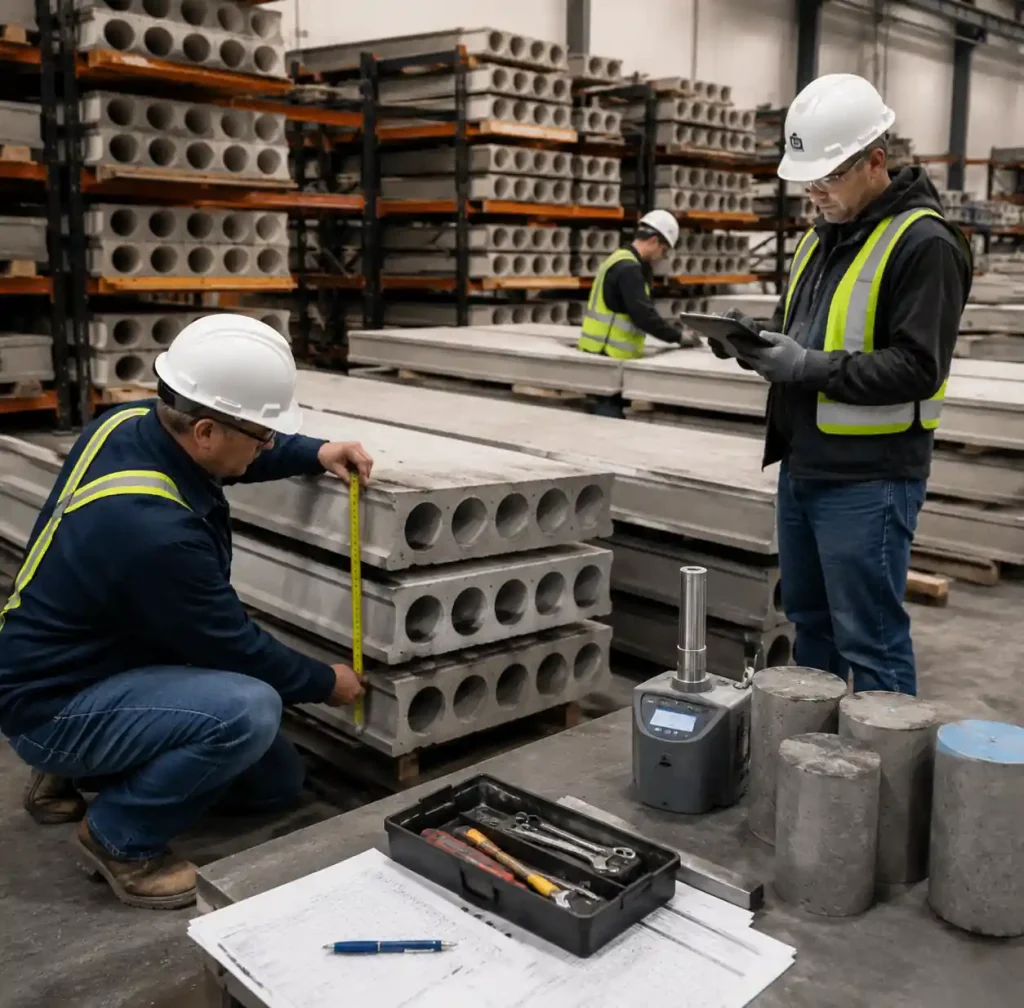
Strength testing: Cylinder breaks at release time (16-24 hours) and 28-day final strength verify concrete performance. Most plants also conduct periodic load testing on finished slabs to validate design assumptions.
Choosing the Right Hollow Core Slab Machine
Selecting appropriate equipment requires analysis of your production requirements, market conditions, and financial capacity.
Production volume threshold: If your confirmed demand exceeds 25,000 square meters annually with multi-year project pipelines, investing in dedicated hollow core equipment makes economic sense. Below this threshold, outsourcing to established producers or focusing on other precast products may deliver better returns.
Product mix requirements: Operations producing only floor slabs benefit from extruder technology’s material efficiency and lower operating costs. Facilities serving diverse precast markets need slipformer flexibility despite higher concrete consumption.
Technical capabilities: Hollow core production requires understanding prestressed concrete technology, quality control procedures, and specialized handling methods. Staff training programs typically span 3 to 6 months before operators achieve consistent production quality.
Facility infrastructure: Adequate land area, utility capacity (especially three-phase power for mixing and handling equipment), and crane access are prerequisites. Converting existing precast facilities costs less than building new dedicated plants.
Market positioning: Successful hollow core producers develop relationships with developers, general contractors, and architects early in project planning. Lead times from order to delivery typically run 2 to 4 weeks, requiring coordination with construction schedules.
Future Trends in Hollow Core Manufacturing
The hollow core slab industry continues evolving through automation improvements and sustainability innovations.
Automated production control: Advanced PLC systems now monitor concrete consistency, adjust extrusion speed based on material properties, and optimize compaction parameters in real-time. These systems reduce operator skill requirements while improving consistency.
Sustainable material innovations: Research into supplementary cementitious materials aims to replace 30-40% of cement content with fly ash, slag, or calcined clay. These substitutions reduce embodied carbon while maintaining structural performance.
Digital manufacturing integration: Building Information Modeling (BIM) connections between design software and production equipment enable direct fabrication from architectural models. This integration reduces engineering time and eliminates manual data transfer errors.
Lightweight core materials: Experimental systems using expanded polystyrene (EPS) cores instead of hollow voids achieve weight reductions up to 50% while improving thermal insulation. Market adoption depends on cost-effectiveness and code approval processes.
FAQs
What is the minimum production volume to justify a hollow core slab machine investment?
Plan for at least 20,000 to 25,000 square meters of confirmed annual demand before investing in dedicated equipment. At this volume, material savings and production speed advantages offset the capital investment within 24 to 36 months. Smaller operations should consider partnerships with existing producers or focus on complementary precast products with shorter payback periods.
How long does installation and commissioning take for a new hollow core production line?
Casting bed construction requires 4 to 6 weeks including concrete curing time. Equipment installation takes 2 to 3 weeks. Operator training and process optimization add 6 to 8 weeks before reaching consistent production quality. Budget 4 to 5 months from facility preparation to reliable full-scale production.
Can hollow core slab machines produce other precast concrete elements?
Extruders focus on hollow core slabs within their height and width ranges. Slipformers can produce piles, poles, solid slabs, and other prestressed shapes by changing molds. If you need product variety beyond flooring, choose slipformer technology despite its higher material consumption.
What is the typical service life of a hollow core slab machine?
With proper maintenance, extruder and slipformer machines operate reliably for 15 to 25 years. The mold cavity and auger screws require periodic replacement every 5 to 8 years depending on production volume and concrete abrasiveness. Hydraulic systems, electrical controls, and structural frames last the machine’s full life with routine maintenance.
Do I need prior prestressed concrete experience?
Understanding basic concrete technology helps but specialized prestressed concrete knowledge can be developed through equipment supplier training programs and industry resources. Most hollow core producers employ engineers with structural concrete backgrounds and train production staff over 3 to 6 months to achieve proficiency in prestressing, quality control, and troubleshooting procedures.
What safety considerations are critical for hollow core slab production?
Prestressing operations create significant stored energy in tensioned strands that can cause serious injury if equipment fails or operators work in hazardous zones. Comprehensive safety training, controlled access to tensioning areas, redundant anchoring systems, and regular equipment inspection are mandatory. Crane operations for slab handling require qualified operators and established rigging procedures.
Conclusion
Hollow core slab machines enable efficient production of prestressed concrete flooring elements that reduce construction time, lower building weight, and provide long-span capabilities for residential, commercial, and industrial projects. Modern extruder technology delivers material savings of 30% compared to slipformers while maintaining production capacities from 200 to 800 square meters per shift.
Total investment for mid-scale production facilities ranges from $400,000 to $750,000 including equipment, infrastructure, and working capital. With production costs of $20 to $30 per square meter and market pricing from $45 to $75 per square meter, established operations achieve payback periods of 18 to 36 months when serving consistent demand volumes above 25,000 square meters annually.
Raytone Block Machinery specializes in automated concrete production equipment including prestressed systems and precast manufacturing lines. Our engineering team provides facility planning, equipment selection, and technical support for producers entering the hollow core slab market. Contact our specialists for equipment specifications and project feasibility analysis tailored to your production requirements and regional market conditions.