





After two decades troubleshooting failed block batches across production lines in Africa and Asia, I can tell you this: the difference between a 3.5 MPa block and a 4.5 MPa block isn’t what happens at the press—it’s what happens in the 72 hours afterward. Most manufacturers focus on mix ratios and compaction pressure, then treat curing as an afterthought. That’s why reject rates stay stuck at 8-12% while operations controlling curing drop to 2-3%.
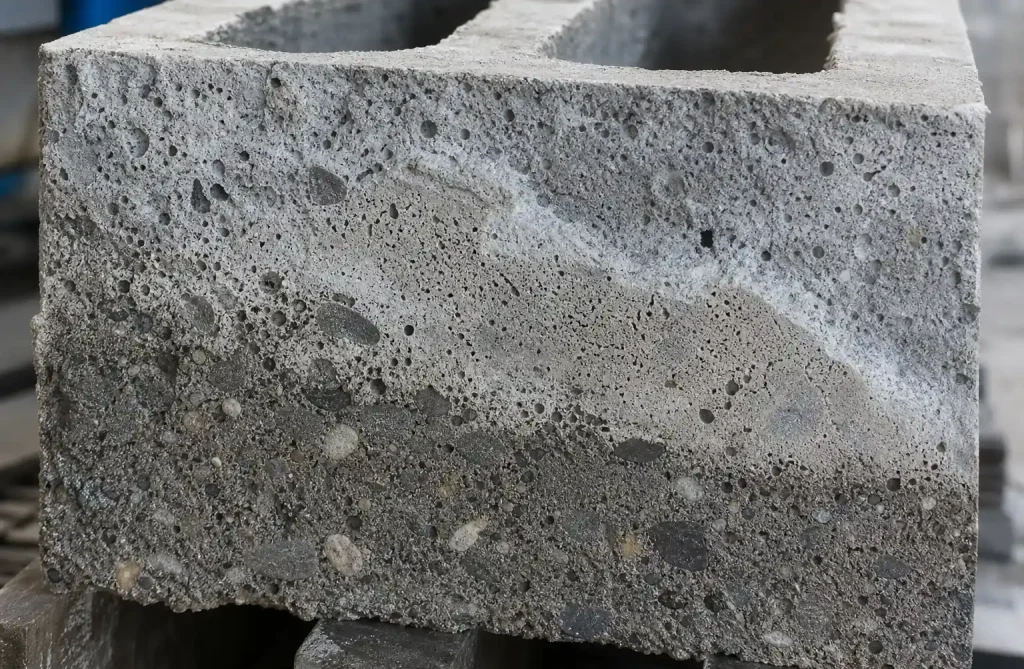
The block curing process determines whether blocks achieve their designed compressive strength, dimensional stability, and surface finish. Poor curing doesn’t just reduce strength by 20-30%—it creates surface cracks, dimensional variations causing layer misalignment on job sites, and efflorescence that customers reject on sight.
Understanding Curing Chemistry That Drives Block Strength
Cement hydration—the chemical reaction between portland cement and water—continues for months, but 65-70% of final strength develops in the first 7 days according to concrete curing research. The catch: hydration stops when internal relative humidity drops below 80%. A block demolded at 24 hours still contains unhydrated cement particles needing moisture to complete the reaction.
Temperature accelerates hydration, but the relationship isn’t linear. At 10°C (50°F), strength gain proceeds at roughly 50% of the rate at 20°C (68°F). Above 32°C (90°F), rapid hydration generates heat faster than it dissipates, creating thermal gradients that induce microcracks. The complete automatic brick plant solutions we design include climate-controlled curing zones because ambient conditions rarely stay within the 15-25°C (59-77°F) optimal range.
Primary Curing Methods: Performance vs. Cost Trade-offs
The choice between water curing, membrane curing, and accelerated steam curing isn’t about “best practice”—it’s about matching method to production volume, climate, and strength requirements.
Comparison of Block Curing Methods
| Curing Method | 7-Day Strength (% of 28-day) | Water Usage per 1000 Blocks | Setup Cost | Best Application |
|---|---|---|---|---|
| Water curing (immersion) | 75-80% | 2,000-3,000 L | Низкий | High-strength applications, load-bearing blocks |
| Water curing (sprinkler) | 70-75% | 1,500-2,500 L | Средний | Large curing yards, moderate climates |
| Wet burlap covering | 68-73% | 800-1,200 L | Низкий | Small-batch production, manual operations |
| Plastic sheet covering | 62-68% | Minimal | Very low | Dry climates, budget operations |
| Curing compounds (membrane) | 65-70% | None | Низкий | High-volume production, labor constraints |
| Accelerated steam curing | 85-95% (12-18 hrs) | 500-800 L | Very high | Fast turnover, commercial projects |
Water Curing: The Gold Standard
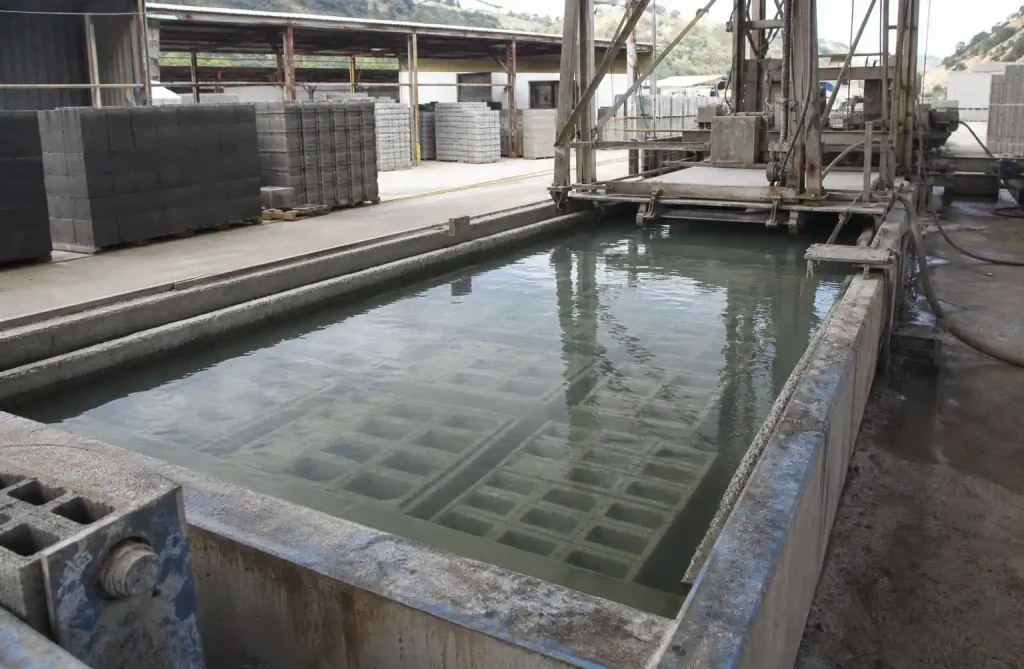
Continuous moisture supply produces the densest hydration products and highest ultimate strength. Immersion tanks at plants in Mozambique and Zimbabwe where clients demand 4.5+ MPa compressive strength for load-bearing applications show blocks submerged for 7 days test 5-8% higher than sprinkler-cured controls.
Immersion requires careful water chemistry management—dissolved salts above 2,000 ppm cause efflorescence. The operational challenge is handling waterlogged blocks (390×190×190mm hollow blocks gain 2-3 kg absorbed water) and extended yard time before they’re dry enough to palletize for transport.
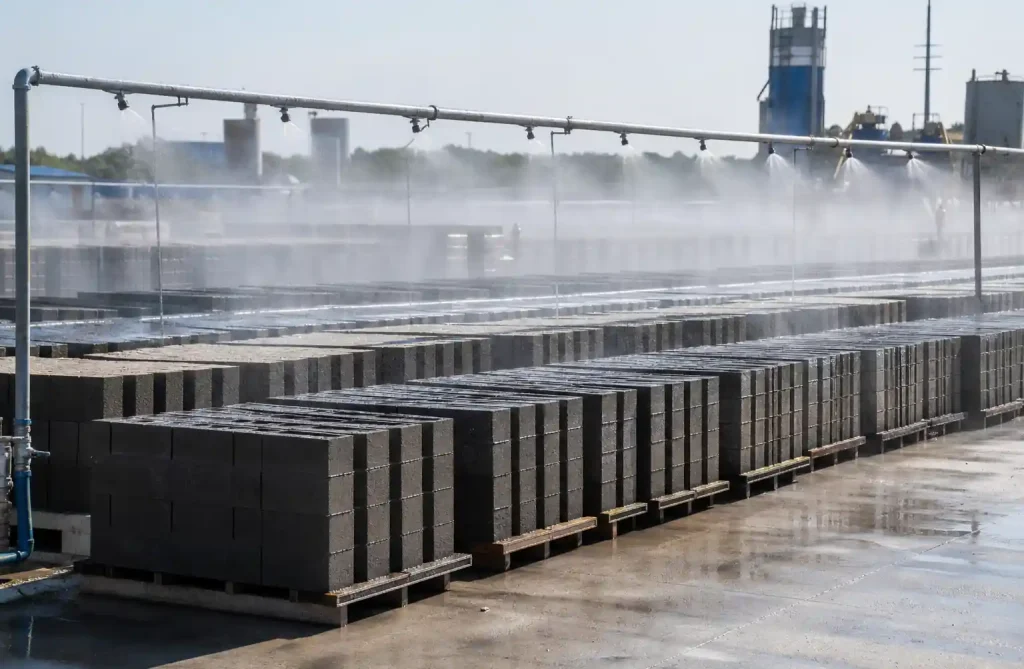
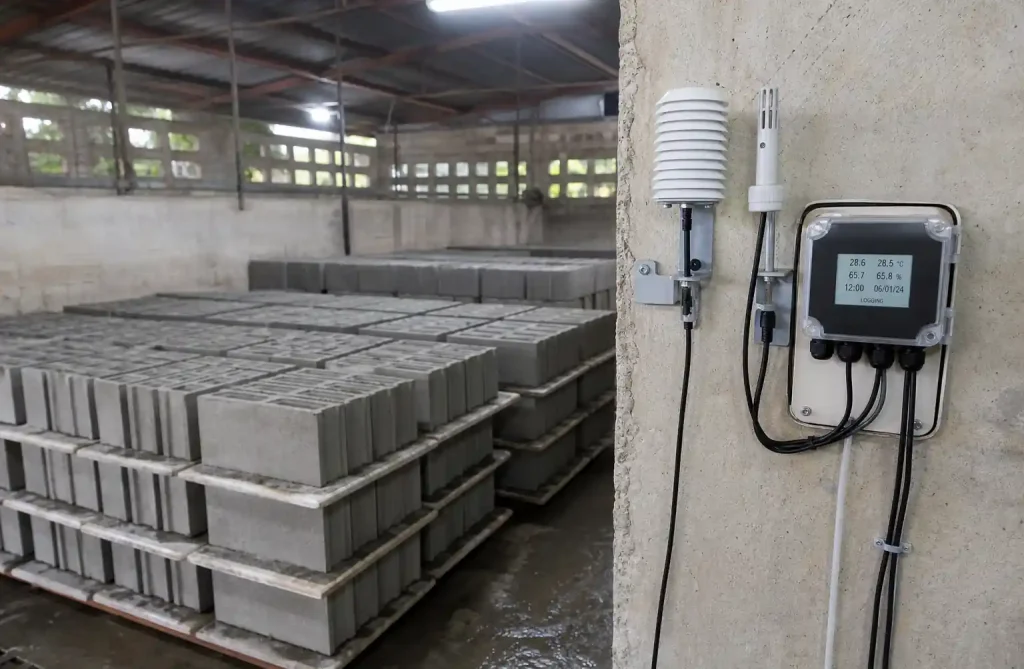
Sprinkler systems offer a middle ground. Our Senegal installation runs misters on 20-minute cycles (3 minutes on, 17 minutes off) controlled by humidity sensors, maintaining surface moisture while using 40% less water than immersion. The limitation: wind speeds above 15 km/h create uneven coverage.
Membrane Curing: Practical for High-Volume Operations
Curing compounds—liquid membranes sealing in mixing water—solve the labor problem. One operator with a backpack sprayer treats 2,000 blocks per hour versus the 6-8 workers needed to keep burlap wet. The strength sacrifice (5-10% versus water curing) is acceptable for non-structural blocks, and compound-cured blocks can be handled 12-18 hours earlier.
Application timing is critical. The window is typically 2-6 hours after demolding. Wax-based formulations leave residue preventing mortar bond—unacceptable for structural masonry. Resin-based compounds cost 30-40% more but break down under UV exposure after 28 days, leaving a bondable surface.
Accelerated Steam Curing: Fast Turnover Investment
Steam curing in climate-controlled chambers achieves in 12-18 hours what ambient curing delivers in 7 days. The автоматические блочные машины we integrate with steam curing follow a four-phase cycle: delay period (2-4 hours at ambient temperature), temperature rise (10-20°C per hour to 60-80°C), hold period (3-4 hours at peak), and controlled cool-down. Rush any phase, and blocks test strong at 18 hours but weaken by 28 days due to disrupted hydration products.
Steam curing requires significant capital (USD $85,000-$150,000 for a system handling 5,000 blocks per cycle). Payback comes from eliminating curing yard space (cutting land requirements 60-70%), enabling 2-3x daily production cycles, and meeting project deadlines commanding 12-18% price premiums.
Environmental Controls: Temperature and Humidity Management
The 28-day compressive strength target assumes curing at 20°C ± 2°C and >95% relative humidity. Real production happens in Sahel summer heat and harmattan-season dryness. Controlling these variables separates consistent quality from batch-to-batch gambling.
Impact of Curing Temperature on Strength Development
| Curing Temperature | 7-Day Strength (% of 28-day at 20°C) | 28-Day Strength vs. Standard | Surface Quality Issues | Mitigation Required |
|---|---|---|---|---|
| 5-10°C (41-50°F) | 35-45% | 85-90% | Slow setting, mold growth risk | Insulated coverings, heated areas, extended cure time |
| 10-15°C (50-59°F) | 50-60% | 92-97% | Delayed strength gain | Extended curing period (10-14 days minimum) |
| 15-25°C (59-77°F) | 65-75% | 100% (reference) | Optimal | Standard protocols |
| 25-35°C (77-95°F) | 70-75% | 95-98% | Rapid drying, surface crazing | Increased watering, windbreaks, shading |
| >35°C (>95°F) | 60-70% | 85-92% | Plastic shrinkage cracks | Immediate post-demold wetting, night shifts |
Hot-Weather Protocols
In Djibouti where summer temperatures reach 42-45°C, we implement thermal management protocols:
Pre-production cooling: Mixing water chilled to 8-12°C drops fresh mix temperature by 6-8°C, delaying initial set and reducing thermal cracking.
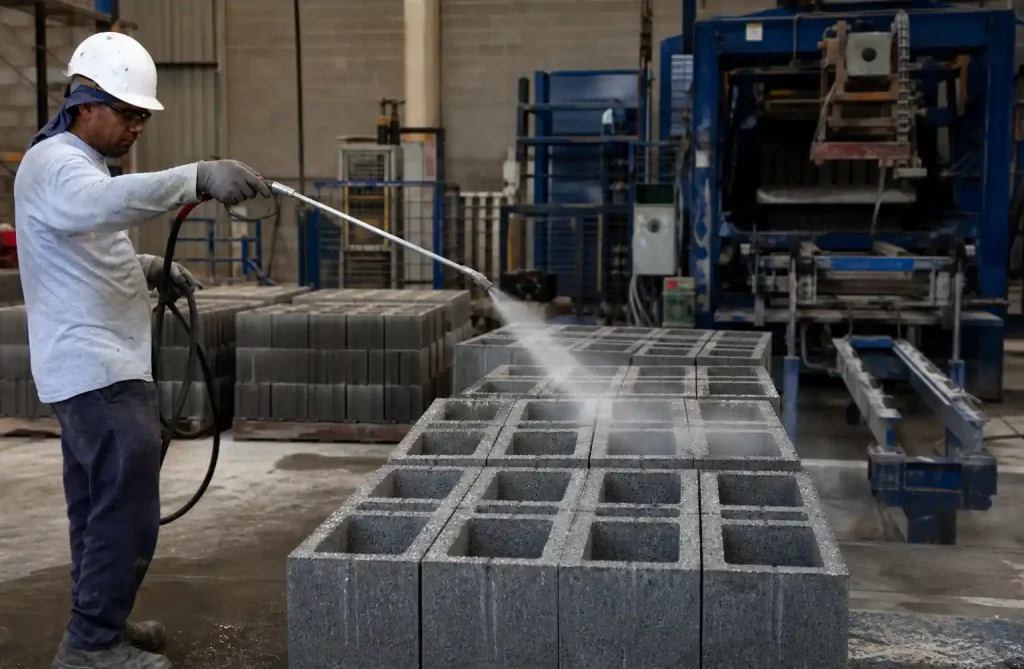
Immediate post-demold wetting: Blocks get first water application within 15 minutes of demolding. Delaying even 30 minutes in 40°C conditions loses 20-30% of potential 7-day strength.
Night-shift production: Several clients shifted production to 1900-0400 hours. This cut crack rates from 11% to 3% while reducing cooling water consumption by 45%.
Cold-Weather Curing: Freeze Damage Protection
Below 5°C, hydration slows dramatically, and water freezing inside block pores destroys paste structure. Antifreeze admixtures (calcium chloride, calcium nitrate) lower the freezing point while accelerating hydration. We dose at 1.5-2% by cement weight for production down to -5°C.
Ethiopian plants use thermal mass storage—stacking blocks 6-8 rows high and covering with insulated tarps. Hydration heat from thousands of blocks creates a micro-climate 8-12°C warmer than ambient air for the first 48 hours.
Quality Testing Protocols: Verification Before Problems Reach Customers
Quality control means testing blocks that fail, not just blocks that pass. The goal is catching process drift before it produces rejects.
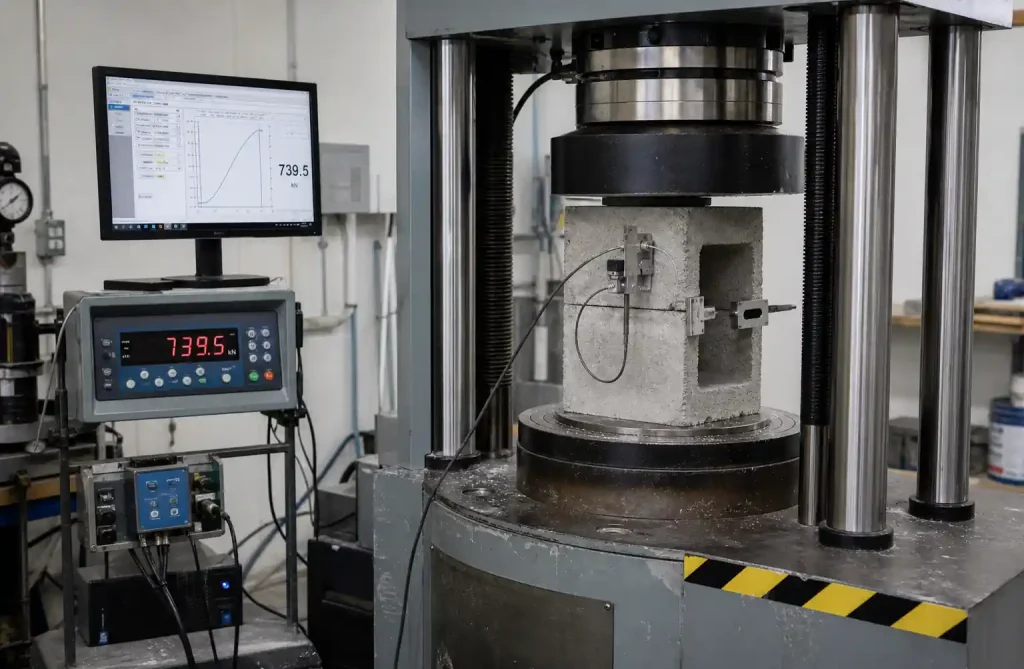
Field Testing Schedule at High-Volume Plants
Daily: Visual inspection of 100% of production for surface defects (cracks, spalling, discoloration). Any block showing surface cracks wider than 0.3mm gets flagged for strength testing.
Weekly: Compressive strength testing on six specimens (three at 7 days, three at 28 days) per 10,000 blocks produced. Results plotted on control charts with alert limits at ±10% of target strength.
Monthly: Water absorption testing—dry blocks to constant mass, immerse 24 hours, measure weight gain. Target: <10% for hollow blocks, <7% for solid units. High absorption indicates incomplete curing.
Common Defects and Root Causes
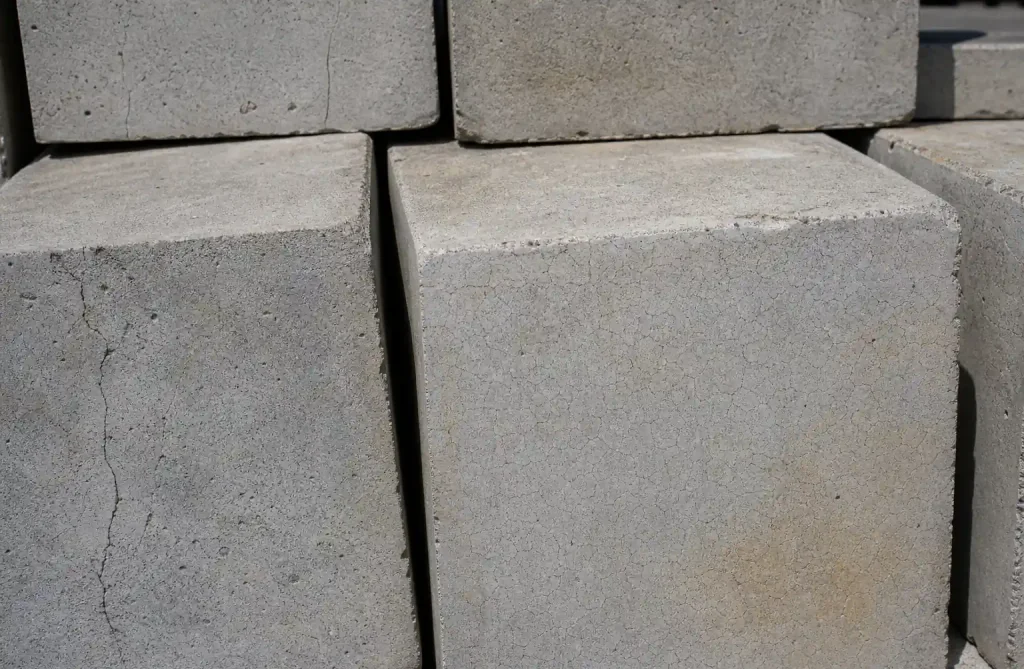
Surface crazing (fine interconnected cracks, 0.1-0.5mm wide): Caused by rapid surface drying shrinkage while core concrete remains plastic. Prevention: earlier initial wetting, lower ambient air velocity during first 12 hours.
Corner spalling: Results from thermal shock when hot blocks (30-35°C internal temperature from hydration heat) contact cold water during first wetting. Solution: gradual temperature reduction.
Efflorescence (white salt deposits): Dissolved salts migrating to surface with evaporating water. Control by limiting water-soluble salts in all materials to <0.5% by mass.
Dimensional instability: Blocks that shrink 0.5-1.2mm after curing due to drying shrinkage. Caused by excess mixing water (slump >75mm), inadequate curing period (<7 days), or poor aggregate grading.
Integrating Curing into Complete Production Systems
Effective curing integrates with batching precision, mixer performance, and handling equipment. The semi-automatic block machines we supply include curing protocols because machine capability means nothing if blocks crack in the yard.
Space Requirements for Different Curing Systems
Water immersion: 40-60 m² per 1,000 blocks. Budget 8-10 labor-hours per 1,000 blocks for handling.
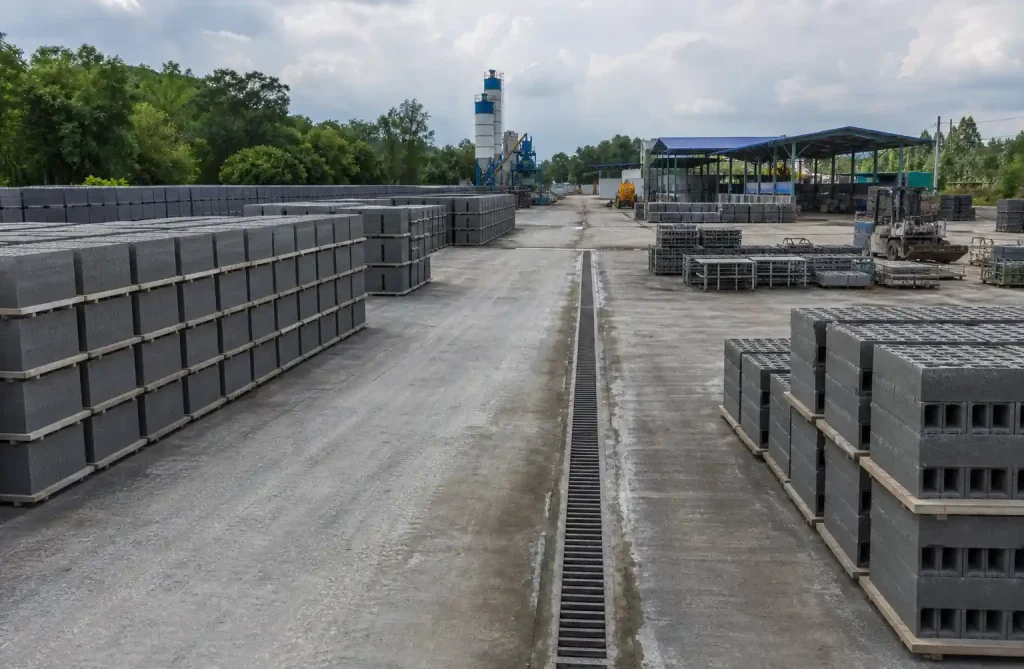
Sprinkler curing yards: 7-day curing of 5,000 blocks/day production needs 1,200-1,500 m² with drainage. Labor drops to 2-3 hours per 1,000 blocks.
Membrane curing: Most space-efficient—blocks stack 4-6 high within 24 hours. A 5,000 blocks/day operation needs 600-800 m². Labor-intensive operations (ручные блочные станки) benefit most.
FAQ: Block Curing Process Questions
Q: Can I mix curing methods—water cure for 3 days then switch to membrane sealing?
Yes, and this is common for high-strength applications where early water curing establishes dense hydration products, then membranes take over. The transition should occur while blocks are still saturated.
Q: How do I verify blocks were properly cured after receiving them from a supplier?
Visual indicators: uniform color (not lighter/darker patches indicating uneven moisture), no surface crazing, sharp edges without spalling. Technical verification: water absorption testing (properly cured blocks absorb 7-10%, under-cured blocks 12-18%).
Q: Does curing method affect mortar bond strength during construction?
Water-cured blocks develop the densest surface structure with best mortar bond. Membrane-cured blocks must use compatible compounds that degrade before masonry work—residual wax-based membranes reduce bond strength by 30-40%.
Q: What’s the minimum curing period before transporting blocks?
Structural blocks: 7 days minimum, 10-14 days in extreme temperatures. Non-structural blocks: 3-5 days if membrane-cured, 5-7 days if water-cured. Steam-cured blocks can ship same-day after cool-down.
Q: How much strength loss from poor curing conditions?
Compared to proper curing: complete loss of moisture at 24 hours reduces 28-day strength by 25-30%, at 3 days by 15-20%, at 7 days by 8-12%. Hot-weather curing (>35°C) without mitigation costs 10-15% strength. Deficits are permanent.
Q: Can I reuse water from immersion tanks?
Tank water can be reused for 4-8 cycles depending on dissolved solids accumulation. Monitor pH (should stay 11.5-13.5) and total dissolved solids (replace water when TDS exceeds 2,000 ppm). High-TDS water causes efflorescence.
Conclusion: Curing as Competitive Advantage
The block curing process separates producers competing on price from those competing on reliability. Proper curing control cuts reject rates from 8-12% to 2-4% and reduces customer complaints by 60-70%. Clients implementing comprehensive curing protocols report payback periods of 4-9 months through reject reduction and premium pricing.
Whether running машины с дизельным блоком at remote sites or operating automatic plants, the principle remains: hydration you don’t protect in the first 7 days, you can’t recover in the next 21. At Raytone Block Machinery, we integrate curing system design into every complete production solution because machine performance and curing effectiveness are inseparable.