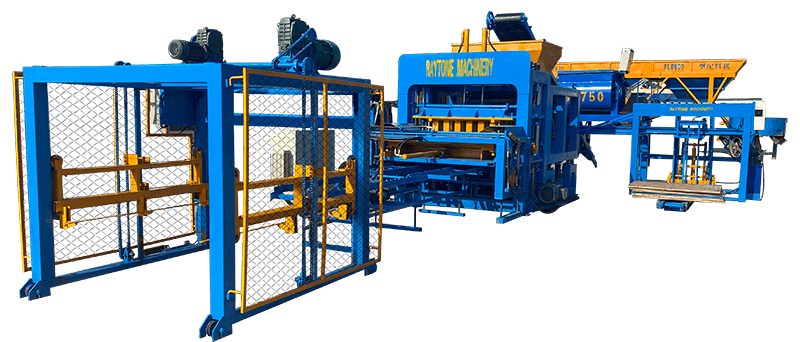
Silica dust in block plants isn’t just a housekeeping issue—it’s a $20,000-80,000 annual cost waiting to derail operations. OSHA’s respirable crystalline silica standard mandates exposure below 50 μg/m³, yet studies show LEV systems reduce exposures by up to 96% when properly implemented. Most block manufacturers install baghouses reactively after citations, spending 40% more than proactive installations while losing production during retrofits.
Industrial dust control is shifting toward integrated systems combining source capture, filtration, and whole-plant ventilation. The global dust control systems market reached $18.00 billion in 2025, projected to hit $28.11 billion by 2034—driven by tightening regulations and proven ROI. Effective dust management isn’t regulatory overhead; it’s operational efficiency protecting equipment, products, and margins.
Why Dust Control Matters in Block Manufacturing
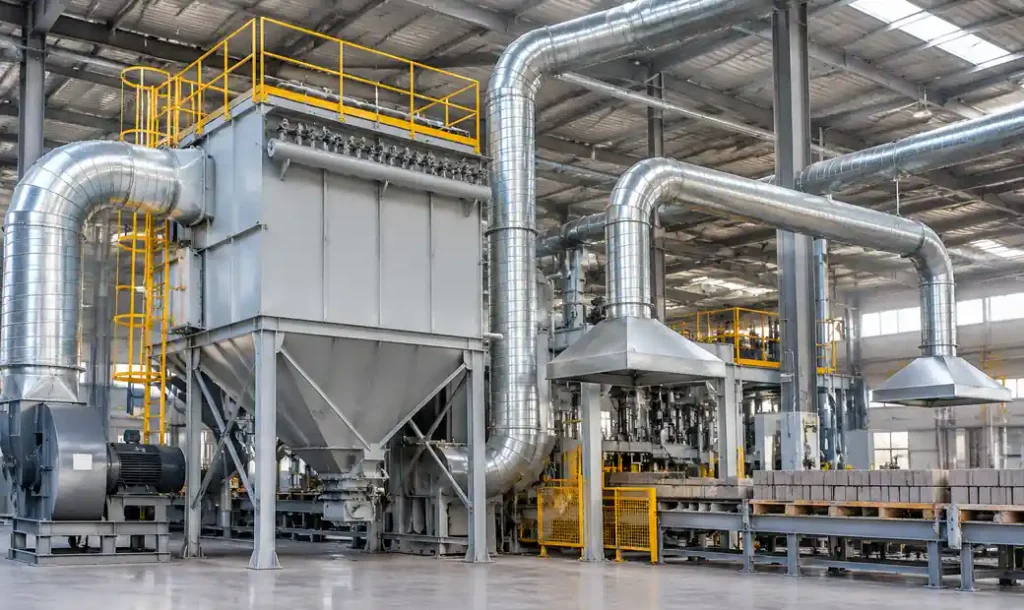
Block production generates dust at every stage: raw material handling creates cement and aggregate particulates, mixing releases fine cement dust, molding produces compacted material dust, and finished block handling kicks up surface dust. Without controls, these processes expose workers to crystalline silica—linked to silicosis, lung cancer, and chronic respiratory disease.
Health Risks and Regulatory Requirements
OSHA’s silica standard (29 CFR 1910.1053 for general industry, 1926.1153 for construction) sets permissible exposure at 50 μg/m³ averaged over an 8-hour shift. More than 840,000 construction workers are exposed to silica levels exceeding this—with concrete product manufacturing among the highest-risk sectors.
Compliance requirements include:
- Air monitoring to assess worker exposures
- Engineering controls (dust collection systems) as primary protection
- Respiratory protection when controls don’t achieve limits
- Medical surveillance for exposed workers
- Employee training on silica hazards
Non-compliance carries fines of $16,131 per violation ($161,323 for willful violations), plus potential criminal liability if worker harm occurs. The 2015 OSHA Regional directive specifically targets concrete block plants, making enforcement likely.
Equipment and Product Protection
Dust accumulation degrades автоматические блочные машины through abrasive wear on hydraulic cylinders, premature bearing failure, and contamination of lubrication systems. Plants report 25-35% shorter component lifespan in uncontrolled environments.
Fine cement dust settling on curing blocks creates surface defects reducing sellable output by 3-7%. Dust contamination in molds requires frequent cleaning, reducing cycle efficiency by 8-12% in high-volume operations. The cost of these impacts often exceeds dust system investment within 18-24 months.
Types of Dust Control Systems
Effective dust management layers multiple control types: source capture at generation points, centralized filtration for collected dust, and area ventilation managing fugitive emissions.
Local Exhaust Ventilation (LEV) Systems
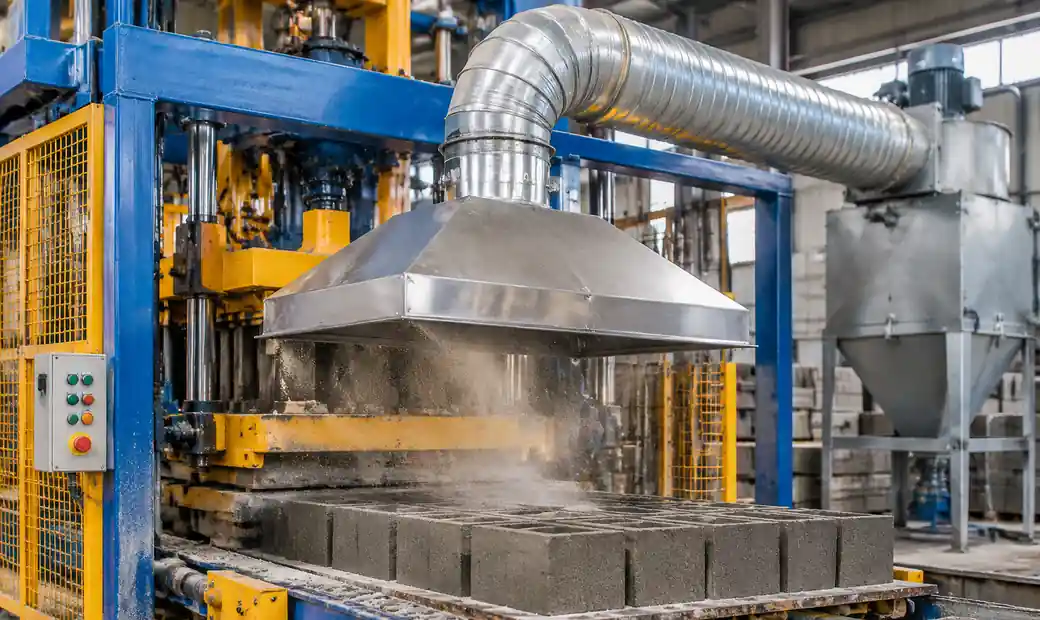
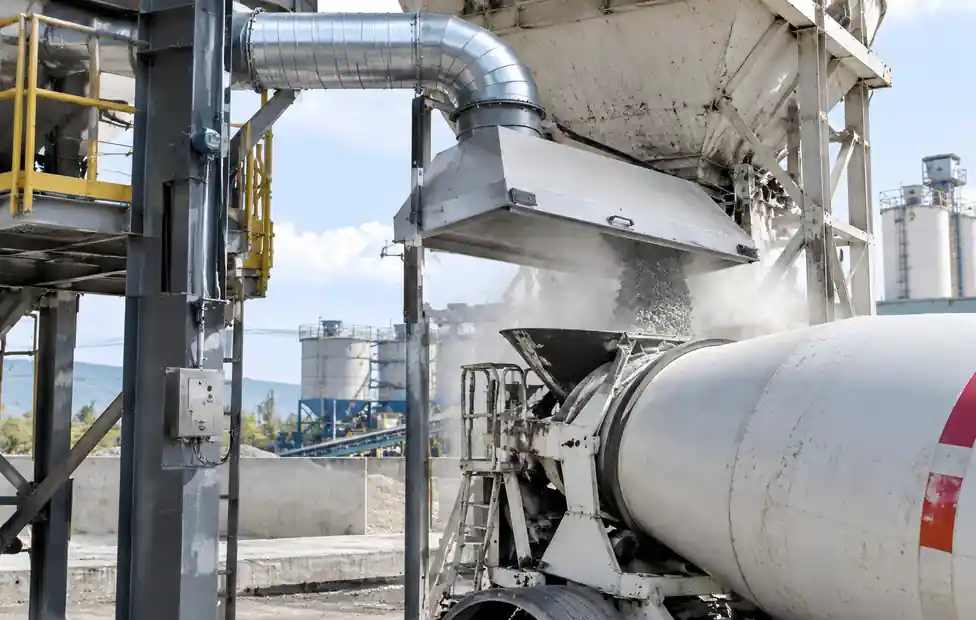
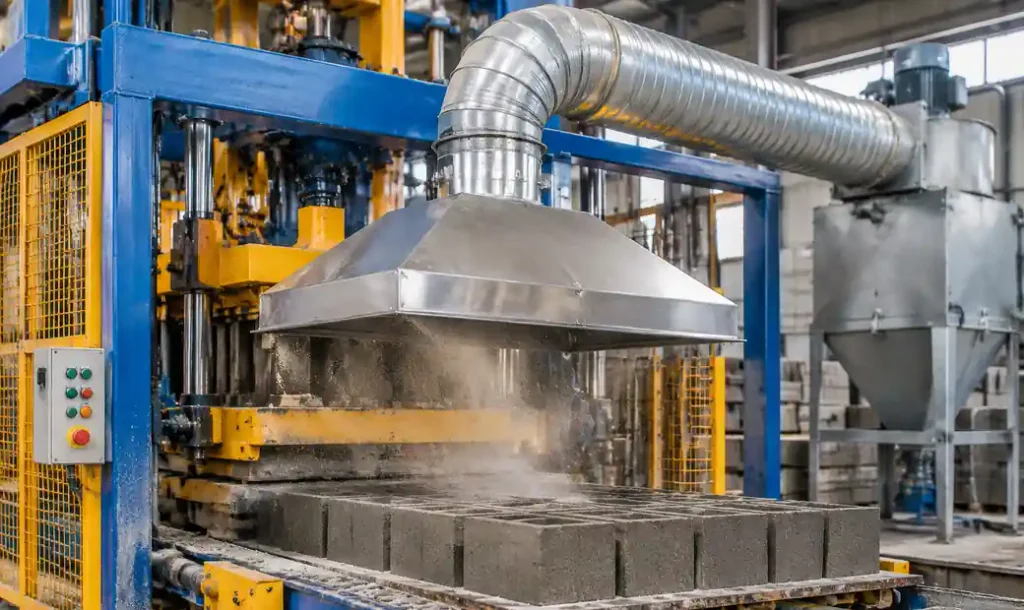
LEV captures dust at the source before it disperses. Hoods positioned at material transfer points—bins, conveyors, mixers—use negative pressure to draw contaminated air into ductwork leading to central collectors.
Critical design factors:
- Capture velocity: 100-200 feet per minute (fpm) at dust source
- Hood placement: Within 12-18 inches of generation point
- Duct velocity: 3,500-4,500 fpm minimum to prevent settling
- Makeup air: Equal to exhaust volume to maintain plant pressure
Proper LEV reduces silica exposures 91-96% in cutting and grinding operations. For block plants, key capture points include cement silo discharge, aggregate bins, concrete mixer loading, and molding machine discharge.
Baghouse Dust Collectors
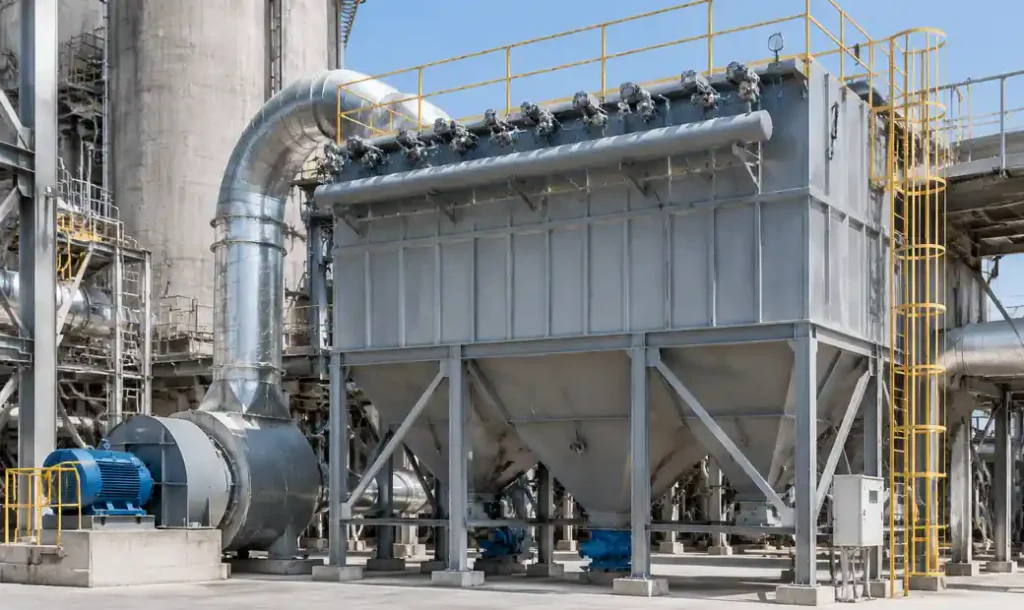
Baghouses dominate block plant applications due to cement’s fine particle size and abrasive nature. Contaminated air passes through fabric filter bags capturing 99%+ of particles while returning clean air.
| Collector Type | Cleaning Method | Capacity Range | Cement Efficiency | Typical Cost |
|---|---|---|---|---|
| Pulse-Jet Baghouse | Compressed air pulses | 5,000-50,000 CFM | 99.5-99.9% | $25,000-$120,000 |
| Shake-Deflate | Mechanical shaking | 2,000-15,000 CFM | 99.0-99.5% | $15,000-$60,000 |
| Reverse-Air | Airflow reversal | 10,000-100,000 CFM | 99.0-99.7% | $50,000-$250,000 |
| Cartridge Collector | Pulse cleaning | 1,000-20,000 CFM | 99.3-99.8% | $8,000-$45,000 |
Baghouses capture 99%+ of transfer emissions when properly sized. Pulse-jet designs dominate due to continuous operation capability—critical for полуавтоматический and fully automatic lines producing 15,000-40,000 blocks daily.
Sizing calculation:
A 25,000-block/day plant processing 45 tonnes of raw materials generates approximately 12,000-18,000 CFM at major dust points. Add 20-30% margin for intermittent operations, requiring 15,000-24,000 CFM total capacity.
Water Suppression Systems
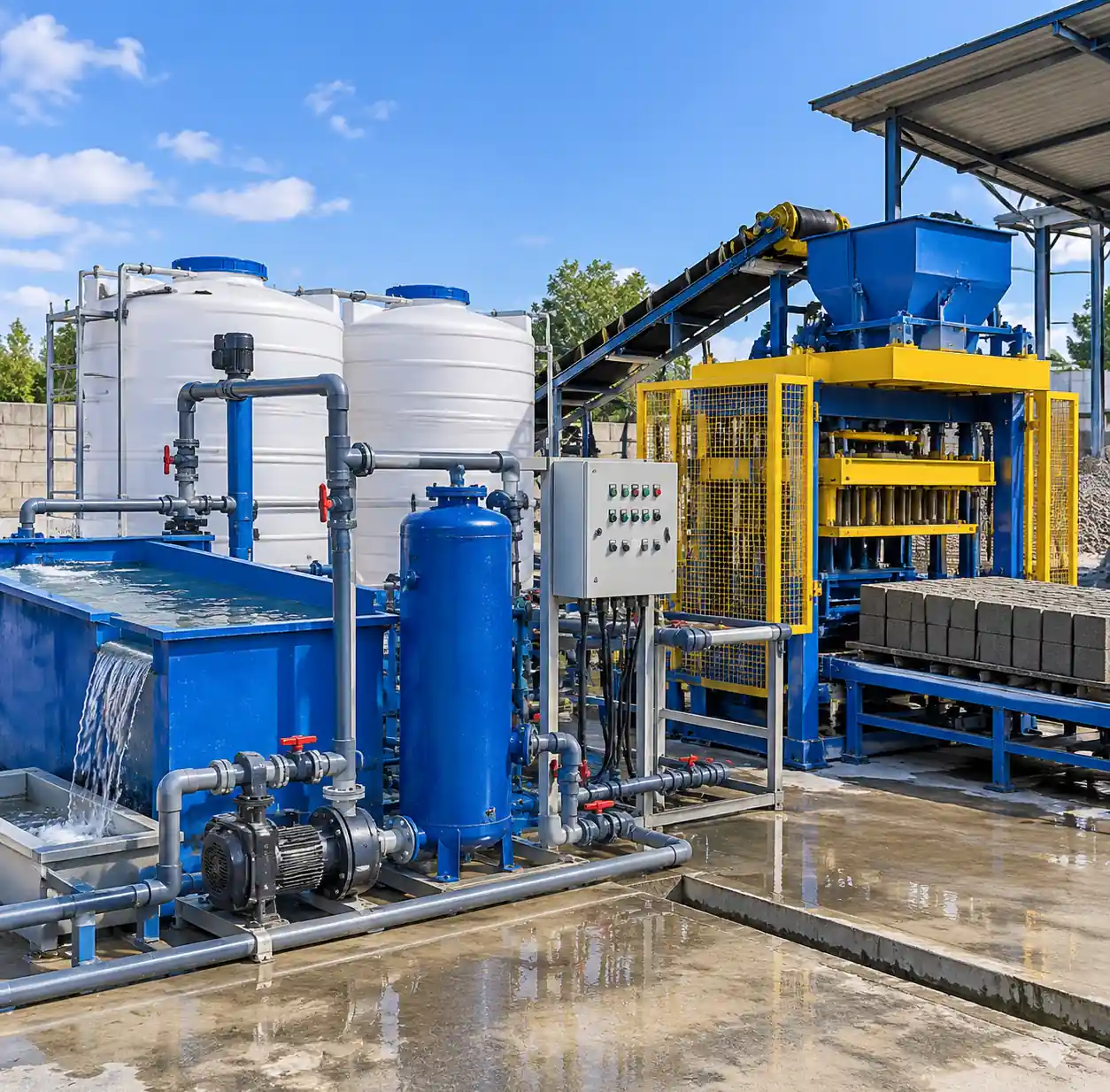
Water spray systems complement filtration by suppressing dust at outdoor material storage and transfer points. Water sprays reduce fugitive dust 70-90% on stockpiles and conveyors.
Application points:
- Aggregate stockpile surfaces (overhead misting)
- Conveyor transfer points (directional spray)
- Truck loading zones (fixed or oscillating sprays)
- Plant roadways and yards (periodic wetting)
Water usage runs 200-600 gallons daily for a mid-scale plant. Recycled water from curing operations supplies most needs, making this a low-cost supplementary control. Avoid spraying indoor areas or finished block handling—moisture risks product quality.
Whole-Plant Ventilation
General dilution ventilation maintains plant-wide air quality where source capture isn’t feasible. Large-volume, low-speed (HVLS) fans or exhaust fans exchange indoor air 4-8 times hourly, preventing accumulation of fine dust escaping localized controls.
Supplementing dust collectors with whole-plant ventilation addresses limitations in capture efficiency and coverage gaps. This layered approach reduces baseline dust levels 40-60% beyond collector systems alone.
Dust Control System Design for Block Plants
Effective systems match collection points to dust generation patterns, size equipment for actual airflow needs, and integrate with production workflows.
Key Collection Points
Cement storage and handling: Silos require top-mounted vents with baghouse filters capturing displaced air during truck filling. Bin discharge points need hood capture rated for 150-200 CFM per square foot of opening area.
Aggregate bins and conveyors: Belt transfer points generate dust during free-fall. Hood enclosures with 200-300 CFM capture per transfer prevent dispersion. Keep enclosure gaps under 6 inches for effective capture.
Batching and mixing: Concrete mixers release cement dust during material charging. Charging hopper enclosures with 500-1,200 CFM extraction (depending on batch size) maintain negative pressure during loading.
Block molding stations: Руководство and automatic machines discharge finished blocks generating compacted material dust. Overhead hoods or side-draft capture drawing 300-800 CFM per station protect operators and prevent recontamination.
Finished product handling: Conveyors moving cured blocks require transfer point enclosures and periodic compressed air blow-off captured by local extraction. This prevents dust from coating subsequent products.
System Sizing and Configuration
Airflow calculation methodology:
- Measure hood face area at each capture point
- Multiply by required face velocity (typically 100-150 fpm for cement dust)
- Add duct friction losses (typically 15-25%)
- Include filter pressure drop allowance (4-6 inches water column clean, 8-10 dirty)
- Apply safety factor (1.2-1.3×)
Example for 10,000-block/day plant:
- Cement silo vent: 800 CFM
- Aggregate bins (3): 1,200 CFM
- Mixer charging: 1,000 CFM
- Molding stations (2): 1,400 CFM
- Transfer conveyors (4): 1,600 CFM
- Subtotal: 6,000 CFM
- With losses and factor: 7,800 CFM required
Match to pulse-jet baghouse rated 8,000-10,000 CFM with appropriate filter media for cement service (typically polyester or P84).
System Cost Breakdown
| Компонент | Small Plant (5,000 blocks/day) | Medium Plant (15,000 blocks/day) | Large Plant (35,000 blocks/day) |
|---|---|---|---|
| Baghouse Collector | $18,000-$28,000 | $45,000-$75,000 | $95,000-$180,000 |
| Ductwork & Hoods | $8,000-$15,000 | $22,000-$38,000 | $48,000-$85,000 |
| Installation Labor | $6,000-$10,000 | $15,000-$25,000 | $32,000-$55,000 |
| Electrical/Controls | $3,500-$6,000 | $8,500-$14,000 | $18,000-$28,000 |
| Commissioning/Testing | $2,000-$3,500 | $4,500-$7,000 | $8,500-$13,000 |
| Total Investment | $37,500-$62,500 | $95,000-$159,000 | $201,500-$361,000 |
| Cost per Block/Day | $7.50-$12.50 | $6.33-$10.60 | $5.76-$10.31 |
Phased installation reduces upfront costs: prioritize high-exposure areas (mixer, molding) first, then add material handling and storage points as production scales.
Operating and Maintaining Dust Control Systems
System effectiveness degrades without maintenance. Plants achieving 99%+ capture rates maintain strict schedules addressing filter condition, airflow verification, and component wear.
Filter Maintenance Requirements
Pulse-jet baghouse bags: Replace every 18-36 months depending on cement abrasiveness and cleaning cycle frequency. Pressure differential gauges indicate filter loading—replace when clean pressure drop exceeds initial by 30-40%.
Bag inspection schedule:
- Weekly: Check differential pressure, note abnormal increases
- Monthly: Inspect sample bags for wear, holes, or cake buildup
- Quarterly: Verify pulse cleaning effectiveness, adjust timing if needed
- Annually: Replace 10-15% of bags on rotating basis
Replacement bags cost $15-45 each depending on media type. A 100-bag collector requires $1,500-4,500 annually in filter replacement—budgeting $0.12-0.18 per 1,000 blocks produced.
Performance Monitoring
Continuous monitoring points:
- Differential pressure (indicates filter loading)
- Airflow measurement (confirms design performance)
- Opacity testing at outlet (detects bag failures)
- Hopper level (prevents overflow backup)
Digital monitoring systems ($2,500-8,000) track these parameters, alerting operators to maintenance needs before compliance failures. Manual monitoring requires daily pressure checks and weekly visual inspections.
Common Maintenance Issues
Dust bridging in hoppers: Cement dust compacts when moisture contact occurs. Design hoppers with 60° minimum slopes and install vibrators or air cannons ($800-2,500) at problem points.
Premature bag failure: Usually indicates improper air-to-cloth ratio (too high), excessive moisture, or chemical attack. Verify operating conditions match bag media specifications before replacement.
Loss of suction: Check for duct leaks (particularly at joints), fan belt wear, or motor issues. Even small leaks reduce system effectiveness 15-25% while increasing energy consumption.
ROI and Cost-Benefit Analysis
Dust control investment pays back through multiple channels: avoiding regulatory fines, reducing equipment maintenance, improving product quality, and protecting worker health.
Direct Cost Savings
Equipment maintenance reduction: Plants installing comprehensive dust control report 30-45% lower maintenance costs on hydraulic systems, bearings, and electronic controls—saving $8,000-22,000 annually on a $150,000 equipment base.
Product quality improvement: Eliminating dust contamination on curing blocks reduces defect rates 3-7%, worth $12,000-35,000 annually at typical production scales and $0.40-0.65 per block revenue.
Energy efficiency: Clean plant air improves motor cooling and reduces HVAC loads. Documented savings of 8-15% on climate control costs ($2,000-6,500 annually) result from dust elimination.
Avoided Compliance Costs
OSHA penalties: Average citation for silica violations runs $8,500-15,000 for serious violations, with follow-up inspections mandated. Willful violations reach $161,323 maximum. Multiple violations compound rapidly.
Medical monitoring costs: Required medical surveillance for exposed workers costs $300-500 per employee annually. A 15-person plant spends $4,500-7,500 yearly—eliminated if engineering controls achieve compliance without respiratory protection.
Payback Calculation
For a 15,000-block/day plant investing $125,000 in comprehensive dust control:
Annual benefits:
- Avoided OSHA fines (probability-weighted): $4,200
- Reduced equipment maintenance: $15,000
- Product quality improvement: $18,000
- Medical surveillance elimination: $6,000
- Energy savings: $3,500
- Total: $46,700
Payback period: 2.7 years before operational savings, 14-18 months when regulatory risk is weighted appropriately.
Integration with Block Production Equipment
Dust control succeeds when designed into production workflows rather than added as afterthought. Coordinate systems with equipment layouts and cycle timing.
Coordination with Block Machines
Автоматические блочные машины cycling every 15-25 seconds create intermittent dust bursts during demolding. Hood capture systems need dampers or variable-speed drives responding to cycle timing, reducing unnecessary airflow 40-50% and cutting operating costs.
Semi-automatic equipment with 45-60 second cycles allows manual damper adjustment between cycles. Operators closing hoods during idle periods cut filter loading and extend bag life 25-35%.
Ручные станки produce lower dust volumes but require operator presence at generation point. Side-draft hoods pulling across work surface provide better protection than overhead capture in manual operations.
Supporting Equipment Integration
Concrete mixers require charging enclosure integration with batching controls—extraction activates only during material loading, not during mixing. This coordination reduces collection system size 30-40% versus continuous operation designs.
Complete automatic plants benefit most from integrated dust control engineered during initial layout. Locating major dust sources (silos, mixers, molding) adjacent to central collector minimizes ductwork costs and improves capture effectiveness.
Environmental Compliance Beyond OSHA
Dust control addresses multiple regulatory frameworks beyond worker protection, including air quality permits and environmental discharge standards.
EPA Air Quality Standards
The National Ambient Air Quality Standard (NAAQS) for PM10 (particles under 10 microns) is 150 μg/m³ for 24-hour average, 50 μg/m³ annual. Block plants in nonattainment areas face stricter requirements including:
- Air quality operating permits ($5,000-15,000 annually)
- Emissions testing (quarterly or annually, $3,000-8,000 per test)
- Potential offset requirements for facility expansion
Properly designed baghouse systems achieve 99%+ capture rates keeping facilities well below thresholds even in nonattainment zones.
Dust Discharge Standards
Collected dust must be disposed properly—landfill disposal or return to production. Plants recycling cement dust back into mixers realize $2,000-6,000 annual savings in raw material costs while eliminating disposal fees ($40-85 per ton).
Ensure recycled dust meets quality standards: excessive fines (>15% passing 200 mesh) weaken blocks. Test recycled dust percentage in trial batches before full implementation.
Implementation Best Practices
Successful installations follow structured approaches covering design validation, phased installation, and performance verification.
Design Validation Steps
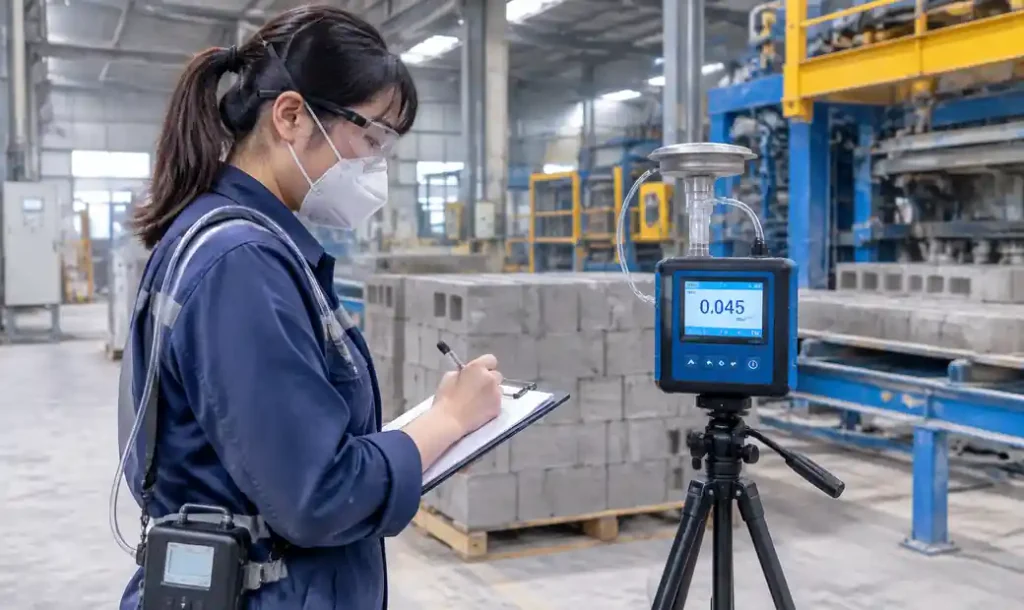
Pre-installation air monitoring: Baseline exposure assessment identifies critical control points and quantifies improvement post-installation. Testing costs $2,500-5,000 but prevents over- or under-sizing systems.
Manufacturer coordination: Work with dust system suppliers familiar with concrete block applications. Generic designs often fail in cement service due to inadequate filter media selection or insufficient capture velocities.
Airflow modeling: For complex plants, computational fluid dynamics (CFD) modeling ($5,000-15,000) optimizes hood placement and duct routing, reducing installation costs 15-25% through first-time-right designs.
Phased Installation Approach
Phase 1 – High exposure points (Weeks 1-4):
- Mixer charging enclosure and extraction
- Molding station capture
- Cement silo venting
Phase 2 – Material handling (Weeks 5-8):
- Conveyor transfer points
- Aggregate bin discharge
- Finished product handling
Phase 3 – Area controls (Weeks 9-12):
- Whole-plant ventilation
- Yard dust suppression
- Monitoring systems
Phased approach maintains production during installation, spreading cash flow, and allowing system refinement based on Phase 1 lessons.
Post-Installation Verification
Performance testing: Third-party industrial hygienists conduct post-installation air monitoring verifying exposures below 50 μg/m³ permissible limit. Testing costs $3,000-6,000 but documents compliance and validates system effectiveness.
Operator training: Effective systems require proper operation. Train operators on filter change indicators, damper adjustment, and troubleshooting procedures. Allocate 4-8 hours training per shift crew.
Documentation: Maintain records of air monitoring, maintenance activities, and filter replacements. OSHA requires exposure records retention for 30 years, maintenance records for system lifetime.

Часто задаваемые вопросы
Q: Can we use water spray systems instead of baghouses to save costs?
Water suppression works for outdoor stockpiles and conveyors but doesn’t address indoor cement dust at mixers and molding stations—the highest exposure points. Cement dust requires dry collection; water creates handling and product quality issues. Use water to supplement, not replace, baghouse systems. Effective outdoor suppression costs $4,000-12,000 versus $40,000-80,000 for comparable baghouse capacity, but they serve different control needs.
Q: How often do baghouse filters need replacement?
Pulse-jet bags in cement service last 18-36 months depending on cleaning cycle frequency and dust abrasiveness. Plants running three shifts with aggressive cleaning cycles replace bags at the shorter interval. Monitor differential pressure—when clean pressure drop exceeds initial by 30-40%, plan replacement. Budget $1,500-4,500 annually for a 100-bag collector, or approximately $0.12-0.18 per 1,000 blocks produced.
Q: What happens if we don’t install dust control systems?
Beyond regulatory fines ($8,500-161,000 per violation), uncontrolled dust reduces equipment life 25-35%, increases product defects 3-7%, and exposes workers to silicosis risk with associated workers’ compensation and liability costs. The economic impact of not controlling dust exceeds system investment within 2-3 years even without regulatory action. OSHA actively targets concrete block plants under its silica enforcement initiative.
Q: Can we install dust control ourselves or do we need contractors?
Simple systems (single-point cartridge collectors under 2,000 CFM) suit DIY installation with mechanical aptitude. Plant-wide systems require professional design and installation due to airflow calculations, duct sizing, and electrical integration complexity. Poor installations waste 40-60% of investment through inadequate capture, undersized collectors, or improper duct routing. Professional design/installation adds 20-30% to equipment costs but ensures first-time effectiveness and regulatory compliance.
Q: How do dust control systems affect energy costs?
Collector fans consume 5-15 kW depending on system size—adding $3,000-10,000 annually in electricity costs for mid-scale operations. However, reduced HVAC loads and improved equipment efficiency from clean environments offset 60-80% of this cost. Variable-frequency drives ($1,500-3,500) reducing fan speed during low-production periods cut energy consumption 25-40%.
Q: What’s the difference between baghouses and cartridge collectors?
Both use fabric filtration but differ in media configuration. Baghouses use vertical cylindrical bags (4-8 inches diameter, 10-16 feet long), while cartridge collectors use pleated cartridges (12-16 inches diameter, 2-4 feet long). For cement applications, baghouses dominate due to higher loading capacity and lower long-term media costs ($15-45 per bag vs $120-220 per cartridge). Cartridge collectors work well for low-volume applications under 5,000 CFM.
Заключение
Dust control in block manufacturing combines regulatory compliance with operational efficiency. Systems costing $40,000-160,000 for typical plants pay back in 2-3 years through equipment protection, product quality improvement, and compliance cost avoidance.
Start with high-exposure points: mixer charging and molding stations capture 70-80% of worker exposure. Add material handling and storage controls as production scales. Proper maintenance extends filter life and preserves system effectiveness—budget $0.15-0.25 per 1,000 blocks annually for replacement filters and routine maintenance.
The shift toward integrated dust management reflects both regulatory pressure and economic reality. Plants installing effective systems gain competitive advantage through reduced downtime, lower maintenance costs, and ability to attract skilled workers. In 2026, dust control isn’t optional—it’s operational infrastructure delivering measurable returns.
Need help designing dust control for your block plant? Contact our technical team for layout assessment and system recommendations tailored to your production scale and equipment configuration.
Sources:
- An Integrated Review of Industrial Dust Monitoring, Removal Mechanisms, Dust Collectors, and System Optimization
- A Guide to Implementing Safe Dust Control in Your Operations
- Concrete Batch Plant Dust Guide
- Supplementing Your Dust Control Equipment with Whole-Plant Ventilation
- OSHA Silica Standard for General Industry
- OSHA Regional Notice – LEP for Silica Exposures
- OSHA Silica Exposure References