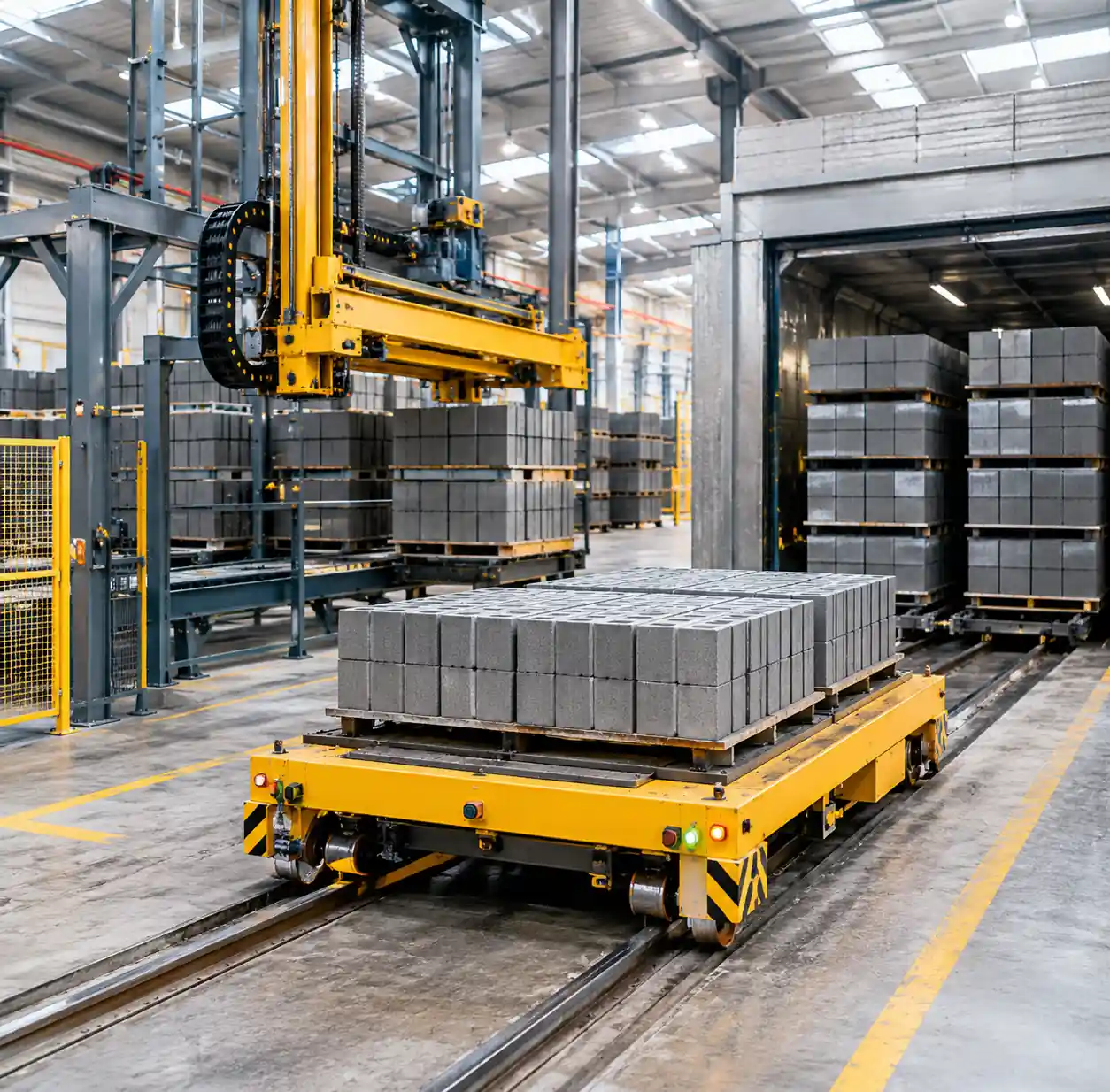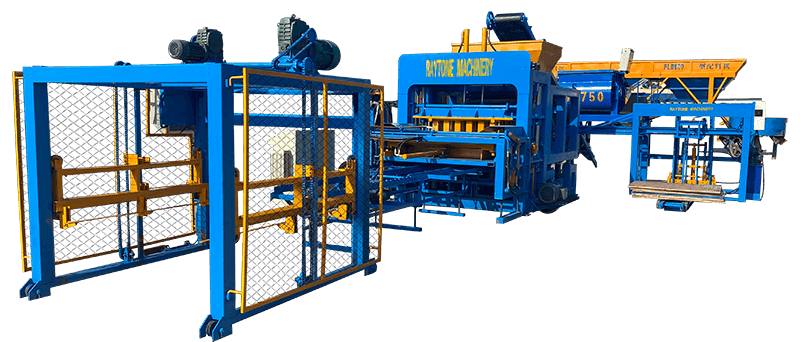






Running a block manufacturing plant without proper material flow control means watching production bottlenecks drain 25-40% of your capacity while labor costs spike. After implementing conveyor automation across block plants in three regions, I’ve seen operations that master material handling achieve 92% uptime versus 68% for plants relying on manual transfer.
Automated material handling systems reduce labor requirements by 60-70% while increasing throughput 35-50% in concrete product manufacturing. The global conveyor belt market reached $6.8 billion in 2025, driven by automation demands across construction material production.
This guide covers conveyor system selection for block production, including belt types, automation integration, capacity planning, maintenance protocols, and ROI calculation for automatic versus semi-automatic configurations.
Why Conveyor Automation Changes Block Production Economics
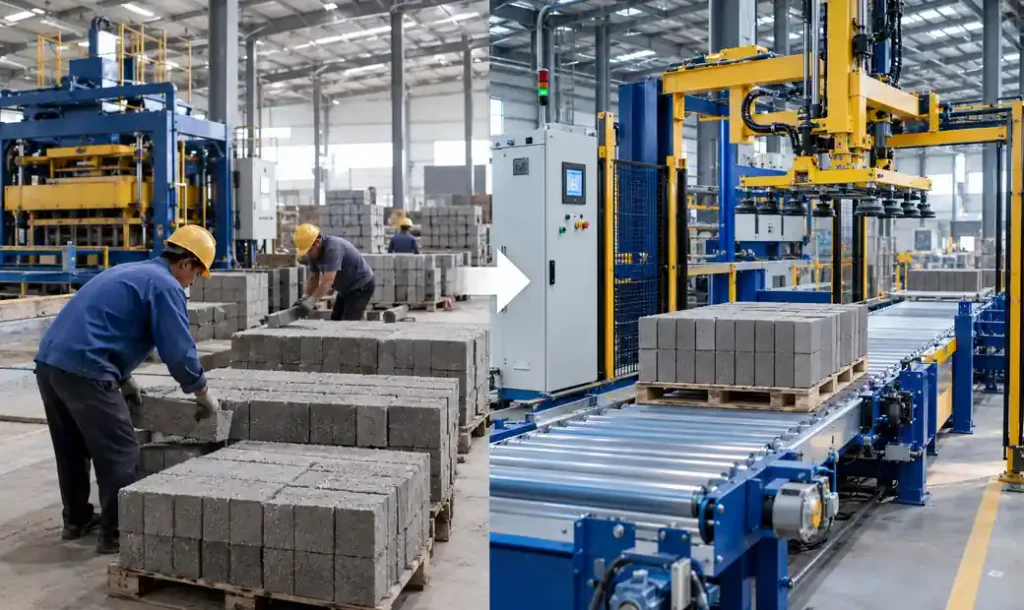
Manual material transfer creates three profit killers: inconsistent cycle times, labor dependency, and quality variability. A 10,000-block daily operation using manual handling requires 8-12 workers for material movement alone—$48,000-72,000 annually just for transfer labor.
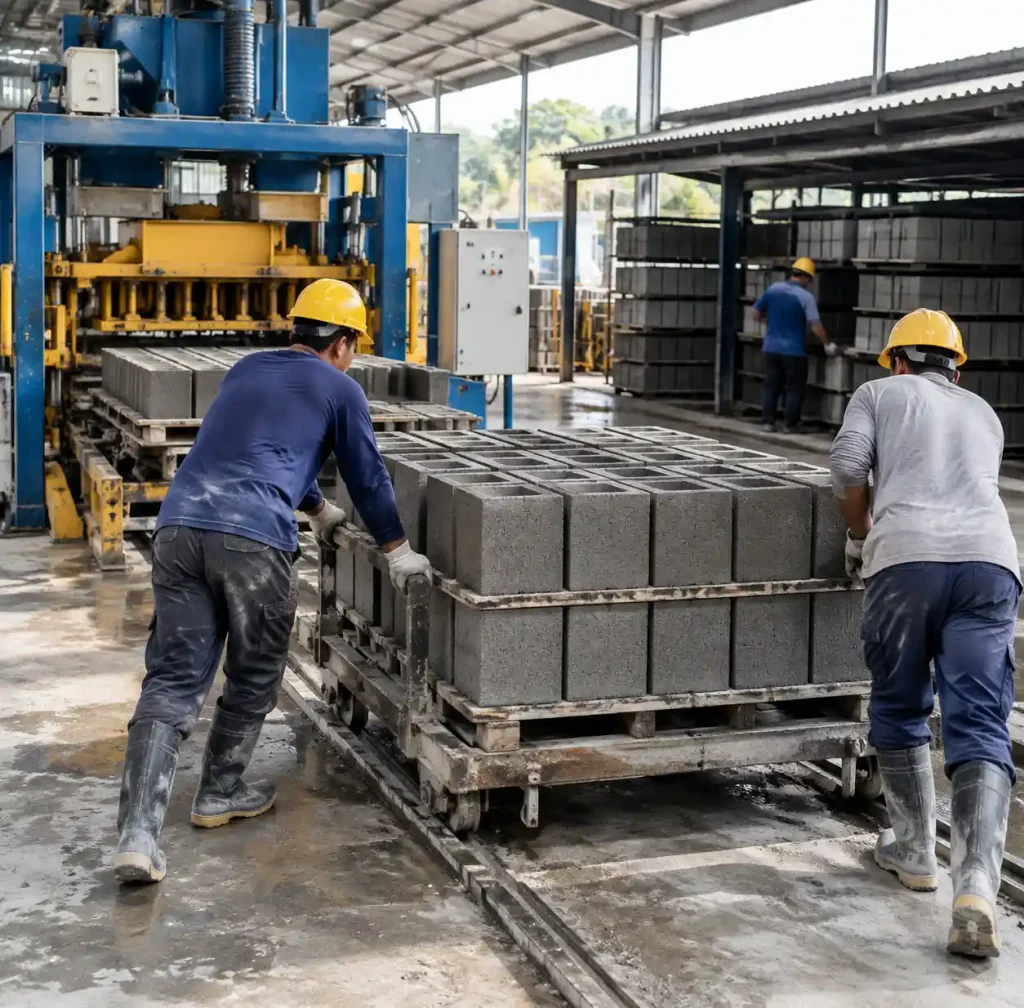
Production Bottlenecks From Manual Handling
Research on block production efficiency shows manual transfer operations create 8-15 minute delays per production cycle. Workers moving 400kg pallet loads develop fatigue-related slowdowns after 4-5 hours, reducing throughput 18-25% during second shifts.
| Production Scale | Manual Labor Cost/Day | Conveyor System Cost | Annual Savings | Payback Period |
|---|---|---|---|---|
| 3,000 blocks/day | $180-240 | $12,000-18,000 | $43,800-58,400 | 3.1-4.9 months |
| 7,000 blocks/day | $240-320 | $22,000-32,000 | $58,400-77,800 | 3.4-6.6 months |
| 15,000 blocks/day | $320-420 | $45,000-65,000 | $77,800-102,300 | 5.3-10.0 months |
| 30,000 blocks/day | $480-600 | $85,000-120,000 | $116,800-146,000 | 6.9-12.3 months |
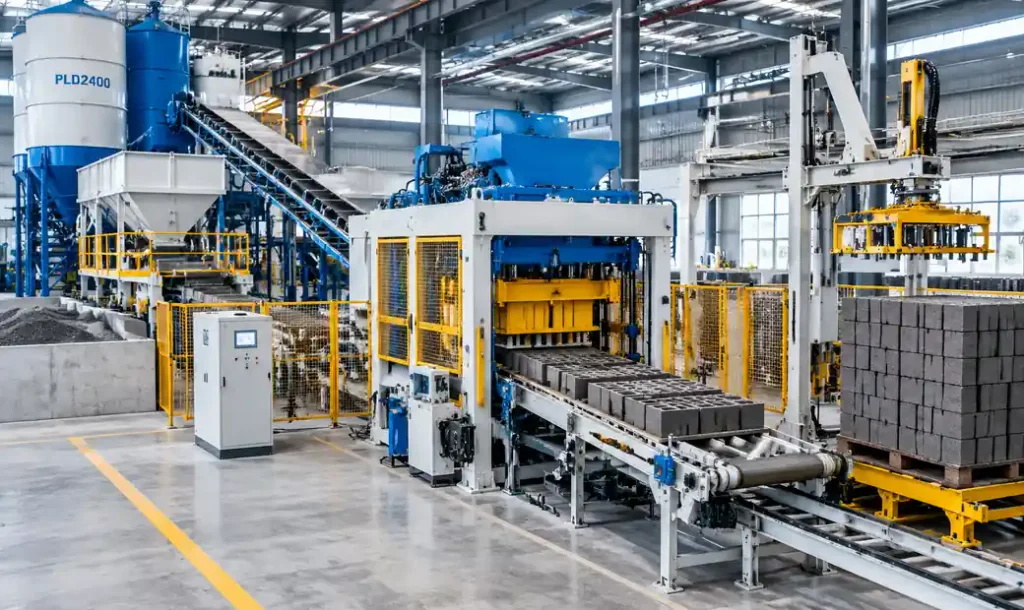
Automatic block production lines with integrated conveyor systems maintain consistent 15-25 second cycle times regardless of shift duration. Semi-automatic systems reduce manual handling by 50-60% while maintaining upgrade flexibility.
Conveyor Belt Types for Block Manufacturing
Block production requires different conveyor configurations depending on product weight, transfer distance, and automation level. Selecting wrong belt type causes premature wear, product damage, and unexpected downtime.
Flat Belt Conveyors for Green Block Transfer
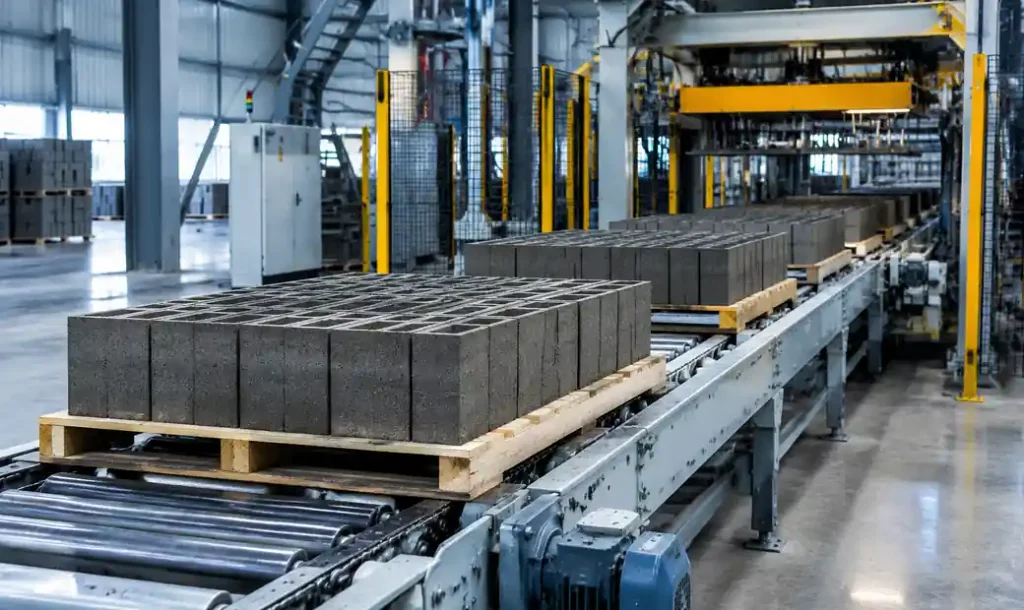
Flat belt systems move freshly molded blocks from press to curing area. These handle 400-600kg pallet loads across 10-50 meter distances. Belt material must resist concrete adhesion and alkaline exposure.
Key specifications:
- Belt width: 800-1200mm for standard pallets
- Speed: 0.1-0.3 m/s to prevent block shifting
- Material: PVC or rubber compound rated for concrete contact
- Load capacity: 800-1500kg per meter of belt length
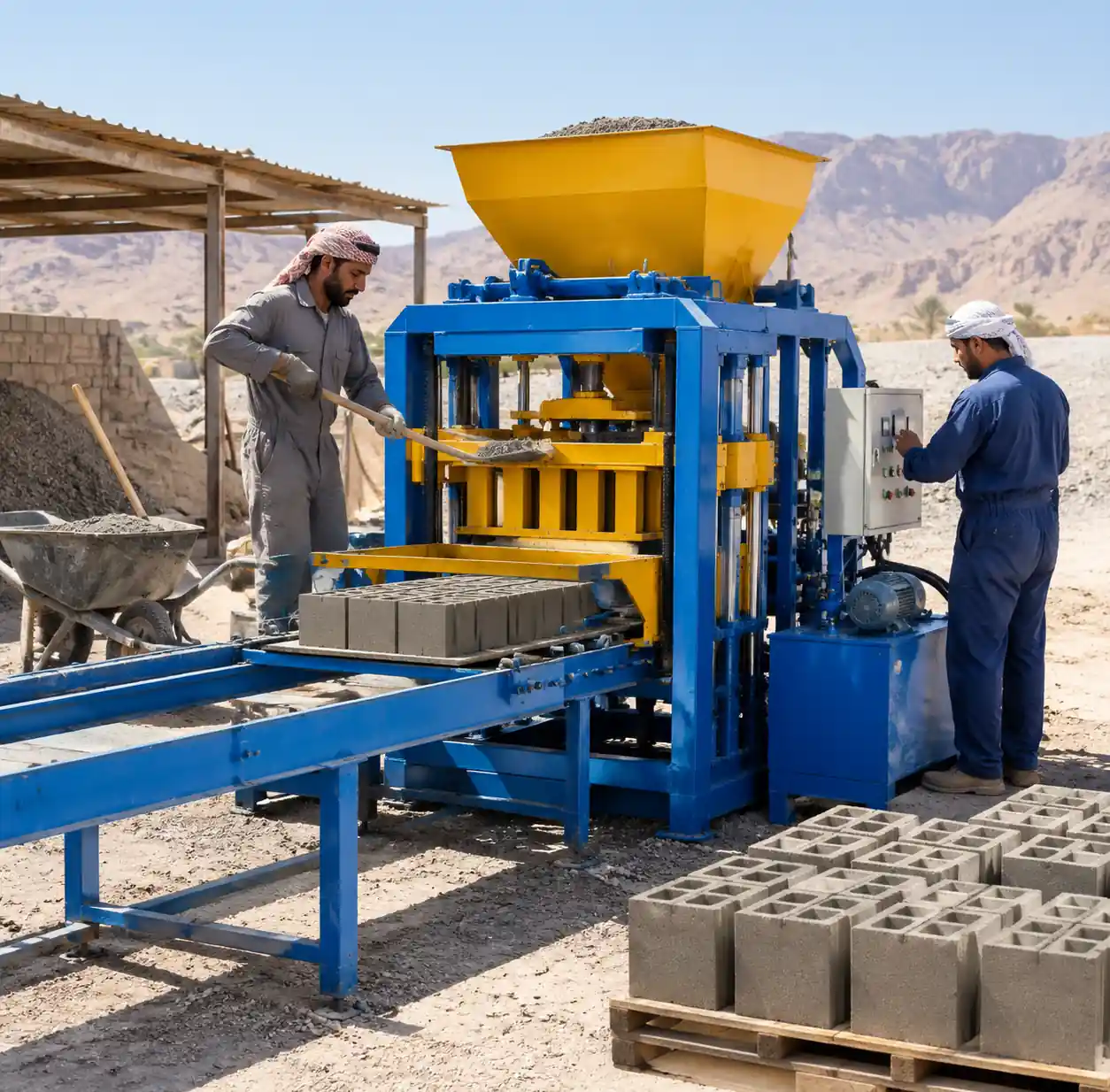
You can use flat belts with ручные блочные станки by adding simple roller bed sections between production stations. This eliminates 70-80% of manual handling while keeping investment below $8,000-12,000.
Roller Conveyors for Heavy Pallet Movement
Roller systems work better for operations moving 800-1200kg loads or requiring accumulation zones where pallets queue before curing. Each roller handles point loads while maintaining smooth pallet travel.
Powered roller conveyors use motors spaced every 3-6 meters, driving accumulated pallets through production flow. Gravity roller sections work for slight declines (2-4%) where pallet weight provides momentum. Most automatic systems combine both types.
Chain Conveyors for Return Pallet Systems
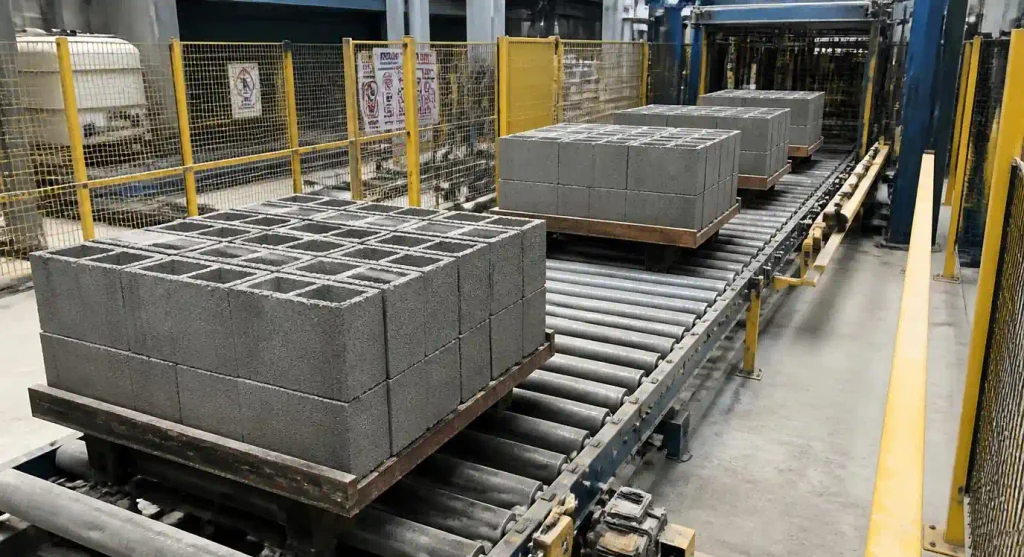
Empty pallet return requires different handling than loaded pallets. Chain conveyors withstand higher impact loads and operate reliably in dusty environments where fine aggregate coats running surfaces.
Вспомогательное оборудование integration with chain return systems creates closed-loop pallet circulation. A 30,000-block daily operation requires 180-250 pallets in circulation—chain systems handle this volume across 80-150 meter return distances.
Automation Integration Components
Complete conveyor automation requires five integrated systems: PLC control, sensor networks, pallet indexing, stacking mechanisms, and curing yard logistics.
PLC Control Systems
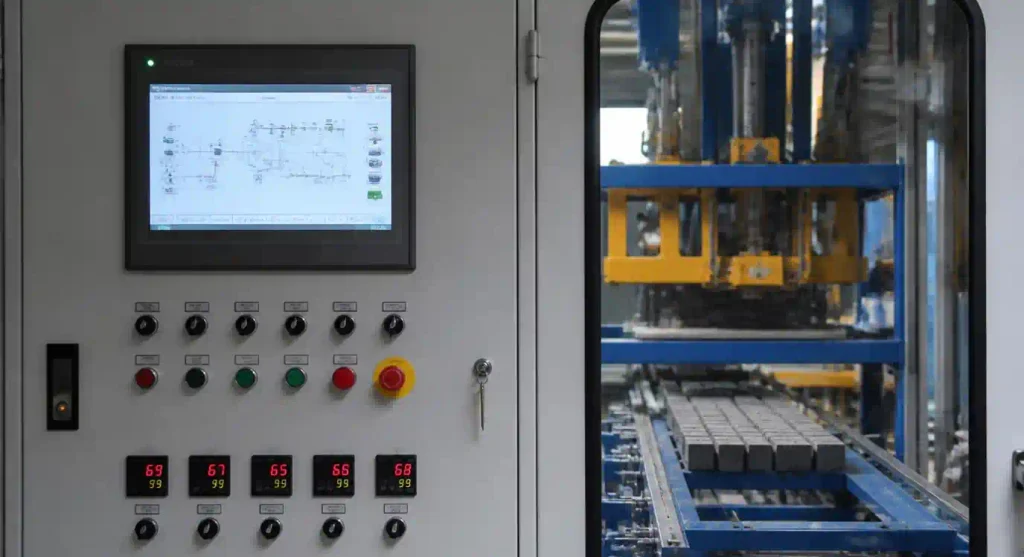
Programmable logic controllers synchronize conveyor speed with block machine cycle times. The PLC reads production status, positions pallets precisely under the mold, and sequences material flow through each station.
Modern PLC systems handle 12-20 I/O points for basic conveyor control: emergency stops, photo sensors, speed control, and accumulation zone management. You need 40-60 I/O capacity when integrating automatic batching, stacking, and curing tracking.
Sensor and Detection Systems
Photo-electric sensors detect pallet position with ±5mm accuracy—critical for automatic stacking and molding alignment. Proximity sensors confirm pallet presence before machine cycles begin, preventing misfires that waste material.
| Sensor Type | Application | Detection Range | Response Time | Typical Cost |
|---|---|---|---|---|
| Photoelectric | Pallet positioning | 0.1-10 meters | 0.5-2 ms | $45-120 each |
| Proximity (inductive) | Metal pallet detection | 2-40mm | 0.1-1 ms | $30-80 each |
| Ultrasonic | Stack height measurement | 50-5000mm | 50-300 ms | $80-180 each |
| Load cell | Weight verification | 0-2000kg | 10-50 ms | $120-280 each |
A basic 10,000-block daily system needs 8-12 sensors. Fully automatic 30,000+ block operations require 25-40 sensors across production, transfer, stacking, and curing zones.
Automatic Pallet Stacking Systems
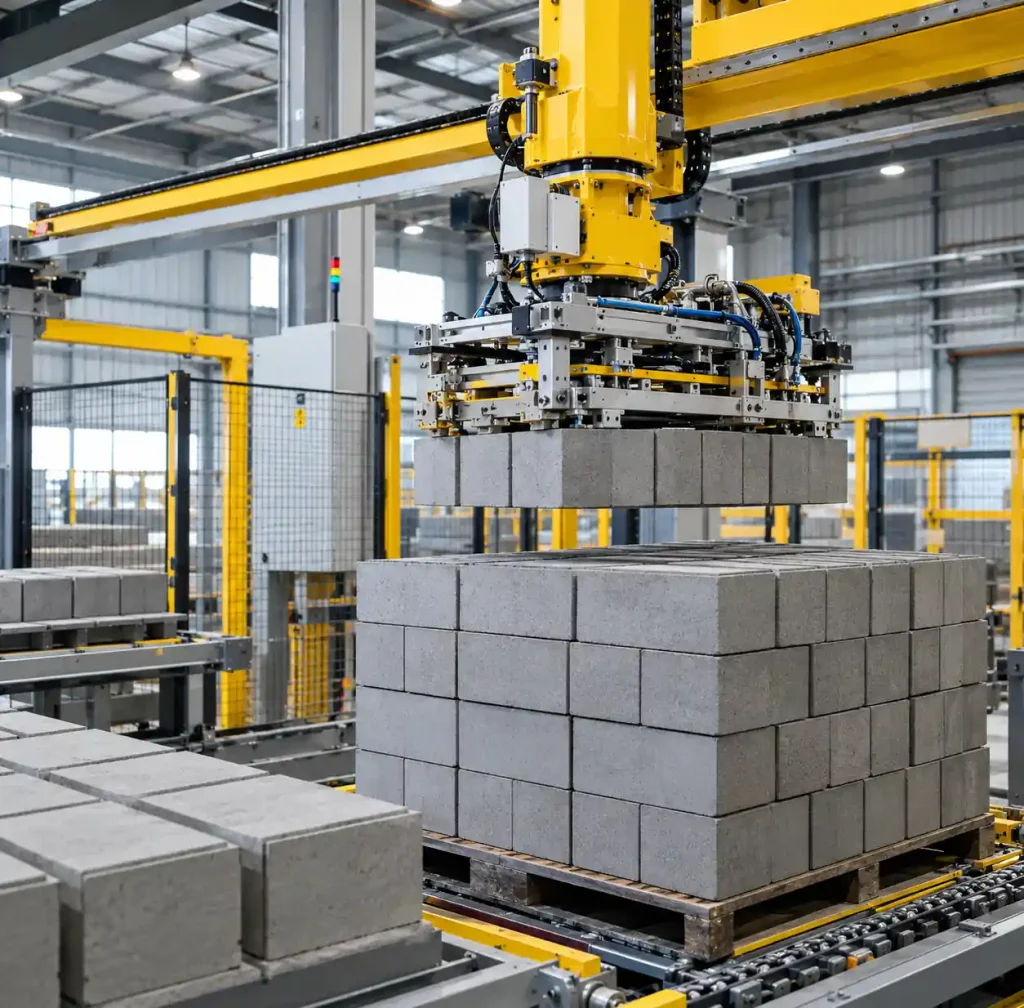
Automatic palletizers arrange finished blocks in preset patterns for curing and transport. These eliminate 4-6 workers from stacking operations while maintaining consistent patterns that optimize curing space.
Robotic stackers handle 15-25 cycles per hour—matching automatic machine output. Gantry-style stackers work for lower volumes (8,000-12,000 blocks daily) with simpler mechanics and $25,000-40,000 lower investment than robotic systems.
Conveyor System Sizing and Capacity Planning
Undersized conveyors create bottlenecks that limit overall production. Oversized systems waste capital and increase operating costs through excess power consumption and maintenance.
Calculating Required Belt Speed
Belt speed calculation starts with production rate and pallet spacing. A machine producing one pallet every 20 seconds with 2-meter minimum spacing requires:
Belt speed = (Pallet spacing × 3600) / Cycle time
Belt speed = (2m × 3600) / 20s = 360 meters/hour = 0.1 m/s
Add 15-25% buffer capacity for line stops and maintenance. This example needs 0.12-0.13 m/s belt speed to prevent accumulation during normal operation.
Layout Design for Material Flow
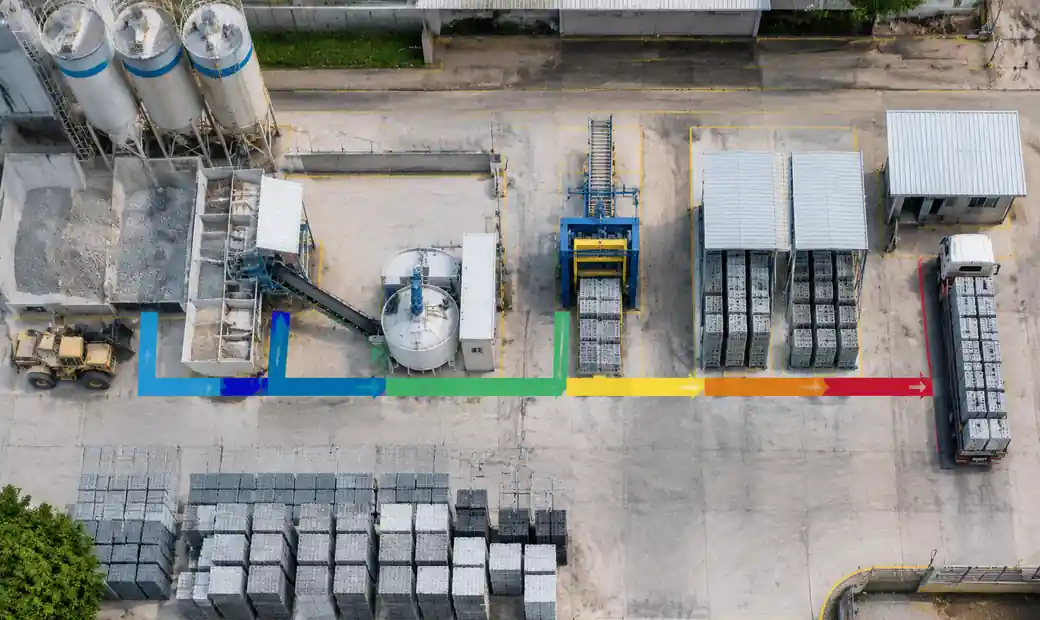
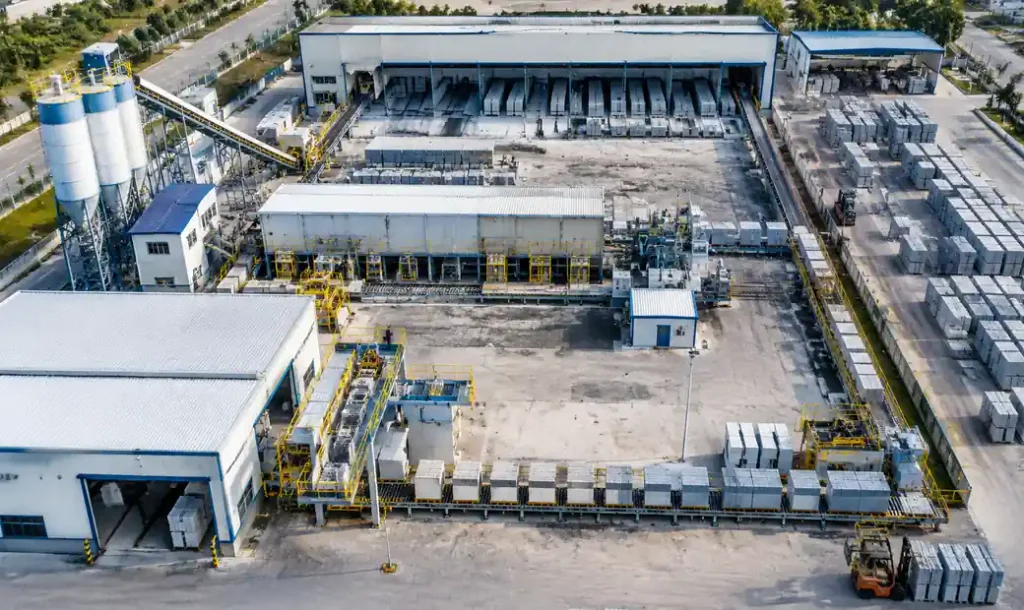
Optimal conveyor layout minimizes transfer distance while maintaining access for maintenance and quality inspection. Production flow should follow L-shaped or U-shaped patterns—machines on one leg, curing on the other, with conveyor connecting them.
Standard layout distances:
- Press to first curing position: 15-40 meters
- Between curing rows: 1.8-2.5 meters
- Curing to finished storage: 30-80 meters
- Empty pallet return: 50-150 meters
Мобильные блоковые машины reduce conveyor requirements by producing blocks near final placement, cutting transfer costs 40-60% for site-based operations.
Maintenance Protocols for Maximum Uptime
Conveyor system failure stops entire production lines. Preventive maintenance costs 70-85% less than emergency repairs while eliminating revenue loss from unplanned downtime.
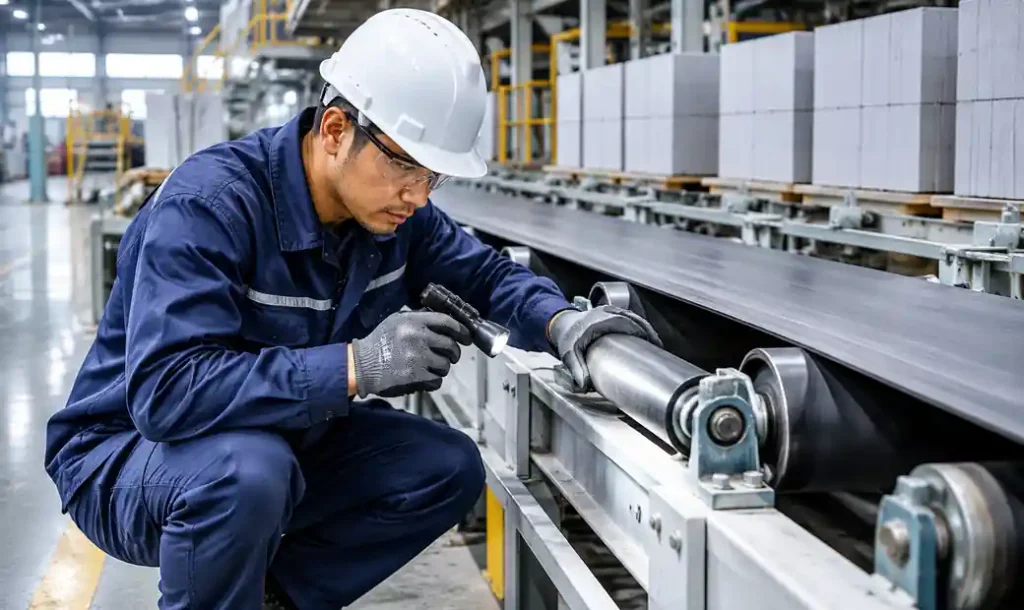
Daily Inspection Checklist
Morning inspection takes 15-20 minutes but prevents 85% of conveyor failures. Check belt tracking, clean roller bearings, verify emergency stops, and inspect splice integrity.
Critical daily checks:
- Belt alignment within centerline ±25mm
- Roller rotation (none locked or squealing)
- Material buildup on rollers or pulleys
- Belt surface damage or wear patterns
- Emergency stop functionality
- Photo sensor lens cleanliness
Weekly and Monthly Maintenance
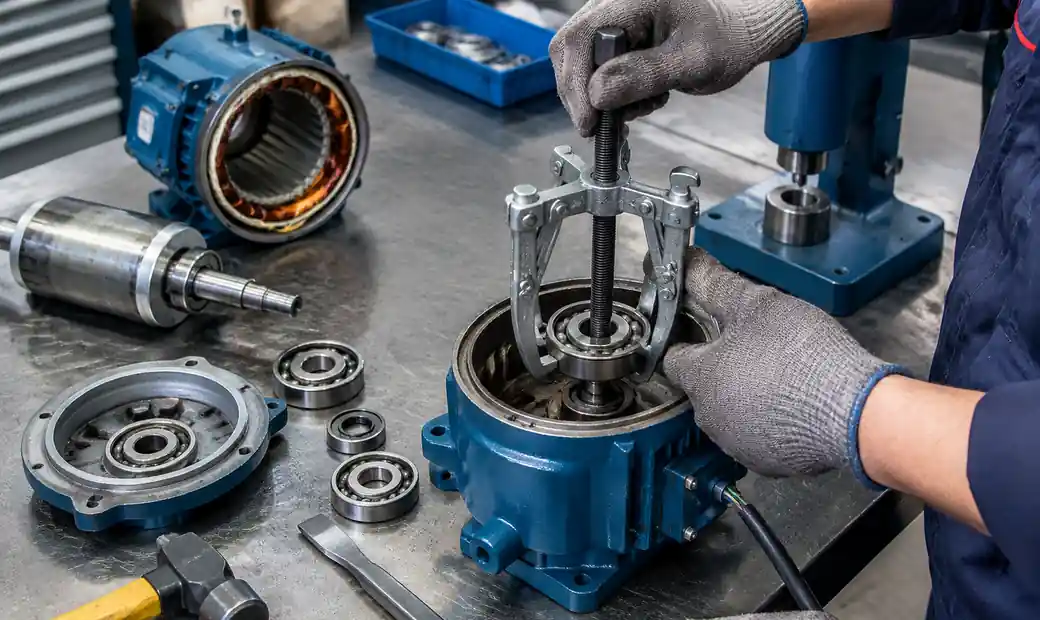
Weekly maintenance includes lubrication of drive chains, tension adjustment, and sensor calibration. Monthly tasks add bearing inspection, belt thickness measurement, and motor temperature monitoring.
| Компонент | Inspection Interval | Replacement Interval | Failure Signs | Typical Cost |
|---|---|---|---|---|
| Conveyor belt | Weekly | 18-36 months | Cracking, thinning, splice failure | $800-2,400 |
| Drive motor | Monthly | 5-8 years | Overheating, noise, vibration | $600-1,800 |
| Roller bearings | Bi-weekly | 24-48 months | Squealing, rough rotation | $15-45 each |
| Chain drive | Weekly | 36-60 months | Slack, worn teeth | $200-600 |
| Sensors | Daily | 48-72 months | Missed detections, false triggers | $30-180 each |
Maintain 3-5% of conveyor system value as spare parts inventory. A $45,000 system needs $1,350-2,250 in backup components: belts, rollers, sensors, and drive components.
ROI Calculation: Manual vs Automated Conveyors
Investment decisions require comparing total cost of ownership rather than initial purchase price. Manual systems show lower capital cost but higher annual operating expenses that eliminate apparent savings within 6-18 months.
Cost Breakdown for Different Production Scales
3,000 blocks/day operation:
- Manual handling: $0 equipment, $48,000-60,000 annual labor
- Basic conveyors: $12,000-18,000 equipment, $18,000-24,000 annual labor
- Net savings: $30,000-36,000 first year, $48,000-60,000 annually after
15,000 blocks/day operation:
- Manual handling: $0 equipment, $116,800-146,000 annual labor
- Automated conveyors: $45,000-65,000 equipment, $36,000-48,000 annual labor
- Net savings: $35,800-81,000 first year, $80,800-110,000 annually after
Beyond direct labor savings, automated conveyors deliver quality improvements worth 8-15% of revenue through reduced breakage and consistent curing conditions. Complete production solutions with integrated conveyors reduce installation time 35-45% compared to piecemeal assembly.
Upgrading Existing Lines with Conveyor Automation
Retrofitting conveyors into manual operations requires evaluating floor space, power capacity, and production flow patterns. Most facilities accommodate basic automation without major structural changes.
Phased Implementation Strategy
Start with highest-impact bottleneck: typically green block transfer from press to curing. This single 15-30 meter conveyor eliminates 2-3 transfer workers while proving automation concepts.
Phase 1 (2-4 months): Basic transfer conveyor between production and curing
Phase 2 (3-6 months): Empty pallet return system
Phase 3 (4-8 months): Automatic stacking and curing integration
Phase 4 (6-12 months): Full PLC control with sensors
Each phase delivers immediate productivity gains while financing next upgrade through labor savings. This works particularly well when upgrading from semi-automatic machines toward full automation.
Часто задаваемые вопросы
What belt speed works for automatic block machines?
Automatic machines producing 15-25 second cycles require 0.08-0.15 m/s belt speed with 1.5-2.5 meter pallet spacing. Faster speeds cause block shifting during transfer while slower speeds create production bottlenecks.
Can conveyors work with existing manual machines?
Yes. Manual machines accommodate simple roller or belt conveyors between production and curing zones. This eliminates 60-75% of handling labor while maintaining manual operation flexibility. Investment typically runs $8,000-15,000 for basic 20-30 meter systems.
How much power do conveyor systems require?
Power requirements depend on system length and load. A basic 30-meter belt conveyor with 1.5kW motor uses 12-15 kWh daily. Fully automated 100-meter systems with multiple conveyors, stackers, and controls consume 45-80 kWh daily.
What causes conveyor belt tracking problems?
Misalignment occurs from uneven roller installation, material buildup on pulleys, belt splice defects, or uneven loading. Adjust tracking by tilting lagging rollers 1-2° toward belt center. Check alignment monthly and after any belt replacement.
Do conveyors work in dusty environments?
Yes, with proper selection. Use enclosed belt systems or chain conveyors rated for concrete production environments. Install dust seals at transition points and clean rollers daily. Sensor housings need protective covers rated IP65 or higher.
What maintenance schedule prevents conveyor failures?
Inspect daily (belt tracking, roller rotation, sensors), lubricate weekly (chains, bearings), and measure belt thickness monthly. Replace components before failure—belts at 70% remaining thickness, bearings at first signs of roughness, sensors showing response delays.
Заключение
Conveyor automation transforms block manufacturing from labor-intensive batch production into continuous flow operations with 35-50% higher throughput and 60-70% lower transfer labor costs. Systems sized correctly for production volume deliver 4-12 month payback through direct labor savings alone.
The path to automation starts with understanding current bottlenecks—typically green block transfer and pallet circulation—then implementing targeted conveyor sections that eliminate highest-cost manual handling. Most operations achieve full ROI on initial conveyor investment within first production season.
Raytone Block Machinery offers complete conveyor integration with automatic, semi-automatic, and manual production systems. Our engineering team designs material handling solutions optimized for your production scale, facility layout, and automation goals.
Свяжитесь с нами сегодня for conveyor system specifications, layout design assistance, and production capacity analysis for your block manufacturing operation.