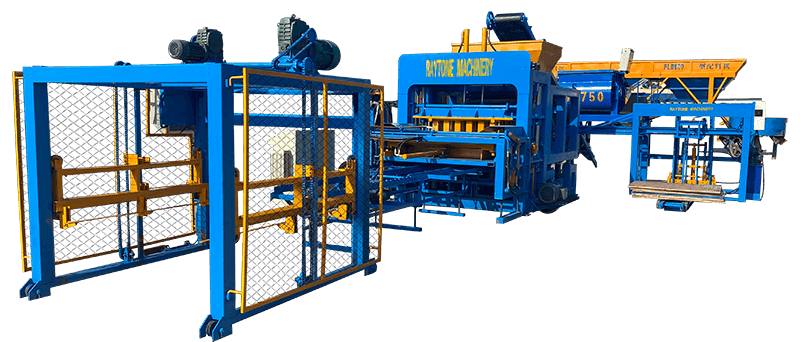






Choosing the right brick pallets for your block production line directly impacts production efficiency, block quality, maintenance costs, and long-term profitability. With pallet material options ranging from traditional wood at $10-15 per unit to steel pallets exceeding $100, and plastic alternatives in between, selecting the wrong type costs producers thousands in premature replacements, production downtime, and quality defects.
Wood pallets dominate 90% of the market due to low initial cost but fail after just 11 production cycles under wet concrete conditions. Steel pallets last 10-15 years but require significant upfront investment. Plastic pallets deliver 250+ cycles with superior moisture resistance at costs 30% higher than wood.
This guide compares wood, steel, and plastic brick pallets across every dimension that matters: durability under wet concrete, dimensional stability for consistent block quality, cost per cycle, compatibility with automatic production lines, and real-world replacement frequency. You will learn exactly which pallet type matches your production scale, how to calculate true cost per thousand blocks, and when premium materials pay back their investment.
Understanding Brick Pallet Requirements for Block Production
Critical Performance Standards
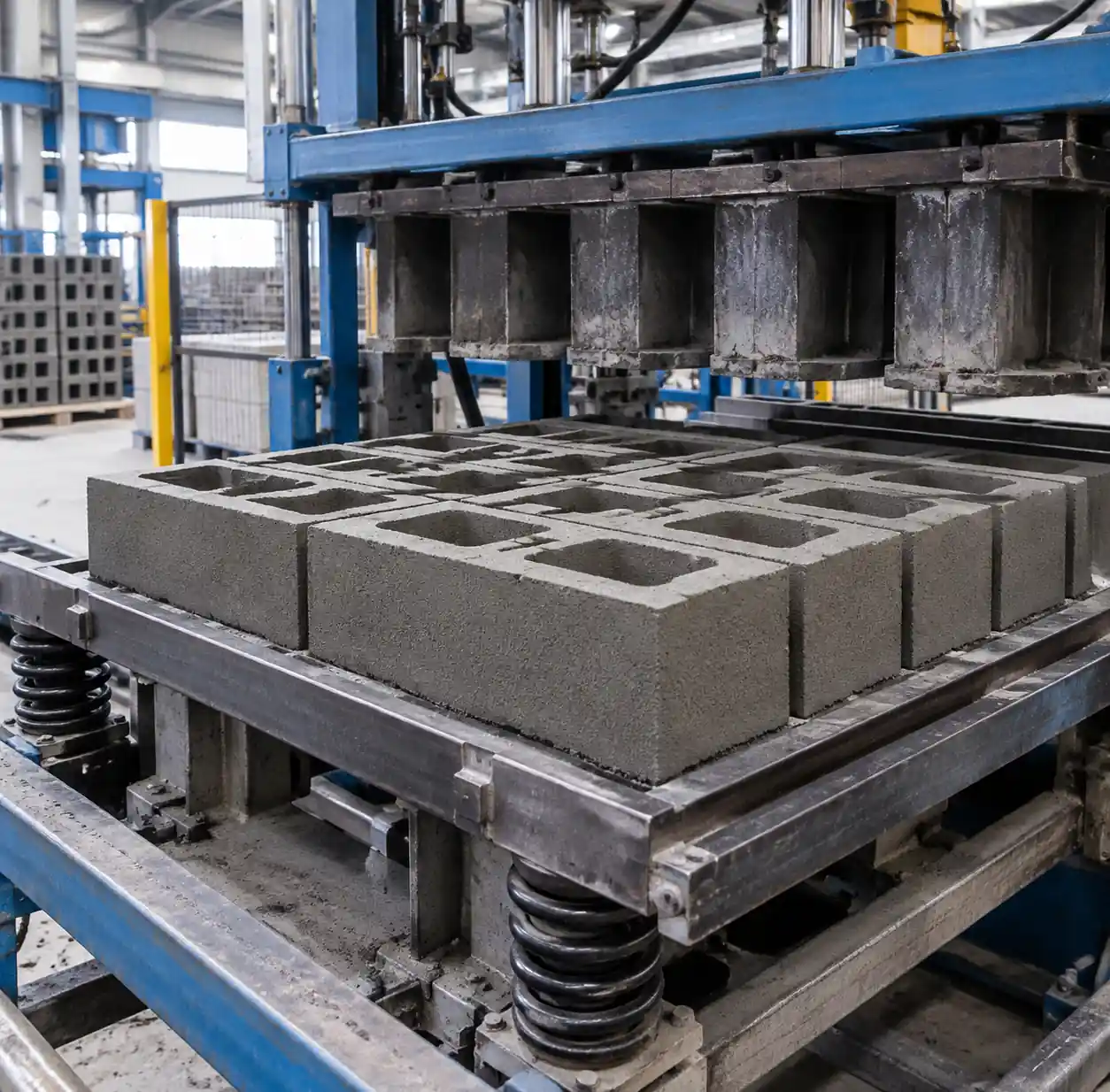
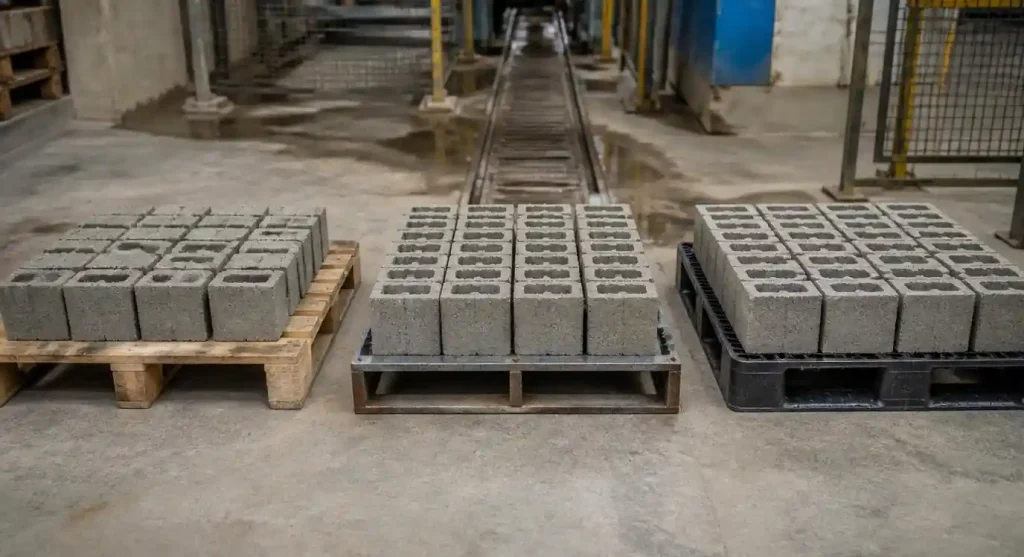
Brick pallets serve as the temporary surface where wet concrete blocks cure immediately after molding. Unlike shipping pallets that simply transport finished goods, production pallets must withstand continuous vibration during block formation, support wet concrete without warping, release finished blocks cleanly, and maintain precise dimensional tolerances cycle after cycle.
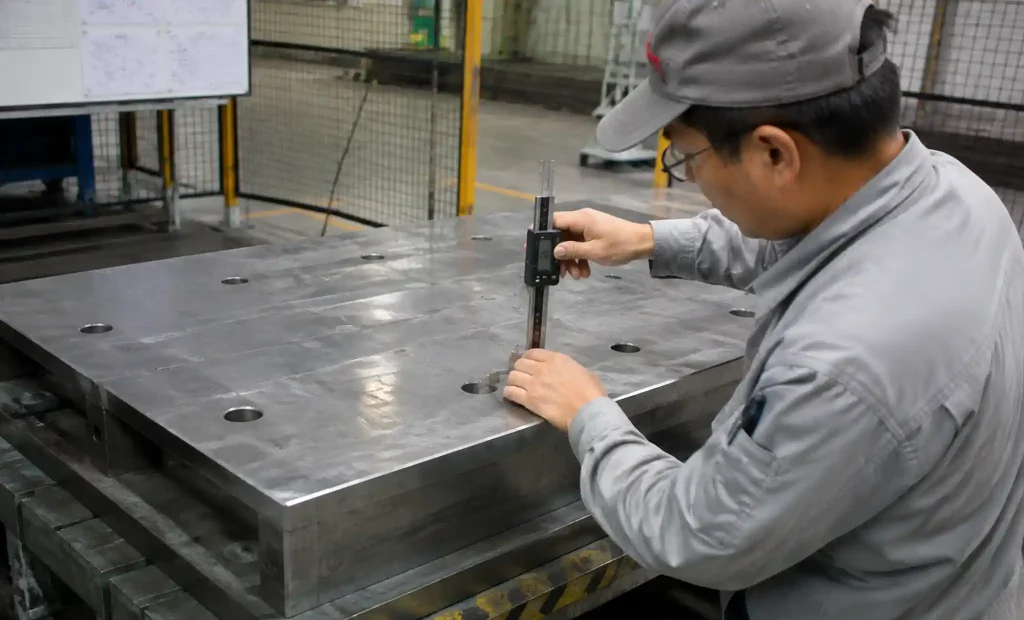
The most critical specification is flatness deviation: pallets must maintain no more than 0.3mm variation per 1000mm across the entire surface. This tolerance keeps block height consistent across every production cycle. Even minor warping causes uneven block dimensions, creating quality rejects and compatibility issues during construction. Warped pallets also increase the risk of block cracking during the curing process when concrete is most vulnerable.
Production Cycle Demands
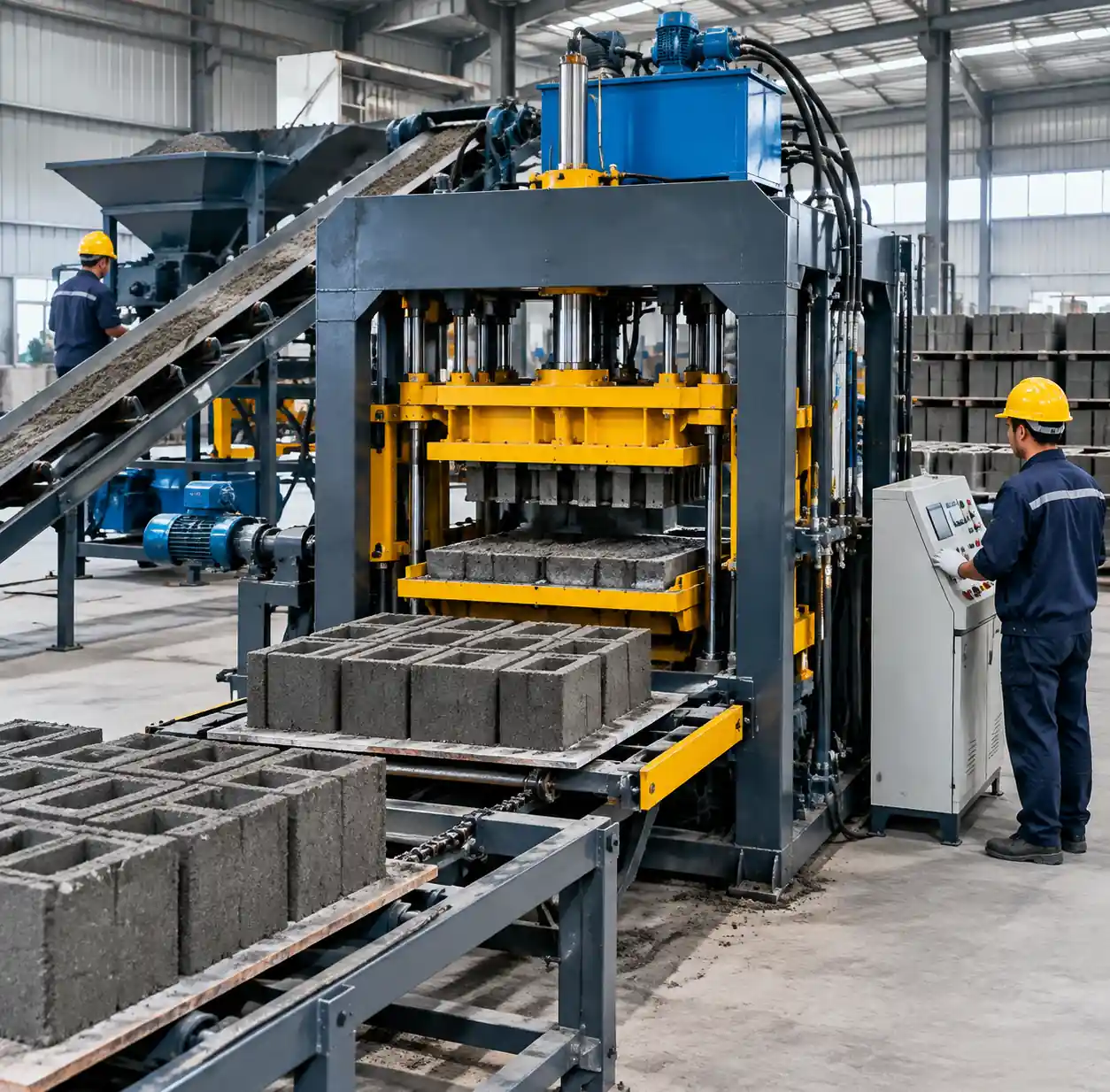
Modern block machines produce 1,260-1,800 units per hour. In an 8-hour shift, a single pallet moves through the molding station, accepts wet concrete under 150-300 bar hydraulic pressure combined with high-frequency vibration, transports the fresh block to curing areas, and returns empty to repeat the cycle. High-volume automatic production lines can cycle a pallet every 15-20 seconds.
This intense cycling exposes pallets to moisture from wet concrete mix, mechanical stress from hydraulic compression, abrasion from material handling equipment, temperature variations in curing areas, and impact forces from automatic stackers. Pallet material selection determines whether your pallets survive hundreds of cycles or fail within weeks.
Wood Pallets: Traditional Choice with Known Limitations
Construction and Materials
Wood pallets represent the original pallet material for block production. Manufacturers typically use pine or fir softwood assembled with slot connections reinforced by through-bolts. The wood surface provides high friction that naturally prevents fresh blocks from shifting during vibration and transport.
Standard wood brick pallets measure 850mm x 680mm x 20-25mm thick for most hollow block production. The natural porosity of wood initially helps with moisture management as the concrete begins setting. Wood pallets work with manual, semi-automatic, and automatic block machines when properly maintained.
Performance Under Production Conditions
Wood pallets deliver acceptable performance in controlled, moderate-volume production environments. Their high-friction surface naturally secures blocks during the molding cycle. Wood’s flexibility absorbs some vibration stress, reducing the jarring impact on fresh concrete.
However, wood pallets face significant durability challenges under wet concrete. Industry data shows wood pallets fail after approximately 11 cycles in general pallet use. In block production, where pallets contact wet concrete mix continuously, degradation accelerates. Wood absorbs moisture from wet concrete, causing swelling, warping, and dimensional instability. As wood pallets age, they develop splinters that damage block surfaces, warp beyond acceptable flatness tolerances, crack along the grain under compression stress, and become unpredictable in automated handling systems.
Cost Analysis
Wood pallets offer the lowest entry cost at $10-15 per unit. For a production line requiring 200 pallets, initial investment totals just $2,000-3,000. This makes wood the accessible choice for startups and operations testing market demand with limited capital.
The hidden cost appears in replacement frequency. Wood pallets typically require replacement every 3-6 months in active block production, sometimes sooner in high-moisture environments. Annual replacement costs for 200 pallets total $4,000-6,000. Over three years, wood pallet spending reaches $12,000-18,000 plus labor for frequent pallet changes and production interruptions when warped pallets jam automated systems.
Best Applications
Wood pallets work best when starting production with minimal capital investment, producing fewer than 100,000 blocks monthly, operating manual or semi-automatic machines where operators can inspect each pallet, working in dry climates with controlled moisture exposure, and prioritizing low upfront costs over long-term efficiency. Many successful producers start with wood pallets to validate demand, then upgrade to more durable materials once production scales beyond 150,000 blocks monthly.
Steel Pallets: Maximum Durability for High-Volume Production
Construction and Material Properties
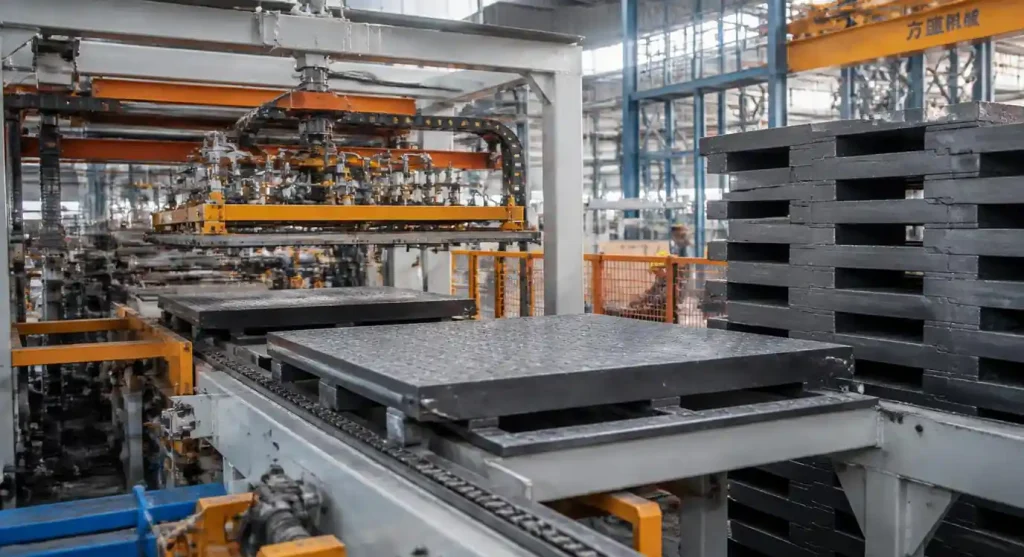
Steel pallets use high-grade structural steel, typically 3-5mm thick, welded or bolted into rigid frames. Manufacturers apply anti-corrosion treatments including galvanization, powder coating, or specialized surface treatments to prevent rust from wet concrete exposure. Premium steel pallets incorporate stainless steel alloys for superior corrosion resistance.
Steel pallets maintain dimensional precision across their entire service life. The rigid steel structure resists warping even under maximum hydraulic pressure and continuous wet concrete contact. Steel pallets can support loads up to twenty times higher than wood, making them ideal for large-format blocks and high-capacity production lines running QT10-15 or QT12-15 automatic machines.
Exceptional Lifespan and Stability
Steel pallets deliver 10-15 years of service life in continuous block production. This exceptional durability stems from steel’s resistance to moisture absorption—wet concrete cannot penetrate or warp steel surfaces. Steel maintains the critical 0.3mm flatness tolerance indefinitely, ensuring consistent block dimensions year after year.
The rigid steel surface provides perfect support for automated production lines. Robotic handling systems and automatic stackers require predictable pallet dimensions and weight. Steel pallets deliver this consistency, preventing the jamming and misalignment issues common with worn wood pallets. One producer switching to steel pallets reduced product damage claims by 18% and reclaimed 4,200 square feet of staging area previously needed for defective blocks.
Investment and Long-Term Economics
Steel pallets require substantial upfront investment at $80-150 per unit depending on size, steel grade, and surface treatment. Equipping a 200-pallet production line costs $16,000-30,000 initially—5-10 times higher than wood.
However, the economic calculation shifts dramatically over time. With 10-15 year lifespan, steel pallets eliminate replacement costs that consume $4,000-6,000 annually with wood. Over ten years, wood pallet replacement totals $40,000-60,000 compared to the one-time steel investment of $16,000-30,000. Steel pallets pay back their premium within 3-4 years and generate savings of $20,000-40,000 over their service life.
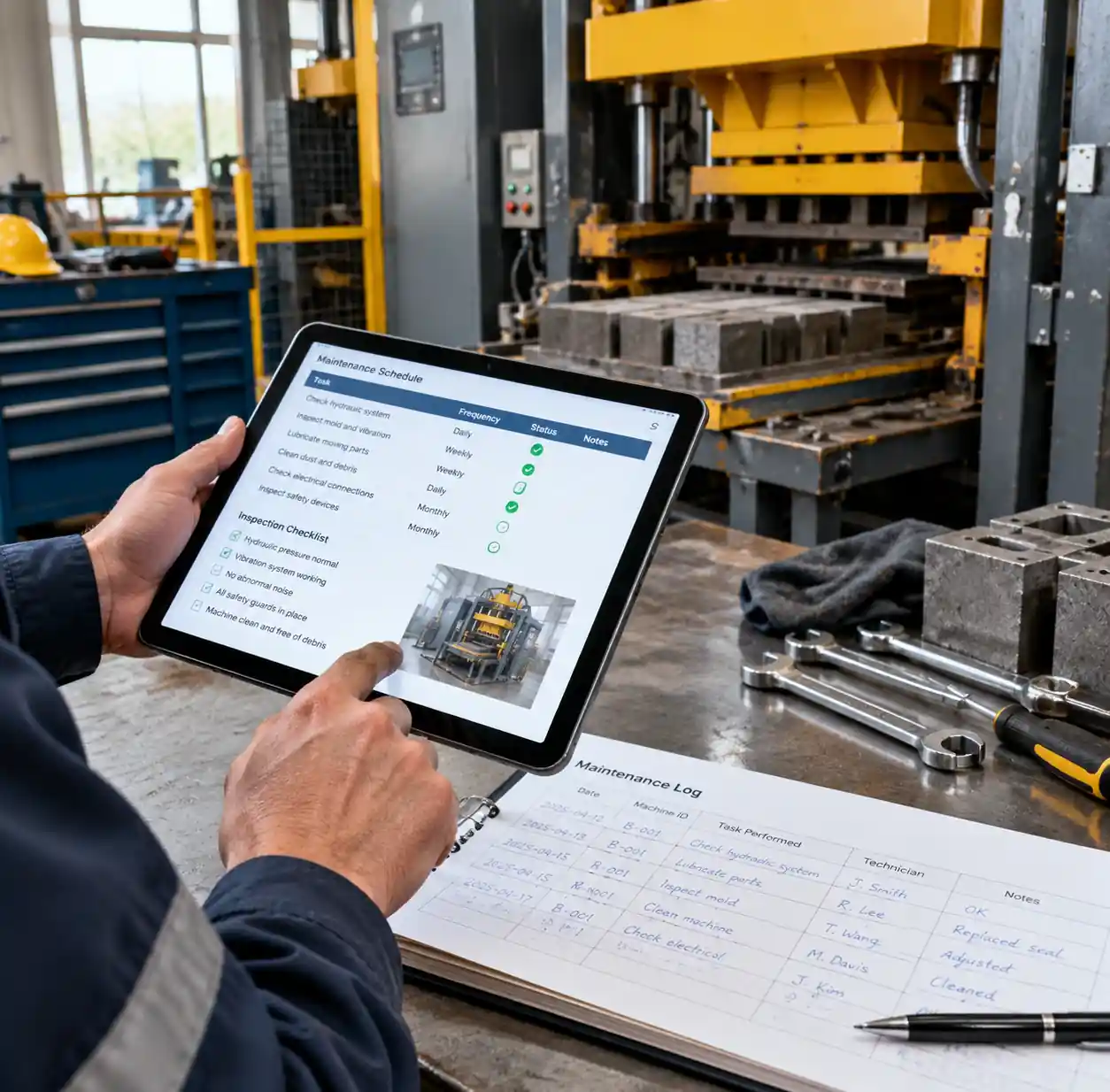
Steel also reduces maintenance labor and production downtime. Wood pallets require weekly inspection and sorting to remove warped units before they damage blocks or jam equipment. Steel pallets need only occasional cleaning and corrosion spot treatment.
Maintenance Requirements
Steel pallets require minimal but important maintenance. Regular cleaning prevents concrete buildup that can affect block release and surface finish. Annual inspection checks for rust development, particularly at weld points and edges where protective coatings may wear. Spot treatment with rust inhibitor or touch-up coating extends steel pallet life to the maximum 15-year range.
Storage matters: steel pallets stacked outdoors without weather protection develop rust faster. Indoor storage or weather-resistant coatings protect the investment. Despite their durability, steel pallets require proper handling to prevent bending or edge damage from forklifts and rough material handling.
Ideal Production Scenarios
Steel pallets deliver best value when operating automatic production lines producing 500,000+ blocks monthly, running high-capacity machines like the QT10-15 or QT12-15 that cycle pallets every 15-20 seconds, producing large-format blocks requiring superior load capacity, prioritizing dimensional consistency for engineering-grade blocks meeting ASTM specifications, and having capital available for premium production equipment that pays back through longevity.
Plastic Pallets: Modern Alternative Balancing Performance and Cost
Material Composition and Design
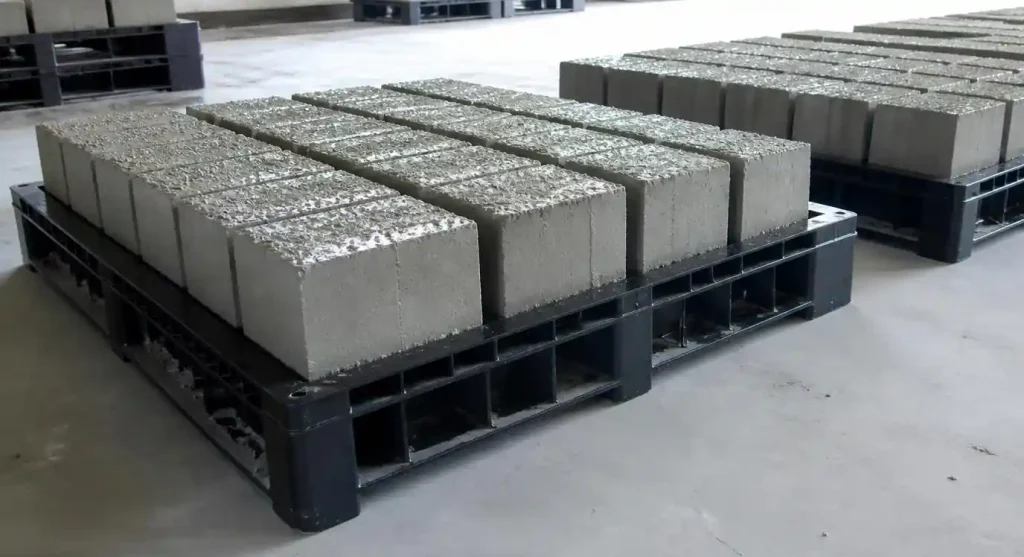
Plastic brick pallets typically use High-Density Polyethylene (HDPE) or Polypropylene (PP), manufactured through injection molding or compression molding. HDPE delivers superior compressive strength, often exceeding 20 MPa at optimal formulations. Modern plastic pallets incorporate ribbed undersides for structural reinforcement, textured surfaces for block adhesion during curing, and UV stabilizers to prevent degradation from outdoor curing exposure.
The plastic pallet market is growing at 7% annually, projected to expand from $7.1 billion in 2025 to $10.4 billion by 2034. This growth reflects increasing adoption in industrial applications including block production where plastic’s moisture resistance and longevity outperform wood.
Performance Characteristics
Plastic pallets deliver 250+ production cycles compared to wood’s 11 cycles. This dramatic improvement stems from plastic’s complete immunity to moisture absorption. Unlike wood that swells and warps when wet, HDPE and PP maintain dimensional stability regardless of concrete moisture content. Plastic pallets resist chemical attack from cement alkalinity that accelerates wood degradation.
Plastic’s smooth, non-porous surface releases blocks cleanly without the sticking issues common with aged wood pallets. This improves demolding efficiency and reduces block surface defects. Plastic pallets weigh 40-60% less than equivalent steel pallets, reducing operator fatigue and material handling equipment stress.
However, plastic has limitations. HDPE and PP flex under high point loads, requiring design verification for specific block sizes and molding pressures. Plastic pallets work well with standard hollow blocks and solid blocks up to 400×200×200mm but may flex excessively under larger formats requiring steel’s rigid support.
Cost and Economic Value
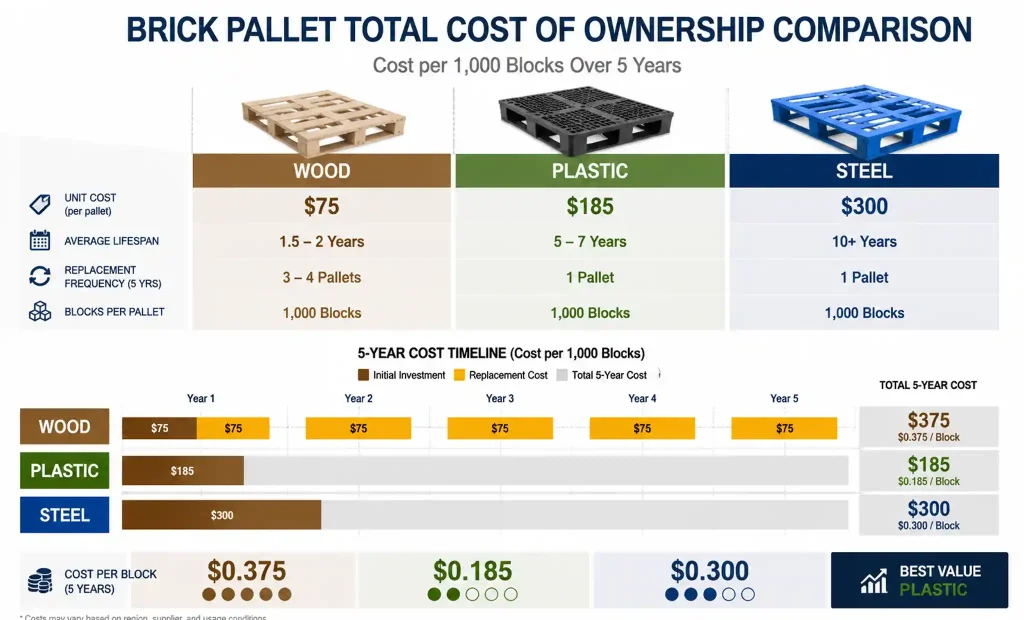
Plastic pallets cost $40-80 per unit—approximately 30% more than wood but 50-70% less than steel. Initial investment for 200 pallets totals $8,000-16,000, positioning plastic as the middle-ground option between wood’s low entry cost and steel’s premium pricing.
The economic advantage appears in longevity. With 5-10 year lifespan and 250+ cycles, plastic pallets match much of steel’s durability at half the initial cost. Producers replacing wood pallets twice yearly at $6,000 spend $30,000 over five years. The same production equipped with plastic pallets invests $12,000 once—a savings of $18,000 over five years plus reduced maintenance labor.
Plastic pallets deliver lower cost per cycle than either wood or steel in medium to high-volume production. For operations producing 200,000-500,000 blocks monthly, plastic offers optimal value: far more durable than wood without steel’s substantial capital requirement.
Environmental Considerations
Plastic pallets support sustainability initiatives. HDPE and PP pallets are fully recyclable at end of life, diverting petroleum-based waste from landfills. Some manufacturers produce pallets from recycled plastic content, further reducing environmental impact. Research shows HDPE incorporation in concrete applications decreases thermal conductivity by 6.4% and can reduce overall material costs while addressing plastic waste management.
Unlike wood pallets that require ISPM 15 heat treatment for international shipping to prevent pest contamination, plastic pallets need no treatment. This simplifies export logistics for producers shipping block-making equipment internationally.
Optimal Use Cases
Plastic pallets excel when scaling production from 150,000 to 500,000 blocks monthly, seeking durability beyond wood without steel’s capital commitment, operating semi-automatic or automatic production lines, producing standard block sizes (400×200×200mm and smaller), prioritizing moisture resistance and consistent block quality, and incorporating sustainability into production practices.
Performance Comparison Across Key Metrics
| Factor | Wood Pallets | Plastic Pallets | Steel Pallets |
|---|---|---|---|
| Unit Cost | $10-15 | $40-80 | $80-150 |
| Initial Investment (200 units) | $2,000-3,000 | $8,000-16,000 | $16,000-30,000 |
| Продолжительность жизни | 3-6 months | 5-10 years | 10-15 years |
| Production Cycles | ~11 cycles | 250+ cycles | 1,000+ cycles |
| Влагостойкость | Плохо | Отлично | Отлично |
| Стабильность размеров | Poor (warps) | Good | Отлично |
| Weight | Средний | Light | Heavy |
| Maintenance | Weekly inspection | Minimal | Annual inspection |
| 5-Year Total Cost (200 units) | $20,000-30,000 | $8,000-16,000 | $16,000-30,000 |
| Best Production Volume | <100K blocks/month | 150K-500K blocks/month | 500K+ blocks/month |
Durability and Replacement Frequency Analysis
Real-World Service Life
Replacement frequency directly determines operating costs and production reliability. Wood pallets typically require replacement every 3-6 months in active production. High-moisture environments or continuous operation accelerate degradation to 2-3 months. This means producers replace wood pallets 4-8 times over two years.
Plastic pallets deliver 5-10 year service life with proper handling. Most producers see 7-8 years before replacing plastic pallets, even in high-volume continuous production. This longevity eliminates the constant pallet inspection, sorting, and replacement that consumes labor with wood.
Steel pallets routinely serve 10-15 years when properly maintained. Some producers report steel pallets lasting 15+ years in controlled indoor production environments with regular rust prevention treatment. Steel’s exceptional longevity makes it effectively a one-time capital investment rather than a recurring operational expense.
Impact on Production Efficiency
Pallet failures disrupt production flow. When wood pallets warp beyond tolerance, they must be removed from circulation before they cause block defects or jam automated equipment. This requires daily or weekly pallet inspection and sorting, consuming 2-4 hours of labor weekly.
Warped pallets that enter production create dimensional variations in finished blocks, increasing rejection rates. Industry data shows that unplanned equipment downtime reduces dispatch capacity by 15-25% on peak days. Failed pallets jamming automatic stackers can halt entire production lines until cleared.
Plastic and steel pallets eliminate these disruptions. Their dimensional stability means producers inspect pallets monthly or quarterly rather than weekly. Production lines equipped with premium pallets run continuously without pallet-related stoppages, maximizing equipment utilization and throughput.
Cost Per Thousand Blocks Analysis
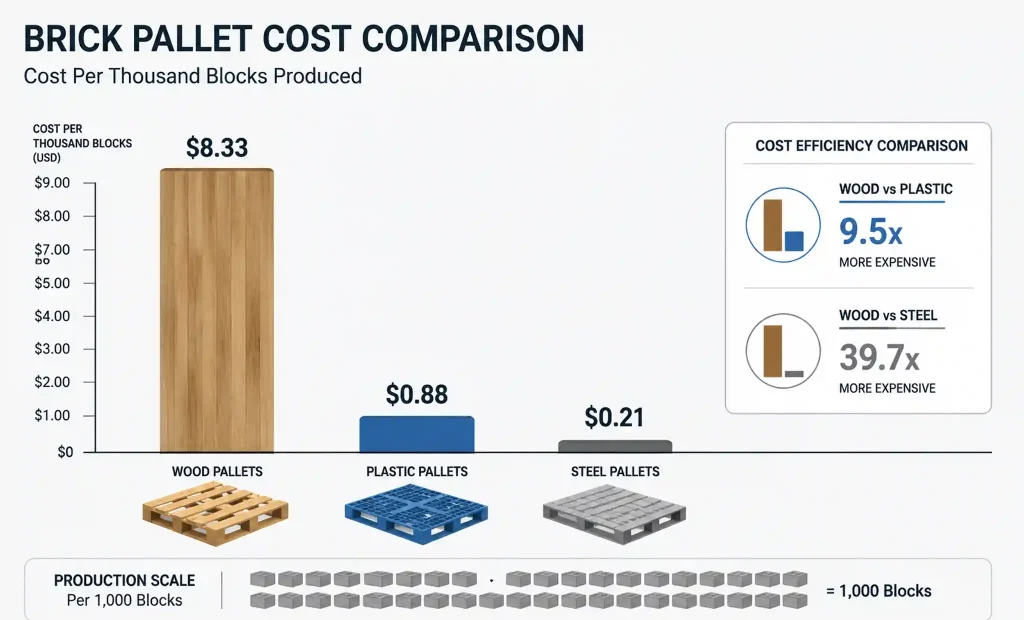
The true economic comparison appears when calculating pallet cost per thousand blocks produced. This metric reveals which material delivers lowest operating cost at your production scale.
Wood Pallet Example:
- 200 pallets × $12.50 average = $2,500 initial investment
- Replacement every 4 months = 3 replacements/year = $7,500 annually
- Production capacity: 3,000 blocks/day × 25 days = 75,000 blocks/month
- Annual production: 900,000 blocks
- Pallet cost per thousand blocks: $7,500 ÷ 900 = $8.33 per thousand blocks
Plastic Pallet Example:
- 200 pallets × $60 average = $12,000 initial investment
- Replacement every 7 years = $1,714 annually (amortized)
- Production capacity: 6,500 blocks/day × 25 days = 162,500 blocks/month
- Annual production: 1,950,000 blocks
- Pallet cost per thousand blocks: $1,714 ÷ 1,950 = $0.88 per thousand blocks
Steel Pallet Example:
- 200 pallets × $115 average = $23,000 initial investment
- Replacement every 12 years = $1,917 annually (amortized)
- Production capacity: 30,000 blocks/day × 25 days = 750,000 blocks/month
- Annual production: 9,000,000 blocks
- Pallet cost per thousand blocks: $1,917 ÷ 9,000 = $0.21 per thousand blocks
The analysis reveals that wood’s low initial cost creates the highest operating expense per block produced. Steel and plastic dramatically reduce per-block pallet costs through longevity despite higher upfront investment.
Compatibility with Different Machine Types
Manual Block Machines
Manual block machines producing 2,000-4,000 blocks per 8-hour shift work with all three pallet types. The lower production volume and hands-on operation allow operators to work around occasional warped wood pallets by manually inspecting and selecting good units for each cycle. Wood pallets suit manual operations prioritizing minimal startup capital.
However, even manual producers benefit from plastic or steel pallets once production exceeds 80,000-100,000 blocks monthly. The time saved not constantly replacing failed wood pallets pays for the upgraded materials within 6-12 months.
Semi-Automatic Machines
Semi-automatic machines producing 5,000-8,000 blocks per shift increase pallet cycling frequency, accelerating wood pallet degradation. At this scale, wood pallet failures begin impacting efficiency as operators spend more time inspecting and replacing warped units.
Plastic pallets match semi-automatic production demands well. Their 250+ cycle lifespan handles the increased throughput while maintaining dimensional consistency. Most producers upgrading from manual to semi-automatic machines should simultaneously upgrade from wood to plastic pallets to capture full efficiency gains.
Automatic Production Lines
Automatic block machines producing 15,000-46,000 blocks per shift require steel or premium plastic pallets. The high-speed automated handling systems cannot accommodate wood pallet dimensional variations. Automatic stackers, robotic transfers, and conveyor systems demand perfect pallet consistency that only steel reliably provides.
High-capacity automatic lines like the QT10-15 cycling pallets every 15-20 seconds generate 1,000+ pallet cycles annually. At this intensity, only steel pallets deliver the required durability and dimensional precision. The premium investment becomes mandatory rather than optional at automatic production scale.
Making the Right Choice for Your Production
Decision Framework
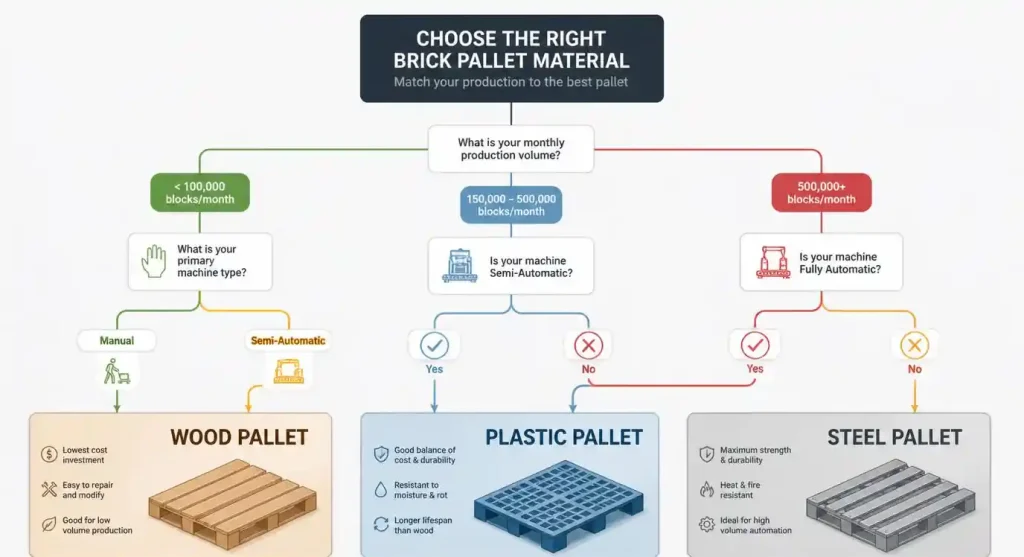
Choose wood pallets when testing new market entry with minimal capital (under $5,000 total equipment budget), producing fewer than 80,000 blocks monthly, operating manual machines where operators directly handle each pallet, working in dry, controlled environments, and planning to upgrade pallets once production volume is proven. Wood makes sense as a temporary solution, not a long-term strategy.
Choose plastic pallets when scaling production from 150,000 to 500,000 blocks monthly, operating semi-automatic or entry-level automatic machines, seeking balance between durability and cost, prioritizing moisture resistance and consistent block quality, working with standard block sizes up to 400×200×200mm, and having $10,000-20,000 available for pallet investment. Plastic delivers optimal value at medium scale.
Choose steel pallets when operating high-capacity automatic production lines producing 500,000+ blocks monthly, running machines like the QT10-15 or QT12-15 with 15-20 second cycle times, producing large-format blocks or engineering-grade blocks requiring perfect dimensional consistency, having $20,000-30,000 capital available for premium equipment, and prioritizing maximum equipment utilization and minimal downtime. Steel becomes economically mandatory at high volume where pallet failures cost thousands in lost production daily.
Hybrid Approaches
Some producers successfully operate hybrid pallet systems, using steel pallets for their automatic production line’s fastest-cycling positions while deploying plastic pallets in curing and storage areas where cycling intensity is lower. This captures steel’s durability where most critical while reducing total steel pallet investment by 30-40%.
Another strategy: start with plastic pallets when installing a new semi-automatic or automatic line, then gradually replace plastic with steel as production volume grows and capital becomes available. This spreads the steel investment over 12-24 months while immediately eliminating wood’s limitations.
Environmental and Sustainability Considerations
Wood pallets require tree harvest and represent the least sustainable option when frequent replacement is factored in. Though biodegradable, the 3-6 month replacement cycle means continuous wood consumption. Wood pallets also require ISPM 15 heat treatment for international shipping, adding processing steps and energy consumption.
Plastic pallets support circular economy initiatives. HDPE and PP are fully recyclable at end of life. Some manufacturers incorporate 30-50% recycled plastic content in production pallets without compromising performance. Plastic pallets also reduce concrete production’s carbon footprint by extending equipment service life and reducing material waste.
Steel pallets offer the longest service life, amortizing their manufacturing impact across 10-15 years of use. Steel is fully recyclable at end of life, with high scrap value. The energy-intensive steel manufacturing process is offset by decades of service life without replacement.
Часто задаваемые вопросы
Can I mix different pallet types on the same production line?
Yes, but with caution. Steel and plastic pallets can work together on the same line if they match dimensions precisely. However, mixing wood pallets with steel or plastic creates problems because wood’s dimensional inconsistency disrupts automated handling systems calibrated for precise pallet dimensions. If mixing materials, use steel and plastic together, not wood with either premium material.
How do I calculate the right number of pallets for my production line?
A general rule: you need pallets equal to (blocks per hour × curing time in hours) ÷ blocks per pallet. For example, producing 1,200 blocks/hour with 24-hour curing time and 1 block per pallet requires 28,800 pallet positions. Most operations use 200-500 pallets for manual and semi-automatic production, and 1,000-3,000 pallets for automatic lines with extended curing areas.
Do steel pallets rust under wet concrete exposure?
Yes, untreated steel rusts rapidly in wet concrete environments due to cement’s alkalinity. Quality steel pallets include anti-corrosion treatment such as galvanization, powder coating, or stainless steel construction. With proper treatment and annual maintenance, steel pallets resist corrosion for their full 10-15 year service life.
Can plastic pallets handle the hydraulic pressure and vibration of automatic machines?
Yes, but with design considerations. Premium HDPE plastic pallets withstand 150-300 bar hydraulic pressure and high-frequency vibration successfully when properly ribbed and reinforced. However, plastic pallets work best with standard block sizes up to 400×200×200mm. Larger formats or specialty high-density blocks may require steel’s superior rigidity.
How much does pallet maintenance cost annually?
Wood pallet maintenance primarily involves labor for weekly inspection and sorting, typically 2-4 hours weekly ($800-1,600 annually in labor). Plastic pallets need minimal maintenance—occasional cleaning and inspection quarterly ($200-400 annually). Steel pallets require annual rust inspection and spot treatment plus cleaning ($500-1,000 annually including materials and labor). Despite steel’s higher maintenance cost, its longevity makes total ownership cost lowest over 10+ years.
What happens to pallet dimensions as they age?
Wood pallets swell when absorbing moisture and shrink when drying, creating dimensional instability that worsens with age. A wood pallet may vary 2-5mm in thickness and 3-8mm in length/width over its short service life. Plastic pallets maintain dimensions within 0.5mm across their entire 5-10 year life. Steel pallets show virtually zero dimensional change, maintaining the critical 0.3mm flatness tolerance indefinitely unless physically damaged.
Заключение
Brick pallet selection determines production costs, block quality consistency, and equipment utilization for years after the initial purchase. Wood pallets minimize startup costs at $10-15 per unit but require replacement every 3-6 months, creating the highest operating expense at $8.33 per thousand blocks. Plastic pallets deliver 250+ cycles and 5-10 year service life at $40-80 per unit, reducing costs to $0.88 per thousand blocks while eliminating wood’s moisture and warping issues. Steel pallets cost $80-150 per unit but last 10-15 years with 1,000+ cycles, delivering the lowest long-term cost at $0.21 per thousand blocks.
Your optimal choice depends on production scale and equipment type. Wood works for manual operations under 80,000 blocks monthly testing market demand with minimal capital. Plastic suits semi-automatic and moderate-scale automatic production from 150,000 to 500,000 blocks monthly, balancing durability with reasonable investment. Steel becomes economically mandatory for high-capacity automatic lines producing 500,000+ blocks monthly where pallet precision and longevity directly impact profitability.
Raytone Block Machinery manufactures complete block production solutions including automatic, semi-automatic, and manual block machines serving producers in over 100 countries worldwide. Our production lines integrate with all three pallet types, with engineering support to help you select optimal pallet materials for your production scale and block specifications. Whether starting with cost-effective materials or installing high-capacity automatic systems, Raytone provides complete technical guidance on maximizing equipment performance and production quality.
Contact our technical team today for detailed recommendations on pallet specifications, production line configuration, and material handling systems optimized for your target production volume and block types.