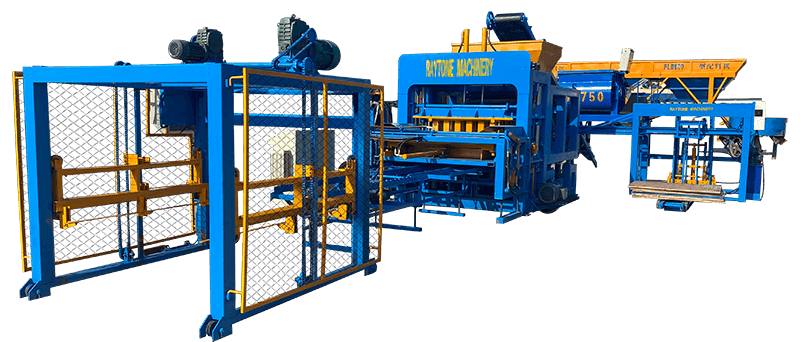






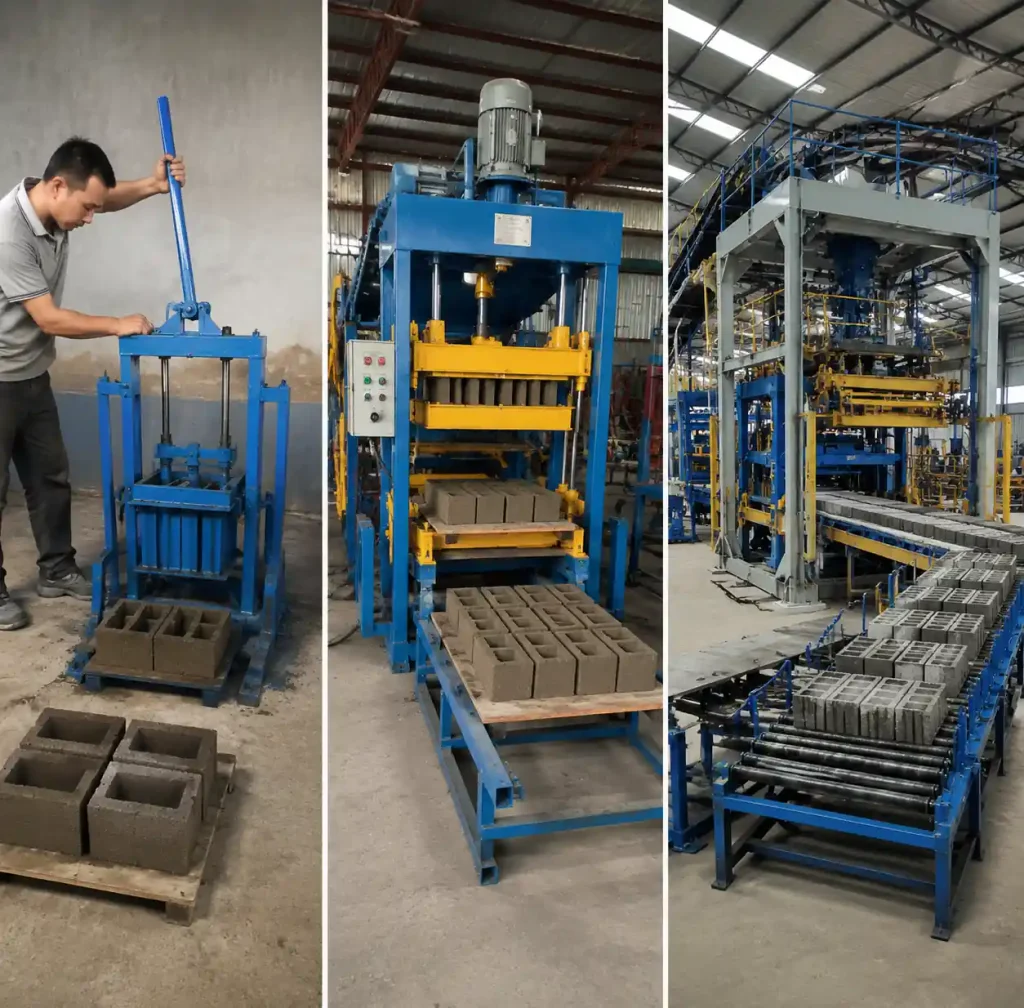
Block production businesses face a critical decision that determines profitability for years: choosing the right level of automation. Manual machines require constant labor but minimal investment. Fully automatic lines maximize output but demand substantial capital. Semi-automatic block machines occupy the strategic middle ground—delivering 3-5 times the output of manual machines while costing 60-75% less than fully automatic systems.
Industry data shows semi-automatic machines achieve payback in 18-24 weeks for established producers, faster than both manual and automatic alternatives when scaled to their optimal production volumes. This advantage comes from combining automated precision in the molding process with manual flexibility in material handling, creating the ideal balance for operations producing 150,000 to 250,000 blocks monthly.
If you want to scale beyond manual production without committing to full automation complexity, understanding how semi-automatic block machines deliver this cost-efficiency balance will determine whether your expansion succeeds or consumes capital without proportional returns.
What Are Semi-Automatic Block Machines?
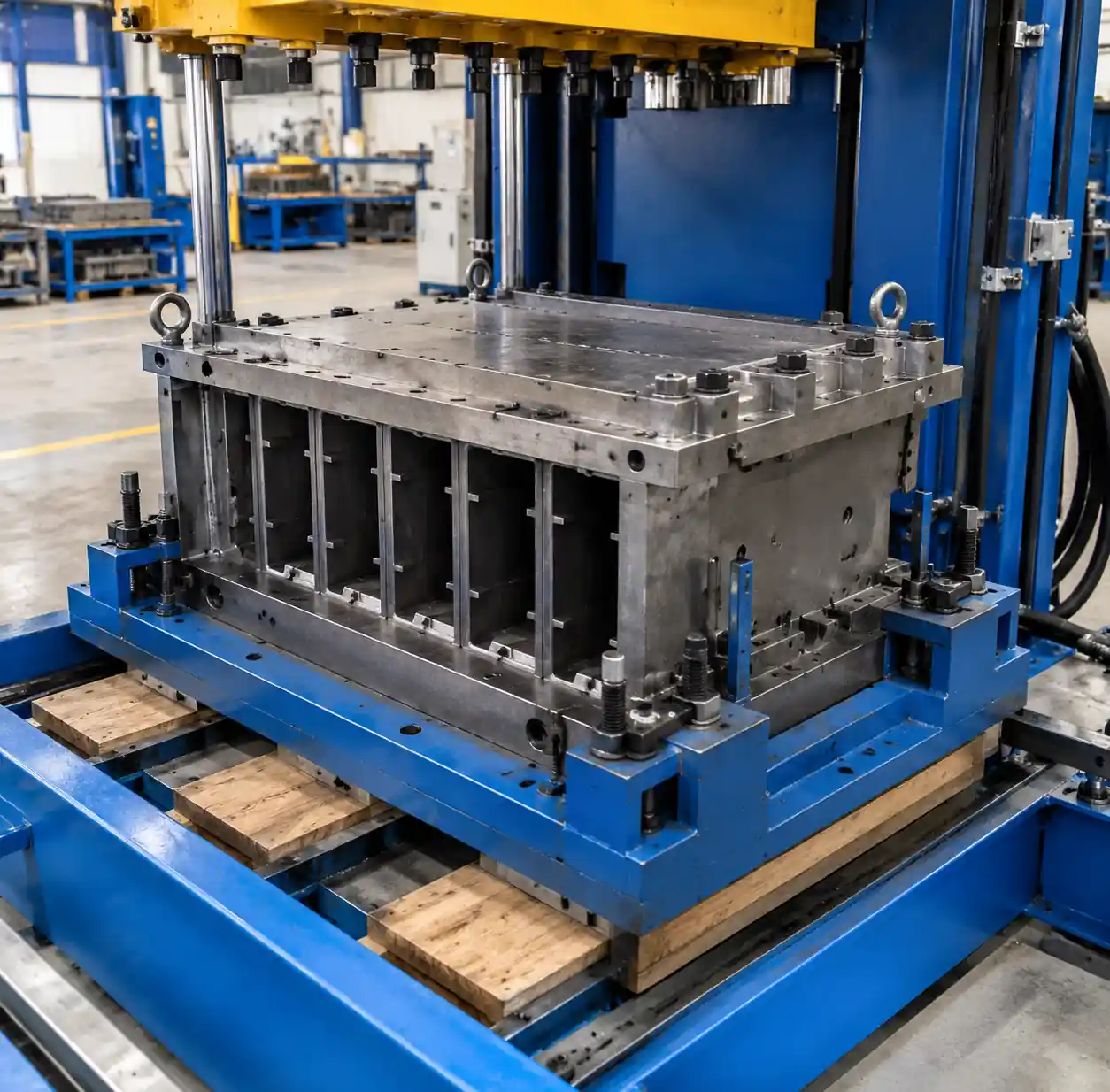
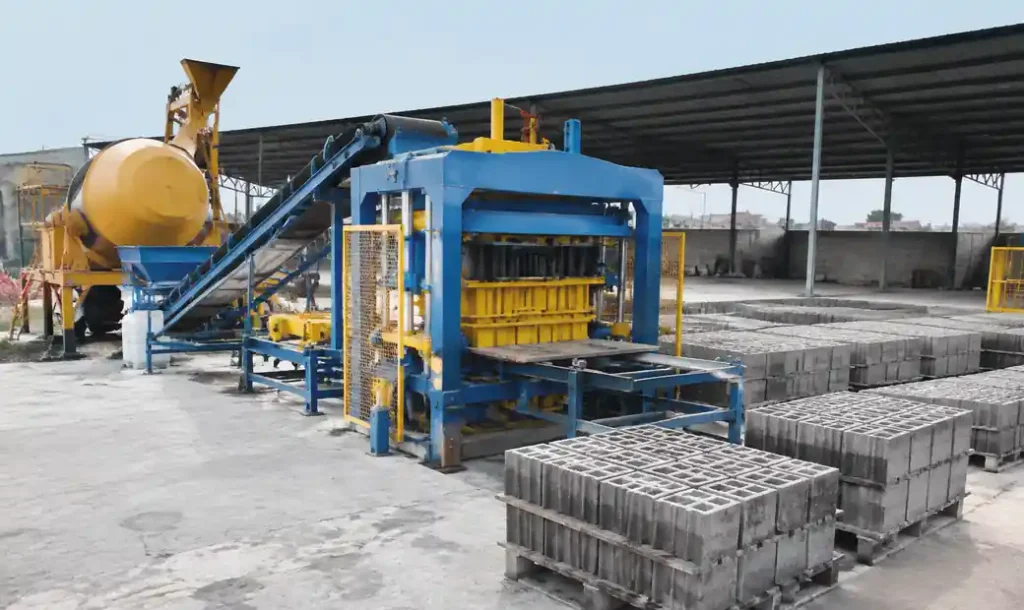
Semi-automatic block machines integrate automated molding cycles with manual material handling. The machine controls vibration force, hydraulic compression, and molding timing through PLC systems, while operators manually load raw materials and remove finished blocks from the production area.
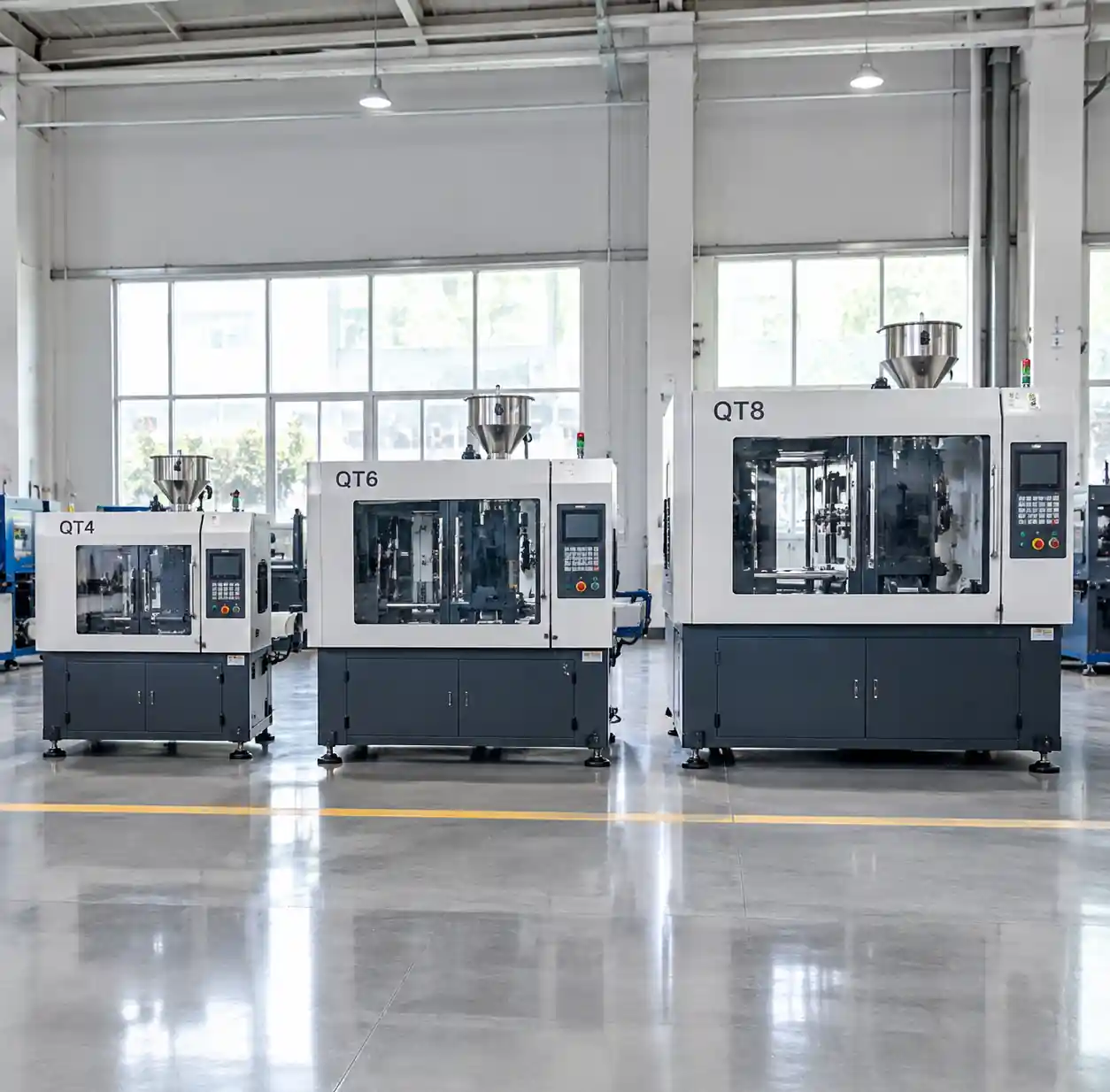
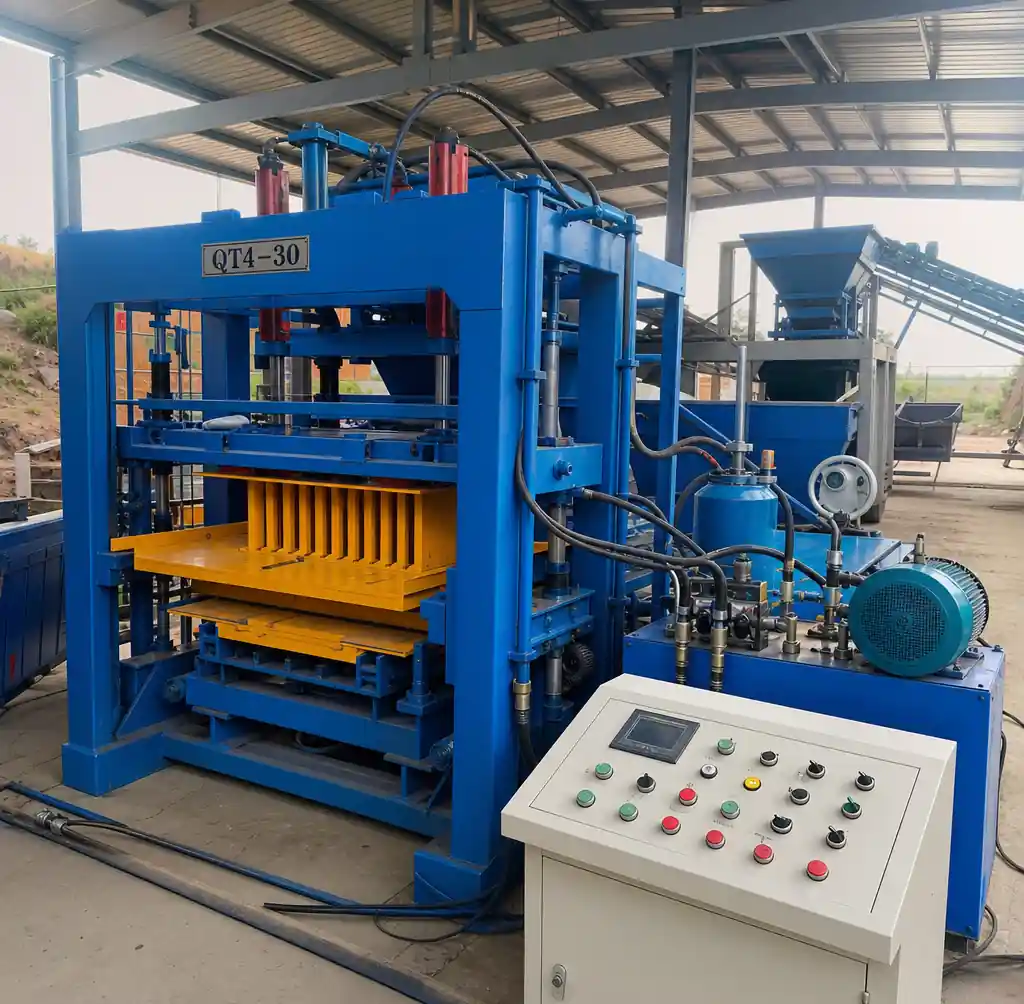
Models like the QT4-30 and QT4-24 use 50KN vibration force combined with hydraulic pressure to form blocks in 24-30 second cycles. The PLC automatically manages vibration frequency, compression pressure, and cycle duration, eliminating the human variation that causes inconsistent block quality in manual production. Operators focus on keeping material hoppers filled and transferring finished blocks to curing areas.
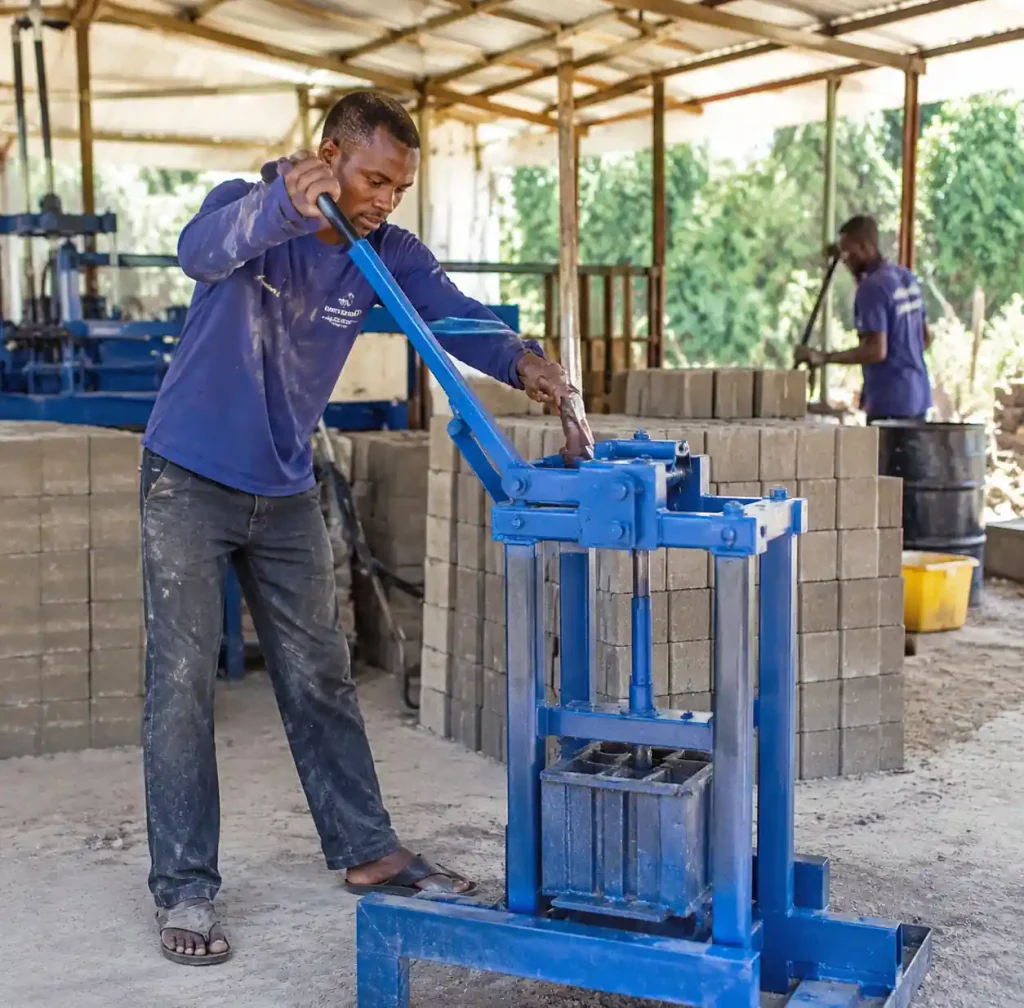
This division of labor reduces the 4-person crew requirement to the same level as manual machines while increasing production from 3,000 blocks per shift to 5,500-7,500 blocks per shift. The automated molding process delivers consistent block dimensions and compressive strength that manual operation cannot match.
Why Semi-Automatic Machines Dominate the Mid-Scale Market
The Cost-Efficiency Sweet Spot
Semi-automatic machines cost $8,000 to $15,000 compared to $50,000-$150,000 for automatic production lines. This 60-85% cost reduction makes semi-automatic systems accessible to producers who have outgrown manual capacity but cannot justify or finance full automation.
The capital efficiency becomes clear when calculating cost per block of additional capacity. Adding 4,000 blocks daily capacity with a second manual machine costs approximately $2 per block of new capacity ($8,000 machine ÷ 4,000 blocks). A semi-automatic machine delivering 7,000 blocks daily costs $1.75 per block of capacity ($12,000 ÷ 7,000). An automatic line producing 30,000 blocks costs $4 per block of capacity ($120,000 ÷ 30,000).
Faster Return on Investment
Break-even analysis for semi-automatic machines shows the fastest payback among all machine types when matched to appropriate production volumes. Assuming $0.30 selling price, $0.12 raw material cost, and $0.02 other costs:
Semi-Automatic Machine (QT4-30):
- Investment: $12,000
- Daily output: 7,000 blocks
- Labor: 4 workers × $800/month = $3,200 monthly ($128 daily)
- Daily profit: 7,000 × ($0.30 – $0.12 – $0.018 – $0.02) = $994
- Payback: 12 days of operation
This 12-day payback assumes full capacity utilization. At 70% capacity utilization (4,900 blocks daily), payback extends to 17 days—still faster than manual machines at 28 days or automatic machines at 26 days when operating at their respective optimal volumes.
Labor Efficiency Without Complexity
Semi-automatic machines reduce labor cost per thousand blocks to $18 compared to $43 for manual machines, a 58% reduction. This happens without increasing total workforce size—both manual and semi-automatic operations use 4 workers. The productivity gain comes entirely from automated molding cycle control.
The critical advantage over automatic lines is operational simplicity. Semi-automatic machines require 5-7 days operator training versus 2-3 weeks for automatic systems. Maintenance needs 30-45 minutes daily versus 60-90 minutes for automatic lines. When production stops, semi-automatic machines resume faster because fewer systems must synchronize.
Production Capacity Analysis
Daily Output by Model
| Model | Molding Cycle | Blocks/Hour | Blocks/8-Hour Shift | Monthly Output (25 days) |
|---|---|---|---|---|
| QT4-30 | 30 seconds | 720-900 | 5,760-7,200 | 144,000-180,000 |
| QT4-24 | 24 seconds | 880-1,050 | 7,040-8,400 | 176,000-210,000 |
Production based on standard 400×200×200mm hollow blocks
The QT4-30 produces 7-9 blocks per mold depending on block size, with automated 30-second cycles delivering 120 molds per hour. The QT4-24 uses a faster 24-second cycle achieving 150 molds per hour. Both models handle the same block types through mold changes taking 15-20 minutes.
Block Type Flexibility
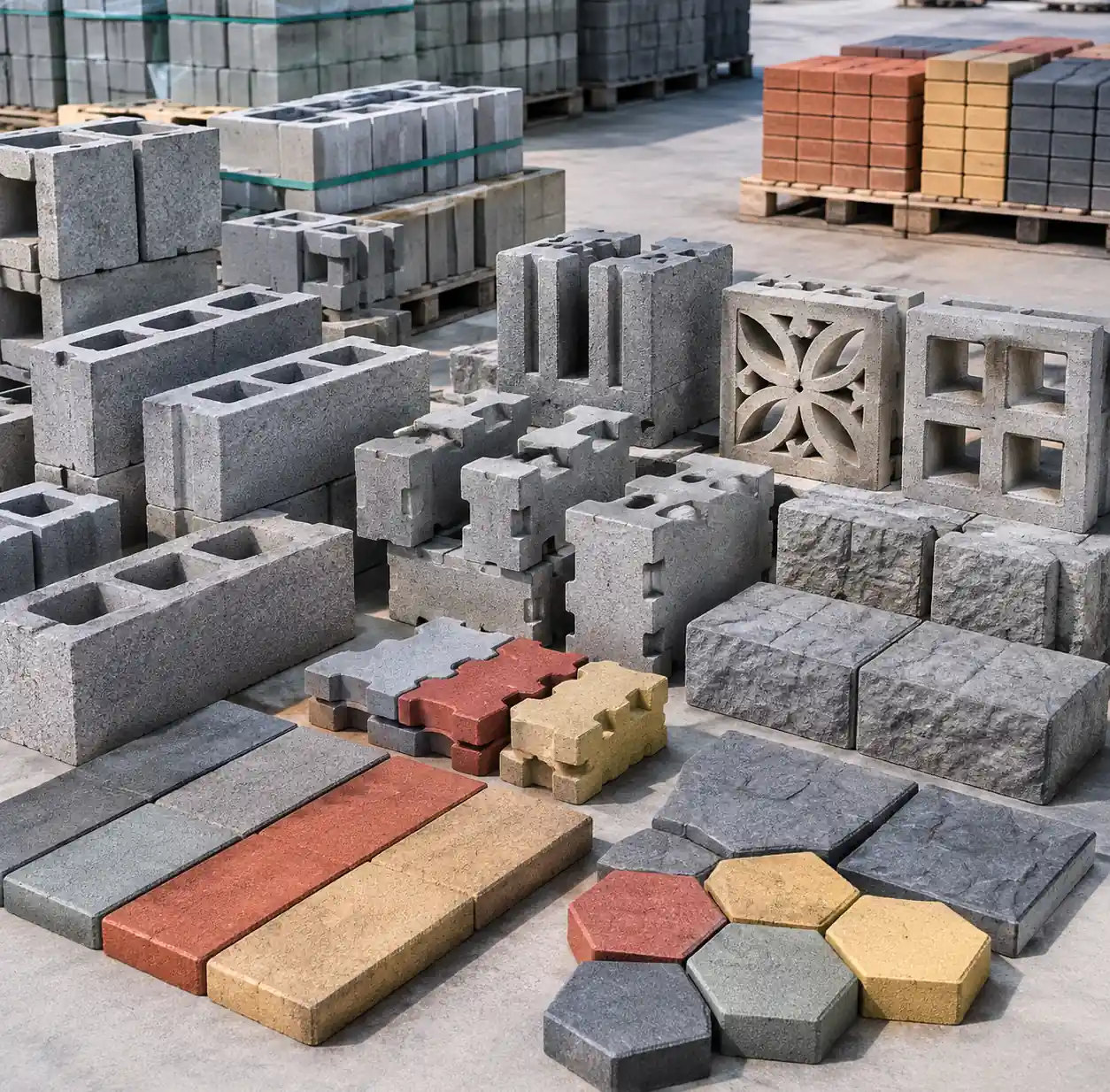
Semi-automatic machines excel at producing multiple block types economically. A typical production schedule might produce hollow blocks for three days, switch molds, then produce pavers for two days. The 15-20 minute mold changeover and simple recalibration make this practical.
QT4-30 Production Range:
- Hollow blocks: 400×100×200mm to 400×250×200mm (4-7 pcs/mold)
- Solid blocks: 240×115×50mm (18 pcs/mold)
- Holland pavers: 200×100×60mm (9 pcs/mold)
- H-shaped pavers: 200×163×60mm (6 pcs/mold)
Automatic lines work best dedicated to one or two high-volume products because their complex calibration and material flow systems require 30-45 minutes to reconfigure. Manual machines change molds easily but cannot exploit the speed advantage because operators control cycle timing inconsistently.
Semi-Automatic vs Manual vs Automatic: Complete Comparison
| Factor | Manual | Semi-Automatic | Automatic |
|---|---|---|---|
| Initial Investment | $5,000-$12,000 | $8,000-$15,000 | $50,000-$150,000 |
| Daily Production | 2,500-3,600 blocks | 5,500-7,500 blocks | 15,000-46,000 blocks |
| Workers Required | 3-4 | 4 | 5-7 |
| Labor Cost/1,000 Blocks | $43 | $18 | $6 |
| Payback Period | 28-30 days | 12-18 days | 26-28 days |
| Training Required | 2-3 days | 5-7 days | 2-3 weeks |
| Daily Maintenance | 15-20 minutes | 30-45 minutes | 60-90 minutes |
| Mold Changeover | 20-30 minutes | 15-20 minutes | 30-45 minutes |
| Power Consumption | 11-18 kW | 20-24 kW | 70-110 kW |
| Quality Consistency | 15-20% variation | 5-8% variation | 3-5% variation |
When Semi-Automatic Wins
Semi-automatic machines deliver optimal value when:
Production volume sits between 150,000-250,000 blocks monthly. Below 150,000, manual machines provide adequate capacity at lower investment. Above 250,000, automatic lines’ labor efficiency justifies their cost.
Multiple block types serve different market segments. Producers making hollow blocks, solid blocks, and pavers for various customers benefit from quick mold changes and operational flexibility.
Capital availability ranges from $12,000-$25,000 total investment including mixer, pallets, molds, and working capital. This makes bank financing accessible without requiring substantial reserves.
Labor costs are moderate ($600-$1,200 per worker monthly). Semi-automatic machines’ labor efficiency advantage matters most in mid-cost labor markets. In very low-cost markets, manual machines compete effectively. In high-cost markets, automatic lines’ dramatic labor reduction justifies their price.
Existing market demand is proven but growth trajectory is uncertain. Semi-automatic machines scale easily by adding a second unit, creating redundancy and 14,000+ block daily capacity without committing to specialized automatic infrastructure.
Technical Specifications and Requirements
QT4-30 Semi-Automatic Block Machine
Machine Specifications:
- Dimensions: 2600×2000×2000mm
- Total power: 23.15 kW
- Vibration force: 50 KN
- Machine weight: 3.2 tons
- Molding cycle: 30 seconds
- Pallet size: 850×450×20mm
Supporting Equipment:
- Concrete mixer: JQ350 (350L capacity)
- Pallets: 850×450mm steel or bamboo (300-500 units)
- Molds: Multiple configurations for different block types
- Curing area: 200-300 square meters
Facility Requirements:
- Workshop area: 60 square meters minimum
- Three-phase electrical power: 380V
- Water supply: 3-5 tons daily
- Concrete foundation: 200mm thick reinforced
Production Process Flow
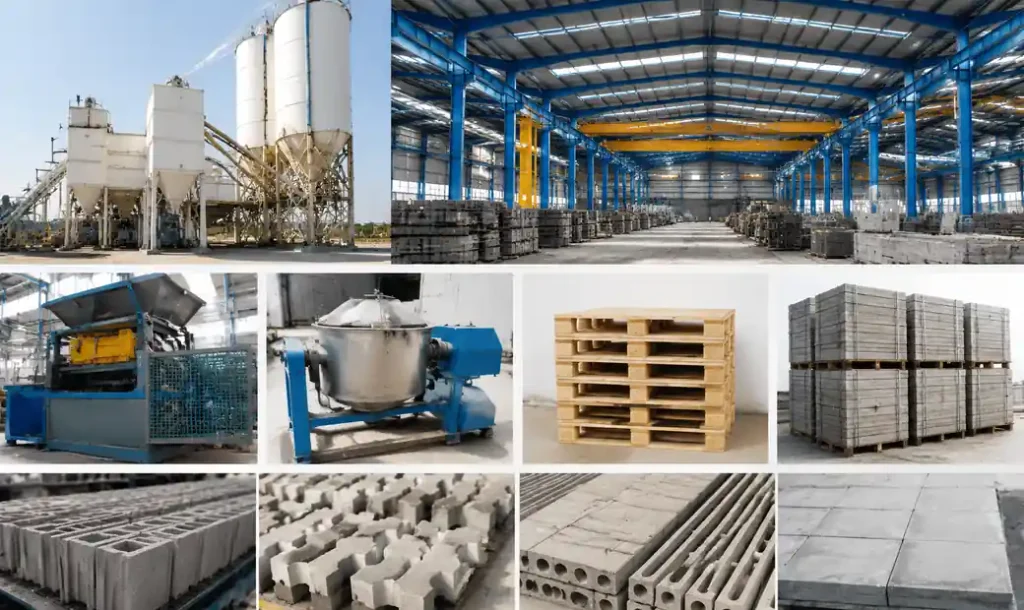
- Material batching: Operators measure cement, aggregates, and water according to mix design
- Mixing: JQ350 mixer produces uniform concrete in 3-4 minute cycles
- Loading: Operators transfer mixed concrete to machine hopper
- Molding: PLC controls 30-second automated vibration and compression cycle
- Removal: Operators remove finished blocks on pallets
- Curing: Blocks cure 24-28 days before shipping
The semi-automatic advantage concentrates in step 4. Manual machines require operators to judge vibration duration and compression force, creating 15-20% strength variation between blocks. The PLC delivers identical vibration and pressure every cycle, reducing variation to 5-8% and meeting national standards consistently.
Cost Analysis and Profitability
Complete Investment Breakdown
Machine and Equipment ($12,000-$23,000):
- Semi-automatic machine: $8,000-$15,000
- Concrete mixer (JQ350): $2,000-$3,500
- Molds (3-4 sets): $800-$1,500
- Pallets (400 units): $1,200-$2,000
- Tools and accessories: $500-$1,000
Facility Setup ($3,000-$8,000):
- Concrete foundation: $1,500-$3,000
- Electrical installation: $800-$2,000
- Roofing and structure: $700-$3,000
Working Capital ($3,000-$5,000):
- Raw materials (2 weeks): $2,000-$3,000
- Labor advance: $1,000-$2,000
Total Initial Investment: $18,000-$36,000
Operating Cost Per Block
Based on 7,000 blocks daily production (175,000 monthly at 25 days):
Raw Materials ($0.12 per block):
- Cement: $0.065
- Aggregates: $0.035
- Water: $0.005
- Additives: $0.015
Labor ($0.018 per block):
- 4 workers × $800/month = $3,200
- Monthly production: 175,000 blocks
- Cost per block: $3,200 ÷ 175,000 = $0.018
Energy ($0.008 per block):
- Machine power: 23.15 kW running 8 hours = 185 kWh daily
- Mixer power: 7.5 kW running 8 hours = 60 kWh daily
- Total: 245 kWh × $0.12 per kWh = $29.40 daily
- Cost per block: $29.40 ÷ 7,000 = $0.004
Maintenance and Depreciation ($0.015 per block):
- Annual maintenance: $800-$1,500
- Depreciation (10-year life): $1,200 annually
- Monthly: $200
- Cost per block: $200 ÷ 175,000 = $0.001
Total Production Cost: $0.161 per block
At $0.30 selling price, profit margin reaches $0.139 per block. Monthly profit: 175,000 blocks × $0.139 = $24,325. Annual profit: $291,900.
Three-Year Profit Projection
Year 1:
- Investment: $20,000
- Monthly production: 175,000 blocks (average)
- Monthly profit: $24,325
- Annual profit: $291,900
- Net Year 1: $271,900
Year 2-3:
- Annual profit: $291,900 each year
- Total 3-year profit: $855,700
Net 3-year return: $835,700 (after initial investment)
This assumes consistent demand and stable raw material costs. The calculation demonstrates how semi-automatic machines generate strong returns for mid-scale producers serving regional construction markets.
Quality and Performance Standards
Block Quality Consistency
Semi-automatic machines improve quality consistency through PLC-controlled processes:
Dimensional tolerance: ±2mm on length, width, and height when PLC controls vibration and compression. Manual machines achieve ±3-5mm because operator judgment varies cycle to cycle.
Compressive strength variation: 5-8% standard deviation across production batches. Manual machines show 15-20% variation because inconsistent vibration time affects concrete compaction density.
Surface finish: Uniform texture because vibration frequency remains constant. Manual operation produces blocks with visible texture differences when operators change vibration duration.
Standards Compliance
Semi-automatic machines consistently meet:
ASTM C90: Standard Specification for Loadbearing Concrete Masonry Units (US market)
EN 771-3: Specification for masonry units – Aggregate concrete masonry units (European market)
GB/T 8239: Standard for concrete small hollow blocks (Chinese market)
The consistent compressive strength and dimensional accuracy allow blocks to pass structural engineering specifications for commercial construction. Manual machines produce acceptable blocks for residential construction but struggle with commercial building specifications requiring tighter tolerances.
Operational Considerations
Workforce and Training
Operator roles:
- Machine operator: Monitors PLC, starts/stops cycles, adjusts settings
- Material handler (2 workers): Load concrete into hopper, maintain material flow
- Block handler: Remove finished blocks, organize curing area
Training requirements differ significantly from manual machines. Operators need basic PLC troubleshooting skills to recognize error codes and reset the system. This 5-7 day training includes understanding vibration force settings, compression pressure adjustments, and cycle timing calibration.
The workforce investment pays back through consistent output. Trained operators produce 7,000 blocks daily regardless of their physical strength or experience level because the PLC controls molding quality. Manual machines show 30-40% output variation between experienced and new operators.
Maintenance Program
Daily maintenance (30 minutes):
- Clean vibration table and mold surfaces
- Check hydraulic oil level
- Inspect electrical connections
- Lubricate moving parts
Weekly maintenance (2 hours):
- Deep clean hydraulic system
- Test PLC sensors and switches
- Inspect mold condition and alignment
- Check vibration motor bearings
Annual costs: $800-$1,500 including replacement parts, hydraulic oil changes, and electrical component replacement. Spare parts inventory should include PLC relays ($150), vibration motor bearings ($80), hydraulic seals ($60), and sensors ($40).
Downtime averages 3-5 days annually when following preventive maintenance schedules. Unplanned failures typically involve PLC sensor faults (easily replaced in 1-2 hours) or hydraulic seal leaks (requiring 4-6 hours repair).
Scaling Strategies with Semi-Automatic Machines
When to Add a Second Machine
Adding a second semi-automatic machine makes sense when:
Current machine runs at 85%+ capacity consistently. At 6,000 blocks daily, you’re approaching the QT4-30’s sustainable output. Adding capacity before reaching 100% utilization prevents order delays.
Customer demand exceeds 300,000 blocks monthly. Two semi-automatic machines producing 14,000 blocks daily (350,000 monthly) cost $24,000 total versus $120,000 for an automatic line delivering similar capacity.
Production redundancy becomes critical. Two machines provide backup when one undergoes maintenance or experiences breakdown. Large construction contracts requiring consistent daily delivery justify this redundancy.
Different block types serve distinct market segments. Dedicate one machine to hollow blocks for builders and one to pavers for landscaping companies. This eliminates mold changeover downtime and simplifies quality control.
When to Upgrade to Automatic
Consider transitioning to automatic block machines when:
Demand exceeds 500,000 blocks monthly consistently. At this volume, automatic lines’ labor efficiency (60-80% reduction) justifies their cost despite higher maintenance complexity.
Labor costs increase above $1,200 per worker monthly. The automatic line’s dramatic labor efficiency becomes financially compelling in high-wage markets.
Large contracts require production capacity certification. Government projects and major commercial developments often specify minimum daily production capacity. Automatic lines’ 30,000+ block capacity meets these requirements.
Production consistency requirements tighten. Automatic lines achieve 3-5% quality variation versus 5-8% for semi-automatic machines. Structural engineering applications sometimes specify these tighter tolerances.
Most successful producers operate semi-automatic machines for 18-36 months while building market position, then transition to automatic production when volume justifies the investment. The semi-automatic machines become backup equipment or dedicated specialty product lines.
Common Challenges and Solutions
Material Flow Management
Challenge: Operators cannot load concrete fast enough to maintain continuous production cycles.
Solution: Stage batches during molding cycles. While the machine completes a 30-second mold, operators measure and load the next batch into a staging hopper. This eliminates waiting time between cycles.
Block Handling Bottleneck
Challenge: Finished blocks accumulate faster than workers can move them to curing areas, forcing production pauses.
Solution: Install simple conveyor system ($800-$1,500) moving blocks directly to curing area. Alternatively, position curing racks immediately adjacent to machine, reducing handling distance to 2-3 meters.
Inconsistent Block Quality
Challenge: Blocks show strength variation despite PLC control.
Solution: Usually indicates inconsistent concrete mix rather than machine problems. Implement strict batching procedures with measured quantities rather than estimated volumes. Water content variation of just 5% significantly affects compressive strength.
PLC Error Codes
Challenge: PLC displays error codes and stops production.
Solution: Common errors relate to sensor faults (cleaned or replaced in 30 minutes) or hydraulic pressure drops (check oil level and connections). Keep sensor spares on hand ($40 each) for immediate replacement. PLC rarely fails—sensors detecting process conditions fail more frequently.
Frequently Asked Questions
How long do semi-automatic block machines last?
Semi-automatic machines operate 10-15 years with proper maintenance. The PLC control system lasts 8-12 years before requiring replacement ($800-$1,500). Vibration motors need rebuilding every 5-7 years ($400-$600). The machine frame and hydraulic system last 15+ years because simple construction makes repair straightforward.
Can one operator run two semi-automatic machines?
No, not effectively. Each machine requires continuous material loading and block removal. One operator cannot maintain production flow on two machines even when positioned side-by-side. However, 6-7 workers can operate two machines more efficiently than running two separate 4-person crews, saving 1-2 workers total.
What happens if electricity fails during production?
The molding cycle stops immediately when power cuts. The mold opens manually using emergency hydraulic release (hand pump included with machine). Remove the partially formed block, clean the mold, and restart when power returns. No permanent damage occurs from power interruptions.
Do semi-automatic machines need special foundations?
Yes, concrete foundation must be 200mm thick with reinforcement because vibration force reaches 50KN. The foundation prevents machine movement during operation and distributes force evenly. Inadequate foundations cause alignment problems as the machine gradually shifts position, resulting in uneven blocks.
Can semi-automatic machines produce interlocking blocks?
Yes, with appropriate molds. Interlocking block molds cost $300-$600 more than standard hollow block molds because precise dimensions are critical for the interlocking mechanism to function. The automated vibration control actually helps because consistent dimensions ensure blocks interlock properly.
Which is better for startup producers: manual or semi-automatic?
Start with manual machines ($5,000-$12,000) when market demand is unproven and capital is limited. Test the market for 6-12 months, establish customer relationships, and understand local demand patterns. Upgrade to semi-automatic when producing 50,000+ blocks monthly consistently. This staged approach minimizes financial risk while building operational knowledge.
Conclusão
Semi-automatic block machines deliver the optimal balance of cost and efficiency for producers operating at 150,000-250,000 blocks monthly. The $8,000-$15,000 investment provides 60-85% cost savings versus automatic systems while doubling manual machine output through PLC-controlled molding processes. This combination produces 12-18 day payback periods and $24,000+ monthly profits at full capacity utilization.
The strategic advantage extends beyond pure economics. Semi-automatic machines’ operational flexibility supports multiple product types through quick mold changes, their moderate training requirements prevent workforce bottlenecks, and their 4-worker crews match manual operations while delivering superior quality consistency. These factors make semi-automatic systems ideal for producers scaling beyond manual capacity without committing to full automation complexity.
Raytone Block Machinery manufactures semi-automatic block machines serving producers in over 100 countries. Our QT4-30 and QT4-24 models combine proven hydraulic systems with modern PLC controls, backed by comprehensive operator training and technical support. Whether expanding from manual production or establishing a new mid-scale operation, Raytone provides complete solutions matched to your production requirements and budget.
Contact our technical team today for detailed specifications, production line designs, and customized recommendations based on your specific production goals and market conditions.