Block manufacturing facilities consume 150-450 liters of water per cubic meter of production, with operations using 10,000-50,000 liters daily depending on capacity. Research on wastewater recycling in concrete production demonstrates that properly designed recycling systems recover 85-95% of process water, reducing freshwater consumption by 12,000-45,000 liters daily while cutting water costs 60-80% annually.
Recent studies on treated wastewater in concrete mixing confirm that recycled water maintains concrete quality when properly filtered and pH-balanced, achieving compressive strengths within 95-98% of freshwater-mixed blocks while eliminating discharge fees and environmental violations.
This guide examines water recycling system technology, treatment methods, equipment integration, cost analysis, and implementation strategies for sustainable block production operations.
Why Water Recycling Transforms Block Manufacturing Economics
Traditional block plants discharge 8,000-35,000 liters of water daily containing cement fines, aggregate particles, and chemical admixtures. Industrial water treatment systems convert this waste stream into reusable process water, eliminating discharge costs while reducing municipal water purchases 70-90%.
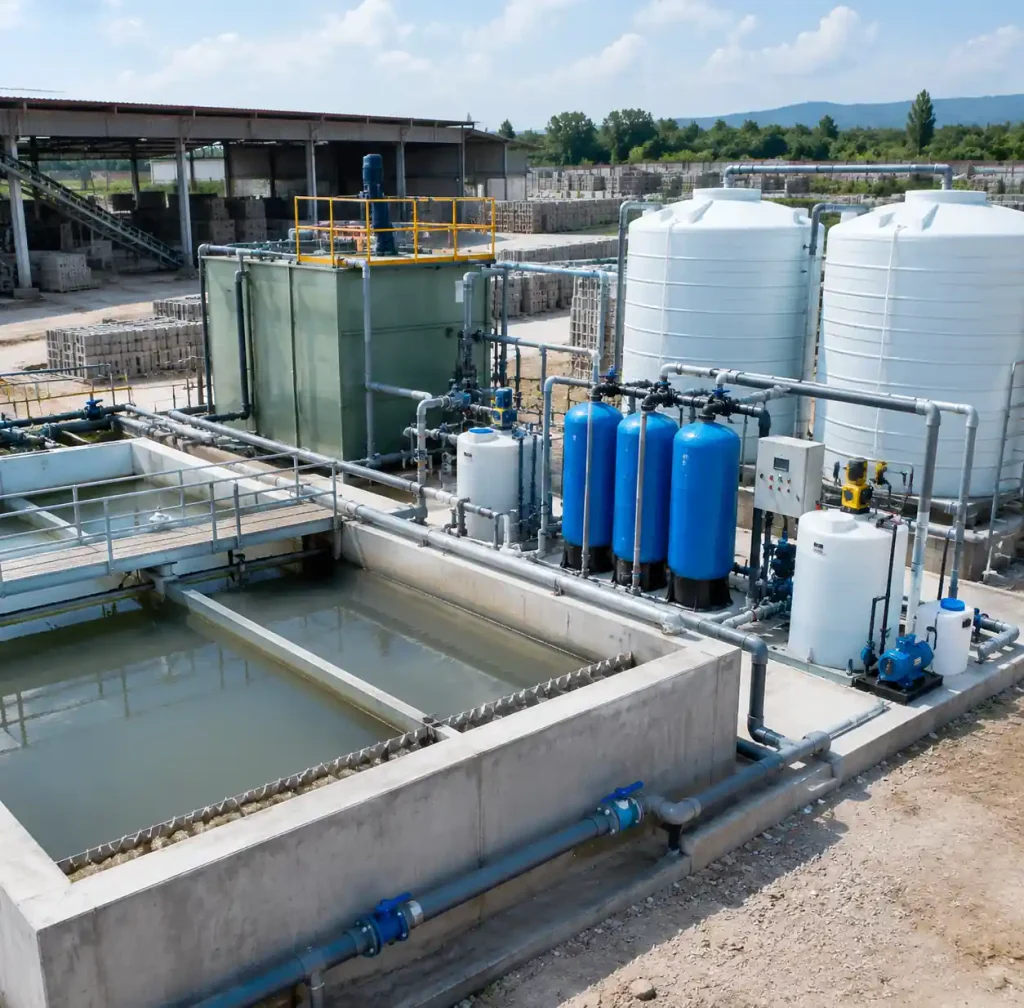
Water consumption breaks down into three primary categories: concrete mixing (45-55%), equipment washing (25-35%), and curing operations (15-25%). Recycling systems capture and treat water from all sources, creating closed-loop systems that operate on 10-20% fresh water makeup only.
| Operation Type | Daily Water Consumption | Recycling Potential | Fresh Water with Recycling | Annual Cost Savings |
|---|---|---|---|---|
| Small operation (100-200 blocks/hr) | 8,000-12,000 L | 85-90% | 1,200-1,800 L | $4,200-$7,500 |
| Medium operation (300-500 blocks/hr) | 18,000-28,000 L | 90-93% | 1,800-2,800 L | $11,000-$18,500 |
| Large operation (800-1,200 blocks/hr) | 35,000-50,000 L | 92-95% | 3,500-5,000 L | $22,000-$38,000 |
| ROI Period | — | — | — | 8-18 months |
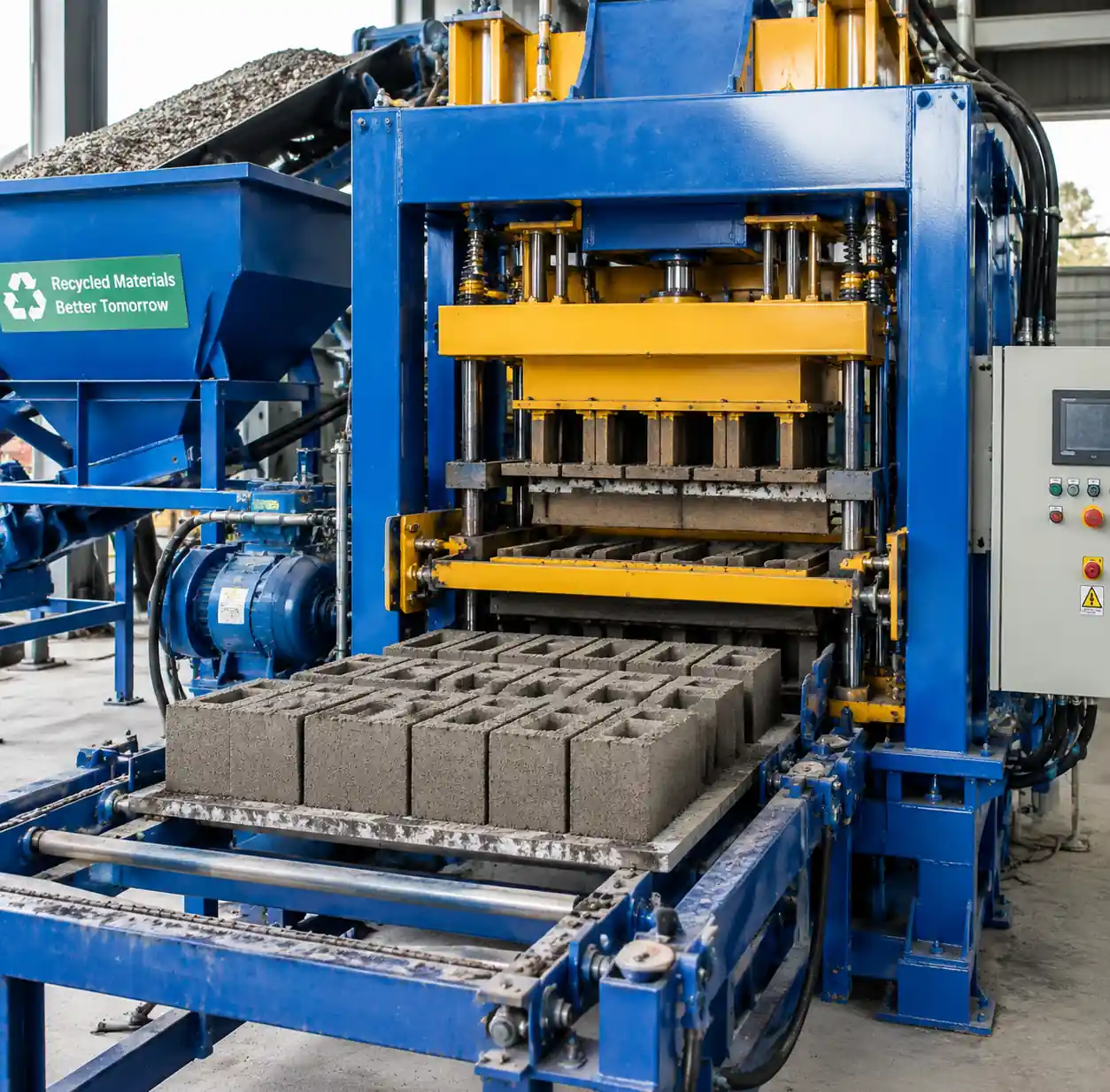
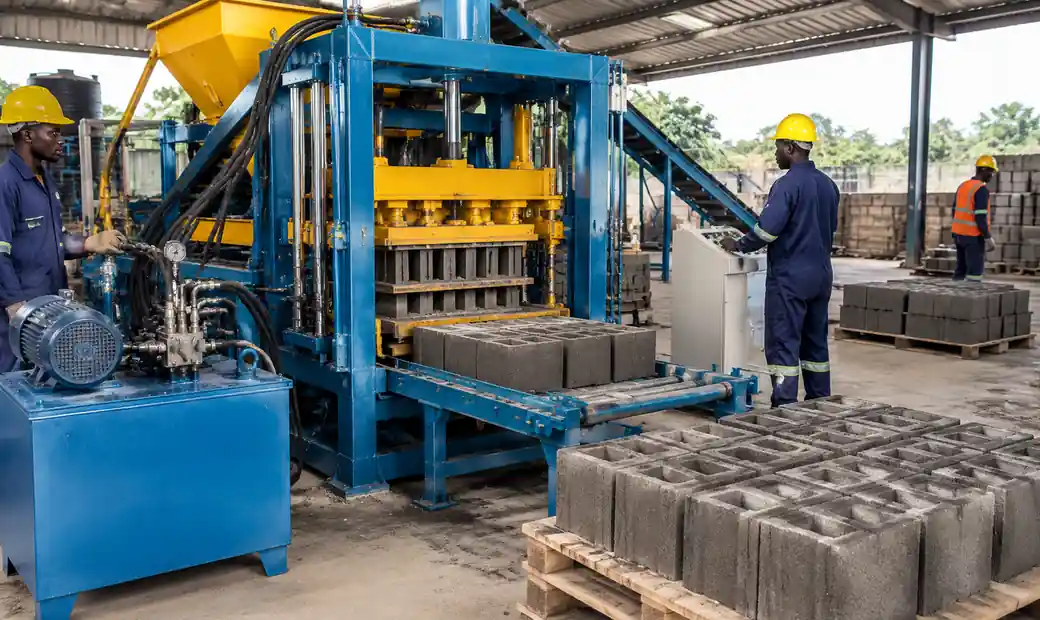
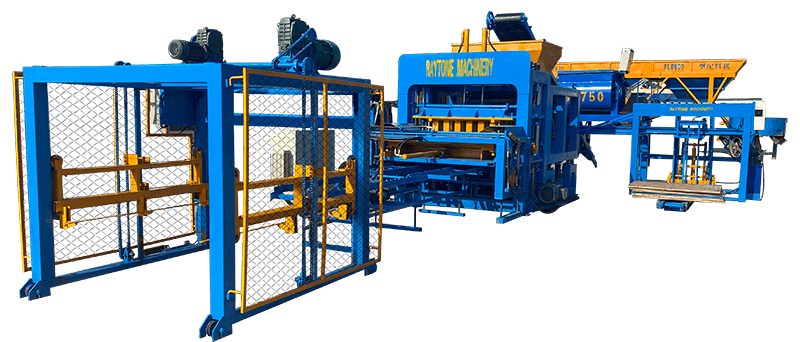
Hydraulic block machines integrate directly with recycling systems through dedicated wash-water collection ports, while automatic production lines require centralized treatment systems handling multiple water sources simultaneously.
Core Components of Block Plant Water Recycling Systems
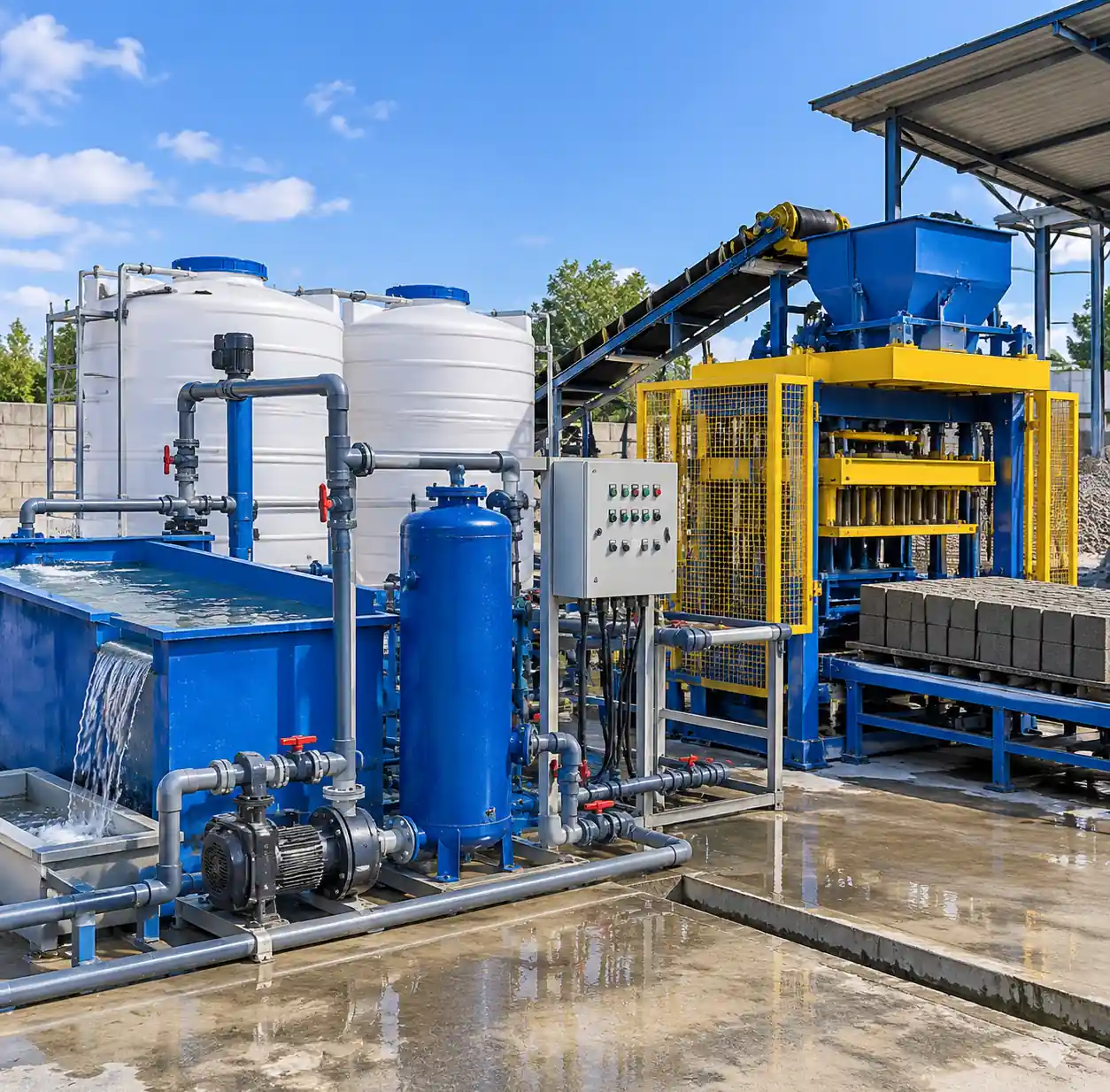
Effective recycling systems integrate four essential components working in sequence: collection and sedimentation, solid separation, filtration, and pH adjustment. Each component addresses specific contaminants affecting water quality and reusability.
Collection and Primary Sedimentation
Washout water from mixer cleanings, mold releases, and equipment washing flows into collection tanks where gravity settling removes coarse particles larger than 0.5mm. Waste wash-water treatment research shows properly sized settling tanks remove 60-75% of suspended solids through 2-4 hour retention time.
Primary settling requires tank volume equal to 4-6 hours of peak water discharge. For a facility producing 500 blocks per hour, design for 3,500-5,000 liter primary settling capacity. Conical or sloped-bottom tanks facilitate sludge removal through bottom drains without disrupting settled water layers.
Overflow weirs positioned 30-40cm below tank top prevent surface turbulence from re-suspending settled particles. Install baffles near inlet zones to dissipate flow energy and promote laminar flow conditions essential for efficient settling.
Solid Separation Equipment
After primary settling, remaining suspended solids (0.05-0.5mm) require mechanical separation. Three technologies dominate block plant applications: filter presses, screw separators, and flocculation tanks with clarifiers.
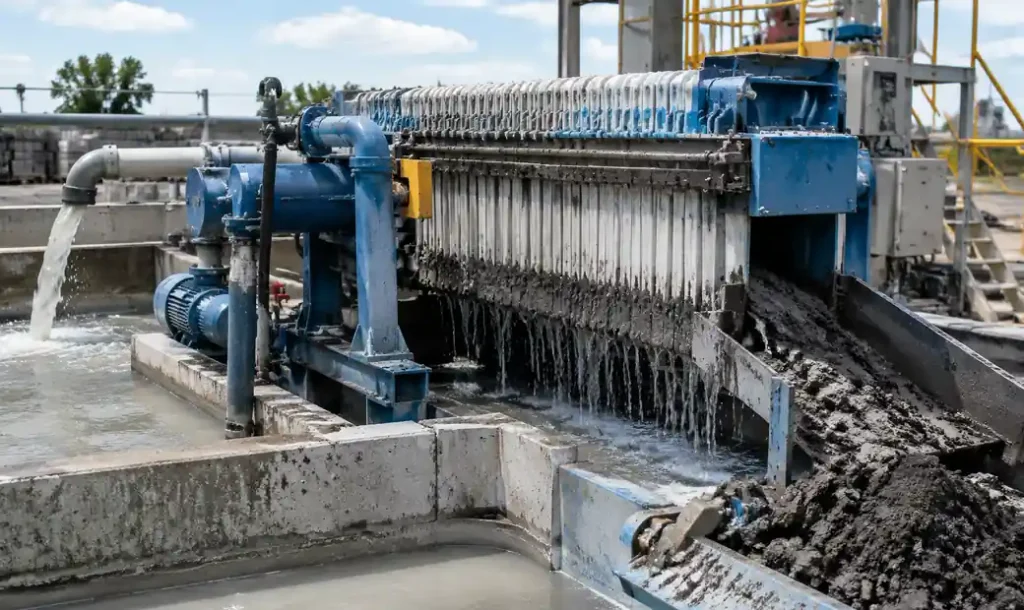
Filter presses deliver driest solids (20-30% moisture content) and cleanest water output but require batch operation and manual cake removal. Screw separators operate continuously with automated discharge but produce wetter solids (35-45% moisture). Treatment system comparisons show filter presses suit operations producing 300+ blocks hourly, while screw separators work effectively for smaller facilities.
Flocculation systems dose recycled water with polyacrylamide or aluminum sulfate polymers that bind fine particles into settleable aggregates. After 15-25 minute reaction time, clarifiers separate clean water from flocculated solids. This chemical-assist approach achieves 92-97% solid removal with lower capital cost than filter presses but ongoing chemical expenses of $0.008-$0.015 per liter treated.
| Separation Method | Capital Cost | Operating Cost | Solids Moisture | Water Quality | Best Application |
|---|---|---|---|---|---|
| Filter press | $12,000-$28,000 | Low | 20-30% | Excellent (95-98% clarity) | Medium-large plants |
| Screw separator | $6,500-$15,000 | Low | 35-45% | Good (88-93% clarity) | Small-medium plants |
| Flocculation + clarifier | $8,500-$18,000 | Moderate | 50-65% (sludge) | Excellent (93-97% clarity) | All sizes |
| Settling only | $2,000-$5,000 | Very low | 70-80% (sludge) | Fair (75-85% clarity) | Small operations |
Filtration and Final Treatment
Secondary filtration through sand beds or cartridge filters removes remaining particles down to 20-50 microns. Slow sand filtration passes water at 0.1-0.2 m³/hr/m² through 0.6-0.9m sand depth, achieving 95-98% removal of particles above 30 microns without chemicals or power.
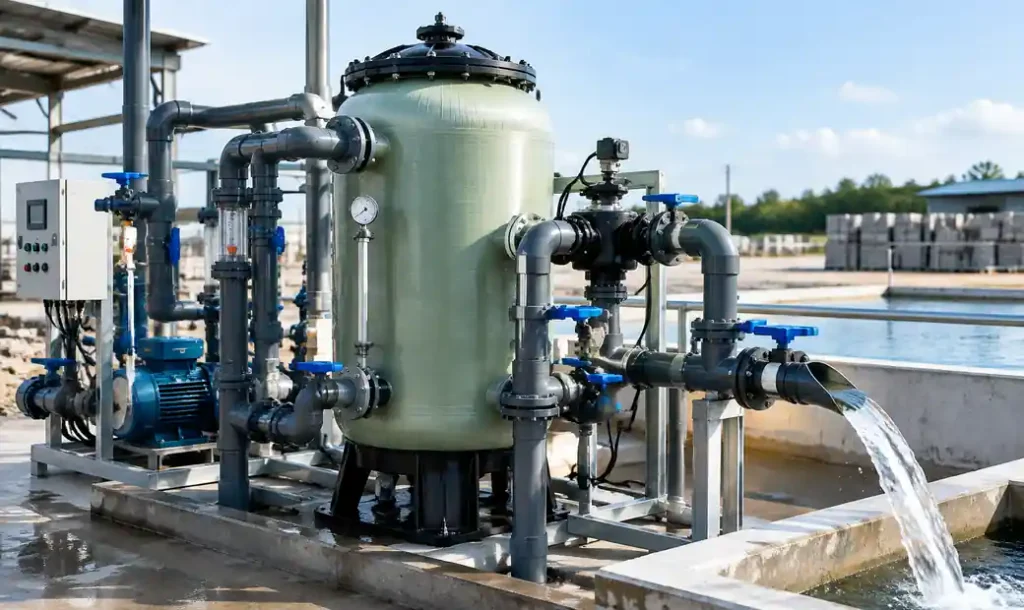
Sand filters require backwashing every 48-96 hours depending on loading. Automated systems reverse flow at 3-5x normal rate for 8-12 minutes, flushing accumulated particles to waste or back to primary settling. Manual backwashing works effectively for operations under 400 blocks hourly.
Cartridge filters using 25-50 micron rated elements provide compact alternative to sand beds but require element replacement every 2-4 months depending on water turbidity. Calculate 1.5-2.0 filter housings per 100 blocks/hour capacity to allow rotation during maintenance.
pH Adjustment and Storage
Cement-contaminated water reads pH 11-12.5, requiring neutralization to pH 7-9 before reuse. Concrete wastewater treatment protocols demonstrate CO₂ injection provides most economical pH control for block plants, avoiding acid handling and achieving precise control within ±0.3 pH units.
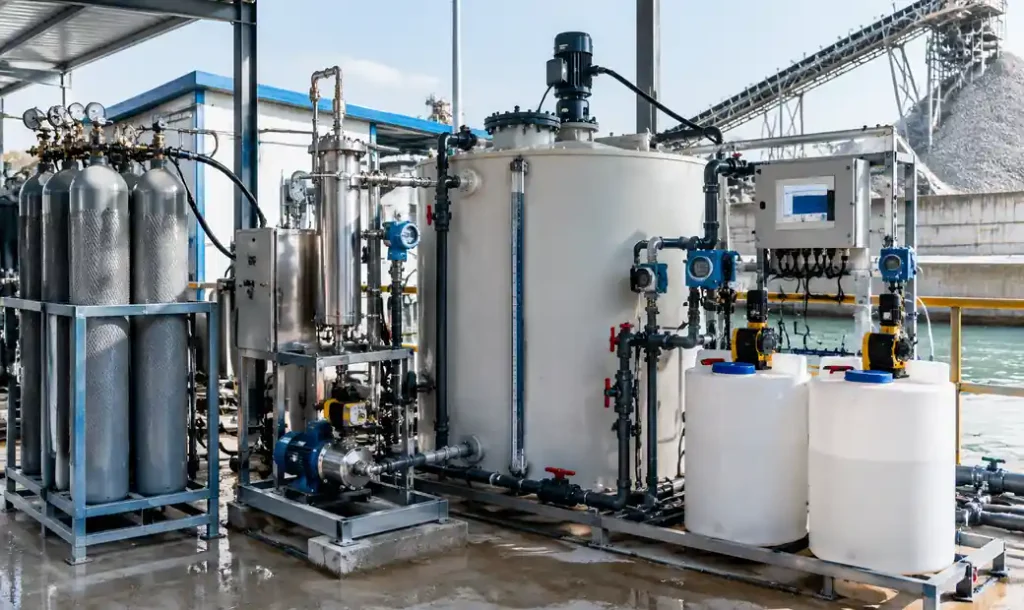
CO₂ systems dose gas through diffuser stones in contact tanks, where dissolved CO₂ reacts with calcium hydroxide forming neutral calcium carbonate precipitate. A 500 blocks/hour operation typically consumes 8-15 kg CO₂ daily at $0.80-$1.20 per kg, totaling $0.003-$0.006 per block.
Treated water storage requires 6-10 hours of production capacity to buffer supply during treatment system maintenance or peak demand periods. Covered tanks prevent algae growth and evaporation losses while maintaining consistent water temperature for reliable concrete properties.
Recycled Water Effects on Block Quality and Strength
The key question for manufacturers adopting recycling systems: how does recycled water affect block strength, durability, and consistency? Multiple research studies provide clear answers backed by laboratory testing and field validation.
Compressive Strength Performance
Studies on treated wash water in concrete blocks tested blocks made with 25%, 50%, 75%, and 100% recycled water replacement. Results showed 28-day compressive strength reached 96-98% of freshwater control blocks at 50% replacement, and 93-95% at 100% replacement when water met clarity and pH specifications.
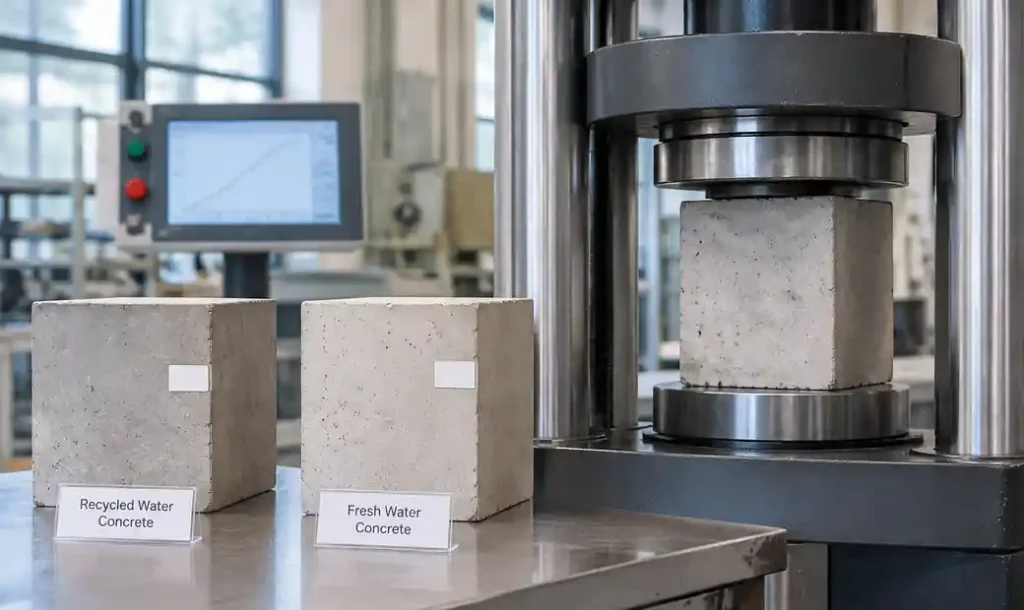
Critical factor: total dissolved solids must remain below 2,000 ppm for structural blocks and 3,500 ppm for non-structural applications. Higher TDS concentrations introduce excess salts affecting cement hydration and potentially causing efflorescence. Weekly TDS testing with handheld meters ($150-$350) ensures water quality consistency.
Suspended solids specification of 200 ppm maximum prevents aggregate interference with cement bonding. Properly treated recycled water consistently achieves 50-100 ppm suspended solids, well within acceptable range for all block types.
Setting Time and Workability
Recycled water containing residual cement fines slightly accelerates initial set, advancing setting time 8-15 minutes compared to fresh water. This affects production scheduling and requires adjusted batching sequences to maintain consistent demolding time.
| Water Parameter | Freshwater Standard | Recycled Water (Well-treated) | Impact on Blocks | Specification Limit |
|---|---|---|---|---|
| pH | 7.0-8.5 | 7.5-9.0 | Slight acceleration of set | 7.0-9.5 |
| Suspended solids | <50 ppm | 50-150 ppm | Minimal strength effect | <200 ppm |
| Total dissolved solids | <500 ppm | 800-1,500 ppm | Slight workability change | <2,000 ppm (structural) |
| Chloride content | <100 ppm | 80-200 ppm | Potential corrosion risk | <500 ppm |
| Sulfate content | <200 ppm | 150-350 ppm | Potential expansion | <400 ppm |
Workability remains comparable when suspended solids stay below 150 ppm. Research on recycled water concrete consistency found 12-14% improved workability in some cases due to residual admixture carryover from mixer washings. However, variable water quality can create batch-to-batch inconsistency unless treatment maintains tight specifications.
Long-term Durability Considerations
Durability testing on blocks made with treated recycled water shows freeze-thaw resistance, water absorption, and weathering performance within 95-102% of freshwater controls. One concern: elevated chloride levels accelerate steel corrosion in reinforced blocks.
Monitor chloride content quarterly, maintaining levels below 300 ppm for unreinforced blocks and 150 ppm for blocks containing steel reinforcement. Chlorides enter recycled water from some admixtures and can concentrate through evaporation if system makeup water contains elevated chlorides.
Efflorescence risk increases slightly with recycled water due to higher dissolved mineral content. Minimize this through proper curing humidity (85-95% RH) and adequate drainage in block stacking yards to prevent moisture migration through blocks.
System Design and Integration with Block Production Equipment
Successful water recycling requires proper integration with existing equipment and production workflows. System design must accommodate peak demand, handle variable water quality, and integrate with mixer timing cycles.
Capacity Sizing and Flow Calculations
Size recycling system capacity to peak hourly water demand plus 20-30% safety factor. QT8-15 block machines consuming 180-240 liters/hour for mixing plus 80-120 liters/hour for equipment washing require treatment capacity of 320-430 liters/hour (350-470 L/hr with safety factor).
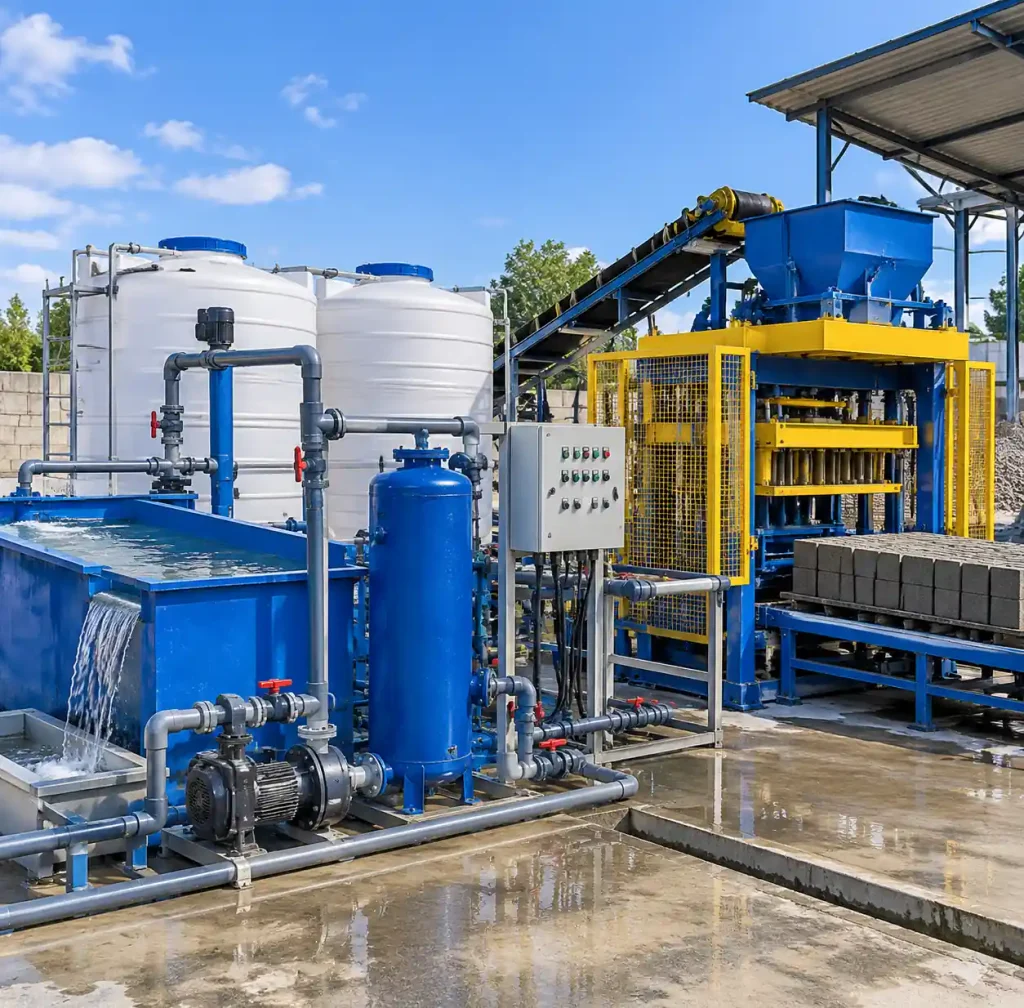
Calculate peak demand based on shortest cycle time operations. A production line running 12-second cycles (300 blocks/hour) consumes water during mixing, mold release, and wash-down in concentrated 15-25 minute periods requiring 2.5-3.5x average flow rates.
Design storage capacity to buffer these peaks: 2-3 hours of treated water storage between filtration system and production equipment ensures continuous supply during treatment maintenance or filter backwashing cycles.
Equipment Connection Points
Integrate recycling systems at four primary locations: mixer washout collection, mold cleaning stations, equipment wash-down areas, and curing water recovery (if applicable). Each connection point requires proper drainage slope (minimum 2%) and adequately sized collection piping (75-100mm diameter for facilities producing 300+ blocks hourly).
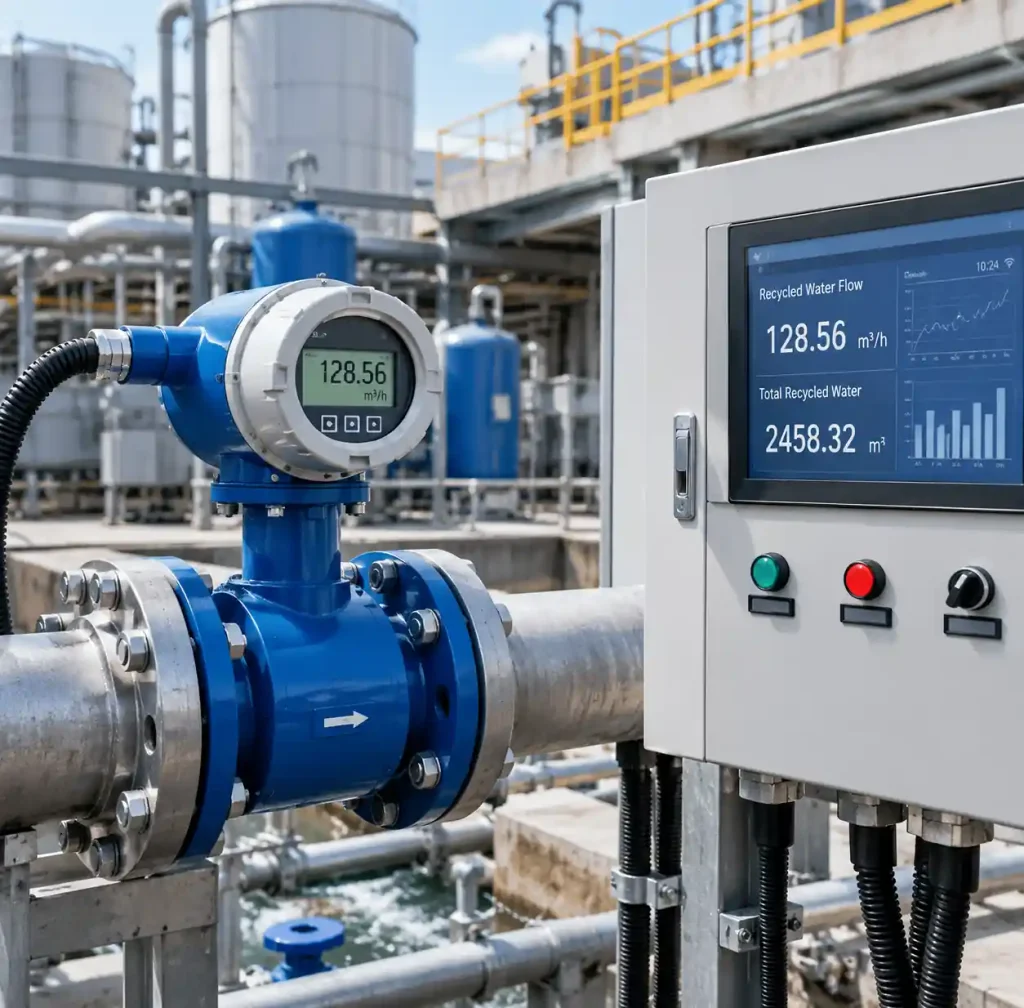
Install flow meters at key points to track water consumption by source, identifying opportunities for water reduction before recycling investment. Many operations discover 15-25% water savings possible through improved equipment maintenance and operational practices before system installation.
Cost Analysis and Return on Investment
Water recycling system investment ranges from $8,500 for basic settling and manual filtration to $45,000+ for fully automated systems with pH control and continuous monitoring. ROI typically occurs within 8-24 months depending on water costs, discharge fees, and production volume.
Capital Cost Breakdown
Investment varies significantly based on automation level, treatment technology, and integration requirements. Below represents typical cost ranges for different operational scales:
| System Component | Small Operation (100-200 blocks/hr) | Medium Operation (300-500 blocks/hr) | Large Operation (800+ blocks/hr) |
|---|---|---|---|
| Collection tanks | $1,500-$2,800 | $3,200-$5,500 | $6,500-$9,500 |
| Solid separation | $4,000-$8,500 | $9,500-$16,000 | $18,000-$28,000 |
| Filtration system | $1,800-$3,500 | $3,800-$6,500 | $7,500-$12,000 |
| pH control | $1,200-$2,500 | $2,400-$4,200 | $4,500-$7,500 |
| Pumps and plumbing | $1,500-$2,800 | $2,800-$4,500 | $5,000-$8,500 |
| Controls and monitoring | $800-$1,500 | $1,800-$3,200 | $3,500-$6,000 |
| Installation | $1,200-$2,400 | $2,500-$4,500 | $5,000-$9,000 |
| Total Investment | $12,000-$24,000 | $26,000-$44,500 | $50,000-$81,000 |
Automatic block making machines typically require higher-capacity systems due to increased water consumption and faster cycle times. Manual block machines can operate effectively with simpler settling-based systems in low-volume applications.
Operating Cost and Savings Calculations
Annual operating costs include filter maintenance, chemical usage (if applicable), electricity, and periodic sludge removal. These costs remain significantly lower than water savings plus avoided discharge fees:
A medium-sized operation (400 blocks/hour, 16 hours daily operation, 25 days monthly) typically realizes:
Annual Savings:
- Municipal water reduction: 540,000 liters × $0.045/liter = $24,300
- Eliminated discharge fees: $2,800-$4,500
- Reduced sludge disposal: $1,200-$2,000
- Total annual savings: $28,300-$30,800
Annual Operating Costs:
- Electricity (pumps/controls): $1,400-$1,900
- Filter maintenance/replacement: $800-$1,400
- pH adjustment chemicals: $600-$1,200
- Periodic sludge removal: $500-$900
- Total annual costs: $3,300-$5,400
Net annual benefit: $22,900-$25,400
ROI period: 12-16 months
Additional financial benefits include regulatory compliance value, reduced environmental liability, and potential green building certification contributions for customers specifying sustainable production methods.
Implementation Strategies and Best Practices
Successful water recycling implementation requires proper planning, phased installation, operator training, and ongoing monitoring. Operations achieving 90%+ recycling rates follow systematic approaches balancing investment, disruption, and performance goals.
Phase 1: Assessment and Baseline Measurement
Begin by measuring current water consumption patterns over 2-4 weeks. Install temporary flow meters at key points: mixer water supply, equipment washing stations, and discharge lines. Track daily consumption, peak demand periods, and seasonal variations.
Collect water samples from discharge streams for laboratory analysis of pH, suspended solids, TDS, chlorides, and sulfates. This baseline data determines treatment requirements and appropriate technology selection.
Phase 2: System Selection and Design
Match treatment technology to water quality and production scale. Operations producing under 250 blocks hourly often succeed with settling tanks plus sand filtration, avoiding complex separation equipment. Facilities exceeding 400 blocks hourly typically require automated solid separation plus pH control.
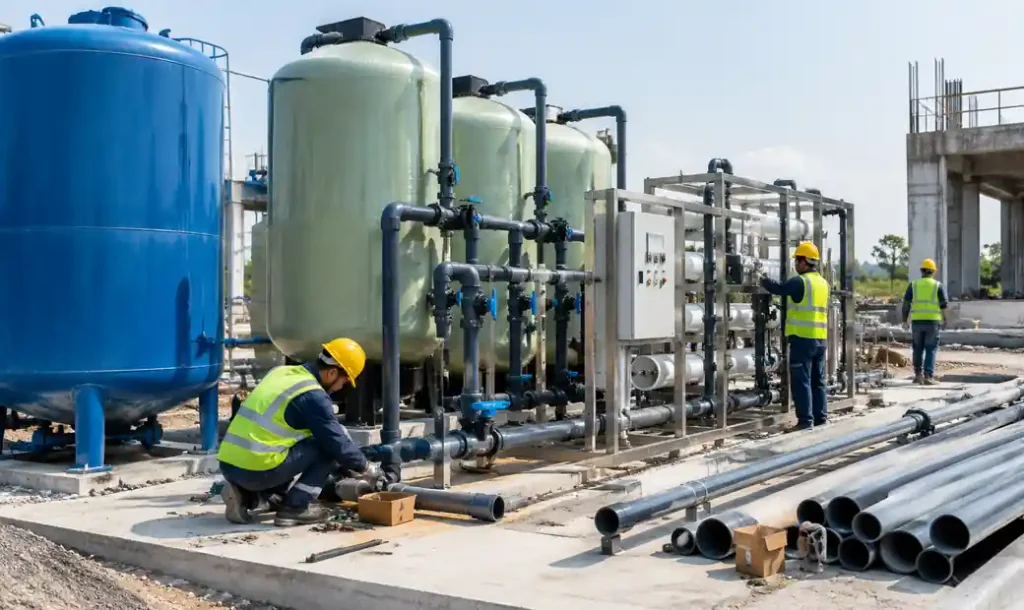
Work with equipment suppliers to design system layout minimizing pipe runs and elevation changes. Gravity flow reduces pumping costs and improves system reliability. Position primary settling near water generation points and treated water storage near consumption points.
Phase 3: Installation and Commissioning
Schedule installation during planned maintenance shutdowns or production slowdowns to minimize disruption. Most systems require 3-7 days for installation plus 2-3 days for startup and adjustment.
Commission systems gradually, beginning with 25-30% recycled water blended with fresh water. Monitor block strength through standard testing protocols, gradually increasing recycled water percentage as confidence builds. Most operations reach 80-90% recycling within 2-4 weeks of startup.
Phase 4: Monitoring and Optimization
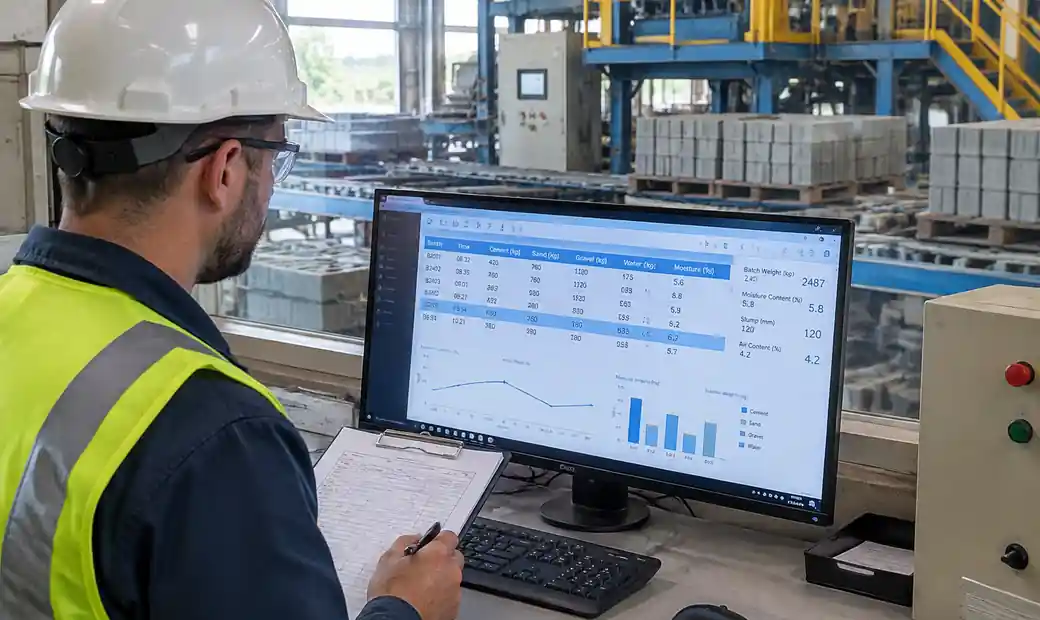
Establish weekly testing protocols: pH (daily), suspended solids (weekly), TDS (weekly), and monthly comprehensive analysis including chlorides, sulfates, and alkalinity. Document results against block strength testing to correlate water quality with product performance.
Many facilities implement progressive optimization, identifying additional water reduction opportunities after recycling system proves itself. Common improvements include: upgrading to high-efficiency spray nozzles for equipment washing (15-25% water reduction), installing sensors to prevent overflow waste (8-12% reduction), and capturing previously-wasted water sources like curing overspray (10-18% additional recovery).
Frequently Asked Questions
Does recycled water affect block strength?
Research demonstrates properly treated recycled water maintains 95-98% of block strength compared to freshwater when suspended solids remain below 200 ppm and pH stays within 7-9 range. Multiple studies testing 100% recycled water replacement show no significant strength reduction when treatment specifications are maintained.
What is the payback period for water recycling systems?
Typical ROI ranges from 8-24 months depending on water costs, discharge fees, and production volume. Operations consuming 25,000+ liters daily in areas with water costs above $0.040/liter typically achieve payback within 12-15 months. Lower volume operations in low-cost water areas may see 18-24 month payback but still achieve strong long-term returns.
Can recycled water be used for all block types?
Yes, with proper treatment. Structural blocks requiring 18-25 MPa strength perform identically with recycled water meeting standard specifications. Architectural blocks, paving blocks, and specialty products all successfully utilize recycled water. Only blocks requiring specific color consistency may need fresh water for mixing to avoid minor color variations from residual cement fines.
How much maintenance do recycling systems require?
Basic systems require 2-4 hours weekly for filter backwashing, sludge removal, and water quality testing. Automated systems reduce manual labor to 1-2 hours monthly for inspection and consumable replacement. Annual maintenance including filter media replacement, pump servicing, and control calibration requires 1-2 days downtime.
What happens to the separated solids?
Separated cement and aggregate solids (cake moisture 20-45% depending on separation method) can be incorporated back into block production at 3-8% by weight, used as fill material, or disposed as non-hazardous solid waste. Many operations achieving 85-95% water recovery also reclaim 40-60% of separated solids back into production, further improving sustainability.
Conclusión
Water recycling systems deliver compelling economics for block manufacturing operations consuming 10,000+ liters daily. Recovering 85-95% of process water through settling, filtration, and pH adjustment reduces freshwater consumption proportionally while eliminating discharge costs and regulatory concerns.
Properly designed systems maintain block quality within 95-98% of freshwater production when treated water meets suspended solids, TDS, and pH specifications. ROI typically occurs within 8-18 months for medium to large operations, with continuing annual savings of $18,000-$38,000 depending on production volume.
Implementation success requires proper capacity sizing, equipment integration, operator training, and consistent monitoring. Operations following systematic approaches achieve 80-90% recycling rates within 2-4 weeks of system startup, progressing to 90-95% rates through optimization.
If you need water recycling systems integrated with block production equipment, Raytone Block Machinery offers consultation on system design, equipment selection, and installation coordination for operations of all scales. Our experience with installations processing 5,000-50,000 liters daily ensures optimal system sizing and reliable performance for your production requirements.