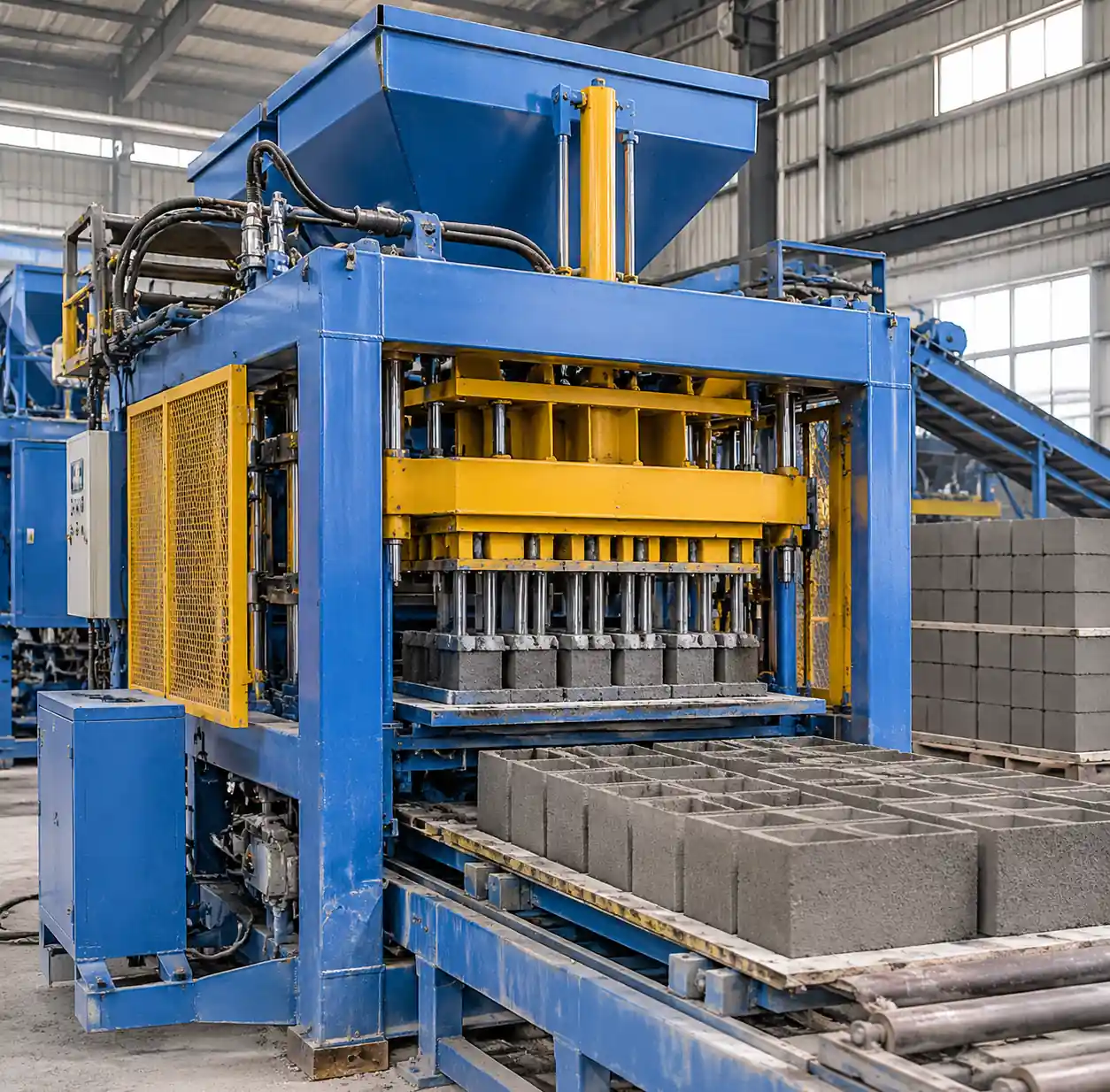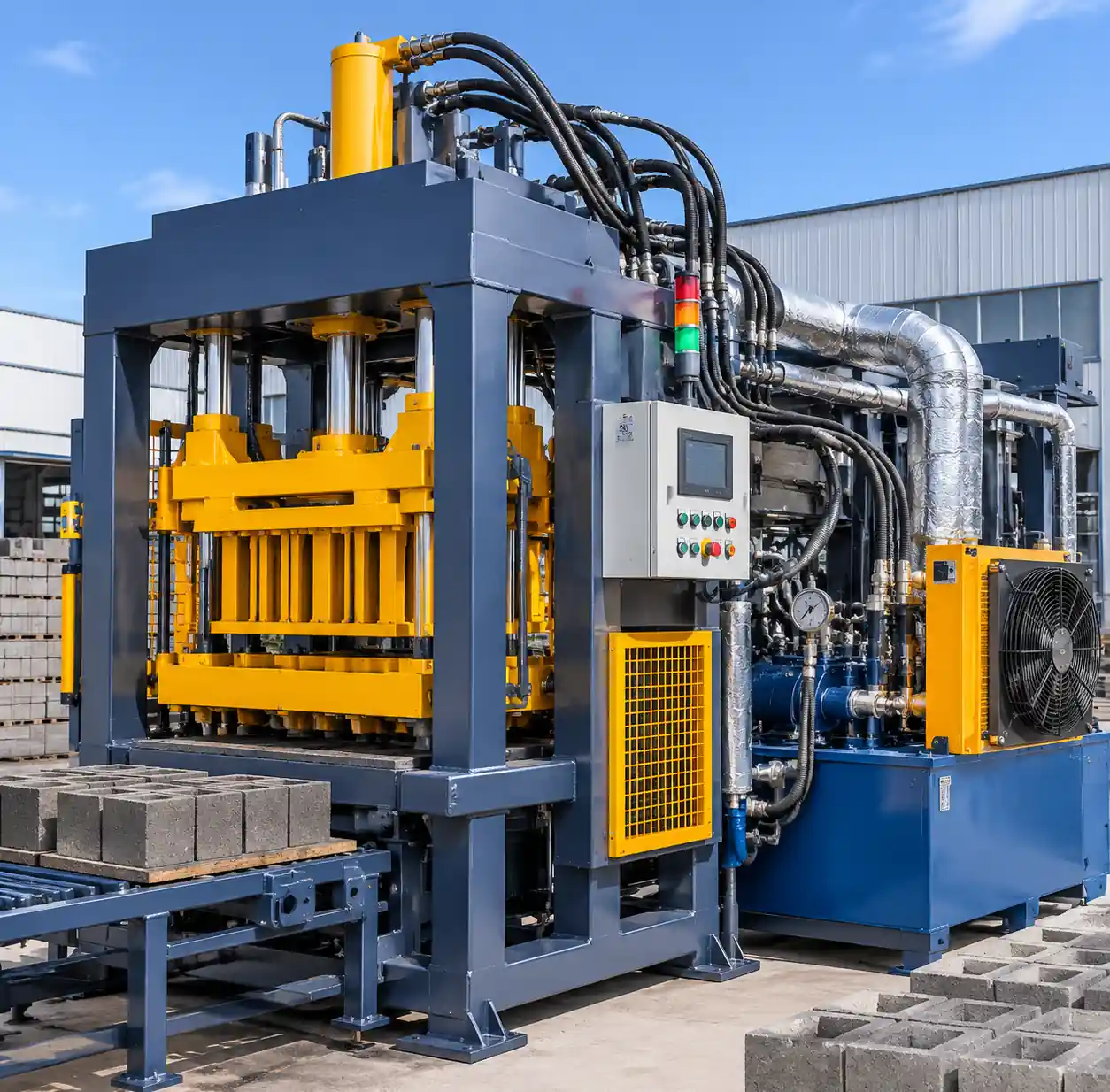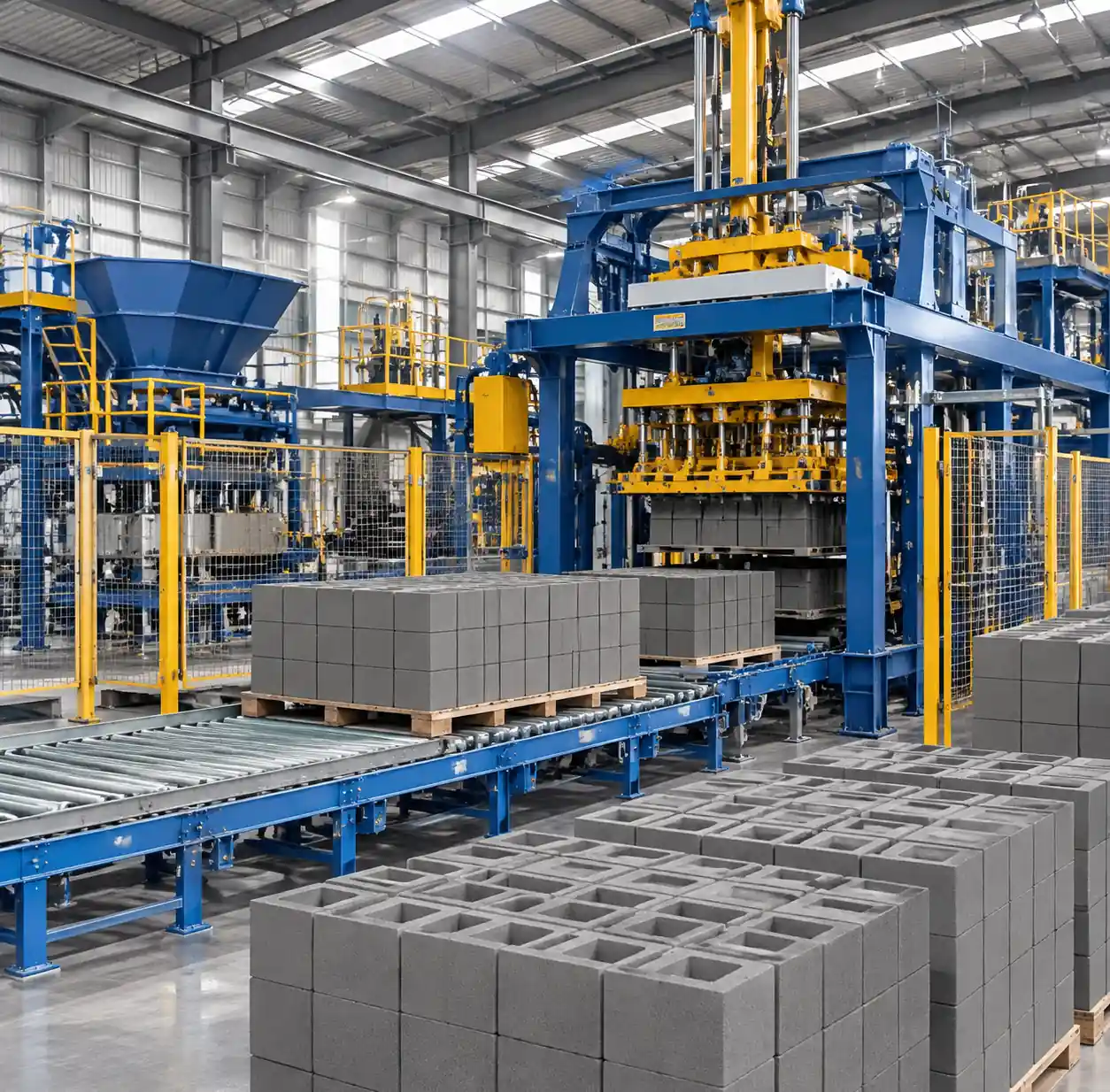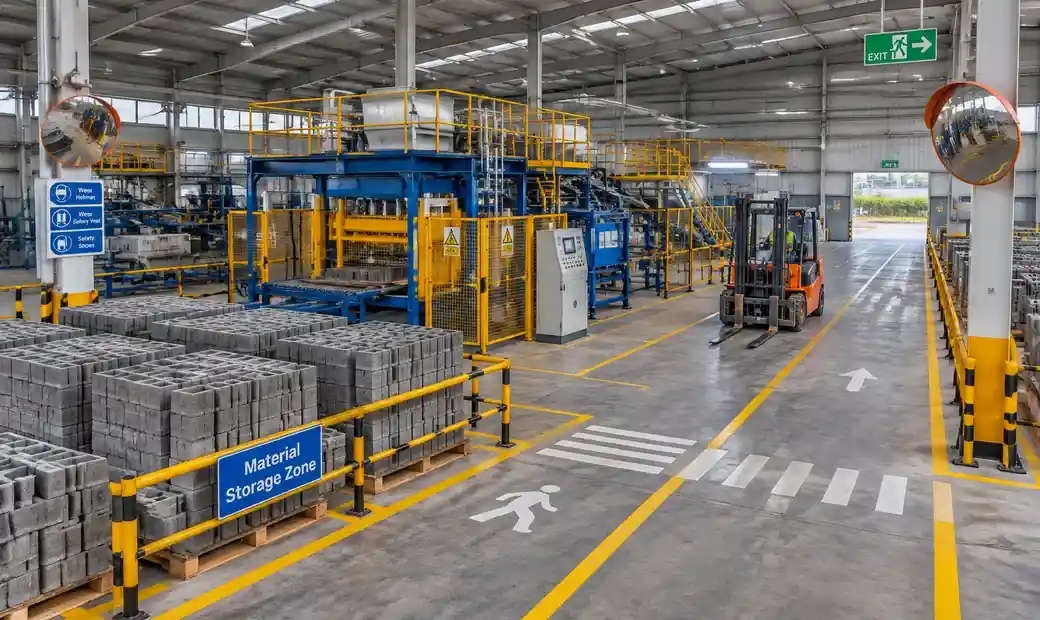






Extreme temperatures destroy concrete block quality faster than equipment failures or operator errors combined. In summer heat above 35°C, blocks can crack within hours of production. In winter cold below 5°C, cement hydration stops entirely, turning fresh blocks into brittle waste. Understanding temperature control separates profitable year-round operations from seasonal businesses struggling with rejection rates and customer complaints.
This guide covers practical strategies for maintaining block quality in extreme weather, including temperature management protocols, mix design adjustments, and equipment modifications that keep production running profitably when competitors shut down.
Why Temperature Matters for Block Production
Concrete block strength development depends on cement hydration—a chemical reaction requiring specific temperature ranges. The optimal zone sits between 10-25°C, where hydration proceeds at ideal rates producing blocks that reach 70-80% of 28-day strength within 7 days.
Outside this zone, problems multiply rapidly. Above 35°C, water evaporates faster than cement can absorb it, creating surface cracks and reducing final strength by 15-25%. Rapid evaporation also causes plastic shrinkage cracks within 2-4 hours of molding.
Below 5°C, hydration slows to near-zero rates. Fresh blocks exposed to freezing temperatures suffer permanent damage—water in the mix expands by 9% when it freezes, creating internal fractures that cannot heal. According to concrete standards research, concrete that freezes before reaching 500 psi (3.5 MPa) loses 50% or more of its potential strength permanently.
For hydraulic block machine operations producing 10,000-30,000 blocks daily, temperature-related losses directly impact profitability. A 10% rejection rate on 15,000 blocks means scrapping 1,500 blocks worth $450-750 daily, plus the wasted cement, aggregates, labor, and machine time.
Summer Block Production Challenges
Heat-Related Quality Issues
Summer production faces three primary threats: accelerated water loss, excessive concrete temperature, and thermal shock during curing.
Rapid water evaporation: At 35°C with 40% humidity and moderate wind, concrete surfaces lose moisture at rates exceeding 1.0 kg/m²/hour. Standard hollow blocks (390mm × 190mm × 190mm) have roughly 0.074 m² of exposed surface after molding. This means losing 74 grams of water per hour per block—enough to impact hydration within 3-4 hours if uncorrected.
Elevated concrete temperature: Fresh concrete temperature above 32°C accelerates cement hydration faster than the mix can handle, creating thermal gradients. The rapid reaction generates heat internally while surfaces cool faster, causing differential expansion and micro-cracking. Research from concrete temperature studies shows that every 10°C increase in concrete temperature above 21°C reduces 28-day strength by 10-15%.
Thermal shock: Blocks produced in 38°C ambient temperature then exposed to sudden cooling (rain, overspray from cooling systems) experience surface cracking from rapid temperature change exceeding 20°C in minutes.
Summer Production Best Practices
Material cooling strategies:
Cold water makes the biggest impact. Pre-cooling mix water to 5-10°C can reduce concrete temperature by 8-12°C compared to ambient water. A simple refrigeration unit or ice addition achieves this. For 10,000 blocks daily requiring 3-4 m³ of water, cooling water from 30°C to 10°C removes approximately 250,000 kJ of heat from the mix.
Shade aggregate stockpiles with tarps or roofing. Direct sunlight heats sand and stone to 45-50°C. Shaded aggregates stay 15-20°C cooler, translating to 4-6°C reduction in final concrete temperature.
Timing adjustments:
Schedule production during cooler hours. Starting at 4-5 AM and finishing by 1 PM keeps work in the 22-30°C zone rather than the 32-38°C afternoon peak. Night production works for operations with proper lighting and worker scheduling.
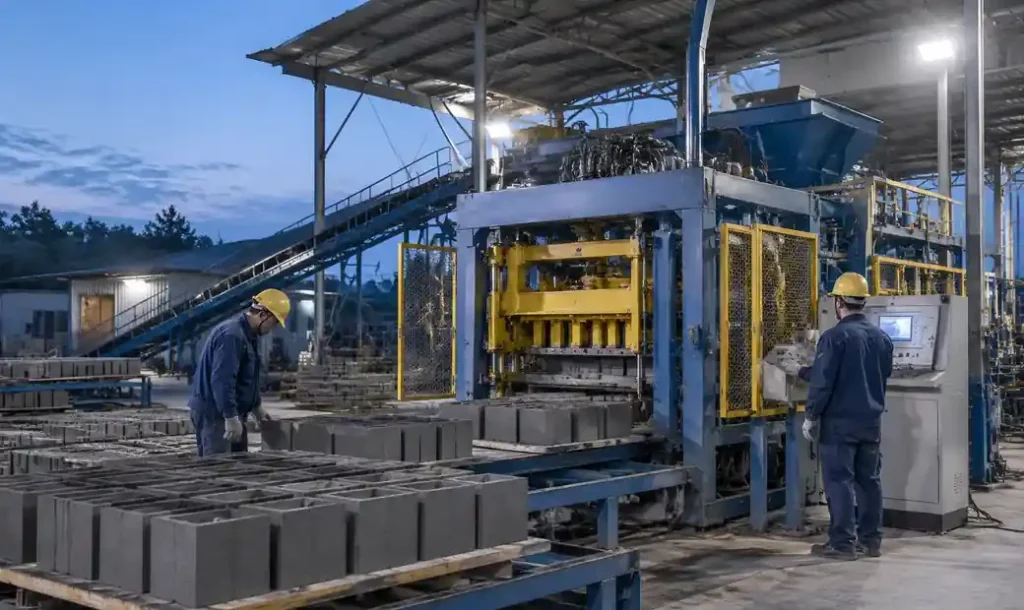
For semi-automatic block machines where operators control timing, this flexibility prevents quality issues without equipment changes.
Mix design modifications:
Increase water content by 5-8% to compensate for evaporation. A typical mix at 0.45 water-cement ratio might move to 0.48-0.50 in summer. This requires testing—too much water weakens blocks, too little creates incomplete compaction.
Use Type II or III Portland cement with lower heat of hydration. These specialized cements generate 15-20% less heat during curing than standard Type I, reducing thermal cracking risk.
Add retarding admixtures at 0.2-0.4% by cement weight. Retarders slow hydration rates by 2-4 hours, giving operators time to complete curing preparation before the critical hydration phase accelerates.
Immediate curing protection:
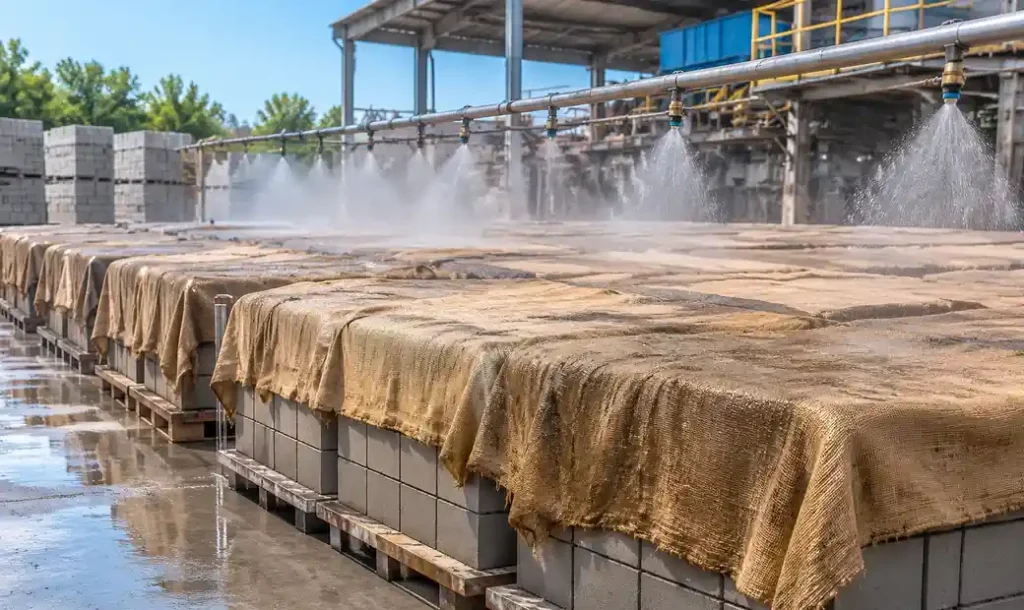
Cover fresh blocks with wet burlap or plastic sheeting within 30 minutes of molding. This simple step prevents surface moisture loss during the vulnerable first 6-8 hours.
Apply curing compound or water misting systems to maintain surface moisture. Misting should deliver light, frequent applications (every 30-60 minutes) rather than heavy soaking.
Equipment considerations:
For automatic block making machines, install misting systems that activate automatically after each molding cycle. Water consumption runs 50-100 liters/hour but prevents hundreds of blocks from cracking.
Keep hydraulic oil coolers maintained—summer heat pushes hydraulic systems hard. Oil temperatures above 70°C damage seals and reduce efficiency.
Winter Block Production Challenges
Cold Weather Quality Risks
Winter presents opposite problems: insufficient hydration, freezing damage, and extended curing times that tie up capital in inventory.
Arrested hydration: Cement hydration drops dramatically below 10°C and nearly stops at 5°C. According to masonry cold weather standards, concrete should not be produced when ambient temperature falls below 5°C without protective measures, because blocks won’t develop adequate strength within normal curing periods.
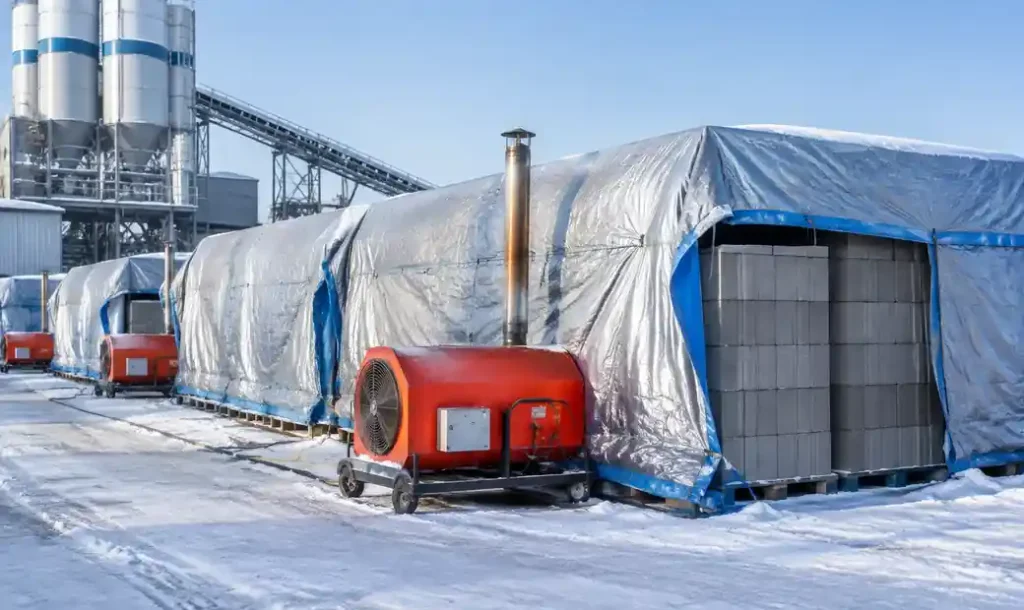
Freeze damage: The critical threshold is 500 psi (3.5 MPa) compressive strength—the point where concrete structure can withstand freeze-thaw cycles. Standard blocks reach this in 24-48 hours at 20°C, but require 4-7 days at 5°C. If blocks freeze before reaching this strength, ice crystal formation creates permanent micro-cracks reducing final strength by 40-60%.
Extended curing times: At 5°C, blocks require 28-35 days to reach strength levels achieved in 14 days at 20°C. This doubles or triples inventory requirements, tying up 10,000-30,000 blocks in curing yards and the capital they represent.
Winter Production Best Practices
Material heating:
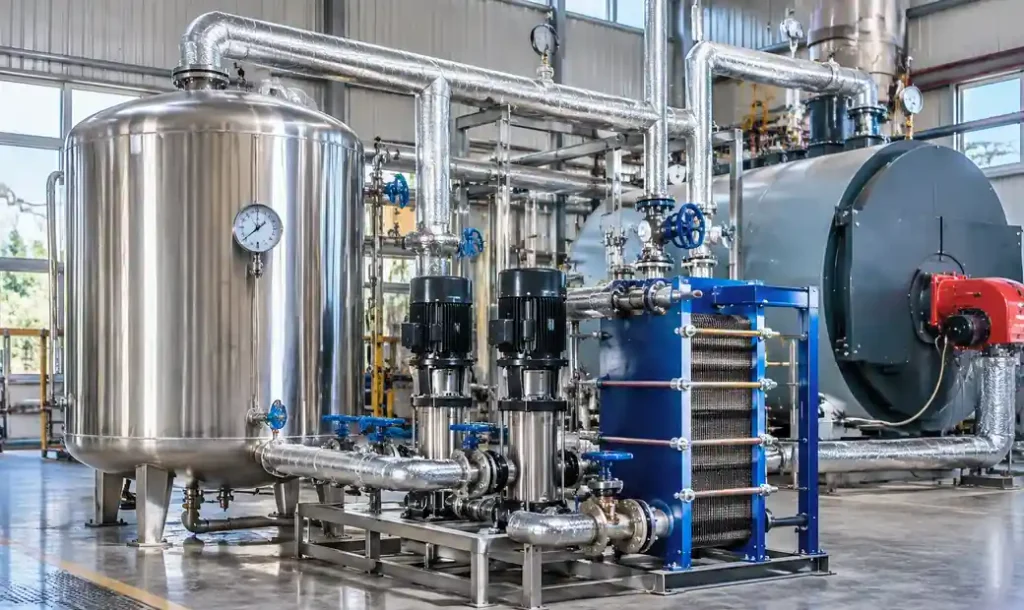
Heat mix water to 40-60°C. This provides the biggest temperature impact with minimal cost. Water at 50°C in a typical mix (15-18% of total weight) raises fresh concrete temperature by 12-18°C. Avoid exceeding 60°C to prevent flash setting when hot water contacts cement.
For larger operations producing 15,000+ blocks daily, consider heating aggregates to 15-20°C using steam pipes or heated enclosures. This adds infrastructure cost but enables continuous winter production.
Accelerated mix designs:
Type III high-early-strength cement generates heat faster and develops strength 30-50% quicker than Type I. Blocks reach critical 500 psi strength in 18-24 hours at 10°C versus 48-72 hours with standard cement.
Add calcium chloride accelerator at 1-2% by cement weight. This accelerates hydration and strength gain, advancing timelines by 24-48 hours. Note: Avoid calcium chloride if blocks will be exposed to steel reinforcement (causes corrosion).
Non-chloride accelerators work for reinforced applications but cost 2-3 times more.
Protected curing:
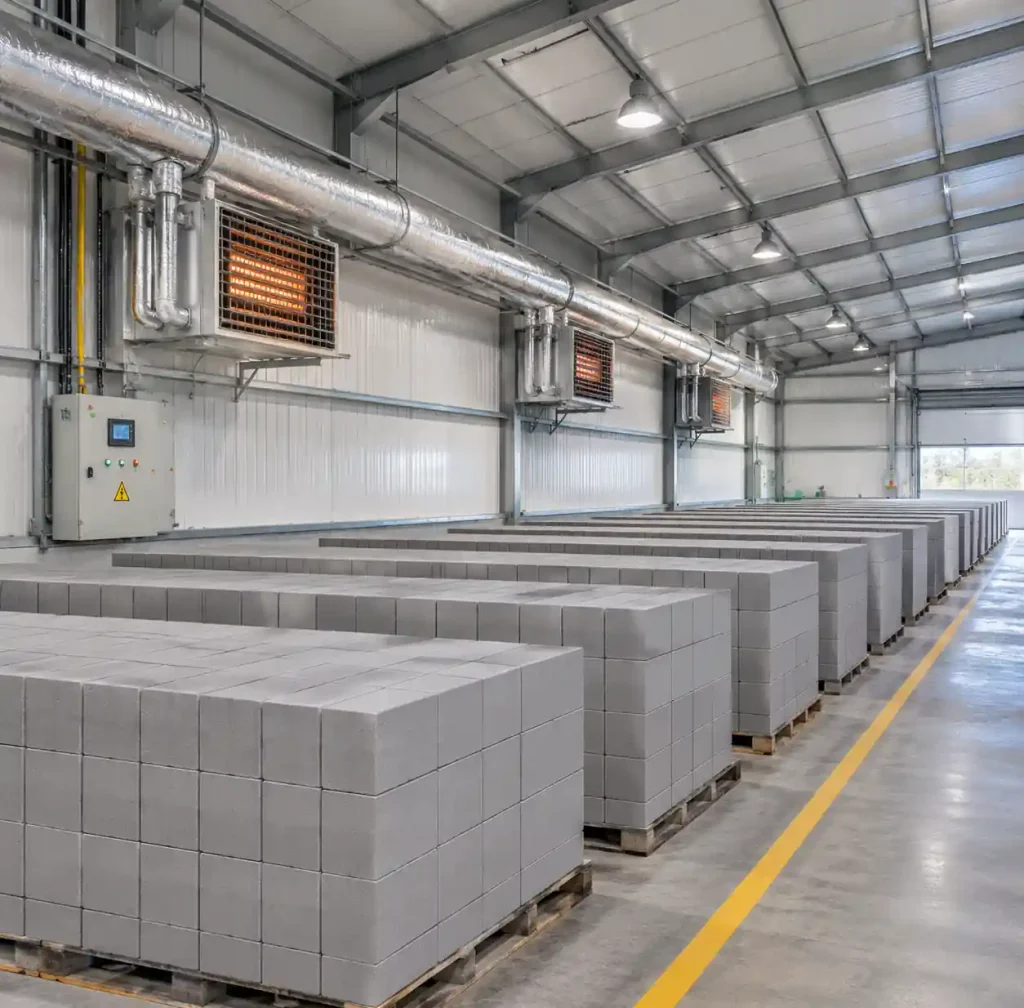
Enclose curing areas with temporary structures—plastic sheeting, insulated tarps, or permanent enclosures for serious operations. Even simple windbreaks raise temperatures 3-5°C.
Heat curing areas with forced-air heaters or radiant systems. Target 15-20°C minimum for first 72 hours. After this critical period, blocks tolerate lower temperatures safely.
For manual block machine operations with limited budgets, focus heating on the first 48 hours only—this covers the critical freeze-damage window.
Timing strategies:
Produce during warmest part of day (11 AM – 3 PM) to maximize natural heat benefits. Even winter sunshine adds 5-8°C to ambient temperature in production areas.
Reduce daily production volume if heating capacity is limited. Better to produce 8,000 quality blocks than 15,000 blocks with 30% losses.
Temperature Control Equipment and Modifications
Essential Equipment for Extreme Weather Operations
| المعدات | Summer Use | Winter Use | Investment Level | Payback Period |
|---|---|---|---|---|
| Water Chiller/Heater | Cool to 5-10°C | Heat to 40-60°C | $2,000-$8,000 | 6-12 months |
| Misting System | Prevent evaporation | Not applicable | $800-$3,000 | 3-6 months |
| Curing Enclosure | Shade structure | Heated enclosure | $5,000-$25,000 | 12-18 months |
| Aggregate Heating | Not applicable | Steam/hot air | $8,000-$35,000 | 18-24 months |
| Temperature Monitoring | Track concrete temp | Monitor freeze risk | $400-$1,500 | Immediate |
| Admixture Dispensers | Retarders | Accelerators | $1,200-$4,000 | 8-12 months |
Water temperature control delivers the highest return on investment. A $4,000 system heating winter water and cooling summer water impacts every block produced, preventing $15,000-35,000 in annual losses for a 10,000 block/day operation.
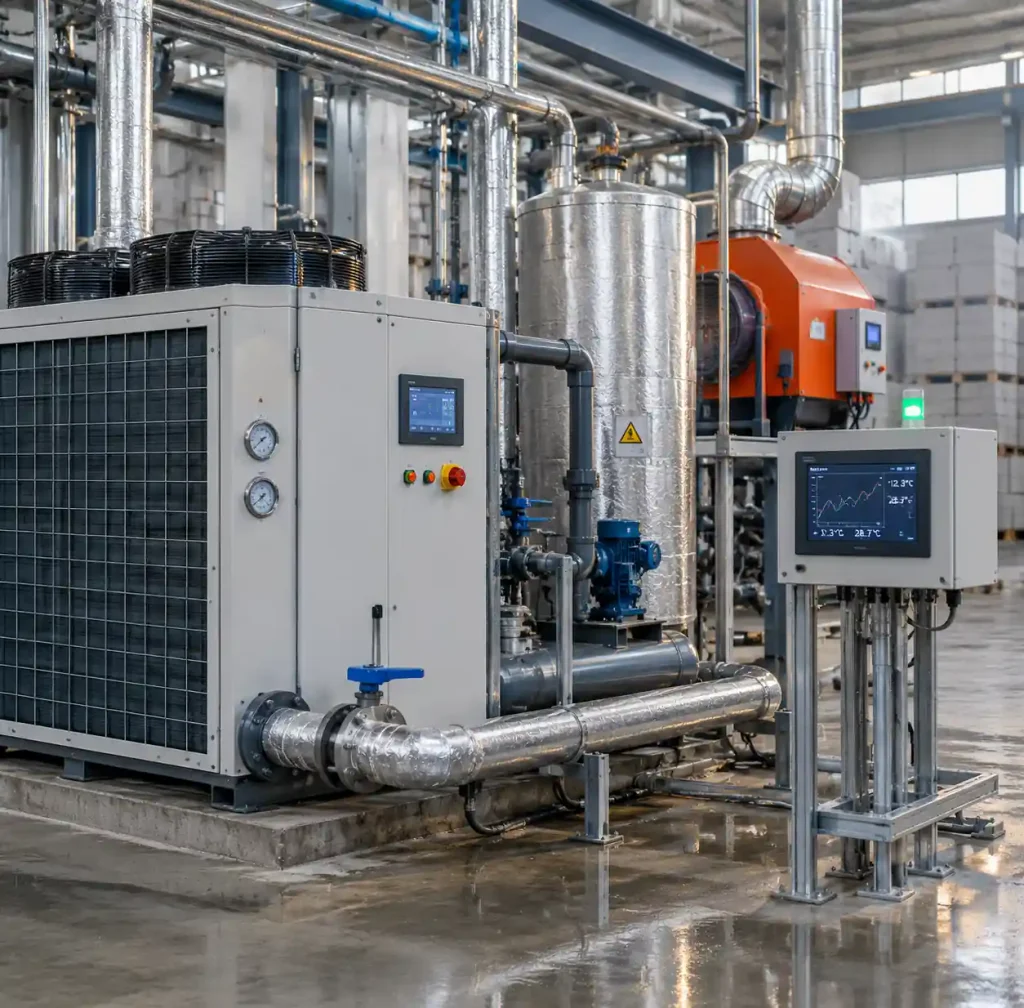
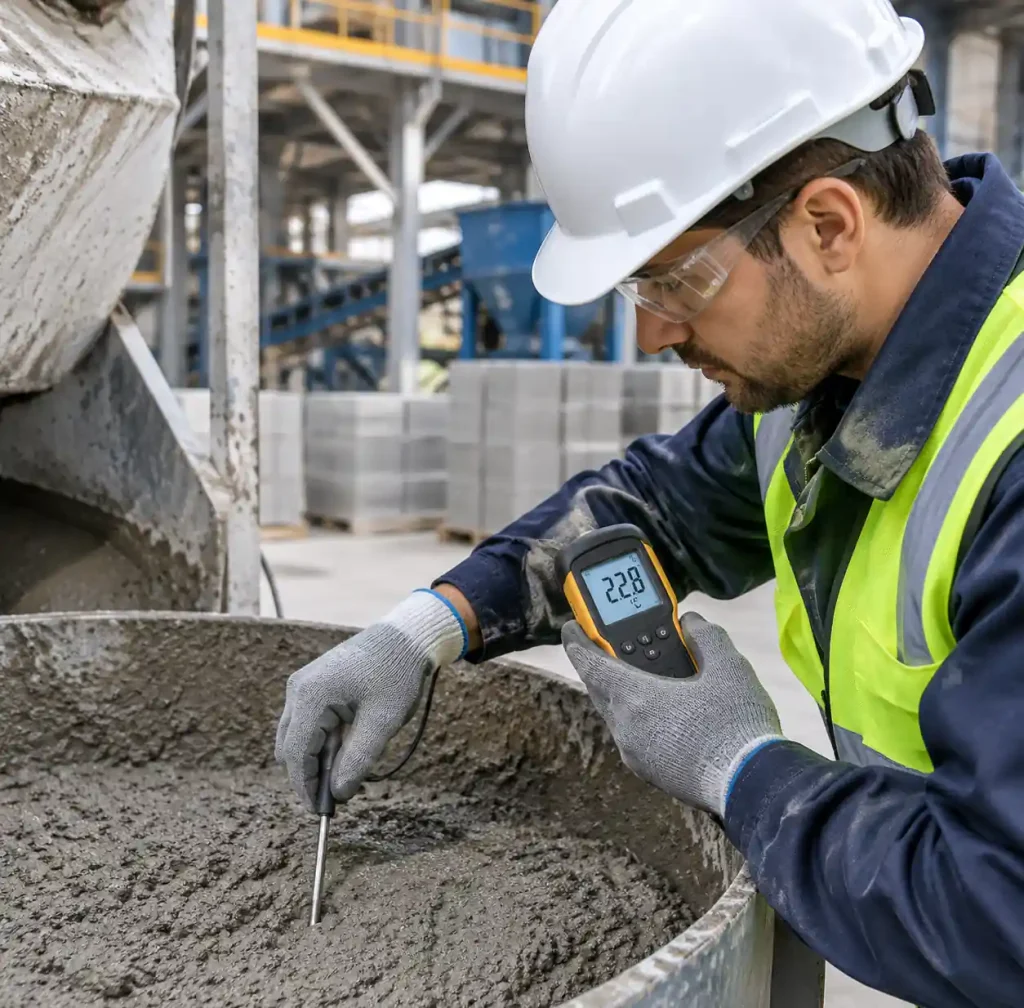
Temperature monitoring seems basic but catches problems early. Digital sensors tracking ambient temperature, concrete temperature, and curing area temperature alert operators before quality issues develop. Systems cost $400-1,500 and prevent entire production runs from falling below specifications.
Machine-Specific Modifications
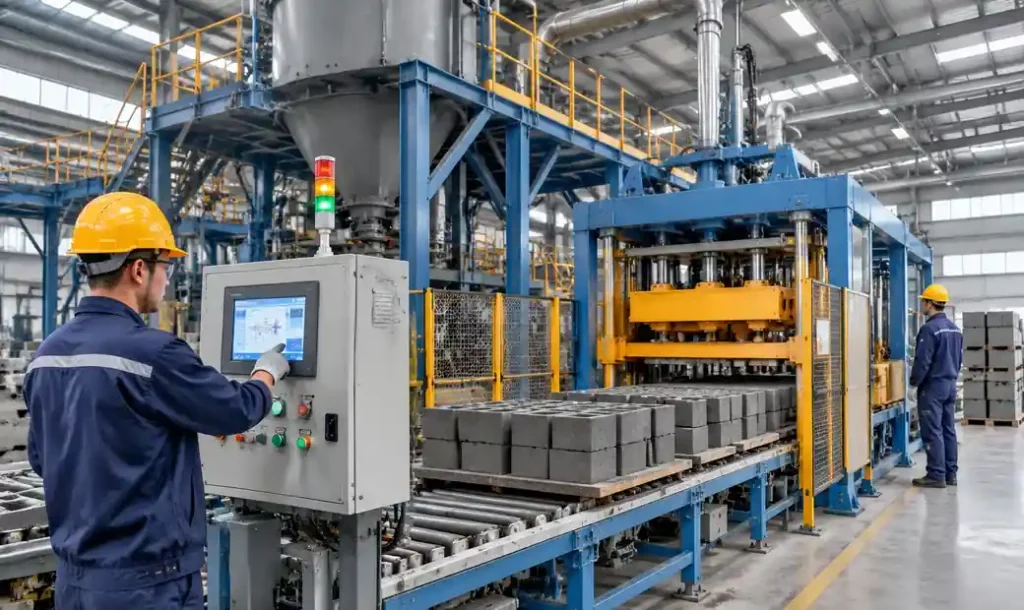
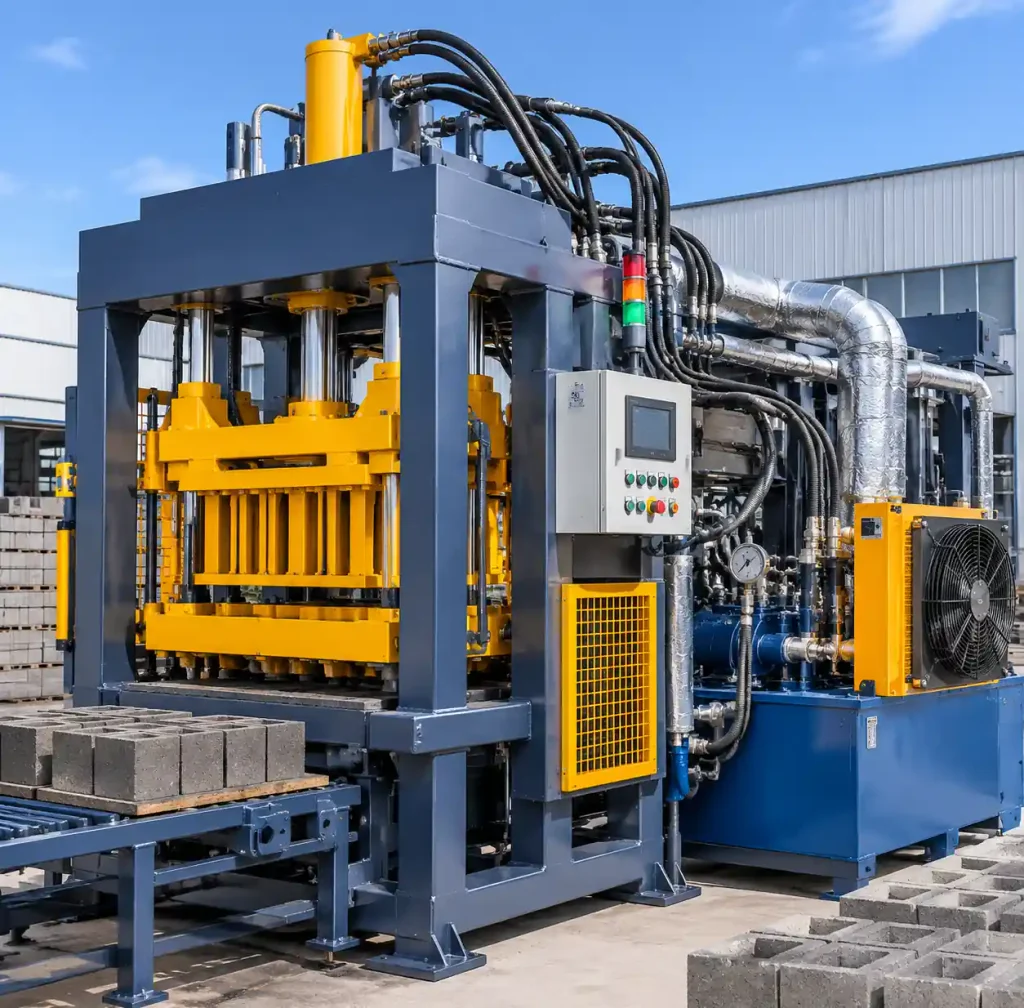
For hydraulic block machines: Install oil coolers rated for summer ambient +10°C. Hydraulic systems running at 75-80°C oil temperature suffer seal failures and reduced cylinder force. Oil coolers maintaining 55-60°C extend seal life from 5,000 to 10,000+ hours.
In winter, insulate hydraulic lines and consider oil heaters for cold starts. Hydraulic oil viscosity doubles at 10°C versus 40°C, reducing system response and wearing pumps during startup.
For automatic systems: Add environmental controls to PLC programs monitoring concrete temperature and adjusting cycle times. If fresh concrete exceeds 32°C, extend cycle slightly for better cooling before de-molding. If below 10°C, alert operators to implement heating protocols.
Temperature Monitoring and Quality Control
Critical Temperature Checkpoints
Successful extreme weather production requires monitoring at five points:
1. Ambient temperature: Simple weather tracking. Production protocols should trigger automatically at 35°C+ (summer measures) or 5°C and falling (winter measures).
2. Material temperature: Check aggregate stockpiles and water temperature. Aggregates can be 15-20°C above or below ambient depending on exposure, wind, and moisture.
3. Fresh concrete temperature: Measure immediately after mixing. Target range: 18-28°C year-round. Adjust water temperature and timing if outside this zone.
4. Concrete temperature during curing: Monitor at 6, 12, 24, and 48 hours. Critical period is first 48 hours—this determines whether blocks achieve freeze-resistant strength before overnight temperature drops.
5. Curing area temperature: In winter, ensure protected curing zones maintain 15°C minimum. In summer, verify shaded areas stay below 35°C.
Quality Testing Adjustments
Standard 7-day strength testing may not reflect true block quality in extreme weather. Supplement with:
24-hour strength tests in winter to verify blocks exceed 500 psi freeze-resistance threshold before overnight temperature drops.
Surface hardness tests in summer to catch early indicators of plastic shrinkage cracking or inadequate hydration from water loss.
Freeze-thaw cycle testing for critical winter production. Select random samples, freeze to -10°C, thaw to 20°C for 5 cycles, then test strength. Properly protected blocks show minimal strength loss (<10%); inadequately cured blocks fail catastrophically.
Economic Impact of Weather Adaptation
Cost-Benefit Analysis
The investment in weather adaptation measures pays back quickly when compared to quality losses and lost production.
Example: 10,000 blocks/day operation
Summer losses without protection:
- Rejection rate: 12-15% (1,200-1,500 blocks/day)
- Material cost per block: $0.35-0.45
- Daily loss: $420-675
- 90-day summer season loss: $37,800-60,750
Winter losses without heating:
- Rejection rate: 20-30% (2,000-3,000 blocks/day)
- Daily loss: $700-1,350
- 90-day winter season loss: $63,000-121,500
Protection investment:
- Water heating/cooling system: $6,000
- Misting system: $2,000
- Curing enclosure (winter): $15,000
- Temperature monitoring: $800
- Admixture systems: $2,500
- Total investment: $26,300
Reduced losses with protection:
- Summer rejection rate: 3-5% (savings: $28,000-50,000)
- Winter rejection rate: 5-8% (savings: $50,000-105,000)
- Annual savings: $78,000-155,000
- Payback period: 2-4 months
Beyond direct rejection savings, year-round production captures market opportunities. Competitors shutting down in extreme weather cannot fulfill orders—operations that maintain quality gain market share and premium pricing for guaranteed supply.
Practical Implementation Roadmap
Phase 1: Essential Measures (Immediate, Low Cost)
Start with high-impact, low-cost interventions implementable within days:
Summer:
- Shade aggregate stockpiles (tarps, temporary roofing): $200-800
- Start production 2-3 hours earlier: No cost
- Cover fresh blocks immediately with wet burlap: $100-300
- Install basic misting setup: $400-1,200
Winter:
- Heat mix water with immersion heaters: $150-500
- Construct windbreaks around curing area: $300-1,000
- Add calcium chloride accelerator: $0.08-0.12 per block
- Insulate fresh blocks with tarps first 24 hours: $200-600
These measures reduce rejection rates from 15-25% to 8-12% for an investment under $2,000.
Phase 2: Core Systems (1-3 months, Medium Investment)
Once immediate measures prove effective, install permanent systems:
Summer:
- Permanent water chilling system: $3,000-6,000
- Automated misting with timers: $1,500-3,000
- Temperature monitoring system: $600-1,200
Winter:
- Water heating system with thermostat: $2,500-5,000
- Enclosed curing area with heating: $8,000-18,000
- Admixture dispensing system: $1,800-3,500
Investment: $17,400-36,700
Payback: 4-8 months from rejection reduction and extended season
Phase 3: Advanced Optimization (6-12 months, Higher Investment)
For operations targeting year-round maximum quality:
Summer:
- Aggregate shading structures: $3,000-8,000
- Evaporative cooling for work areas: $4,000-12,000
- Hydraulic oil cooling systems: $2,500-6,000
Winter:
- Aggregate heating system: $12,000-30,000
- Fully enclosed heated production area: $25,000-80,000
- Backup generator for heating reliability: $8,000-20,000
Total advanced investment: $54,500-156,000
Justification: Operations producing 20,000+ blocks daily in extreme climates, or those serving projects with strict year-round supply requirements.
Equipment Selection for Extreme Weather
Machine Features That Matter
When purchasing equipment for operations facing extreme temperatures, prioritize these features:
Hydraulic system specifications:
- Oil coolers rated for ambient +15°C minimum
- Insulated hydraulic tanks for winter (optional but valuable)
- High-quality seals rated for -10°C to 80°C operation
- Hydraulic oil specifications: multi-grade for wide temperature range
Mixing system:
- Heated water jacket capability (winter)
- Rapid mixing cycle (<90 seconds) to minimize temperature loss
- Insulated mixer drum option for cold climates
- Variable speed control for adjusted moisture content
Control systems:
- Temperature sensors integrated into PLC
- Automatic cycle adjustment based on ambient conditions
- Data logging for quality documentation
- Remote monitoring capability
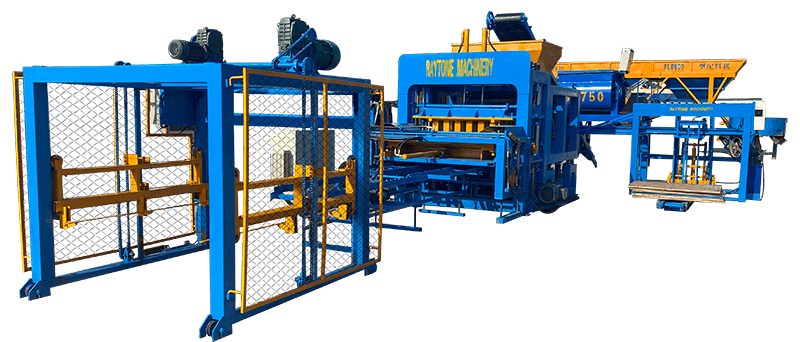
Raytone Block Machinery offers hydraulic block machines specifically configured for extreme climate operations, with factory-installed oil cooling, insulated components, and temperature monitoring systems. Our engineers provide site-specific recommendations based on your local climate data and production requirements.
Regional Adaptation Strategies
Hot Climate Operations (Middle East, India, Australia, Southern USA)
Regions with sustained temperatures above 35°C require permanent summer protocols:
- Schedule all production before 1 PM
- Install permanent shade structures over aggregate storage and curing yards
- Use chilled water year-round (not just peak summer)
- Specify white cement or lighter colored blocks to reduce heat absorption
- Extend curing times to 21-28 days for maximum strength development
- Implement mandatory testing for plastic shrinkage cracks
Consider night production for extreme climates regularly exceeding 40°C. While requiring lighting and worker scheduling changes, night production keeps concrete temperatures in the safe 22-30°C range.
Cold Climate Operations (Russia, Canada, Northern Europe, High Altitude)
Regions where temperatures drop below 5°C for extended periods need permanent winter infrastructure:
- Fully enclosed, heated production facilities
- Continuous aggregate heating capability
- Water heating to 50-60°C standard practice
- Type III cement as default specification
- Extended curing enclosures maintaining 18-22°C for 5-7 days minimum
- Backup heating systems for reliability
Winter operations require higher capital investment but capture premium pricing when competitors cannot deliver. Markets with 6-month winter seasons justify fully enclosed, climate-controlled facilities.
Variable Climate Operations (Most of USA, Europe, East Asia)
Regions experiencing both summer heat and winter cold need flexible systems addressing both extremes:
- Combination water heating/cooling system
- Convertible curing enclosures (shade in summer, heated in winter)
- Stock both retarding and accelerating admixtures
- Flexible production schedules adapted seasonally
- Dual cement specifications (Type I/II for summer, Type III for winter)
This versatility costs more than single-season preparation but less than full climate control, making it ideal for moderate climates with distinct seasons.
الأسئلة الشائعة
Q: What is the minimum temperature for producing concrete blocks?
A: Concrete blocks should not be produced when ambient temperature falls below 5°C without protective measures. Below this temperature, cement hydration slows to rates that prevent adequate strength development, and freeze damage risk becomes critical. With proper heating of materials and protected curing, production can continue safely down to -5°C ambient temperature.
Q: How hot is too hot for block production?
A: Production quality begins degrading above 32°C ambient temperature, with significant issues appearing above 35°C. Rapid water evaporation, accelerated cement hydration, and thermal stress create cracking and strength loss. With cooling measures (chilled water, shaded aggregates, immediate curing), production can continue safely up to 40°C.
Q: Can I use regular mix designs in extreme weather?
A: No. Standard mix designs optimized for 15-25°C conditions will fail in extreme temperatures. Summer requires higher water content, retarding admixtures, and possibly Type II cement. Winter needs reduced water, Type III cement, and accelerating admixtures. Testing adjusted mixes before full production is essential.
Q: How much does weather adaptation equipment cost?
A: Basic adaptation (water temperature control, misting, windbreaks) costs $2,000-8,000 and pays back in 2-4 months through reduced rejections. Intermediate systems (automated temperature control, curing enclosures) cost $15,000-40,000 with 6-12 month payback. Advanced climate control (aggregate heating, enclosed facilities) requires $50,000-150,000+ but enables year-round premium production.
Q: What temperature should fresh concrete be?
A: Target fresh concrete temperature between 18-28°C regardless of ambient conditions. Below 18°C, hydration slows significantly. Above 28°C, thermal stress and rapid moisture loss create quality issues. Adjust water temperature and material conditioning to maintain this range.
Q: How long do blocks need protection from extreme weather?
A: The critical period is the first 48-72 hours after production. During this time, blocks must be protected from temperature extremes, rapid moisture loss, and freezing. After reaching 500 psi (3.5 MPa) compressive strength—typically 2-3 days at normal temperatures—blocks can tolerate weather exposure, though continued moist curing improves final strength.
الخلاصة
Extreme weather control determines whether block plants operate profitably year-round or sit idle during seasonal temperature extremes. Summer heat above 35°C and winter cold below 5°C both damage block quality through different mechanisms—rapid evaporation and thermal stress in heat, arrested hydration and freeze damage in cold.
The solution combines material conditioning (water temperature control, aggregate management), timing adjustments (producing during optimal hours), mix design modifications (admixtures and cement selection), and curing protection (enclosures, heating, shading). These measures reduce rejection rates from 15-30% down to 3-8%, recovering investments within 2-6 months while extending production seasons and capturing market share from competitors who cannot maintain quality.
Raytone Block Machinery specializes in equipment designed for extreme climate operations, offering factory-integrated temperature control systems, insulated components, and application engineering support. Our machines operate reliably in temperatures from -10°C to 45°C, maintaining consistent block quality through automated monitoring and adaptive controls. Contact our engineering team for climate-specific recommendations and system sizing based on your production volume, temperature ranges, and quality requirements.
For comprehensive guidance on block production fundamentals, see our article on quality control in block manufacturing. Operators new to extreme weather production should review block machine operator training for safety protocols specific to temperature-related hazards.