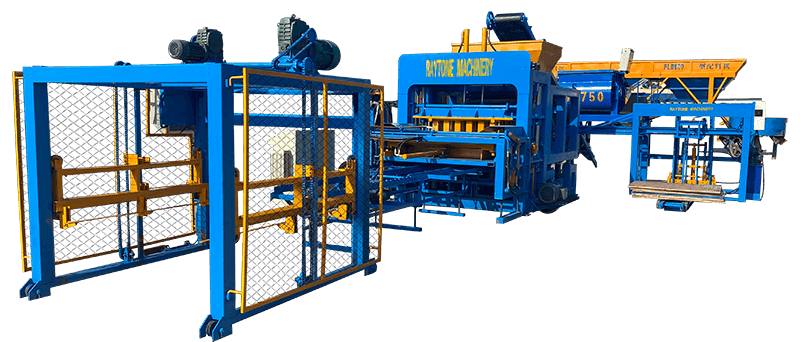






Building with compressed earth blocks eliminates the 8-15% carbon footprint from traditional fired brick kilns while cutting material costs 40% below concrete or clay alternatives. After implementing CEB production across sustainable housing projects in three climate zones, I’ve watched operations achieve 240-480 blocks per hour with machines consuming 85% less energy than conventional masonry equipment.
الـ global CEB machine market reached USD 2.66 billion in 2025 and projects to USD 4.17 billion by 2034 at 5.1% CAGR. Compressed stabilized earth blocks reduce cement use over 50% versus hollow concrete blocks while avoiding 2 tons CO2 per 100 square meters of wall construction.
This guide covers CEB machine technology, production economics, equipment selection, and market opportunities.
How Compressed Earth Block Machines Transform Construction Economics
Traditional fired brick production burns 1.5-2 tons of coal per 10,000 bricks, releasing 2.7-3.2 tons CO2 while requiring kiln infrastructure costing $80,000-150,000. CEB machines eliminate firing entirely, compressing stabilized soil at 1,000-1,900 PSI into blocks that cure naturally over 28 days.
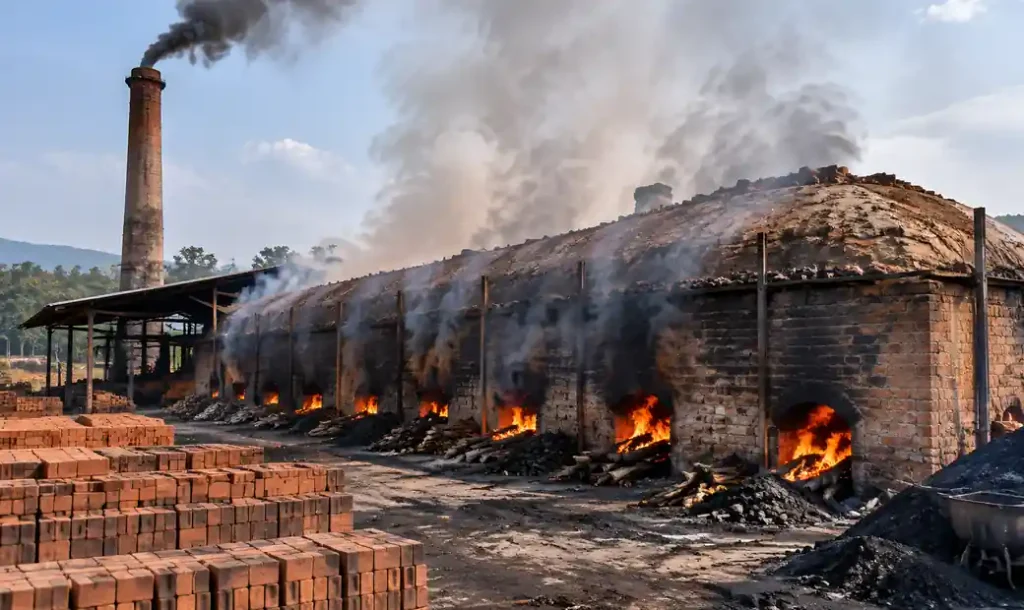
Research from Frontiers in Built Environment documents wall construction cost reductions of 50% with compressed earth blocks. Material and transportation savings drive this advantage—on-site soil eliminates 70-85% of raw material logistics.
| Cost Factor | Fired Clay Brick | Concrete Block | Compressed Earth Block | Savings vs Brick |
|---|---|---|---|---|
| Raw material (per 1000) | $280-350 | $240-300 | $85-120 | 66-72% |
| Fuel/energy cost | $120-180 | $40-60 | $8-15 | 88-93% |
| Transportation | $80-120 | $60-90 | $15-30 | 69-83% |
| Labor per 1000 | $180-240 | $160-200 | $120-160 | 25-40% |
| Total per 1000 | $660-890 | $500-650 | $228-325 | 51-67% |
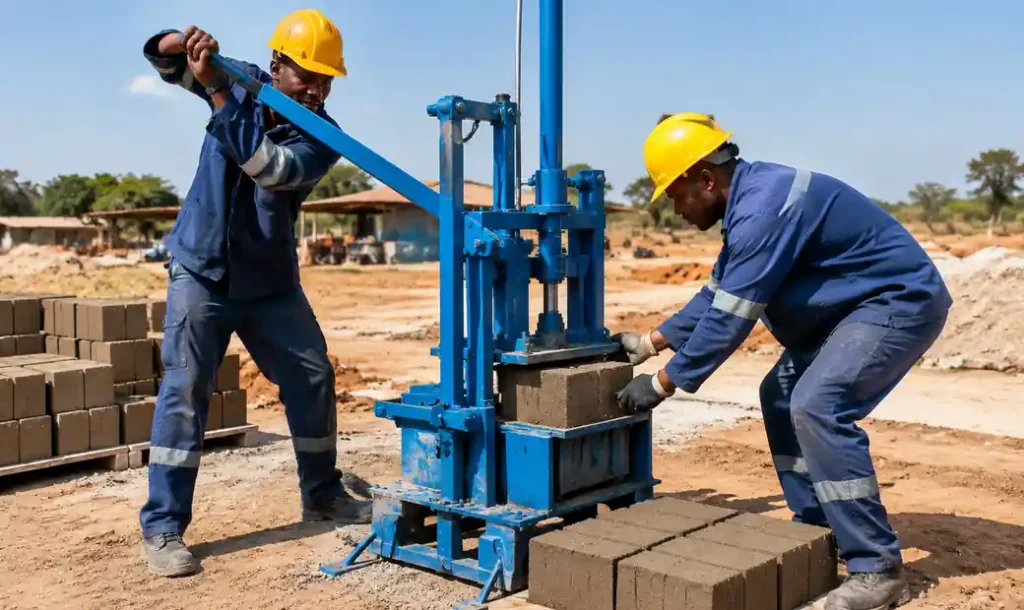
Manual block machines handle CEB production at 120-180 blocks per hour with two operators, while semi-automatic equipment reaches 240-350 blocks hourly. For projects requiring 50,000+ blocks, equipment investment recovers in 3-6 months through material savings alone.
Advanced Earthen Construction Technologies documents CEB machines producing 240-480 blocks per hour while consuming minimal power. A hydraulic CEB press draws 3-5 kW versus 45-60 kW for concrete block lines of equivalent capacity. Annual energy costs for 500,000-block production: fired brick kiln $38,000-52,000, concrete plant $18,000-26,000, CEB hydraulic machine $2,400-4,200, manual press $0.
Understanding CEB Production Technology
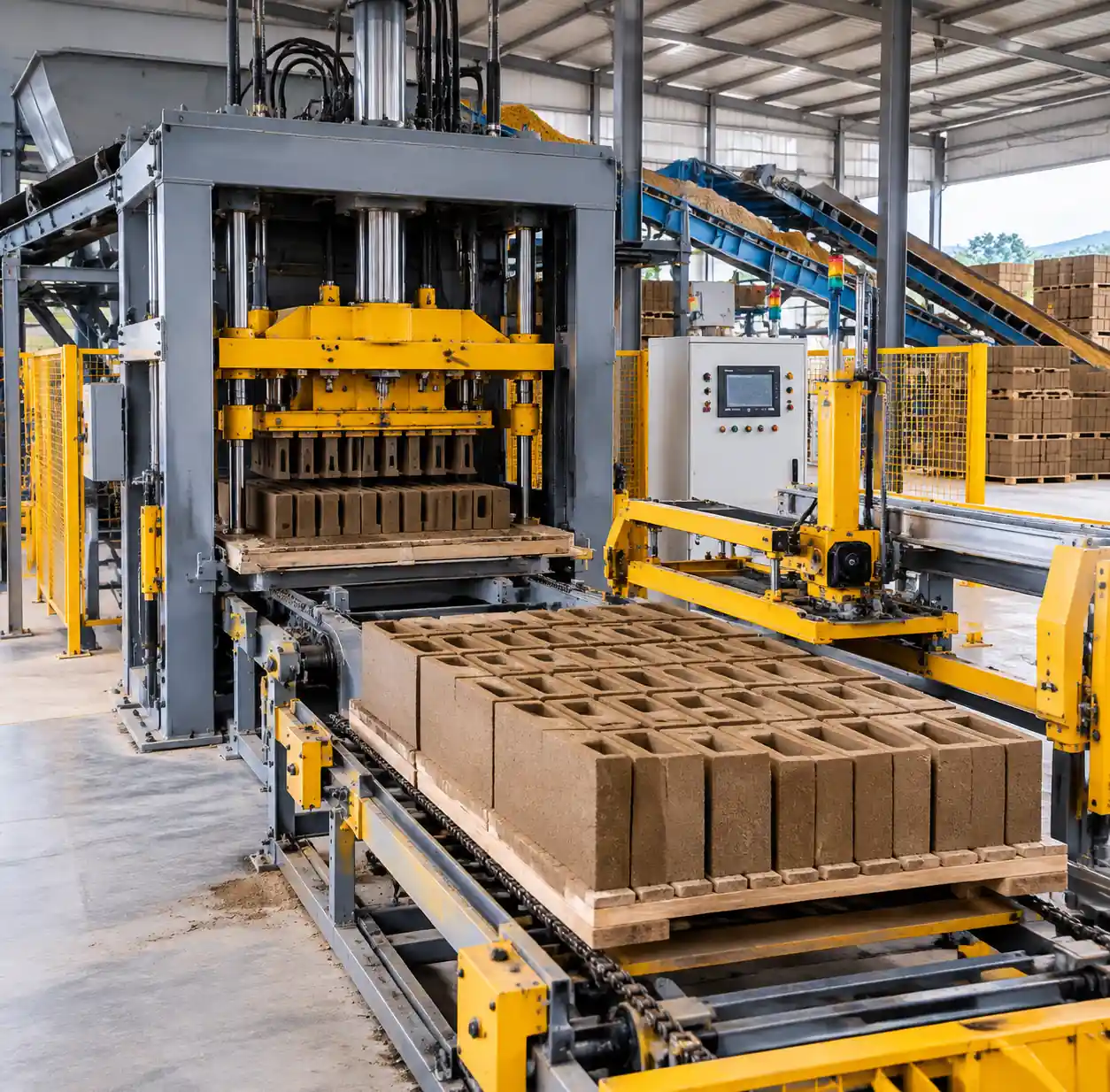
Compressed earth block machines use mechanical or hydraulic pressure to compact dampened soil-stabilizer mixtures into precise dimensions. The process differs fundamentally from concrete casting—compression occurs at room temperature without chemical curing accelerators.
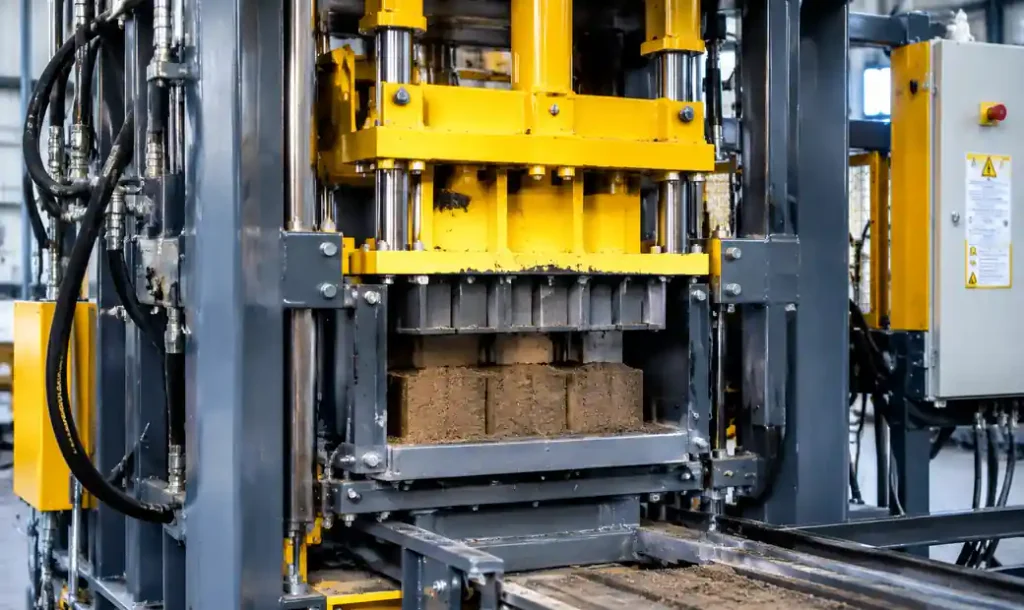
Block Machine Network research shows compression at 1,000-1,900 PSI produces blocks with 2.5-4.5 MPa compressive strength when using 5-8% cement stabilization. Pressure below 800 PSI yields insufficient density, while pressure above 2,200 PSI provides minimal strength gains but increases equipment wear.
Machine pressure correlates directly with block durability: 800-1,000 PSI for interior non-load-bearing walls, 1,200-1,500 PSI for single-story load-bearing structures, 1,600-1,900 PSI for multi-story construction, 2,000+ PSI for maximum weather resistance.
Soil Composition and Stabilization
Optimal soil composition contains 40-70% sand and 30-60% clay. Excessive clay (>65%) causes shrinkage cracks during curing, while insufficient clay (<25%) prevents adequate particle bonding. Essential testing includes sieve analysis, Atterberg limits, linear shrinkage test, and Proctor compaction to identify optimal moisture content.
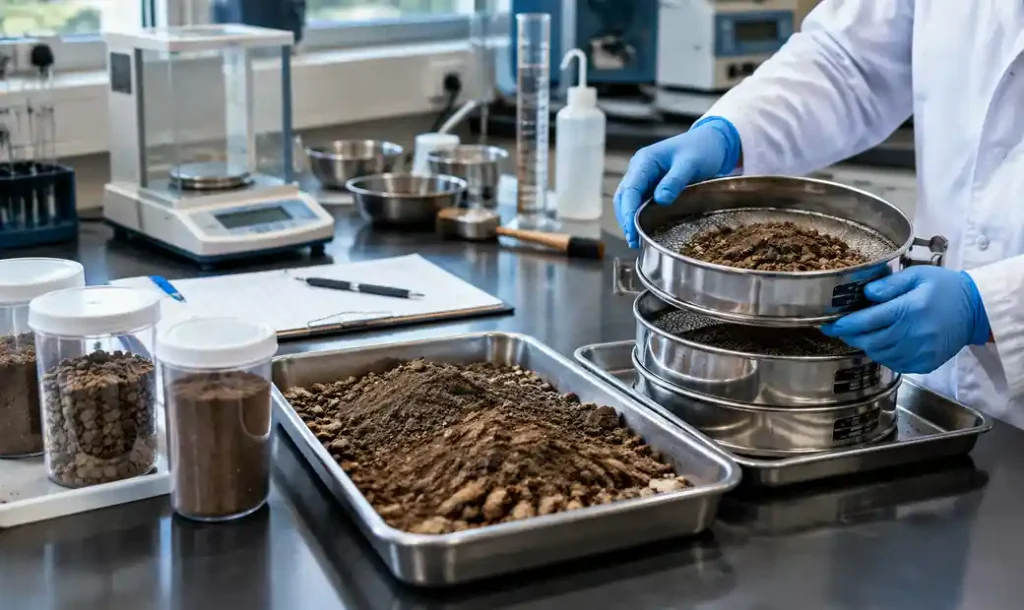
Stabilization with 5-10% cement or lime transforms blocks into water-resistant structural units. Pure unstabilized blocks work for interior partitions in dry climates but lack weather resistance.
| Stabilizer Content | Compressive Strength | Water Resistance | Application | Cost Impact |
|---|---|---|---|---|
| 0% (unstabilized) | 1.2-2.0 MPa | Poor | Interior walls, dry climates | Baseline |
| 3-5% cement | 2.0-3.5 MPa | Moderate | Protected exteriors | +$8-12/m³ |
| 6-8% cement | 3.5-5.5 MPa | Good | Exterior walls, load-bearing | +$15-22/m³ |
| 8-10% cement | 5.0-7.5 MPa | Excellent | Foundation, high-moisture | +$22-30/m³ |
Cement provides faster strength development (7-day strength 60-70% of 28-day) while lime offers better breathability for heritage construction. Some operations combine 4-6% cement with 2-3% lime to balance early strength and long-term durability.
CEB Machine Types and Selection
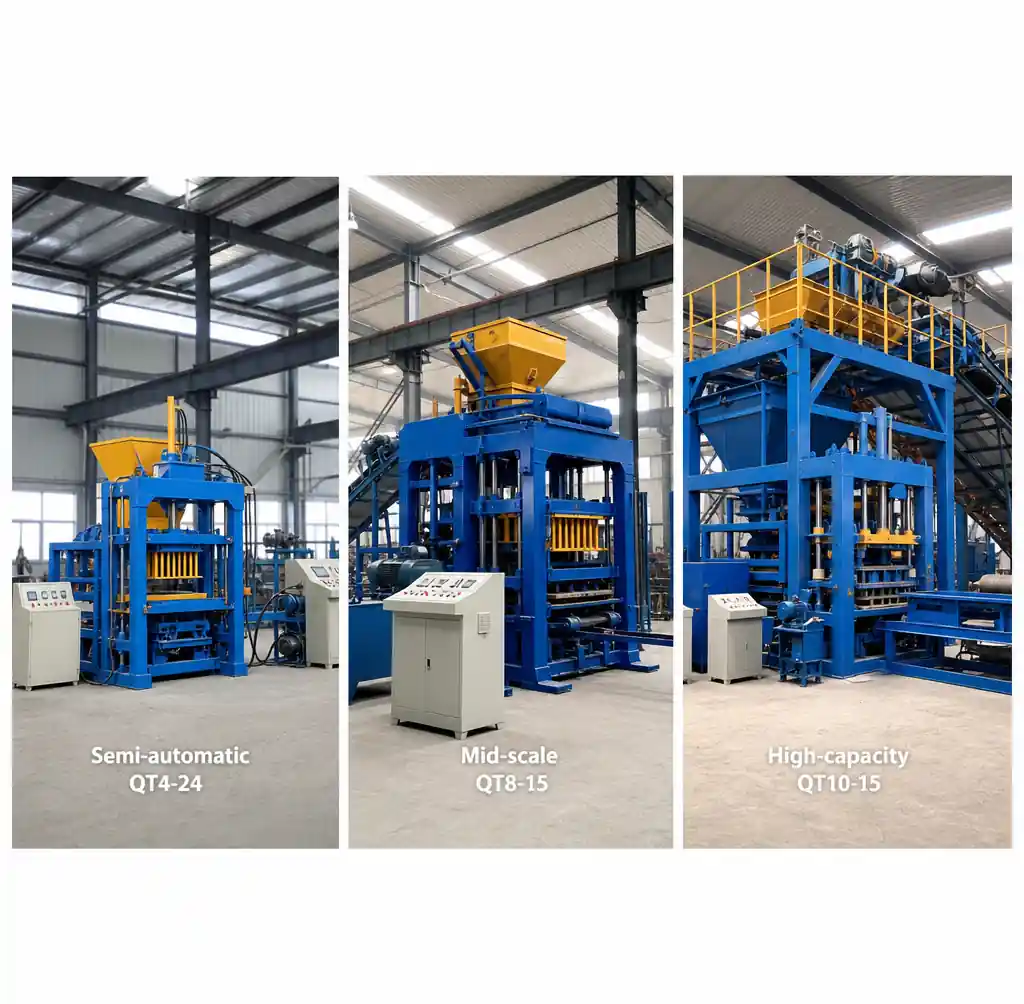
Three machine categories serve different production scales: manual lever presses for 500-1,500 blocks daily, hydraulic machines for 2,000-8,000 blocks daily, and automatic production lines for 10,000+ blocks daily.
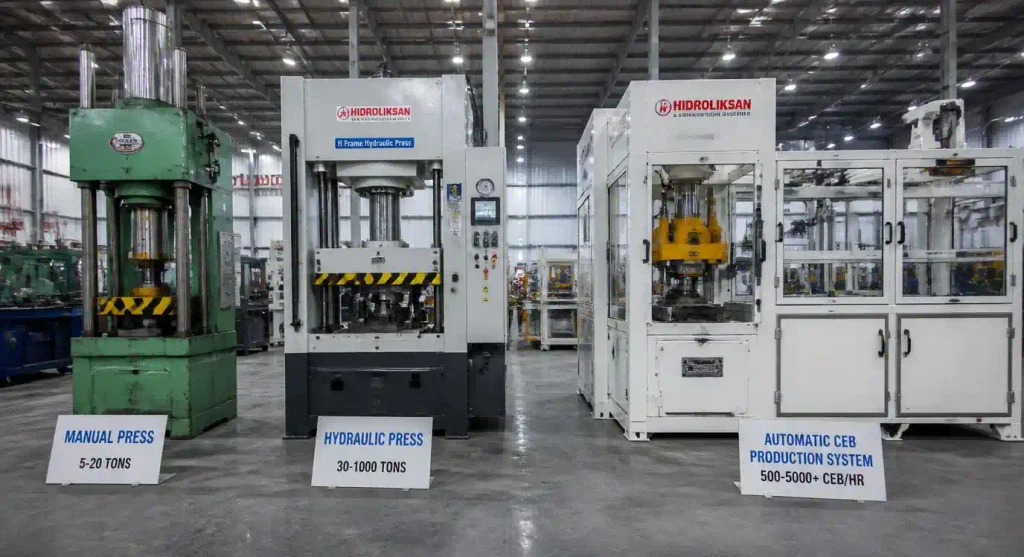
Manual Lever Press
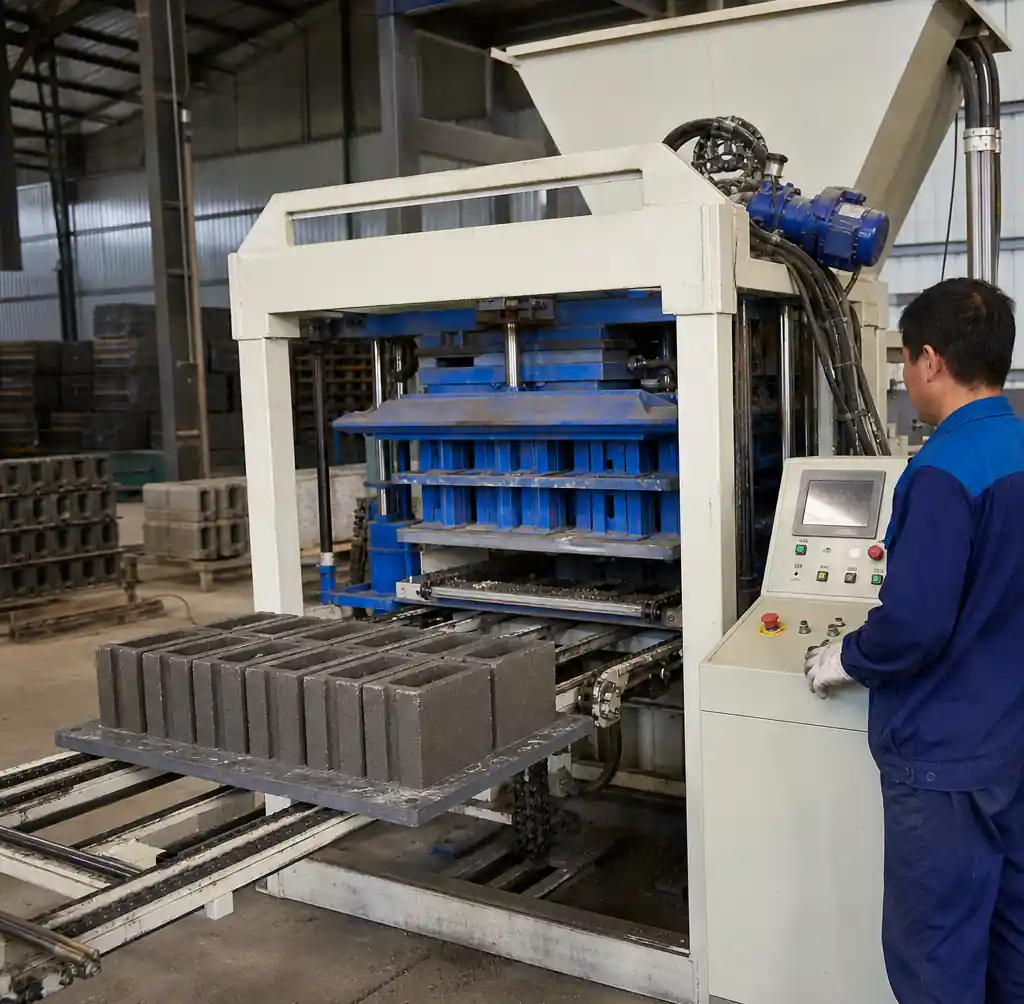
Manual presses use mechanical leverage to multiply operator force 15-30 times, achieving 600-1,200 PSI compression. Two operators produce 120-180 blocks per hour—sufficient for homes under 200 square meters or projects under 40,000 blocks. Initial investment: $3,500-8,000, no electricity required, portable (85-150 kg), operator training in 2-4 hours. Limitations include pressure consistency variance with operator fatigue and lower compression limiting block strength potential.
Hydraulic CEB Machine
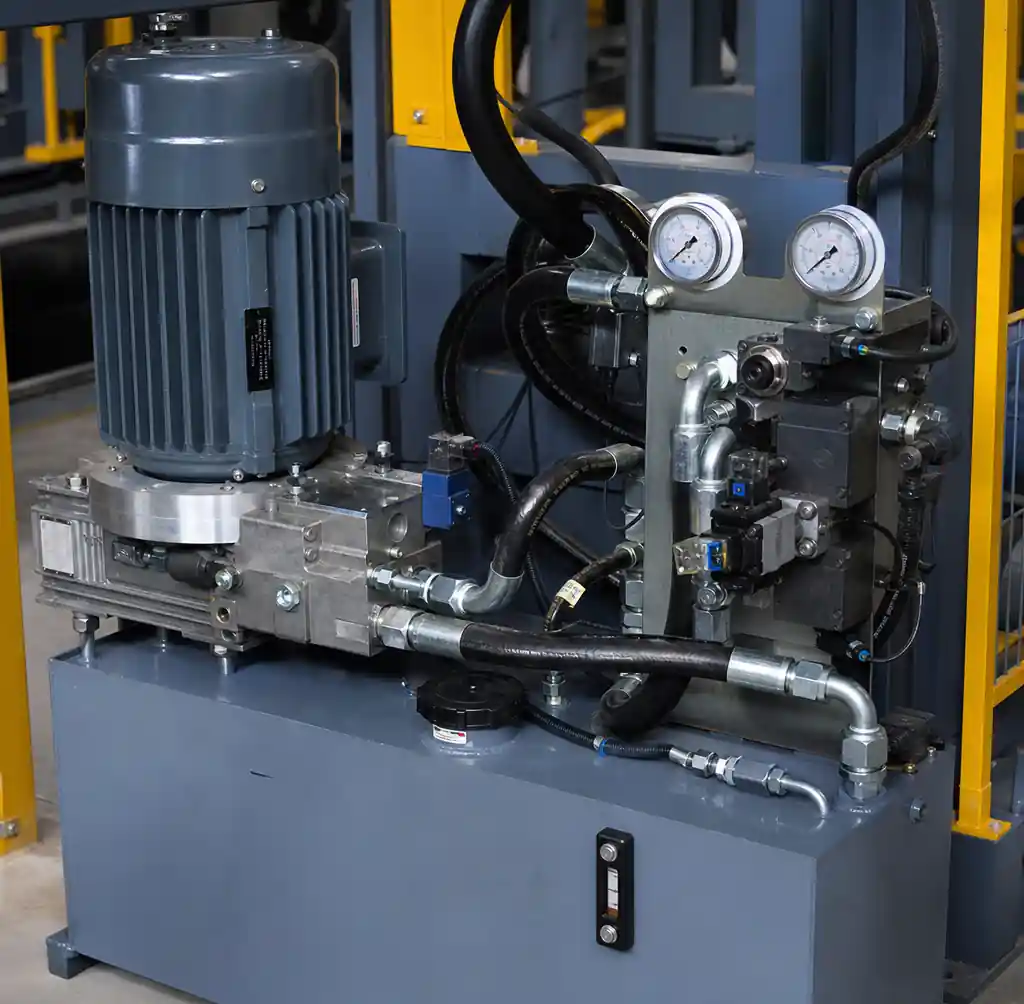
Hydraulic machines use 15-30 ton cylinders to achieve consistent 1,200-1,900 PSI compression. Single-operator production reaches 180-280 blocks per hour. Modern hydraulic machines feature PLC or manual hydraulic control, interchangeable molds, automatic demolding, and power options including 380V 3-phase, diesel hydraulic pumps, or PTO tractor drive. Well-maintained machines achieve 95-98% uptime versus 75-85% for manual presses.
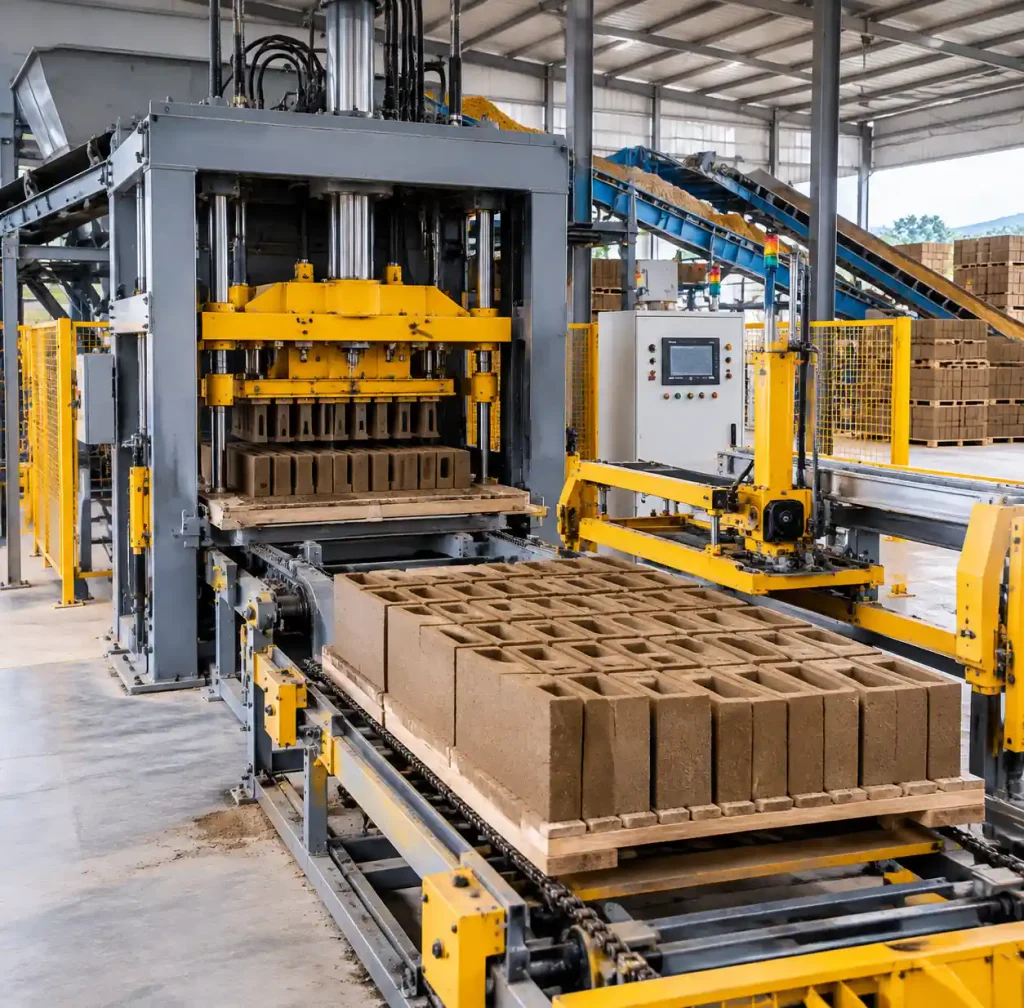
Automatic Production Lines
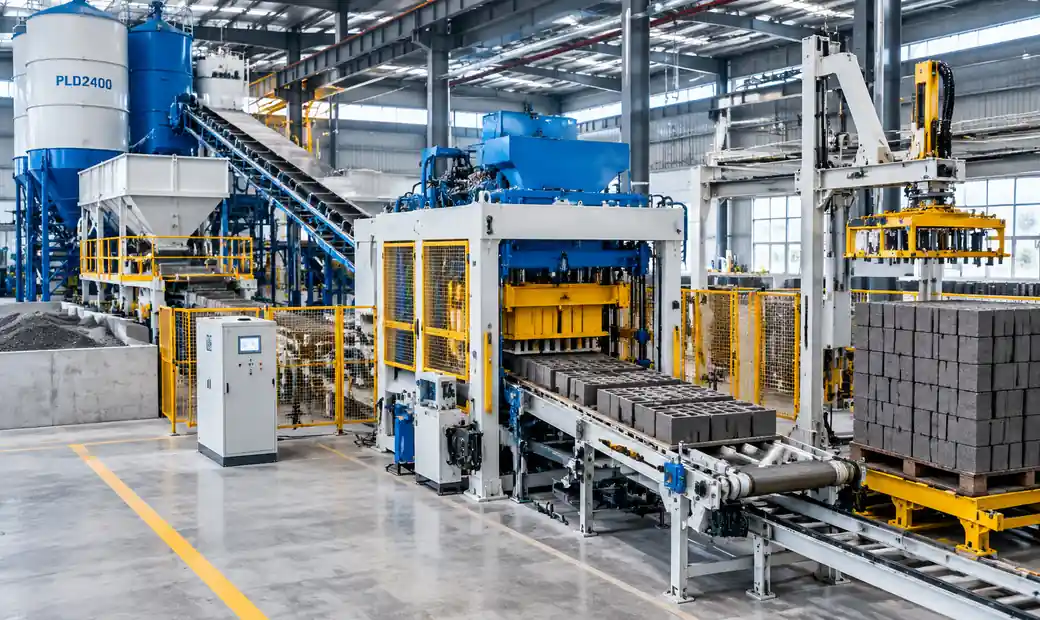
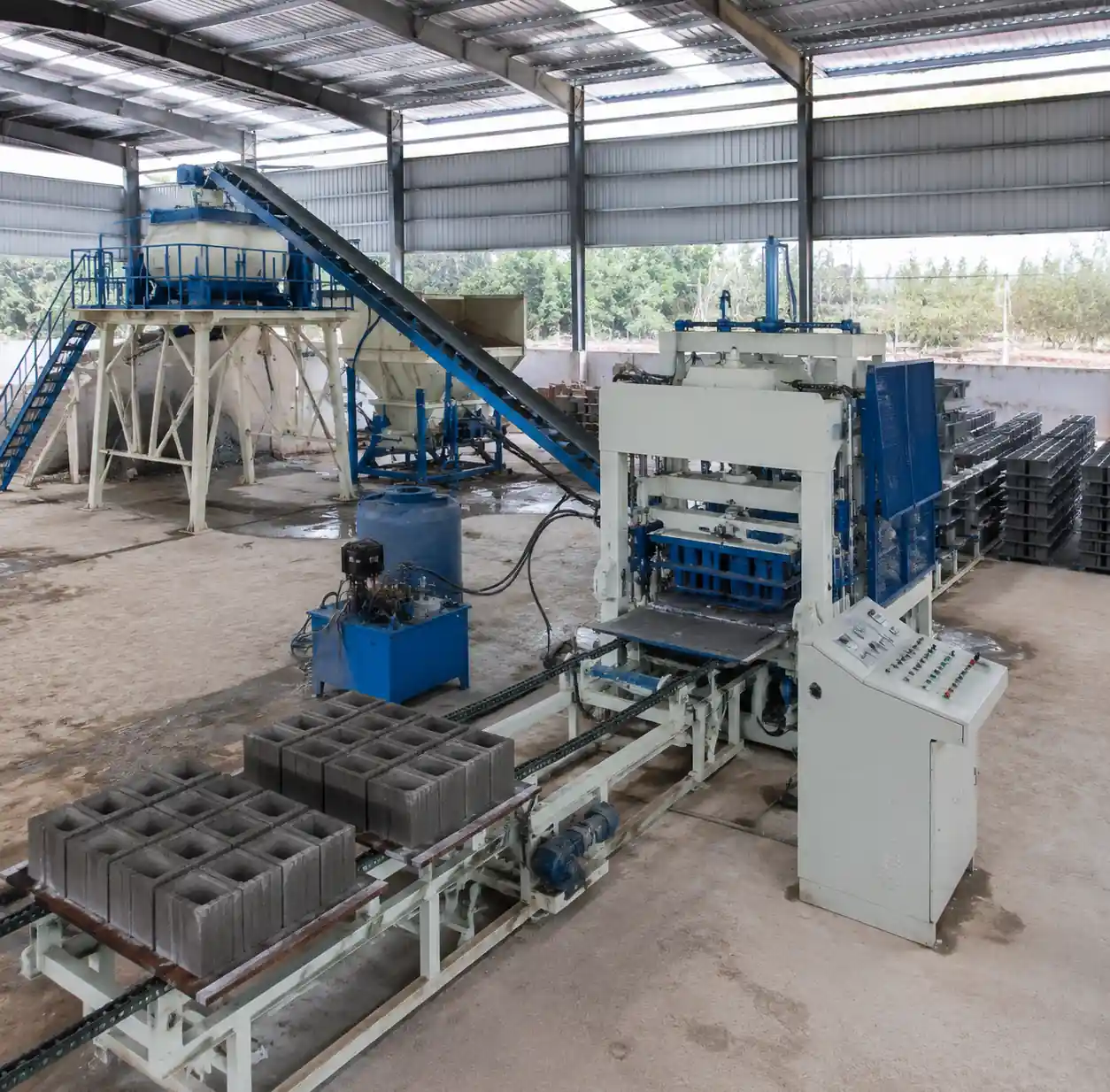
Complete automatic brick plant solutions handle 8,000-15,000 blocks per 8-hour shift with 3-4 operators. Automation includes weigh-batch feeders, paddle mixers with moisture control, automatic mold filling and compression, robotic stacking, and conveyor systems. Capital investment: $85,000-180,000 for 10,000-block daily systems, $200,000-380,000 for 20,000-30,000 block capacity.
Market Opportunities and Performance Comparison
Green building certification programs award points for locally-sourced materials and embodied carbon reduction—factors where CEBs excel. Geographic demand concentrates in Sub-Saharan Africa (38% of current demand), Southeast Asia (52% growth in 2024-2025), Latin America, Middle East, and North America/Europe for sustainable building certifications.
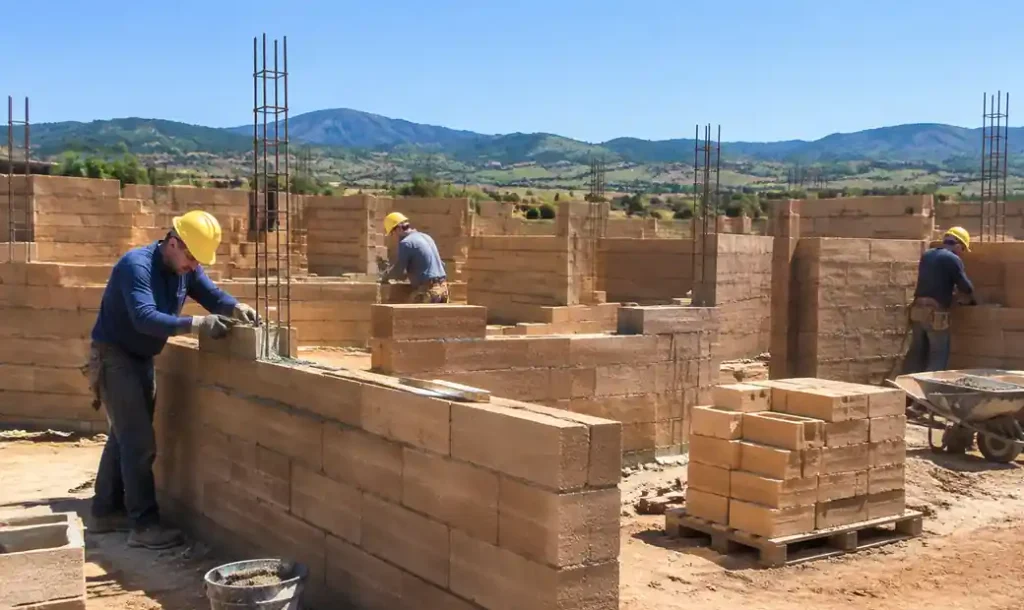
University of Texas research found 20 inches of cement block provides equivalent insulation to stabilized compressed earth blocks of typical wall thickness. CEB thermal mass moderates interior temperature swings 40-55% more effectively than hollow concrete masonry.
| Property | Fired Clay Brick | Concrete Block | CEB (8% Cement) |
|---|---|---|---|
| Compressive strength | 10-20 MPa | 8-15 MPa | 3.5-5.5 MPa |
| Thermal mass (density) | 1,600-1,900 kg/m³ | 650-1,100 kg/m³ | 1,800-2,100 kg/m³ |
| Water absorption | 8-15% | 10-18% | 8-12% (stabilized) |
| Fire resistance rating | 4-6 hours | 2-4 hours | 4-6 hours |
| Embodied CO₂ | 0.24-0.30 kg/unit | 0.15-0.22 kg/unit | 0.04-0.08 kg/unit |
CEB walls provide HVAC energy reductions of 25-40% compared to frame or hollow-block construction. Single-wythe 350mm CEB walls meet thermal code requirements without additional insulation in climate zones 3-5.
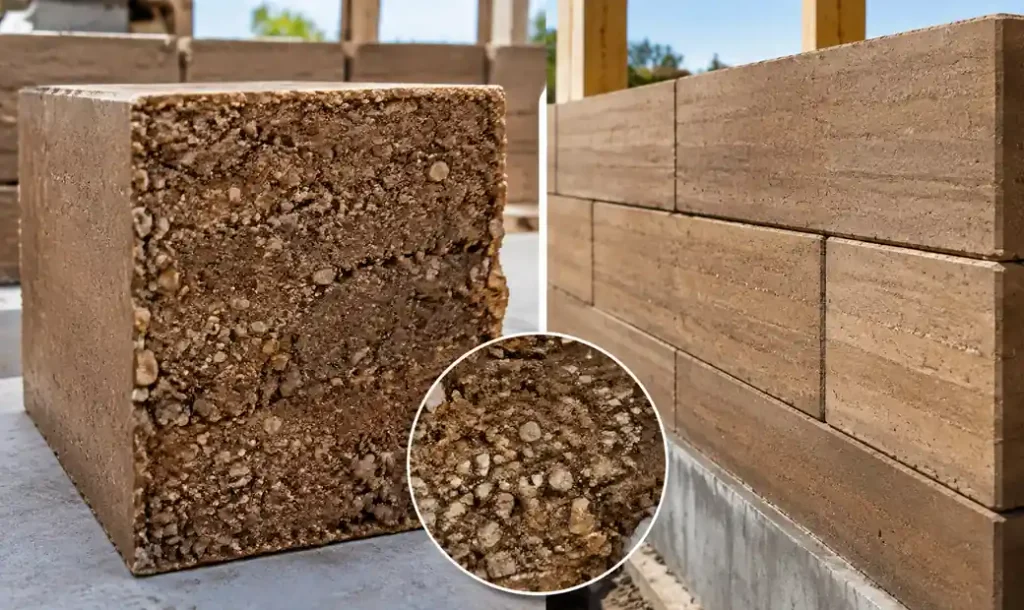
Starting CEB Production: Setup Requirements
Launching commercial CEB production requires soil assessment, equipment selection matching volume projections, curing space allocation, and quality control protocols.
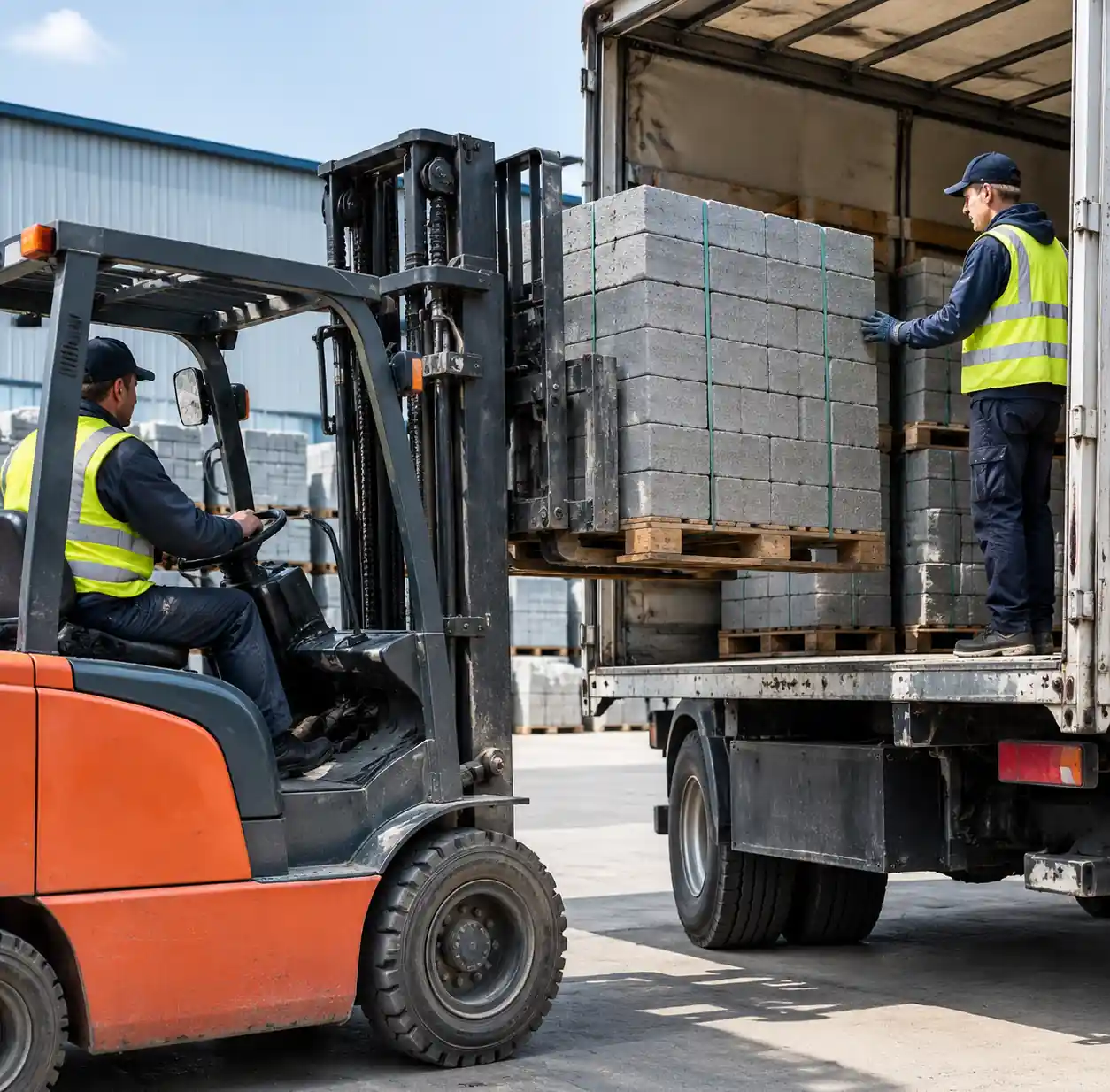
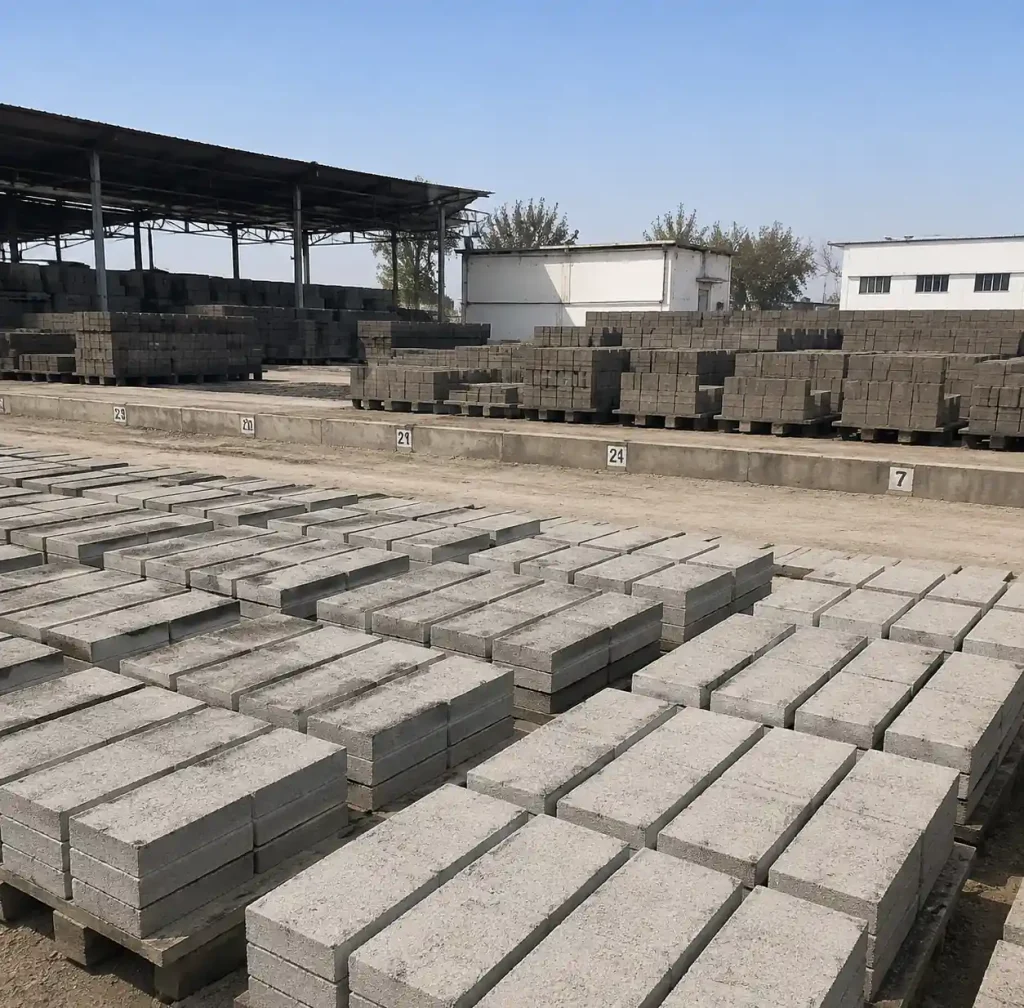
CEB production needs four zones: raw material storage, mixing and pressing area, green block handling, and curing yard. Space requirements: 3,000 blocks/day needs 500-800 m², 7,000 blocks/day needs 1,200-1,800 m², 15,000 blocks/day needs 2,500-3,500 m². The 28-day curing cycle means 28 days of production accumulates before first blocks ship.
Consistent quality requires systematic testing: daily soil tests (moisture content ±2% tolerance), hourly block inspection (dimensional accuracy ±3mm), and weekly strength testing (three samples at 7, 14, 28 days). Digital calipers, moisture meters, and a compression testing frame cost $1,800-3,200 total. Reject rate in properly managed operations runs 2-4%.
FAQ: Compressed Earth Block Machine Questions
How long do compressed earth blocks last?
Stabilized CEBs with 6-10% cement demonstrate 80-100+ year lifespan when properly protected from moisture. Structures built in the 1930s-1940s remain structurally sound across Australian, American, and African sites. Unstabilized blocks exceed 50-year service life in arid regions with proper roof overhangs.
Can CEB machines work in cold climates?
Production stops when temperatures fall below 5°C (41°F) as moisture freezes during curing. Cold-climate operations concentrate production in spring through fall, building 6-9 month inventory. Indoor facilities with climate control enable year-round operation.
What soil types work best for CEB production?
Ideal soil contains 40-70% sand and 30-60% clay with minimal organic content (<2%). Loam and sandy clay loam perform best. Laboratory sieve analysis costs $150-280 and prevents production failures from unsuitable soil selection.
How much does a CEB machine cost?
Manual lever presses range $3,500-8,000, hydraulic machines $15,000-45,000, and automatic production lines $85,000-380,000 depending on capacity. Semi-automatic brick plant solutions offer balanced investment at $35,000-85,000 for mid-scale operations.
Are compressed earth blocks waterproof?
Unstabilized blocks absorb moisture readily—unsuitable for exterior exposure without protection. Adding 6-10% cement stabilization reduces water absorption to 8-12% (comparable to fired brick) and qualifies blocks for exterior use with proper foundation barriers and roof overhangs.
What production capacity should I plan for?
Match equipment capacity to project pipeline plus 20-30% buffer. Housing projects under 50,000 blocks suit manual or small hydraulic machines (2,000-4,000 blocks daily). Commercial developments exceeding 200,000 blocks justify semi-automatic systems (5,000-10,000 daily).
الخلاصة
Compressed earth block machines eliminate traditional masonry’s carbon footprint while reducing construction costs 40-54% through on-site soil utilization. The technology scales from manual presses producing 120-180 blocks hourly to automatic lines achieving 10,000-15,000 daily blocks for commercial development.
Market growth from USD 2.66 billion (2025) to USD 4.17 billion (2034) reflects sustainable construction demand where CEBs reduce cement consumption over 50% and avoid 2 tons CO2 per 100 square meters versus conventional masonry. Operations achieving proper soil composition (40-70% sand, 30-60% clay), adequate stabilization (6-8% cement for load-bearing applications), and consistent compression (1,200-1,900 PSI) produce blocks meeting structural standards with thermal mass advantages reducing HVAC energy 25-40%.
Supporting equipment integration transforms manual operations into productive facilities recovering capital investment in 6-18 months through material savings and labor efficiency gains.